Septic drain field size: how big does yours need to be?
By the SepticMind Editorial Team
TL;DR
- Drain field size comes from your home's daily wastewater flow (roughly 75 to 150 gallons per bedroom per day) multiplied by an absorption rate set by a soil percolation test.
- A 3-bedroom home usually needs 450 to 1,500 square feet of trench-bottom area.
- Sandy soil shrinks that number.
- Clay nearly doubles it.
- State codes set the floor; your soil sets the real answer.
What determines septic drain field size?
Three things drive every drain field calculation: how much wastewater your household makes each day, how fast your soil takes in liquid, and what your state's minimum loading and setback rules require. Miss any one of those and you get a system that floods in wet weather, or surfaces raw sewage across your lawn.
Daily wastewater flow gets estimated by bedroom count, not by your water meter. Most state codes use 75 to 150 gallons per bedroom per day (gpd) as the design flow, and 100 to 120 gpd per bedroom is the common midpoint [1]. So a 3-bedroom house lands around 300 to 450 gpd. Got a home office that's occupied all day, or a washing machine that runs every morning? Bump that estimate up before you lock in a design.
Soil absorption rate is the second lever. It gets written as a percolation rate in minutes per inch (MPI), and it tells you how fast a square foot of trench bottom can accept water without backing up. Sandy loam at 5 MPI needs a fraction of the square footage that silty clay at 45 MPI demands. Flow and absorption together give you the trench-bottom area you need.
Then the rules add a floor. Even if your numbers say 400 sq ft would work, plenty of states require a 600 sq ft minimum, or they dictate minimum trench length, width, and depth no matter what the perc test says. Check your state's onsite wastewater code before you finalize anything.
How does a percolation test work and why does it matter so much?
A percolation test measures how fast water soaks into your soil at the depth where the trenches will sit. A licensed soil evaluator or engineer digs test holes, pre-soaks them for at least four hours (many state protocols call for overnight), then times how far the water level drops over a set interval, usually 30 to 60 minutes [2].
The answer comes back in minutes per inch. Water drops 1 inch in 10 minutes? Your perc rate is 10 MPI. States set the acceptable window. The EPA's onsite systems manual notes that soils draining faster than 1 MPI (basically gravel) or slower than 60 MPI (dense clay) are generally unsuitable for conventional trenches without an engineered alternative [3].
Here's why MPI controls everything: the absorption area formula divides your design flow by a loading rate, and that loading rate comes straight from the MPI. Slow soil earns a low loading rate, which means more square footage for the same daily flow. A 450 gpd system might need 750 sq ft in 10 MPI soil. Drop to 45 MPI soil and the same house could need 1,500 sq ft or more.
A lot of states have shifted away from strict perc tests toward soil morphology evaluations. A licensed soil scientist reads the soil profile and assigns a long-term acceptance rate (LTAR) based on texture, structure, and how deep the restrictive layer sits. If your state allows this, it usually beats a perc test for accuracy because it accounts for seasonal swings and compaction. Ask your county health department which method they accept.
What is the formula for calculating drain field size?
The core formula is short:
Required absorption area (sq ft) = Design flow (gpd) ÷ Loading rate (gpd/sq ft)
The loading rate comes from a table in your state code that pairs perc rates with allowable gallons per square foot per day. A typical table looks like this:
| Perc rate (MPI) | Loading rate (gpd/sq ft) | 3-bed home at 360 gpd needs |
|---|---|---|
| 1 to 5 (fast sandy) | 1.2 | 300 sq ft |
| 6 to 15 (loam) | 0.8 | 450 sq ft |
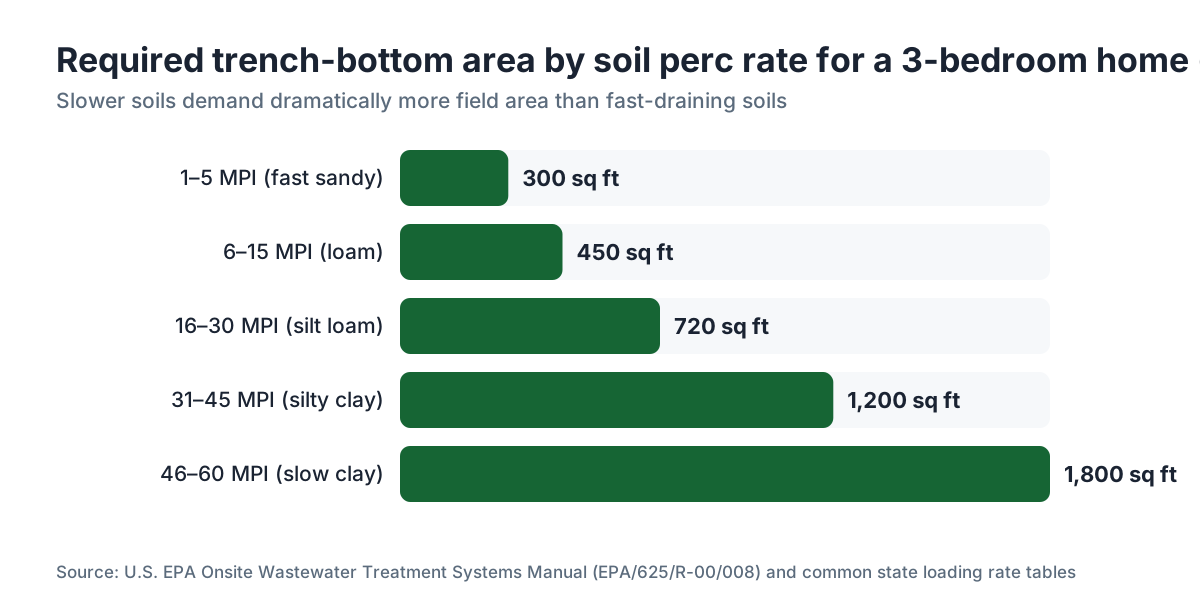
| 16 to 30 (silt loam) | 0.5 | 720 sq ft |
| 31 to 45 (silty clay) | 0.3 | 1,200 sq ft |
| 46 to 60 (slow clay) | 0.2 | 1,800 sq ft |
Those figures are composites from common state tables, and your state's breakpoints may differ [4]. The 360 gpd design flow here assumes 3 bedrooms at 120 gpd each.
Trench-bottom area is not total trench area. A standard trench runs 2 feet wide with perforated pipe down the center. Most state codes give absorption credit only for the trench bottom, not the sidewalls. So 750 sq ft of trench-bottom area in 2-foot-wide trenches works out to 375 linear feet of trench.
Then comes the reserve. Most states make you set aside a replacement field of equal size, untouched and uncompacted, in case the primary field fails someday. That requirement roughly doubles the land you have to keep clear.
How big is a drain field for a 3-bedroom house?
For a 3-bedroom house at 360 gpd design flow (120 gpd per bedroom), trench-bottom area runs from about 300 sq ft in excellent sandy soil to 1,800 sq ft in borderline-slow clay. Average suburban soils (10 to 30 MPI loam to silt loam) land in the 450 to 900 square foot range [4]. That's the honest answer: it depends on your soil, but you can narrow it fast.
Picture 750 sq ft on the ground. That's three trenches, each 125 feet long and 2 feet wide, running parallel across the yard with 6-foot gaps between them.
Now count the whole footprint. Three trenches at 8 feet each (2 ft trench plus 6 ft spacing) times 125 feet is roughly 3,000 sq ft of yard. That number catches most homeowners off guard, because they pictured something the size of a garden bed.
Buying a property where the field looks tiny for the house? That's a flag. A septic tank inspection before you close should compare the permitted field size against the design documents on file with the county.
How big does a drain field need to be for a 4- or 5-bedroom house?
Each extra bedroom adds about 120 gpd to the design flow in most state codes, and the required area scales right along with it. Here's a quick reference for average loam (loading rate around 0.6 gpd/sq ft):
| Bedrooms | Design flow (gpd) | Approx. trench-bottom area |
|---|---|---|
| 2 | 240 | 400 sq ft |
| 3 | 360 | 600 sq ft |
| 4 | 480 | 800 sq ft |
| 5 | 600 | 1,000 sq ft |
| 6 | 720 | 1,200 sq ft |
These are planning numbers, not permit numbers. Your actual permit gets issued against a site-specific perc test or soil evaluation, and the state minimum can override the formula entirely. In North Carolina, for instance, the minimum permitted field for a 3-bedroom home is 1,125 sq ft of absorption area no matter what the soil test shows [5].
Big households with heavy water users (teenagers, laundry going all day, a hot tub that drains to the system) should talk to their engineer about a 20 to 25% design flow buffer. That cushion costs little at installation. A failed field costs a fortune later. Repairs run anywhere from $5,000 to $30,000 depending on system type and site access, so the math favors sizing up a bit.
What lot size do you need for a drain field?
Setback rules govern minimum lot size more than raw square footage does. You need clearance from wells, property lines, buildings, trees, and water features on top of the field itself.
Typical setbacks (these vary by state and locality) [6]:
| Feature | Typical setback from drain field |
|---|---|
| Private well | 50 to 100 ft |
| Public water supply | 100 to 200 ft |
| Property line | 5 to 10 ft |
| Foundation/basement | 10 to 25 ft |
| Surface water / streams | 25 to 100 ft |
| Trees (large hardwoods) | 10 to 30 ft |
Draw all those exclusion zones on a site plan and the usable area on a small lot shrinks fast. The EPA SepticSmart program tells homeowners to "protect your drainfield" by keeping vehicles, heavy equipment, and deep-rooted plants off the system [7].
A quarter-acre suburban lot with a well, a house, a detached garage, and mature trees might have only 2,000 to 3,000 sq ft of usable soil left after setbacks. That's just enough for a modest field plus its reserve. If you're not sure a lot can take a septic system at all, hire a licensed site evaluator to map the usable area before you buy. It's cheaper than finding out afterward.
What if you don't have enough space for a conventional drain field?
Gravity trenches aren't your only option. When lot size, shallow soil, or slow perc rates rule out a standard field, engineers reach for alternatives that need less horizontal room. They cost more, and most need more maintenance, but they work where a trench field can't.
Pressure distribution systems push effluent evenly across the field, and some states then credit sidewall absorption on top of trench bottom. That can cut the footprint by 20 to 40% in the right soil.
Mound systems sit above grade on imported sand fill when native soil is too shallow or too slow. The mound takes up more surface area than an in-ground field of the same capacity, but it works over thin soil or a high water table that would otherwise be a dead end.
Drip irrigation systems run treated effluent through tubing buried a few inches down, at a drip rate slow enough for almost any soil to absorb. They need a treatment unit first (often an aerobic treatment unit, or ATU), which adds cost and an ongoing maintenance contract. But they fit tight or oddly shaped lots that no trench field could use.
Clustered or community systems tie several homes to a shared field on a dedicated easement. This shows up more and more in subdivisions where individual lots are too small but nearby land can be permitted for one larger field.
Facing a space problem? The cost to install a septic system climbs hard with alternative designs. Budget $15,000 to $50,000 or more for a mound or ATU-drip system, versus $8,000 to $20,000 for a conventional gravity system in a typical rural setting.
How is a drain field actually installed?
Knowing how a drain field goes in helps you ask sharper questions and catch problems before they get expensive. Installation follows the same sequence every time, once the permit is in hand.
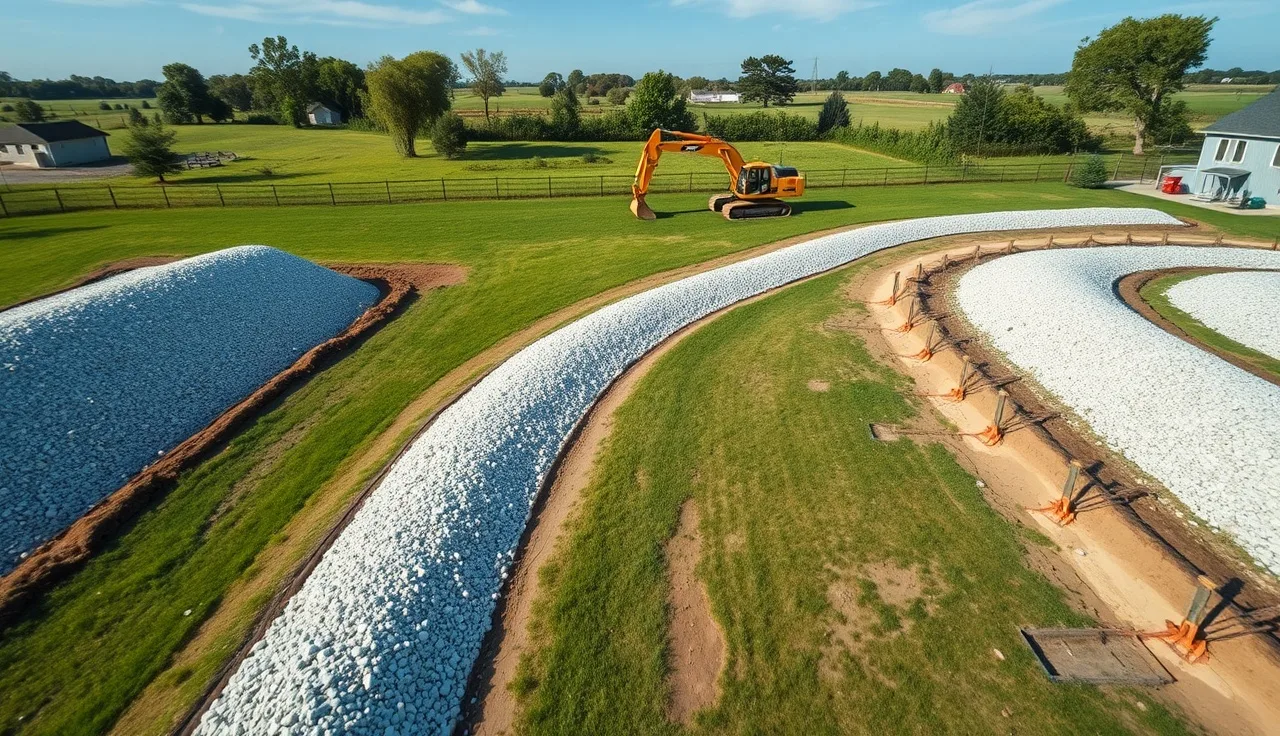
First the crew stakes out the site to the approved design. Topsoil in the trench footprint gets stripped and stockpiled; it does not go back in the trench. Then heavy equipment digs the trenches to permitted depth, usually 18 to 36 inches, and the operator takes care not to smear or compact the trench bottom, because that alone kills absorption.
Washed stone lines the trench bottom, usually 3/4-inch crushed, 6 to 12 inches deep. Perforated pipe goes on top of the stone, sloped 1/8 to 1/4 inch per foot away from the distribution box. More stone covers the pipe, typically to 2 inches above the pipe crown. A geotextile filter fabric goes over the stone to stop soil from working its way into the aggregate over the years.
Backfill covers the fabric, mounded slightly for settlement. The distribution box splits flow evenly from the tank outlet into the individual trenches, and it gets set dead level on a stable base before any trench is buried. Level matters more than people think: a slight tilt on the D-box dumps all the flow into one trench and starves the rest, overloading that run and burning it out early.
A county inspector usually visits before backfill and again after, checking pipe slope, stone depth, and setbacks. Never backfill before the inspector signs off. The permit process protects you, your neighbors' wells, and the surface water nearby.
If you run multiple projects and need to track permit status, inspection dates, and maintenance schedules across a fleet of systems, SepticMind's operations software is built for exactly that, keeping field crews and office staff working from the same record instead of a pile of paper.
Once it's in, keep heavy vehicles and equipment off the field for good. The soil structure under those trenches is what makes the whole thing work. Compact it once and you may never get the absorption capacity back.
How long does a septic drain field last?
A properly sized, properly maintained drain field should last 20 to 30 years, often longer. A field fed oversized solids loads from an under-pumped tank, or drowned by excessive water use, can fail in 10 years or less.
The main failure mode is biomat. Bacteria and suspended solids slowly clog the soil pores right at the trench interface. Some biomat is normal and actually helps fine-tune the absorption rate. Too much, and the trench turns impermeable, water ponds, and you get wet spots or sewage odor in the yard.
Pumping your tank on schedule (roughly every 3 to 5 years for a 1,000-gallon tank on a 3-bedroom home) is the single best thing you can do to stretch field life [8]. Solids that spill over into the field pile up fast and are nearly impossible to remove without replacing the field. Regular septic tank pumping is cheap insurance against a five-figure repair.
Tree roots are the other common killer. Willows, maples, and other water-seekers planted too close chase the moisture straight into the perforated pipe and can pack a trench solid within a few years.
Some failing fields recover after being rested, taken offline for 6 to 12 months so the biomat aerates and breaks down. Others get treated with aerobic bacteria injections or mechanical scarification. Penn State Extension points to biomat buildup and solids overload as the dominant failure drivers behind these repairs [12]. Results are mixed. Nobody has good controlled data on recovery treatments, though installers report cautiously positive results on mildly failed fields.
What are the signs a drain field is too small or failing?
Slow drains and gurgling toilets are the first symptoms homeowners notice, but those also point to a full tank or a blocked pipe. Suspect the field when you see wet, spongy ground over the trench lines, lush green stripes of grass above the trenches (effluent is fertilizing them), or sewage odor outside even though you just pumped the tank.
A hydraulic load test confirms saturation. An inspector runs a measured volume of water into the system and watches whether the tank level rises abnormally, which means the field isn't accepting flow.
If you bought the home without checking the permitted design, pull the county health department records and compare the permitted field size against what the house actually has. Unpermitted additions do real damage here. A converted garage apartment can leave you with five de facto bedrooms on a field sized for three.
For operators running multiple residential or commercial accounts, keeping field age, pump-out history, and inspection records in one place heads off exactly these surprises. SepticMind surfaces that risk across a whole service portfolio.
A failing or undersized field needs repair or full replacement. Costs for septic system repair swing wide, from around $1,500 for a distribution box swap to $20,000-plus for a whole new field.
Do drain field size rules differ by state?
Yes, and a lot. Septic regulation in the United States happens at the state level, and states diverge on perc-rate tables, minimum field sizes, setbacks, and accepted design methods. A few examples:
North Carolina uses a tiered soil classification with minimum field sizes that can run larger than the basic formula, and it requires a licensed soil scientist for most evaluations [5].
Texas hands primary authority to individual counties, so requirements shift from one county to the next. The Texas Commission on Environmental Quality (TCEQ) sets statewide minimums and system standards, but local rules can be stricter [9].
Florida has some of the tightest setbacks in the country because the water table sits so shallow across much of the state, and many counties now require nitrogen-reducing systems in sensitive water quality areas [10].
California's State Water Resources Control Board sets the baseline, but local environmental health departments issue the permits and often pile on more requirements, especially near the coast or an impaired water body [11].
Here's the takeaway: never treat a sizing formula from a website (this one included) as a substitute for your county's permitting rules. Pull the state code, call your county environmental health office, and work with a licensed designer. The permit process isn't bureaucratic friction. It's the thing standing between your drain field and your neighbor's drinking water.
How much does drain field size affect installation cost?
Field size is one of the biggest cost drivers in a septic install, but not the only one. Excavation, stone, pipe, and labor all scale with linear feet of trench. The rough relationship:
| Trench-bottom area | Approximate installed cost (gravity trench) |
|---|---|
| 400 to 600 sq ft | $4,000 to $8,000 |
| 600 to 900 sq ft | $7,000 to $12,000 |
| 900 to 1,200 sq ft | $10,000 to $18,000 |
| 1,200 to 1,800 sq ft | $15,000 to $25,000 |
These are national ballpark ranges for field installation only, not counting the septic tank and distribution box. Regional labor rates, tough site access, and rock or high groundwater can push you well past the top of these ranges.
Soil type drives cost indirectly by controlling field size. A site with 45 MPI clay may need twice the trench footage of a sandy loam site for the same house, which roughly doubles the field portion of your budget.
The reserve area barely costs anything at install time, since you set it aside rather than build it. But that land stays restricted forever. On a high-value lot, that reserved square footage is real opportunity cost, because you can never put landscaping, a structure, or paving there.
For the full picture of what a new system runs, tank, field, permits, and site work together, see our guide on cost to install a septic system.
Frequently asked questions
What is the minimum drain field size allowed by code?
Minimums vary by state, but many codes set a floor no matter what the soil or flow math says. North Carolina, for example, requires at least 1,125 sq ft of absorption area for a 3-bedroom home even when the formula produces less. Check your county health department for your specific minimum. The formula alone won't get you a permit.
Can I make my drain field smaller by using a grease trap or filter?
Effluent filters and tank baffles cut suspended solids reaching the field, which extends field life but generally doesn't shrink the permitted size under most state codes. Design flow and perc rate still control the calculation. Some states allow a small reduction (10 to 20%) for pretreatment like aerobic units, but that varies widely by jurisdiction.
How many square feet of drain field do I need per gallon of daily flow?
It depends entirely on your perc rate. Fast-draining soil (5 to 10 MPI) might need only 0.8 to 1.0 sq ft per gallon per day. Slow soil (45 to 60 MPI) can need 4 to 5 sq ft per gallon per day. There's no universal ratio. Run the formula with your actual perc result and your state's loading rate table.
Does a garbage disposal affect drain field size requirements?
Yes. Most state codes add a 20 to 30% flow increase to the design flow when a garbage disposal is present, because disposals send a lot more suspended solids and BOD into the tank. Some codes require a bigger septic tank instead of a bigger field. Either way, a disposal isn't free from a sizing standpoint.
Can I expand my drain field if the current one is failing?
Sometimes. If you have usable soil in the reserve area that meets setbacks, adding trench capacity is straightforward and often the best repair. If the original field went in without a reserve area, or if the rest of the lot has unsuitable soil, you may need an alternative design. A licensed installer can evaluate the site and pull a permit for expansion.
Do drain field size rules apply to commercial properties?
Yes, but commercial design flows use different math. Instead of bedrooms, designers estimate daily flow from fixture units, occupancy counts, or use type (restaurant, office, retail). Commercial fields often face stricter loading rates and may need engineered designs with stamped plans. The same perc test and setback rules apply.
How deep should a drain field trench be?
Most state codes specify 18 to 36 inches of total trench depth, with perforated pipe set on 6 to 12 inches of stone and covered by another 2 inches of stone above the pipe crown, then soil to grade. The key constraint is depth to any restrictive layer (seasonal high water table, bedrock, hardpan), which most codes require to stay at least 2 to 4 feet below the trench bottom.
What is the difference between drain field area and trench length?
Drain field area is the total trench-bottom square footage that counts toward absorption credit. Trench length is linear feet. To convert, divide the required area by trench width (typically 2 feet). So 900 sq ft of absorption area needs 450 linear feet of 2-foot-wide trench, spread across however many parallel runs the site allows.
How far apart should drain field trenches be spaced?
Most state codes require at least 6 feet between trench centerlines, which leaves 4 feet of undisturbed soil between the edges of adjacent 2-foot-wide trenches. Some codes want up to 10 feet center to center. Closer spacing compresses the soil between trenches and can let adjacent runs hydraulically connect, spreading failure from one trench to the whole field.
Can I build over a drain field or pave it?
No. Paving or building over a drain field cuts off oxygen exchange and compacts the soil, wrecking absorption capacity and voiding your permit. Most codes ban any impervious surface, structure, or heavy traffic over the field or the reserve area. Even parking cars on it regularly does damage over time.
How do I find out the size of my existing drain field?
Start with your county health department's permit records, which should include the original design drawing showing trench locations, lengths, and permitted area. If the records are missing, a septic inspector can probe the yard for trenches and measure from surface markings and the distribution box. Some inspectors run a camera to trace the pipe layout.
Does a larger septic tank mean I need a smaller drain field?
No, not directly. Tank size affects how long solids settle before effluent reaches the field, which shapes effluent quality, but the field is sized to daily flow and perc rate, not tank volume. A properly sized tank (at least 1,000 gallons for a 3-bedroom home in most states) is needed for the field to perform, but going bigger on the tank doesn't let you go smaller on the field.
What happens if a drain field is installed too small?
An undersized field gets hydraulically overloaded. Effluent arrives faster than the soil can take it, the trenches waterlog, and biomat forms early. You'll see wet spots, slow drains, and eventually surfacing sewage. The field can fail within a few years. A properly sized replacement is usually the only lasting fix, which is why getting the size right from the start matters so much.
Sources
- U.S. EPA, Onsite Wastewater Treatment Systems Manual (EPA/625/R-00/008): Design flow estimates of 75 to 150 gallons per bedroom per day used in onsite system sizing
- U.S. EPA, Onsite Wastewater Treatment Systems Manual (EPA/625/R-00/008): Percolation test protocol including pre-soaking and measurement interval procedures
- U.S. EPA, Onsite Wastewater Treatment Systems Manual (EPA/625/R-00/008): Soils with perc rates faster than 1 MPI or slower than 60 MPI generally unsuitable for conventional trenches
- University of Minnesota Extension, Soil Treatment Area Requirements for Septic Systems: Loading rate tables correlating perc rate ranges to allowable gallons per square foot per day for trench sizing
- North Carolina Department of Health and Human Services, On-Site Water Protection (15A NCAC 18E): North Carolina minimum absorption area requirements and licensed soil scientist evaluation rules
- U.S. EPA SepticSmart Program: Typical setback distances from wells, property lines, and surface water for drain fields
- U.S. EPA SepticSmart Program: EPA SepticSmart advises homeowners to protect the area around their drain field from traffic and deep-rooted plants
- U.S. EPA SepticSmart Program, Maintain Your System: Recommended septic tank pumping frequency of every 3 to 5 years to protect drain field longevity
- Texas Commission on Environmental Quality, On-Site Sewage Facilities: Texas statewide minimum standards for on-site sewage facilities with county-level authority
- Florida Department of Health, Onsite Sewage Treatment and Disposal Systems: Florida setback requirements and nitrogen-reducing system mandates in sensitive water quality areas
- California State Water Resources Control Board, Onsite Wastewater Treatment Systems Policy: California baseline onsite wastewater standards with additional local health department permitting requirements
- Penn State Extension, Septic System Maintenance and Repair: Biomat formation as dominant drain field failure mode and effect of solids loading from infrequent tank pumping
Last updated 2026-07-09