Septic leach field: how it works, what fails, and what it costs
By the SepticMind Editorial Team
TL;DR
- A septic leach field (also called a drain field) is the underground network of perforated pipes, gravel, or chambers that takes clarified wastewater from your septic tank and releases it slowly into soil for final treatment.
- Most fields handle 50 to 70 gallons per person per day.
- When one fails, sewage backs up indoors or surfaces on the lawn.
- Replacement usually costs $3,000 to $15,000 depending on soil and design.
What is a septic leach field and what does it actually do?
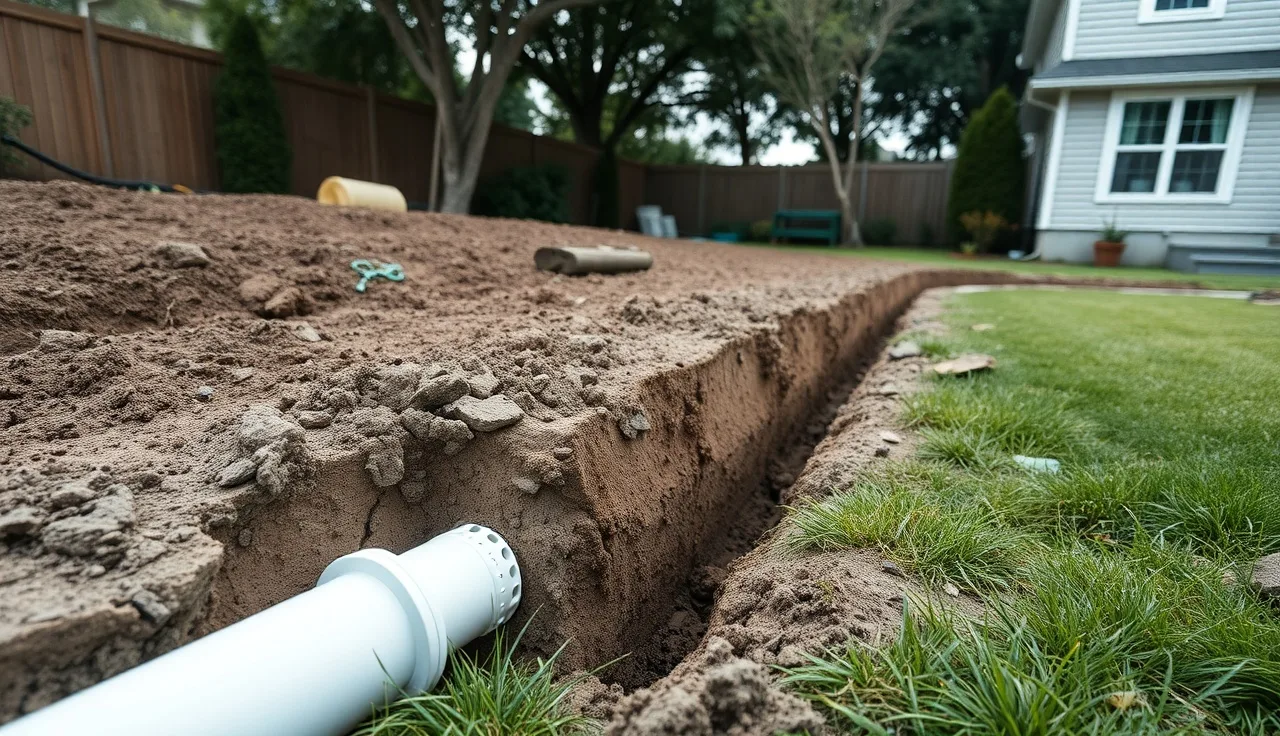
A leach field is the last treatment stage for household wastewater in a conventional septic system. Solids settle in the tank. Grease floats. The liquid layer in the middle, called effluent, flows out through an outlet baffle into a distribution box or manifold, then spreads through perforated pipes buried in gravel-filled trenches. Soil bacteria and filtration finish the job.
The soil does the treatment, not the pipe. It strips pathogens, absorbs nutrients, and breaks down organic matter across two to four feet of unsaturated ground before treated water reaches groundwater. The EPA's SepticSmart program describes the drain field as the part of the system that provides "final treatment and disposal of the septic tank effluent." [1] That's the whole assignment: slow, even distribution so the soil never gets more liquid than it can absorb at once.
A typical residential field for a three-bedroom home covers 300 to 900 square feet of trench area. The exact size depends on your soil's percolation rate, local code, and estimated daily flow. Coarse sandy soils drain fast. Clay soils drain slowly and need more trench footage or a different system design. Most state codes size the field at 75 to 150 gallons per bedroom per day. [2]
The pipe matters less than the dirt around it. Perforated PVC, usually four inches across, sits in about twelve inches of clean crushed rock (0.75 to 2.5 inch aggregate), wrapped in geotextile fabric under the backfill. The fabric keeps soil particles out of the gravel so the pore space stays open. Older systems used perforated corrugated HDPE pipe, and it works fine if it was bedded correctly. See septic system leach field pipe details for sizing and material specifics.
How does a septic system with a leach field work step by step?
Follow the water. Wastewater leaves the house through a drain line sloped at least 1/4 inch per foot toward the septic tank. Inside the tank, heavy solids sink into sludge and light material floats as scum. The clarified effluent in between exits to the field. A properly sized tank gives that separation roughly 24 hours of retention time. [3]
From the outlet, effluent moves to a distribution device. Older systems use a D-box (distribution box), a concrete or plastic box that splits flow into parallel trenches. Newer pressure-distribution systems use a pump and small-diameter orifice pipes to dose the field in timed pulses. The rest between doses gives the soil time to recover, and it stretches the field's life considerably. Pressure systems cost more and are often required where environmental rules are tighter.
Inside each trench, effluent seeps through the pipe holes, drops through the gravel, passes the biomat (a thin microbial slime layer that does much of the pathogen removal), and moves down through unsaturated soil. Unsaturated is the word that matters. A high water table or waterlogged soil short-circuits the treatment, and pathogens reach groundwater.
That's why setbacks exist. Most states require at least 100 feet from a well, 50 feet from surface water, and 5 to 10 feet from a property line. [2] Those distances aren't guesses. They give the soil enough horizontal travel for pathogens to die off before treated effluent reaches anything you'd drink or swim in.
What are the most common reasons a leach field fails?
Biomat overload leads the list. Every field grows a biomat at the soil-gravel interface, and in moderation it helps. When hydraulic loading runs too high, or the tank is overdue for septic tank pumping, that biomat thickens into a black slime layer water can't pass. The field puddles. The tank backs up. Sewage surfaces or comes back inside.
Solids carryover is the cousin of that problem. Once sludge fills past about a third of tank capacity, it starts riding out with the effluent and clogging the gravel in the trenches. No microbial process fixes clogged gravel without a shovel. That's the strongest argument for pumping your septic tank on schedule: you're protecting the field, which costs far more to replace than the tank costs to pump.
Compaction and root intrusion are mechanical failures. Cars, heavy equipment, even steady foot traffic crush the pipes and collapse trench structure. Willow and maple roots chase the moisture plume above a field and slip into pipe perforations within a few years. Roots rarely kill a field overnight. They shave capacity slowly until one wet winter tips it over.
Too much water gets overlooked. A family of five on a system sized for three bedrooms overloads it. So does a spare room booked on Airbnb four weekends a month. A garbage disposal adds an estimated 50 percent more solids to the tank, by some extension-service estimates, which speeds up sludge buildup and shortens the safe interval between pump-outs. [4]
Outside water is the failure nobody sees coming. A field in a low spot can run fine for years until a neighbor's new French drain routes groundwater straight upslope of it. Roof drains and foundation drains piped into the septic line dump clear water that loads the field with no benefit at all. Redirect those sources and you sometimes save a field that was on the edge.
What does septic leach field failure look like?
The clearest sign is wet, spongy ground over the field, often with a sewage smell, even when it hasn't rained. Effluent is surfacing because the soil can't take it fast enough.
Indoors, you notice slow drains and gurgling first. Then toilets back up. Eventually sewage shows up in the lowest fixture, usually a basement floor drain or a first-floor toilet. If you have a pump chamber or dosing tank, the high-water alarm may sound before any indoor symptom appears.
Green, oddly lush grass right over the trenches in a dry stretch is a softer signal. A healthy field grows slightly better grass on top. Rank growth or standing water means effluent is fertilizing the surface instead of filtering through soil.
A septic tank inspection that finds the liquid level sitting above the outlet invert confirms the field isn't accepting flow. That's the definitive test.
Can a failed leach field be repaired, or does it always need replacement?
Sometimes repair works. Sometimes you're pouring money into a dead system. Here's how to tell the difference.
Resting the field for several weeks, while wastewater goes to a portable toilet or a backup system, can let the biomat oxidize and the soil recover some permeability. Penn State Extension has documented field recovery after rest periods in its onsite wastewater research, though recovery isn't guaranteed and depends on how long the field has been failing and whether the gravel is physically clogged with solids. [5]
Hydrojetting the pipes to cut out solids and roots can buy years on a field that's mechanically blocked rather than biologically overloaded. Paired with a tank pump-out and baffle check, it's often the first repair worth trying before you condemn anything. Figure $300 to $800 depending on trench footage.
Terralift and similar pneumatic tools inject air and polystyrene beads below the trench to fracture compacted soil and open new flow channels. Results are all over the map. Some operators report multi-year recovery. Others see the field fail again within a season. No large controlled trial has pinned down consistent results, and I wouldn't spend $2,000 on it without a clear diagnosis that compaction, not biomat, is the limit.
Chemical additives sold to "restore" leach fields have almost no independent evidence behind them. The EPA's position is that additives haven't been shown to reduce pumping needs or fix failed systems. [6] Keep the $30 and put it toward a pump-out.
When the gravel is permanently fouled or the soil structure is clogged for good, replacement is the only real fix. Act early. The sooner you move after the first symptoms, the better your odds of catching it while repair still has a chance. For the full set of repair pathways, see septic system repair options.
How much does septic leach field installation or replacement cost?
Leach field costs swing more than almost any other home system, because soil, lot size, permitting, and local labor all pull the number in different directions.
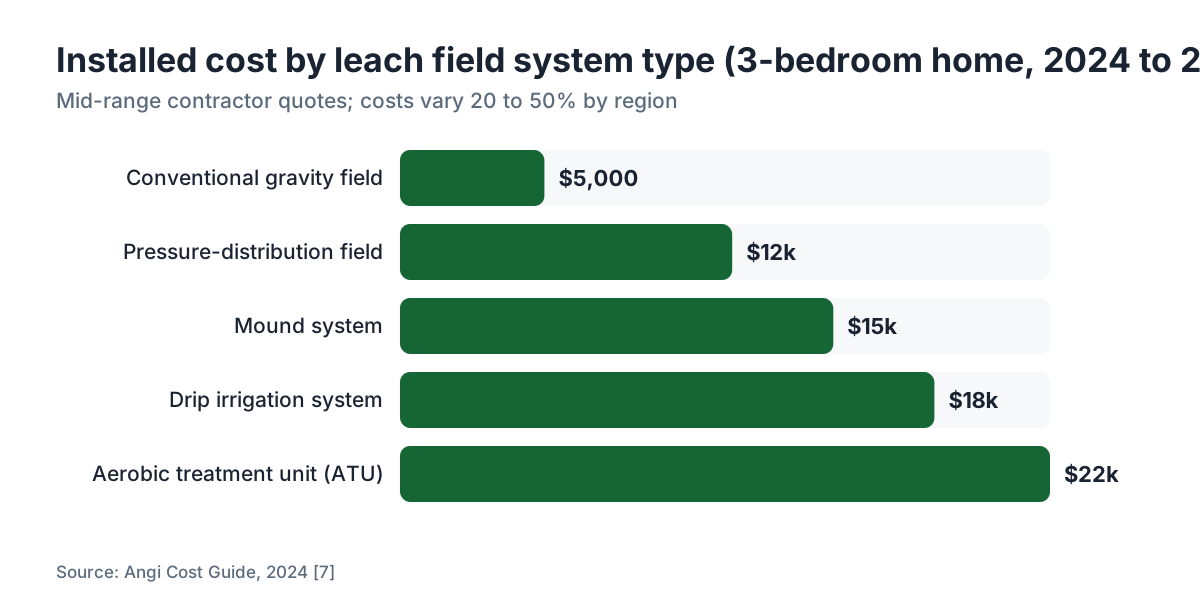
For a conventional gravity-fed field on a three-bedroom home, expect $3,000 to $7,000 for the field alone in most U.S. markets in 2024 and 2025. Add design, permits, and inspection fees and the total lands around $5,000 to $10,000. Pressure-distribution systems run higher, typically $8,000 to $15,000, because of the pump, controls, and smaller-diameter piping.
Alternative systems, required when conventional fields won't pass a perc test, add another tier. Mound systems (fill soil built up above grade) average $10,000 to $20,000. Drip irrigation and constructed wetlands can top $25,000. If you also need to replace the full septic system, add $3,000 to $8,000 for tank replacement on top of field costs. [7]
The table below shows typical installed ranges by system type for a three-bedroom home. These are mid-range contractor quotes. Rural areas with cheaper labor may run 20 to 30% less. Dense coastal markets often run 30 to 50% higher.
| System type | Typical installed cost | Notes |
|---|---|---|
| Conventional gravity leach field | $3,000 to $7,000 | Best soil conditions, flat lot |
| Pressure-distribution leach field | $8,000 to $15,000 | Required in many states for new installs |
| Mound system | $10,000 to $20,000 | Needed when water table is high or soil fails perc |
| Drip irrigation / subsurface drip | $12,000 to $25,000 | Common in environmentally sensitive areas |
| Aerobic treatment unit (ATU) | $15,000 to $30,000 | Includes tank, field, maintenance contract |
Permitting adds $200 to $2,000 depending on the state. Some counties require a licensed engineer to stamp the design. Others let the contractor submit it. Budget for soil testing ($200 to $600) and any required reserve area on top of that.
Septic operators who track jobs across counties increasingly use platforms like SepticMind to log site data, tie permit records to service history, and flag properties where field age or prior repairs mean replacement is coming. That kind of running record cuts the hours spent diagnosing a vague failure.
What are the rules for septic leach field installation?
No federal law directly regulates residential leach field design. The EPA publishes design guidance, and state agencies have to meet Clean Water Act and Safe Drinking Water Act standards. [8] In practice, every state writes its own onsite wastewater code, and many hand further authority to county health departments.
The thread running through every state code is the perc test (percolation test) or soil morphology evaluation. It measures how fast water moves through your soil, which sets how many linear feet of trench you need. Many states now favor a soil profile evaluation by a licensed soil scientist over the old timed perc test, because soil morphology gives more information and isn't thrown off by how wet the ground was that week. [9]
Setbacks are hard minimums, not suggestions. A 100-foot setback from a water supply well is standard in most states. Some require 150 feet. Setbacks from property lines, buildings, surface water, and bedrock outcrops all live in the state code and vary enough that you need to pull your own state's table before you design anything.
Reserve area is required in many states. You have to identify and protect a second undeveloped area big enough for a replacement field if the first one fails. Building a driveway or a shed over the reserve area is a common mistake that turns into a real problem at a sale or a repair.
Local health departments issue the permits, inspect during installation (usually a pre-cover inspection before backfill and a final inspection after), and record the system. If a contractor wants to skip the pre-cover inspection, treat that as a red flag. Once the dirt goes back, nobody can verify trench depth, pipe grade, or gravel depth.
For operators installing fields across jurisdictions, the state-by-state variation is one of the biggest time sinks in the work. A permit and inspection checklist kept per county saves the rework.
How do you maintain a leach field to make it last as long as possible?
Field maintenance is mostly a list of things you don't do.
Don't park on it. Don't plant trees within 30 feet. Don't tie roof drains or sump pumps into the septic line. Don't run a garbage disposal without shortening your pump interval to match. Don't flush wipes (even the "flushable" ones), grease, or medications. Simple rules. Expensive consequences when you ignore them.
Do pump the tank on schedule. For an average household (three to four people, three-bedroom home, 1,000-gallon tank) that's every three to five years. [10] A tank pumped on schedule almost never kills the field with solids carryover. A tank ignored for ten or fifteen years very often does.
Do spread laundry across the week instead of running six loads on Saturday. A washer going all day sends a concentrated slug of water the field may not clear before the next dose lands. HE washers help because they use less water per load.
Do locate and map your cleanout, distribution box, and field boundaries. Sketch them and keep the sketch somewhere you can find it. A buyer's inspector will want these. And at 2 a.m. during a backup, knowing exactly where everything sits saves hours.
Do have the effluent filter (if your tank has one) cleaned at every pump-out. Many tanks installed after 2000 have a filter on the outlet baffle that catches fine particles before they reach the field. A plugged filter throws the same symptoms as a failing field, and cleaning it takes five minutes.
The EPA's SepticSmart guidance tells homeowners to "have your system inspected every 3 years" and pump on a schedule set by tank size and household size. [1] That's the baseline. Pump more often if you have a garbage disposal, a water softener that backwashes to the septic, or more people than the system was built for.
How long does a septic leach field last?
A well-sited, correctly sized, well-maintained leach field lasts 20 to 30 years on average. Some run 40 or more. Plenty fail in 10 to 15 because of neglect, overloading, or a bad original design.
Tank pumping history is the single best predictor of how long a field lasts. A field that never got hit with solids carryover outlives one that took in raw sludge, almost regardless of soil type. That's why operators harp on the tank over the field. The tank is the field's bodyguard.
Soil type sets the initial capacity but matters less for longevity once the field runs within its design limits. A sandy-soil field and a loamy-soil field, both loaded correctly, degrade at roughly the same rate, because the biomat rather than the raw soil becomes the limiting layer over time.
Age alone doesn't condemn a field. A 35-year-old gravity field that passes a dye test with no surfacing effluent may be perfectly sound. Plenty of home sales with older septic systems clear inspection with no field concerns at all. Don't let an inspector write off a working field on age alone.
What should you know before buying a house with a septic leach field?
Ask for the permit and the as-built drawing. Most county health departments hold records for systems put in after the 1970s. An as-built shows tank location, field location, number of trenches, and reserve area. If the seller can't produce one, the county may have it. If neither does, budget for a locate before closing.
Order a full septic inspection, not a walk-around look. A proper inspection pumps the tank, checks liquid levels before and after pumping (high levels before pumping can signal field saturation), inspects the baffles, locates the D-box, and runs water to watch distribution. Some inspectors add a dye test to confirm no surface breakout. [11] Figure $300 to $500 on top of the pump-out cost. It's worth every dollar.
Ask about the reserve area. If it's been built over, paved, or planted with trees, a future replacement may need variances or a different system type, which can run $15,000 to $30,000. That's a material fact in any negotiation.
Check the age of the tank and the field together. If both went in during 1992, you might have 5 years left or 20, depending entirely on how the system was maintained. A pump-out receipt history from the current owner is genuinely useful due diligence.
For cost-of-ownership planning, see cost to put in a septic tank and septic tank installation if the system is aging and you want to budget for eventual replacement.
Are there alternative leach field designs for difficult soil or small lots?
Yes, and they keep getting more common as good conventional sites run out and environmental rules tighten.
Mound systems build an engineered fill pad above the natural soil, creating the unsaturated treatment depth that a high water table or shallow bedrock would otherwise deny you. A pump doses the field in timed pulses. Mounds are bulky (a 300-foot-long mound isn't unusual) and need ongoing pump maintenance, but they work where a conventional field can't.
Drip irrigation systems push effluent through tiny emitters buried a few inches down, spreading it over a larger footprint at very low application rates. They fit small lots, slopes, and sensitive areas well. They need clean effluent from an aerobic treatment unit upstream, and the emitters need periodic inspection and replacement.
Chamber systems (Infiltrator, ADS, and similar) swap the gravel bed for plastic arch-shaped chambers that sit right on native soil. They cut out the gravel trucking cost, use 30 to 50% less trench length than gravel systems for the same capacity per manufacturer data, and are approved in most states. [12] In many regions they're now the default field for new residential construction.
Constructed wetlands and recirculating sand filters come in where nutrient reduction (nitrogen, phosphorus) is required, usually near surface water or in coastal areas with tight nitrogen limits. They add complexity and upkeep but treat far beyond what a conventional field can.
Every alternative system has to be engineered to the site. Perc rates, water table depth, setbacks, and local code decide which options are even possible. Your county health department or a licensed onsite wastewater designer can narrow the list fast.
What questions should you ask a septic contractor about leach field work?
Before any repair or install, ask these straight out.
Are you licensed for onsite wastewater installation in this county? Requirements vary by state, but most require it. A contractor who dodges the question is a problem.
Will you pull the permit? Unpermitted leach field work is illegal in most places, creates title trouble at a sale, and voids any warranty. If the contractor floats skipping permits to save money, walk.
What is your pre-cover inspection process? The health department inspector has to see the trench before it's filled. Ask who calls for the inspection and whether the crew waits for approval before backfilling.
How do you size the new field? A contractor who quotes without the perc test results or the soil evaluation report is guessing. Size has to come from site data, not a hunch.
Do you warranty the field? Most reputable contractors offer one to two years on workmanship. Soil performance isn't warrantable, because your water use drives it, but installation quality is.
For operators, there's a business angle here too. If you run a septic service company, tracking which fields you've installed, repaired, or flagged as marginal is the kind of running record that prevents callbacks and supports proactive outreach. SepticMind is built for exactly that: service records, site conditions, and scheduling in one operator workflow.
Frequently asked questions
How do I find my septic leach field on my property?
Start with the as-built drawing from your county health department. No drawing? Trace the pipe from the septic tank outlet (usually 10 to 30 feet from the house) toward the flattest, most open part of the yard. A metal or soil probe can find the gravel trenches by feel. Some inspectors use tracer dye or a camera pushed through a cleanout. Don't dig until you've identified the pipes.
Can you build a deck or driveway over a septic leach field?
No. Covering a field with concrete, asphalt, or pavers blocks the oxygen exchange and rainfall infiltration the soil needs to work. It also puts the field out of reach for inspection and repair. Even a wood deck adds load and risk. Most state codes flatly prohibit structures over a leach field. The same rule protects your reserve area, which has to stay clear for future use.
What should you never put down the drain if you have a leach field?
Grease and cooking oils (they coat gravel and pipe), wipes of any kind, medications (they pass through the field into groundwater), paint and solvents (they kill soil bacteria), heavy doses of antibacterial soap, and excessive bleach. A little household bleach is fine. Daily sanitizer dumps are not. Garbage disposal use adds serious solids load, so if you run one, pump the tank more often.
How much does it cost to pump a septic tank to protect the leach field?
Septic tank pumping usually costs $250 to $550 for a standard 1,000 to 1,500-gallon tank, depending on region and access. Pumping every three to five years for an average household runs a few hundred dollars. A failed leach field that pumping would have protected costs $5,000 to $20,000. The math isn't subtle. See our full guide on septic tank pumping for scheduling.
Does a perc test always pass for a new leach field?
No. Soils that drain too slowly (clays) or too fast (coarse gravels) can fail a perc test or soil evaluation. Very fast percolation is a problem because effluent moves through before the soil can treat it, reaching groundwater dirty. Very slow percolation means the field floods. When conventional conditions fail, the designer specifies an alternative such as a mound, drip system, or aerobic treatment unit.
How long does it take to install a new leach field?
Trenching, pipe placement, gravel, and backfill for a conventional field on a straightforward site take one to three days for a typical crew. Permitting and soil testing done ahead can take two to eight weeks depending on your county's backlog. The pre-cover inspection adds a half-day hold. From first call to finished install, six to ten weeks is realistic in most markets.
Can tree roots really destroy a leach field?
Yes, over time. Willows, silver maples, and cottonwoods are the worst because their roots aggressively hunt moisture. Roots slip into pipe perforations, fill the trench with root mass, and can crack distribution boxes. Oaks and most fruit trees are lower risk but not zero. General guidance: keep any tree with a mature canopy over 20 feet at least 30 feet from the field boundaries.
Is it normal to smell sewage near the leach field occasionally?
A faint earthy smell just above the ground on humid days can be normal, especially right after heavy water use. A persistent strong sewage odor, especially with wet ground or standing water, is not normal and points to surfacing effluent. Odor inside the house, from drains or toilets, usually means something else, either a venting problem or a failed inlet baffle, rather than the field.
How often does a leach field need to be inspected?
The EPA recommends a professional inspection every three years for conventional systems. Systems with mechanical parts (pumps, aerobic units) need inspection annually or per the service contract. During a pump-out, a good technician checks effluent levels, inspects baffles, and looks at the outlet line toward the field. That's not a full field inspection, but it catches most early warnings. A septic tank inspection at every pump-out is the minimum standard.
What is the difference between a leach field and a drain field?
They're the same thing. Leach field, drain field, absorption field, and soil treatment area all name the same component: the network of perforated pipes in gravel or chambers that distributes and treats septic effluent in soil. Regional terminology varies. Some technical codes prefer "soil absorption system" or "subsurface wastewater infiltration system," but all describe the same structure and function.
Will a water softener damage my leach field?
High-volume softeners that backwash to the septic system add water volume and sodium, and both cause trouble. Sodium can break down soil structure in clay soils, cutting permeability over time. The hydraulic load from frequent regeneration is another strain on an already-marginal field. The Water Quality Association recommends demand-initiated regeneration softeners as the less harmful option, and some onsite pros route softener backwash to a separate drywell where code allows. [13]
Can heavy rain cause leach field failure?
Yes, sometimes temporarily and sometimes for good. During long wet spells the water table rises and saturated soil surrounds the trenches, so effluent can't percolate. Surfacing during wet weather that clears once things dry out is a sign of a marginal but not yet failed field. If those saturation events get more frequent and severe, the field is degrading. A field that stays saturated even in dry conditions has likely failed for good.
Do I need a reserve leach field area?
Most states require you to identify and protect a replacement area when you permit a new system. It has to be large enough for a full replacement field and stay undeveloped. Some older systems predate this rule. If your lot has no usable reserve area because of size, setbacks, or development, a future replacement may need a more space-efficient alternative system, which costs more. Check your permit documents or county health records for the reserve designation.
Sources
- EPA SepticSmart Program, Homeowner Information: The EPA SepticSmart program describes the leach field as providing final treatment and disposal of septic tank effluent and recommends inspection every three years.
- EPA, Onsite Wastewater Treatment Systems Manual (EPA/625/R-00/008): Setback requirements and design flow rates (75 to 150 gallons per bedroom per day) used in sizing leach fields are detailed in EPA onsite wastewater guidance.
- EPA, Onsite Wastewater Treatment Systems Manual (EPA/625/R-00/008): A properly sized septic tank provides roughly 24 hours of hydraulic retention time to allow solids to settle before effluent exits to the field.
- Penn State Extension, Septic Tank Pumping and Care: Garbage disposal use adds significantly more solids to tank influent, accelerating sludge accumulation and shortening pump intervals.
- Penn State Extension, Onsite Wastewater Treatment Resources: Field recovery can follow rest periods that allow the biomat to oxidize, though recovery is not guaranteed and depends on the degree of clogging.
- EPA SepticSmart, Septic System Additives: EPA states that septic system additives have not been shown to reduce the need for pumping or to restore a failing septic system.
- Angi, Septic System Cost Guide (2024): Installed cost ranges for conventional and alternative leach field systems: conventional $3,000 to $7,000; mound $10,000 to $20,000; drip irrigation $12,000 to $25,000.
- EPA, Summary of the Clean Water Act: State onsite wastewater programs must meet federal Clean Water Act standards, though states set specific design rules for septic systems.
- EPA SepticSmart, Maintaining Your Septic System: EPA recommends pumping a septic tank every three to five years for average household use as part of routine system maintenance.
- EPA SepticSmart, How to Care for Your Septic System: A thorough septic inspection includes pumping the tank, checking liquid levels, inspecting baffles, and verifying distribution to the field.
- Infiltrator Water Technologies, Chamber System Technical Specifications: Plastic chamber systems require 30 to 50% less trench length than equivalent gravel-pipe systems and are approved for use in most U.S. states.
- Water Quality Association, Water Softeners and Septic Systems: Demand-initiated regeneration softeners produce less backwash volume and are recommended over time-clock models for homes with septic systems.
Last updated 2026-07-10