Roebic septic tank treatment: does it actually work?
By the SepticMind Editorial Team
TL;DR
- Roebic products, including the K-37 formula, add live bacteria and enzymes to a septic tank to supplement natural digestion.
- A 2010 EPA review of 17 studies found no consistent evidence that biological additives improve tank performance or reduce pumping frequency.
- They're generally safe.
- They're also unnecessary for a healthy tank you pump on schedule.
What is Roebic septic tank treatment and what does it contain?
Roebic Laboratories has made septic additives since the 1950s. The flagship product, Roebic K-37, is a liquid blend of naturally occurring bacteria strains, principally Bacillus species, combined with enzymes including protease, amylase, and cellulase. The pitch is simple. Pour it in monthly, and the bacteria supposedly boost the microbes already breaking down solids and grease.
The bacteria in K-37 are mesophilic, meaning they work best in the 60-100°F range typical of a buried tank. Roebic also sells K-570 (a heavier-duty version for slow or sluggish drains), K-67 (a root-killing copper sulfate product, which is a different category entirely), and a newer line of dissolvable treatment pods. The pods are the same bacterial formula in a pre-measured packet. Treat them as a convenience format, not a different product.
One thing Roebic is not: a chemical cleaner. It has no bleach, no acid, no surfactants built to kill organisms. That puts it in the 'biological additive' category, which the EPA and most state agencies treat very differently from chemical additives.
What does the EPA actually say about biological septic additives?
The EPA's 2010 review of septic system additives is the most authoritative public document on this question [1]. The agency examined 17 studies on biological additives and concluded that "there is no scientific evidence that bacterial or enzyme additions improve the performance of properly maintained septic systems."
That's a direct quote from the EPA's SepticSmart guidance, and it's worth sitting with. Not "inconclusive evidence." No evidence.
To be fair, the EPA also found that most biological additives, Roebic K-37 included, caused no measurable harm. That's the real trade-off. You're almost certainly paying for something that does nothing extra in a healthy system, but you probably aren't breaking anything either.
Two caveats matter. First, most of the 17 studies were small and had methodological limits. Nobody has funded a large, long-term randomized trial on septic additives, partly because there's no obvious funder with a financial motive to prove they don't work. Second, some studies looked at very high doses applied after system disturbances, which isn't how people actually use these products at home.
The University of Minnesota Extension reached the same conclusion independently, finding no peer-reviewed studies that showed consistent performance improvement in conventional systems [8]. NC State Extension notes that a septic tank already holds billions of bacteria per milliliter of wastewater, and adding more rarely shifts that equilibrium [2]. A healthy tank isn't bacteria-limited.
So why do so many homeowners swear by Roebic in their reviews?
Read enough Roebic reviews and a pattern shows up. Homeowners start using the product, notice no backups for a year or two, and credit Roebic. That's a post-hoc attribution problem. Systems that are loaded right and pumped on schedule run fine for years on their own. The product takes credit for the baseline.
Some cases involve a genuine improvement. Those tend to fall into a few buckets.
First, systems recovering from antibiotic disruption. If someone in the house takes a heavy course of oral antibiotics, a meaningful fraction can reach the tank and suppress the microbial community for a while [3]. A concentrated bacterial dose in that window at least has a plausible mechanism, though no published controlled study confirms it helps.
Second, systems that were neglected and then pumped. After a pump-out, the tank is basically restarting. Some operators and extension educators suggest a one-time inoculant makes sense here. The evidence is still anecdotal.
Third, the review selection effect. People whose systems fail don't blame the additive. They blame something else. So the reviews skew positive because the failures get attributed elsewhere.
I'm skeptical of any five-star review claiming a dramatic turnaround in a healthy system. But I don't think Roebic is a scam. It's closer to a vitamin supplement. Plausibly useful in a specific deficiency, probably irrelevant otherwise.
How does Roebic K-37 compare to other septic tank treatments?
The septic additive market is crowded. Here's an honest comparison of the main product types.
| Product Type | Example | Active Ingredient | EPA Position | Typical Cost/Dose |
|---|---|---|---|---|
| Biological liquid (Roebic K-37) | Roebic K-37 | Bacillus bacteria + enzymes | No evidence of benefit; no harm | $10-15 per month |
| Biological pods | Roebic pods, Rid-X pods | Same bacterial strains | Same as above | $12-20 per month |
| Yeast-based | Fleischmann's yeast (DIY) | Saccharomyces cerevisiae | Not evaluated; anecdotal use | Under $1 per month |
| Chemical (acidic) | Various brand names | Sulfuric acid | May harm tank and field [1] | $5-15 per dose |
| Chemical (basic) | Sodium hydroxide products | Caustic base | May harm tank and field [1] | $5-15 per dose |
| Enzyme-only | Many generic brands | No live bacteria | Limited effect without bacteria | $8-15 per month |
Roebic K-37 does have one clear edge over part of the field. It has none of the caustic chemicals the EPA warns can kill the anaerobic bacteria in your tank, corrode concrete, or push solids into the drain field [1]. If you're going to use any additive, a biological product is the right category.
The pods, including Roebic's own format and competitors like Rid-X pods, deliver essentially the same bacterial strains as the liquids. The pod is more convenient if you forget to measure, and the fixed dose kills the guesswork. Neither format has an evidence advantage over the other.
And the cost adds up over a 10-year horizon. A $12 monthly dose is $1,440 over a decade. That's real money that could fund part of your next septic tank pump out.
Does Roebic reduce how often you need to pump your septic tank?
This is the claim that matters most for your wallet, and the answer is no, not reliably [1]. The EPA's guidance is explicit on this point.
Solids build up regardless of bacterial activity. The sludge layer settles at the bottom, the scum layer floats on top, and even bacteria working at full efficiency can't digest all of it. Sand, grit, hair, and plastics are biologically inert. Even digestible solids leave a residue. The tank fills because matter keeps entering it and digestion is incomplete by design.
Pumping frequency depends on tank size and household usage, not additive use. EPA SepticSmart guidance puts most households at a pump every 3-5 years [4]. A 1,000-gallon tank serving four people usually needs pumping every 3-4 years. No additive changes that math in any documented way. Penn State Extension makes the same point: inorganic solids and biological residues accumulate regardless of additive use, and pumping stays the one intervention with clear evidence behind it [9].
Want the full picture on schedules and what drives them? The how often to pump septic tank guide breaks down the variables.
When might Roebic actually help?
I want to be fair here. 'No evidence of benefit in a healthy system' is not the same as 'never useful under any conditions.'
Four scenarios where there's at least a reasonable argument for a biological additive.
After heavy antibiotic use. Studies on municipal wastewater document that antibiotic residues affect microbial communities [3]. The same idea applies at the tank. If your household went through a round of broad-spectrum antibiotics, a one-time dose during recovery has a plausible mechanism. It doesn't need to be monthly. A single application after the course ends is the logical play.
After a long vacancy. A vacation home that sat empty six months or more may have a thin microbial community from lack of fresh organic input. A starter dose makes intuitive sense, though the tank will re-seed itself from incoming wastewater within days.
After pumping, if the operator flushed with a disinfectant. Some operators clean tanks with sanitizing agents around a pump-out. That can suppress bacteria for a while. Ask your operator what they used. If it was a disinfectant rinse, a restart dose has a rational basis.
Systems in very cold climates with slow bacterial activity. Anaerobic bacteria slow down hard below 50°F. A well-insulated buried tank usually stays above freezing, but a shallow or badly placed tank in a cold climate can run cold enough to stall digestion. Whether adding more bacteria to a cold-suppressed tank helps is genuinely unclear. It's the scenario where I'd be least skeptical.
Outside these cases, in a normally running tank with steady occupancy, Roebic is unlikely to change anything you could measure.
Are there any situations where Roebic could cause harm?
For the standard K-37 biological formula, serious harm to a healthy system is unlikely. The bacteria are common environmental strains with no documented pathogenicity at normal application rates.
Two minor cautions are worth raising.
First, the risk of a delayed diagnosis. If a system is failing, Roebic might cut odors or soften the visible symptoms for a while, and a homeowner leans back instead of calling a pro. A septic system repair problem that costs $3,000 today can cost $15,000 once the drain field is destroyed. Additives mask symptoms. Don't let a $12 bottle of bacteria stand in for an actual diagnosis.
Second, some states regulate or restrict septic additives. Wisconsin, for one, requires additives to meet a state evaluation standard before they can be sold for use in Wisconsin systems [7]. Washington State's Department of Health has published guidance stating no additive has been proven to benefit onsite systems. Check your state's onsite wastewater program before assuming any product is unrestricted where you live. This matters most for operators recommending products to clients.
Operators managing inspections and customer communication at scale can use a platform like SepticMind to track which clients are running additives and flag those systems for earlier inspection cycles, since additive use sometimes signals a homeowner quietly managing an underperforming system.
How do you use Roebic K-37 correctly?
Roebic's label calls for an initial double dose (typically 32 oz) flushed down the toilet, then a monthly maintenance dose of 16 oz. The toilet delivery is deliberate. Flushing straight into the tank line skips the sink traps that might dilute or filter the bacteria before they reach the tank.
A few practical notes.
Don't apply it right after cleaning with antibacterial products. If you just cleaned toilets or drains with bleach-based products, wait 48-72 hours before adding Roebic. Leftover disinfectant in the line will kill the live bacteria before they take hold.
Use it consistently or not at all. Sporadic use, say once a year when you remember, probably does nothing. If you commit to the product, the monthly schedule at least gives it a theoretical shot at holding a population.
Store it right. Liquid bacterial products break down at temperature extremes. Leaving K-37 in an uninsulated garage through a summer or a winter can kill the live bacteria and leave you with an expensive bottle of dead enzyme solution. Room temperature is the right call.
Check the expiration date. Bacterial additives have a shelf life. An expired bottle has fewer viable colony-forming units than a fresh one, and maybe none at all.
What's actually more effective than any additive for septic health?
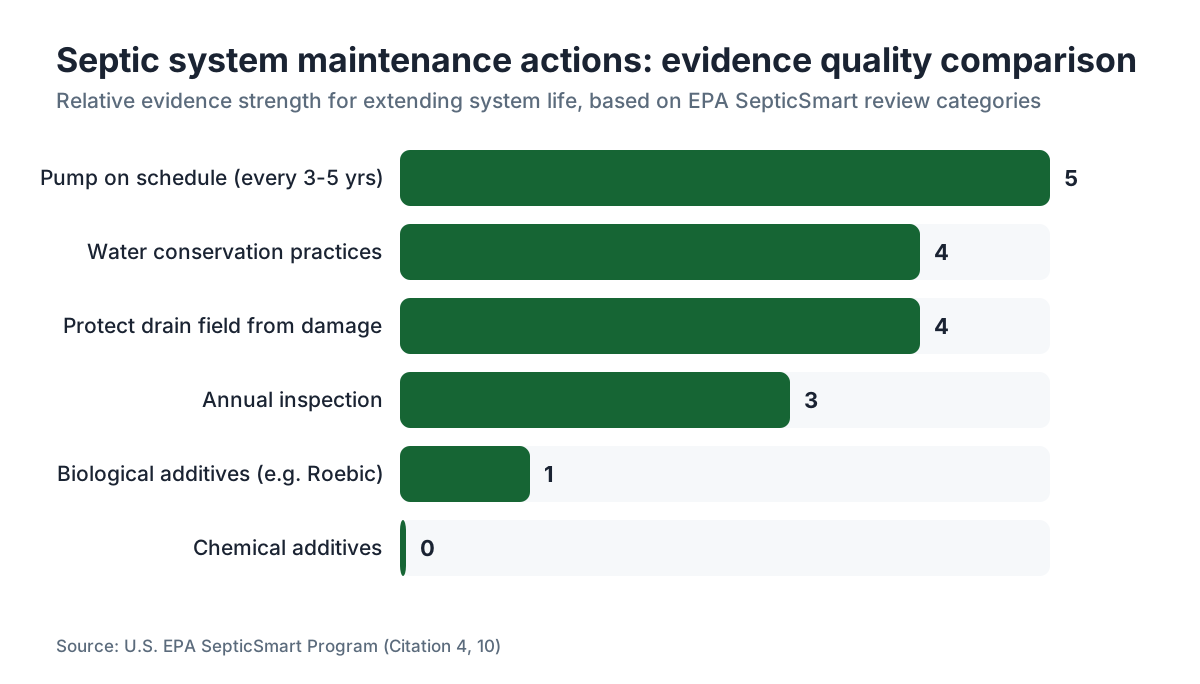
The EPA's SepticSmart program is blunt about it. The four behaviors that actually protect a septic system are pumping on schedule, conserving water, keeping non-biodegradables out of the tank, and protecting the drain field from physical damage and excess water [4].
Pumping is the only intervention with strong evidence behind it. Skipping a pump cycle because you're using an additive is the worst trade you can make. A septic tank cleaning every 3-5 years costs $300-600 in most markets. A drain field replacement runs $5,000-20,000 depending on soil conditions and system type [6].
Water conservation matters more than most homeowners think. High-flow days, like a big gathering or six loads of laundry in one afternoon, can hydraulically overload a drain field and push undigested solids into the leach field. Spreading laundry across several days is one of the cheapest, most effective moves you can make. The leach field guide covers the hydraulic load dynamics.
Keeping heavy vehicles, aggressive tree roots, and excess surface water off the drain field costs nothing and has a documented, large effect on system life [10].
A septic tank inspection every 1-3 years, depending on system age and type, catches problems before they turn into failures. That's a far better use of $100-250 than 12 months of additive.
How do Roebic septic tank treatment pods compare to the liquid version?
Pods and liquid K-37 use the same biological approach. The differences are practical, not chemical.
Pods are pre-measured, so there's no under-dosing or over-dosing. They're neater to handle, with no pouring liquid into a toilet from an awkward angle. They also run a bit more per dose, usually $15-20 a month against $10-15 for liquid.
The 'best septic tank treatment pods' question is almost always about format, not performance. If you've decided to use a biological additive, pick the format you'll actually use every month. Inconsistent use of any of these products is the most common failure mode.
Watch one thing on pods: some brands pack in heavy surfactant concentrations alongside the bacteria, sold as grease-cutting power. Certain surfactants emulsify fats and carry them into the drain field instead of letting them settle and digest in the tank. Read the ingredient list. A pod that's mostly bacteria and enzymes is a safer bet than one loaded with surfactant.
What should a septic service operator tell customers asking about Roebic?
Operators get this question constantly. Here's the honest answer, one that neither dismisses the customer nor upsells them on something that doesn't work.
Tell them the truth. A properly maintained system doesn't need additives. Pumping on schedule is what keeps it healthy. The EPA reviewed the evidence and found no benefit from biological additives in well-maintained systems.
Then get specific about what you saw at their last pump-out. If the sludge layer was thicker than expected for the interval, that's a sign of high load, not a bacterial deficit. If the tank looked good, say so. If the drain field shows early stress, have that conversation directly. The septic tank repair guide lists failure patterns worth flagging.
Some operators carry and sell Roebic as a revenue line. That's a business call. But don't tell customers the product will reduce pump frequency or prevent failures. That claim isn't supported by evidence, and making it creates liability if the system fails and the customer points back at your recommendation.
For operators running customer communication at scale, tracking additive-use notes in service records helps flag clients who may be self-managing a struggling system. Software built for septic operations, like SepticMind, lets you add custom notes to service records and set follow-up triggers so nothing slips.
What do state regulators say about septic additives?
State positions vary a lot, and that variation matters if you're an operator recommending products or a homeowner trying to stay compliant.
Wisconsin's Department of Safety and Professional Services runs a formal additive approval process [7]. Products get evaluated before they can be sold for use in Wisconsin septic systems. Approval doesn't mean a product is proven to work. It means the product cleared a safety threshold.
Washington State's Department of Health guidance states directly that there is no scientific evidence that additives improve the performance of a properly functioning septic system.
North Carolina's onsite wastewater rules, under 15A NCAC 18A, don't ban biological additives but make no allowance for them as a substitute for required maintenance [2].
The EPA's SepticSmart program, a national public education effort rather than a binding regulatory framework, consistently discourages reliance on additives and points to pumping, inspection, and water conservation as the evidence-based maintenance actions [4].
Bottom line for operators: check your state's onsite wastewater code before recommending any product. Recommending an unapproved additive in a state with an approval requirement can create licensing trouble.
Frequently asked questions
Does Roebic K-37 really work?
In a healthy, properly maintained septic system, the honest answer is probably not in any measurable way. The EPA reviewed 17 studies on biological additives in 2010 and found no consistent evidence of benefit. Roebic K-37 is unlikely to harm your system, but it won't substitute for regular pumping. The situations with the most plausible benefit are after heavy antibiotic use or after a pump-out involving disinfectants.
How often should you use Roebic septic tank treatment?
Roebic's label calls for an initial double dose (32 oz) followed by 16 oz monthly, flushed down the toilet. If you're going to use it, monthly consistency gives it the best theoretical chance. Sporadic use, such as once or twice a year, is unlikely to hold a stable bacterial population. Avoid applying it within 48-72 hours of using bleach-based toilet or drain cleaners.
Can Roebic fix a failing septic system?
No. If your drain field is failing, or if solids have migrated out of the tank, no biological additive reverses that damage. Drain field failure requires physical intervention, which may include resting zones, aeration, or full replacement. Adding Roebic to a failing system can temporarily mask symptoms like odors, which delays proper diagnosis. Call a licensed septic professional instead.
Is Roebic K-37 safe for all septic system types?
Generally yes for conventional anaerobic tanks and standard drain fields. For aerobic treatment units (ATUs), which inject air into the treatment chamber on purpose, check your manufacturer's guidance. Some ATU warranties are voided by non-approved additives. For mound systems and other alternative designs, the strains in K-37 are unlikely to cause harm, but there's also no evidence they improve performance in those configurations.
What's the difference between Roebic K-37 and Rid-X?
Both are biological additives using Bacillus bacteria strains and digestive enzymes. The strains and concentration differ slightly between brands, but independent testing hasn't shown a meaningful performance difference. Rid-X comes in powder and liquid formats; Roebic K-37 is liquid. Both carry the same evidence profile: no documented harm, no documented improvement in properly maintained systems. Price and availability are the practical differentiators.
Do septic tank treatment pods work better than liquid treatments?
No evidence suggests pods outperform liquids biologically. Pods are a convenience format delivering similar bacterial counts and enzyme types to liquid products. They're pre-measured, which eliminates dosing errors, and they're cleaner to handle. They cost slightly more per dose. If you struggle to remember a monthly liquid dose, pods may improve your consistency, which matters more than the format itself.
How long does it take Roebic to work?
Roebic's marketing suggests the bacteria establish within a few days and start contributing to digestion in the first week. There's no independently published timeline. In practice, because a healthy tank already holds billions of bacteria per milliliter, the added organisms have to compete with an established community. Whether they meaningfully change the population balance in any measurable period hasn't been documented in peer-reviewed research.
Can you use Roebic in a tank that was recently pumped?
Yes, and this is one of the more defensible use cases. After pumping, the tank has a greatly reduced microbial population and needs to rebuild. A one-time Roebic dose shortly after pumping is a reasonable move. The tank will re-seed naturally from incoming wastewater, but if you want to give it a head start, this is a logical moment. You don't need a monthly routine from here. One dose is enough.
Does Roebic eliminate septic odors?
Roebic and similar products sometimes cut odors for a while, likely because any boost in bacterial activity speeds digestion of odor-producing organic material. But persistent septic odors usually point to a bigger problem: inadequate venting, a cracked tank lid, a struggling drain field, or a full tank. Treating odors with Roebic without finding the source is a way to delay a diagnosis that gets expensive if you ignore it.
Is Roebic approved by the EPA?
The EPA doesn't pre-approve septic additives the way it registers pesticides. Roebic K-37 isn't an EPA-registered product because it makes no pesticidal claims. The EPA's SepticSmart program evaluated the category of biological additives broadly and found no scientific evidence of benefit in properly maintained systems. That's an evaluation of the product category, not a specific approval or disapproval of the Roebic brand.
Will using Roebic let me wait longer between pump-outs?
No credible evidence supports that. Sludge accumulates regardless of additive use because bacteria can't digest all the solid material entering the tank. Pumping frequency depends mainly on tank size relative to household size, and standard guidance stays at every 3-5 years for most households regardless of additive use. Extending the pump interval based on additive use is how drain fields get damaged.
Are there states where Roebic or similar additives are restricted?
Yes. Wisconsin requires septic additives to be approved by the Department of Safety and Professional Services before they can be sold for use in Wisconsin systems. Washington State's Department of Health has published guidance discouraging additive use. Some states with sensitive groundwater concerns, including parts of Florida and New England, have tightened their onsite wastewater rules in ways that affect additive recommendations. Check your state's onsite wastewater program.
What's the cheapest effective septic tank treatment?
Water conservation and pumping on schedule. These are free or low-cost behaviors with more documented impact than any commercial additive. Spreading high-water-use activities across the week, fixing leaking toilets (a running toilet can add 200 gallons per day to your tank load), and keeping the drain field free of competing water sources all reduce system stress. No commercial product has better evidence behind it than these simple practices.
Can Roebic be used with a garbage disposal?
Yes, but the bigger point is that garbage disposals significantly increase the solids load entering a septic tank, often by 50% or more by some estimates. Households with garbage disposals typically need more frequent pumping. Adding Roebic doesn't offset that load in any documented way. If you run a garbage disposal on a septic system, shorten your pump interval rather than adding treatments.
Sources
- U.S. EPA, "Septic System Additives" (SepticSmart program): EPA reviewed 17 studies and found no scientific evidence that bacterial or enzyme additions improve the performance of properly maintained septic systems; chemical additives may cause harm to the tank and drain field.
- NC State University Extension, Onsite Wastewater Program: Septic tanks already contain billions of naturally occurring bacteria per milliliter of wastewater; adding more rarely changes the equilibrium in a healthy system.
- National Institutes of Health / PubMed: Antibiotic residues in domestic wastewater and effects on microbial communities: Antibiotic residues in wastewater have documented effects on microbial community composition, providing a plausible mechanism for bacterial supplementation after heavy antibiotic use.
- U.S. EPA SepticSmart: How to Care for Your Septic System: EPA recommends pumping every 3-5 years as the primary maintenance action; pumping frequency depends on tank size and household size, not additive use.
- U.S. EPA, "Septic Systems: Overview": Drain field replacement is a major cost consequence of system failure; EPA SepticSmart program cites system replacement as far more costly than regular pumping.
- Wisconsin Department of Safety and Professional Services, Plumbing Products Approval: Wisconsin requires septic system additives to meet state evaluation standards before they can be sold for use in Wisconsin onsite systems.
- University of Minnesota Extension, Septic System Additives: Do They Work?: University of Minnesota Extension reviewed biological additive evidence and found no peer-reviewed studies demonstrating consistent performance improvement in conventional septic systems.
- Penn State Extension, Septic System Maintenance: Penn State Extension notes that inorganic solids and biological residues accumulate regardless of additive use, and pumping on schedule remains the only intervention with clear evidence of benefit.
- U.S. EPA SepticSmart: Protect Your Investment: EPA SepticSmart identifies water conservation, pumping on schedule, and drain field protection as the evidence-based behaviors that extend septic system life.
Last updated 2026-07-09