Roebic leach and drain field treatment: does it actually work?
By the SepticMind Editorial Team

TL;DR
- Roebic Leach and Drain Field Treatment (K-570) is a bacterial additive built to break down biomat buildup in a septic drain field.
- Independent evidence for it is thin.
- It might help a little with early-stage sluggishness, but it won't save a saturated or structurally broken field.
- Regular pumping and cutting water use do far more, for less money.
What is Roebic Leach and Drain Field Treatment?
Roebic K-570, sold as Leach and Drain Field Treatment, is a liquid bacteria and enzyme concentrate aimed at homeowners whose drain field has slowed down or started backing up. The pitch is simple: pour in bacteria that eat through the greasy, sludgy layer called a biomat, the one that builds up at the soil-pipe interface after years of normal use.
The active ingredients are a mix of aerobic and facultative bacteria, mostly Bacillus species, plus cellulase and lipase enzymes. [11] The label tells you to pour one quart straight into a toilet once a month for several months, then drop back to quarterly for maintenance.
Roebic Laboratories has made septic additives since 1958, which puts it among the older names in the category. The full line covers tank treatments, root inhibitors, and field products. K-570 is the field-specific formula, not the same as their general tank bacteria.
Add bacteria, restore flow. That's the whole claim. Whether it holds up is the question this article answers, and the real answer has more edges than the label lets on.
How does a drain field actually get clogged?
Before you can judge any additive, you have to know what breaks in a drain field. It's almost always the biomat.
Effluent leaving your septic tank still carries suspended solids, fats, and biological oxygen demand even after the tank settles out the big stuff. That liquid runs into perforated pipes buried in the trenches, seeps down through gravel, and enters the native soil. The soil does the real treatment: bacteria in the dirt filter pathogens and consume nutrients as water percolates toward groundwater. [8]
Here's where it goes wrong. A biomat is a dense, black, anaerobic microbial layer that forms where gravel meets soil. In thin amounts it's normal and even useful, because it slows effluent enough to let the soil treat it. Let it thicken too far and it turns nearly waterproof. The soil below it suffocates. Water backs up into the pipes, then the tank, then the house.
Biomat overgrowth speeds up when too much solids-heavy effluent reaches the field (an under-pumped tank), when too much water hits the trenches at once (a household running the well dry every day), or when fats, oils, and grease keep coating the surface. The EPA's SepticSmart program says it plainly: "Have your septic system inspected at least every three years by a licensed professional and pump your tank every three to five years." [1] Skipping pumps is the single biggest reason fields die early.
Once a field is fully saturated or the soil structure is physically broken, no additive brings it back. That isn't a shot at Roebic. It's physics.
What does the research say about septic additives?
The honest answer: the research is thin, and what exists mostly runs against biological additives as field restorers.
The most-cited independent review is a University of Minnesota Extension evaluation of dozens of septic additives. It concluded that no additives have been shown to eliminate the need for regular pumping, and that biological additives carried low risk but produced no measurable improvement in field function under controlled conditions. [2]
A study reported through the National Environmental Services Center looked at several commercial bacterial additives and found no statistically significant difference in effluent quality or soil percolation between treated and untreated systems over 12 months. [7] No signal. Just noise.
The EPA does not endorse any additive for drain field restoration. Its septic guidance states that additives, including biological ones, do not enhance septic tank or drain field performance and may damage a system or contaminate local water resources. [1]
Wisconsin's Department of Natural Resources landed in the same place, noting that the native soil bacteria already living in a working field vastly outnumber anything a bottle can add. [3] Minnesota's Pollution Control Agency reached a nearly identical conclusion: low environmental risk, no documented improvement. [12]
None of this makes K-570 a scam. The bacteria in it are real and they do digest organic matter in a lab. The catch is that a failing drain field is a complicated engineered-soil system, not a beaker. Getting live bacteria in useful numbers to a clogged biomat by flushing them down a toilet is genuinely hard, and peer-reviewed field evidence that it works is basically absent.
Some installers and pumpers say they've seen slow fields perk up a little after months of additive use. Nobody has clean data on this. Those reports aren't controlled, and the selection bias is obvious: the people who saw nothing just stopped buying the stuff.
When might Roebic K-570 actually help?
There's a narrow window where an additive like K-570 is at least plausible, and it's worth being honest about it.
If your field is only mildly slow, with no surface ponding and no indoor backups yet, and the slowdown started recently, the biomat may still be thin enough that extra bacteria could speed its breakdown a bit. Treat it as a cheap hedge with almost no downside at $20 to $30 a quart.
K-570 is also reasonable as a monthly dose to keep a field healthy after it's been rested and recovered. Resting a drain field (diverting flow to an alternate field, or cutting water use hard) is one of the few approaches with real field evidence behind it. Adding bacteria during or after a rest might help lock in whatever recovery happened.
Roebic also sells K-570 for grease traps and slow kitchen drains, and that's a more defensible use. A confined, high-organic pipe is a lot closer to the lab beaker where these bacteria actually perform.
Where it won't do a thing: a field with ponding across the whole drainfield area, a system with effluent breaking out at the surface (a public health violation in every state), a field sitting in saturated or clay-heavy soil that never percolated well, or any system where a neglected tank is passing solids. Fix the tank first. Every time.
How do you use Roebic K-570 correctly?
The standard instructions call for an initial dose of one quart poured into the toilet closest to the tank, flushed in with several gallons of warm water. For a badly sluggish field, Roebic says repeat monthly for three to six months, then go quarterly. [11]
A few things worth getting right.
Don't dose right after bleach, antibacterial cleaners, or a garbage disposal run. Disinfectants kill bacteria, and even the diluted bleach from a toilet bowl cleaner can wipe out a dose before it ever reaches the field.
Time the dose for low water use, late at night or right before a vacation, so the bacteria spend more time sitting in the tank and field instead of getting flushed straight through by heavy flow.
The bacteria have to travel from the toilet, through the tank, into the distribution box, and out into the trench pipes to reach the biomat. In a tank thick with sludge or scum, most of them get consumed or trapped before they ever get close to the field. That's exactly why pumping the tank before you start an additive regimen makes more sense than skipping it.
If you want to know whether the product is doing anything measurable, a licensed inspector with a probe can check soil absorption rates before and after a treatment period. Almost no homeowner bothers. It's the only real way to tell.
What are the realistic alternatives to a drain field additive?
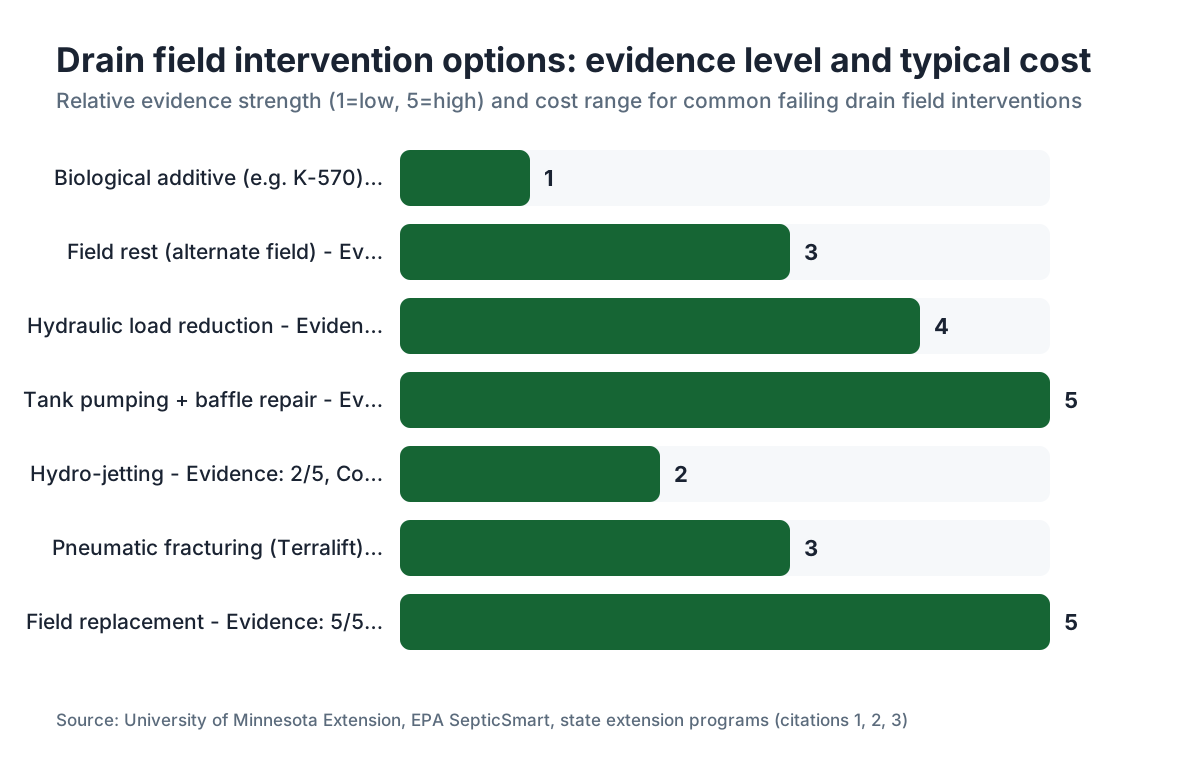
If your field is genuinely failing or close to it, here's the honest order of options, roughly cheapest to priciest.
Rest the field. If you have a two-field system (common in older installs), switch to the alternate field and let the primary sit for six to twelve months. Aerobic conditions slowly return, the biomat can partly break down, and in some soils the field fully recovers. Cost: nothing but the switchover.
Cut the water load. Fix leaky faucets and running toilets. A single running toilet can waste 200 gallons a day. Stagger laundry, install low-flow fixtures. The EPA puts average indoor use at about 70 gallons per person per day; trimming that 20 to 30 percent buys a struggling field real time. [4]
Pump the tank, then look. Get it pumped and inspected. Ask the pumper straight out whether solids are passing into the field, which would mean the baffles need replacing or the schedule needs shortening. More in our guide on septic tank pumping.
Hydro-jetting. Some contractors jet the field to physically break up the biomat. Results are mixed and often temporary (six to 18 months), but it buys time. Figure $500 to $2,000 depending on field size.
Terralift or fracturing. A pneumatic probe injects air and polystyrene pellets to crack compacted soil and reopen pores. Independent reviews of this have been kinder than anything for chemical or biological additives, with some extension programs reporting real percolation gains. Cost runs $1,000 to $3,000.
Field replacement. If the soil is genuinely saturated or structurally shot, replacement is the only permanent fix. A standard leach field replacement usually runs $3,000 to $15,000 depending on soil, size, and permitting. With tight setbacks or bad soils, an alternative system can hit $30,000 or more. Full numbers in our cost to install septic system guide.
Septic operators managing a book of client accounts can flag which properties sit at high risk for field failure based on pumping history and usage. Tools like SepticMind exist to catch those patterns before an emergency call turns into a replacement.
Is Roebic K-570 safe for your septic system and the environment?
Safety is the one place biological additives beat chemical ones cleanly.
Bacillus-based products like K-570 are generally recognized as safe. The bacteria are non-pathogenic and already live in soil, so they don't drop exotic organisms into a working system's microbial community. No state I'm aware of has banned biological additives on safety grounds, though several have banned certain chemical ones. [3][12]
The enzymes (the lipases and cellulases in K-570) break down at the same pace as any organic compound in soil and pose no groundwater risk at label doses.
Safety gets murkier with heavy or too-frequent dosing. Pour in several quarts a month chasing a dying field and you're reworking the bacterial balance of your tank. An over-seeded tank can foam, and its biological oxygen demand and suspended solids can actually climb for a while. That pushes more half-treated effluent toward the field, which is the opposite of the goal.
So the safe approach is boring: use it as directed, not more. And never treat it as a swap for pumping.
How does Roebic K-570 compare to other drain field products?
The drain field treatment market is crowded and most of it is low-evidence. Here's how the main categories stack up.
| Product type | Examples | Mechanism | Evidence level | Typical cost |
|---|---|---|---|---|
| Bacterial/enzyme (biological) | Roebic K-570, Bio-Clean, Rid-X Septi-Pac | Seed bacteria, enzyme digestion | Low (no peer-reviewed field data) | $15-$40/dose |
| Yeast-based | Various DIY recipes | Fermentation byproducts | Very low | $1-$5 |
| Chemical solvents | Some older formulas | Dissolve biomat chemically | Low, possible groundwater risk | $10-$30 |
| Hydrogen peroxide | Agricultural field restoration | Oxidize biomat, add oxygen | Moderate (some state studies) | $200-$800 professional |
| Aeration systems | Jet Aeration, Infiltrator | Mechanically add O2 to field | Moderate-high (engineering data available) | $1,500-$5,000 installed |
| Terralift/fracturing | Terralift, Bio-Nomic | Pneumatic soil fracturing | Moderate (extension data) | $1,000-$3,000 |
K-570 sits in the lowest-risk, lowest-evidence tier. As a $25 monthly experiment on a mildly slow field, the downside is close to zero. As the main fix for a failing field, it's the wrong tool.
Hydrogen peroxide injection got more serious study in the 1990s and early 2000s. Some programs showed real percolation gains, but it needs professional application at high volume and can kill beneficial soil bacteria if overdosed. Several states have restricted it.
What are the signs your drain field is failing beyond what an additive can fix?
At some point you stop experimenting with bottles and call a pro. These are the markers that mean you're there.
Surface ponding over the drainfield, especially after rain or a heavy laundry day, means the soil is saturated past what rest or additives can pull back quickly. Wet, spongy ground over the trenches is the tell.
Lush, oddly green grass in a stripe pattern over the field lines during dry weather means effluent is fertilizing the surface, so it isn't being absorbed the way it should.
Sewage smell outdoors near the field, or indoors near floor drains, means the system is under pressure and effluent is finding its way to the surface or the air.
Multiple slow drains at once across the house, paired with gurgling in the pipes, points to the tank or field backing up rather than a single clogged trap.
A septic tank inspection that finds effluent standing at or above the outlet baffle means the field can't take flow as fast as the house produces it.
Any of these earns a site visit from a licensed onsite wastewater professional, not another bottle of additive. Most states license these contractors separately from general plumbers, so your state environmental or health agency's website is where the lookup tool lives. [6]
What does regular maintenance actually do that K-570 can't?
The EPA's SepticSmart guidance is blunt about it: the best thing you can do for a drain field is pump the tank on schedule and control what goes down the drain. [1]
A tank pumped on time (every three to five years for a typical household, sooner for heavy use or a small tank) keeps solids out of the field. Solids loading is the main driver of biomat overgrowth. Everything else is second.
The math is clean. A 1,000-gallon tank serving four people builds up roughly 50 to 60 gallons of sludge a year under normal use. [10] After five years that's 250 to 300 gallons filling 25 to 30 percent of the tank, cutting settling time and raising the odds that solids slip through to the field. Full breakdown in the how often to pump septic tank guide.
Past pumping, the field's long-term health rides on what enters the tank. Fats, oils, and grease coat the biomat and make it tighter. A garbage disposal can raise suspended solids load by 50 percent or more. [9] Antibacterial products kill the bacteria that make the field work. Large amounts of flushed antibiotics can suppress the microbial community in the soil too.
None of that gets fixed by a bottle down the toilet. All of it is manageable with plain habits. For homeowners who want to keep pumping intervals straight and get reminders, SepticMind's homeowner tools are built around exactly these intervals.
For the wider maintenance picture, see our guides on septic tank cleaning and septic tank pump out.
How much does Roebic K-570 cost, and where can you buy it?
Roebic K-570 runs about $20 to $35 a quart at home improvement stores like Home Depot and Lowe's, and from the usual online retailers. A 32-ounce bottle is one dose in most protocols.
Run the six-month initial course plus quarterly maintenance and you're looking at $120 to $175 the first year, then $60 to $100 a year after that.
Against the cost of a septic system repair or a field replacement, that's cheap. The real question isn't whether K-570 is expensive. It's whether $100 a year on something with weak evidence beats that same $100 put toward a proper pumping schedule or a plumber's look at your running toilet. It doesn't.
Here's the frame I'd use. If your field is fine and you want to do something extra, the additive is harmless and cheap, so knock yourself out. If your field is struggling, spend the money on a site assessment instead.
Frequently asked questions
Does Roebic K-570 actually work to restore a failing drain field?
Independent research, including a University of Minnesota Extension review and EPA guidance, finds no peer-reviewed evidence that biological additives like K-570 restore failing drain fields. The bacteria are real and do digest organic matter, but delivering them effectively to a clogged biomat through normal toilet flushing is difficult. K-570 poses minimal risk and may offer marginal help in very early-stage sluggishness, but it won't fix a genuinely failing field.
How often should I use Roebic Leach and Drain Field Treatment?
Roebic's own instructions call for one quart monthly for three to six months during an initial restoration period, then one quart quarterly as maintenance. Don't exceed label doses. More isn't better: over-seeding your tank can temporarily increase suspended solids and push more organic matter toward the field. Time doses for low-water-use periods, away from recent bleach or antibacterial product use.
Can I use Roebic K-570 instead of pumping my septic tank?
No. No additive replaces pumping. The EPA and every state environmental agency are consistent on this: pump your tank every three to five years (more often with heavy use or small tanks). A tank with excessive sludge passes solids into the drain field, which is the primary cause of field failure. An additive dumped into a sludge-filled tank mostly gets consumed before it reaches the field anyway.
Is Roebic K-570 safe for my septic system and groundwater?
Yes, within normal use. The Bacillus bacteria in K-570 are non-pathogenic and naturally present in soil. The enzymes break down like any organic compound. No state bans biological additives on safety grounds. At label doses, there's no credible groundwater risk. The main safety concern is using too much too often, which can disrupt tank biology and temporarily worsen effluent quality.
What is the biomat in a drain field and can bacteria dissolve it?
A biomat is a dense, dark, anaerobic microbial layer that forms where effluent meets soil at the bottom and walls of drain field trenches. It's a normal part of system function in thin layers but becomes a problem when it thickens enough to block percolation. Bacteria can theoretically digest biomat organic matter, but field evidence that bottle-dosed bacteria do so at meaningful scale is not well supported by controlled studies.
What happens if I pour Roebic directly into the drain field cleanout instead of the toilet?
Some installers suggest applying concentrated bacterial treatments directly into the distribution box or field inspection ports to bypass the tank and get bacteria closer to the biomat. There's logic to this: fewer bacteria get consumed in transit. Roebic's label doesn't specify this method, and you'd want to confirm with a licensed installer before doing it, since pouring large volumes of liquid into dry or collapsed trenches can cause other problems.
How do I know if my drain field is failing vs. just slow?
Key failure signs: surface ponding over the field area, unusually lush green grass in a stripe pattern during dry spells, sewage odors outdoors near the field, multiple slow drains throughout the house simultaneously, and gurgling pipes. A sluggish single drain or slow toilet is more likely a pipe clog. If you see any of the field signs above, skip the additive and get a licensed inspection. Surface breakout is a public health violation in every state.
How does Roebic K-570 compare to Rid-X for drain field problems?
Rid-X is primarily a tank treatment using Bacillus bacteria and enzymes. K-570 is formulated specifically for field restoration with a somewhat different enzyme blend targeting lipids. In practice, the mechanisms are similar and the evidence base for both is similarly thin for field restoration specifically. Neither has peer-reviewed controlled field data showing meaningful restoration. For tank biology maintenance, Rid-X is fine; for field problems, neither is a substitute for mechanical or professional intervention.
Can I use Roebic K-570 as preventive maintenance if my system is healthy?
This is the most defensible use case. A healthy field with regular pumping and reasonable water use doesn't need an additive, but adding one poses minimal risk. If you want the peace of mind and don't mind the $60 to $100 per year cost, quarterly use on a well-maintained system is harmless. Just don't let it substitute for pumping. Maintenance means pump schedule plus water conservation, with additives as an optional extra.
What should I do first if my drain field is sluggish?
In order: (1) check for and fix any running toilets or leaking faucets, which can add hundreds of gallons per day; (2) check when the tank was last pumped and pump it if overdue; (3) have a licensed professional assess whether the field is genuinely failing or just under hydraulic stress; (4) ask about resting the field or Terralift fracturing if the soil is compacted. Additives can come after those steps, not before.
Does the EPA recommend Roebic or any septic additive?
No. The EPA states that scientific evidence does not support the use of additives, including biological ones, to enhance septic tank or drain field performance. Their SepticSmart program recommends routine pumping, water conservation, and proper disposal habits as the primary maintenance tools. The agency also warns that some additives may damage system components or contaminate groundwater, though this concern applies more to chemical additives than biological ones.
How long does it take Roebic K-570 to show results?
Roebic suggests three to six months of monthly treatment before evaluating results. That timeline reflects how long it takes bacterial populations to establish and begin working on the biomat, assuming they survive transit through the tank and reach the field in adequate numbers. If you see no change in drainage after six months of consistent use while controlling water load and keeping the tank pumped, the field likely has a problem that bacteria won't solve.
Can Roebic K-570 help if tree roots are in my drain field?
No. K-570 does not kill roots or dissolve root masses. Root intrusion in pipes is a mechanical problem: roots physically block the perforated pipes and crush laterals. If roots are the issue, you need a plumber or septic contractor to assess and clear them, and possibly apply a copper sulfate root killer in the pipes (a different product entirely). Roebic makes a separate root killer product for this purpose.
Sources
- EPA SepticSmart Program: EPA states scientific evidence shows additives do not enhance septic tank or drain field performance; recommends pumping every 3-5 years and inspection every 3 years.
- University of Minnesota Extension, Septic System Additives: University of Minnesota Extension review concluded no additives have been shown to eliminate the need for regular pumping or improve field performance under controlled conditions.
- Wisconsin DNR, Septic System Additives Guidance: Wisconsin DNR found native soil bacteria far outnumber any introduced by bottle treatments and reviewed commercial additive products finding no evidence of measurable improvement.
- EPA WaterSense, Indoor Water Use: EPA estimates the average American uses about 70 gallons per person per day indoors.
- EPA, Septic System Licensing and Oversight: Most states license onsite wastewater professionals separately from general plumbers; EPA directs homeowners to state agencies for contractor lookup.
- National Environmental Services Center, West Virginia University: Study reported through the National Environmental Services Center found no statistically significant difference in effluent quality or soil percolation rates between systems treated with bacterial additives and untreated control systems over 12 months.
- EPA, How Your Septic System Works: EPA explains biomat formation at the soil-effluent interface as a normal process that becomes a failure mechanism when it impedes percolation.
- North Carolina State University Extension, Onsite Wastewater: NC State Extension explains that garbage disposals increase suspended solids load by 50 percent or more, accelerating drain field biomat development.
- Penn State Extension, Septic Systems and Drain Fields: Penn State Extension documents typical sludge accumulation rates and recommends pumping schedules based on household size and tank volume.
- Roebic Laboratories, Product Information K-570: Roebic K-570 contains Bacillus species bacteria plus cellulase and lipase enzymes; label calls for one quart monthly for 3-6 months then quarterly.
- Minnesota Pollution Control Agency, Septic System Additives: Minnesota PCA concluded that biological additives pose low environmental risk but provided no documented improvement in drain field performance.
Last updated 2026-07-09