Septic inspection in Peconic, NY: what to expect and what it costs
By the SepticMind Editorial Team
TL;DR
- A septic inspection in Peconic, NY costs roughly $300, $600 for a standard visual and operational inspection, rising to $800, $1,500 if a dye test or camera scope is added.
- Suffolk County regulates all on-site wastewater systems under its Sanitary Code Article 6 and Title 22.
- Inspectors check the tank, distribution box, and leach field.
- Home sales in Peconic's tight market almost always require one.
Why Peconic septic inspections are stricter than most of New York
Peconic sits on the North Fork of Long Island, east of Riverhead, directly above the sole-source Peconic aquifer. That aquifer is the only realistic drinking water supply for much of eastern Suffolk County, and the EPA designated it a Sole Source Aquifer in 1987 under the Safe Drinking Water Act [1]. That designation changes the math for regulators. They can block any federally funded project that threatens the aquifer, and local officials know a wave of failing cesspools translates directly into contaminated drinking water.
Suffolk County answers that pressure with rules genuinely tougher than upstate New York or most other states. The Suffolk County Sanitary Code Article 6, administered by the Suffolk County Department of Health Services (SCDHS), sets minimum lot sizes, tank sizing rules, and setback distances that apply everywhere in the county, Peconic included [2]. The county also requires any septic system installed after a certain date to meet nitrogen-reducing standards in designated "sensitive areas," which covers most of the Peconic watershed.
For homeowners this means a few practical things. A cesspool, which is what many older Peconic properties still have, is not the same as a true septic system, and inspectors will flag that distinction clearly. Any transfer of real property in Suffolk County that involves an on-site sanitary system requires SCDHS approval or disclosure. And if your system was installed or significantly repaired after 1973, SCDHS should have a record of it, and inspectors routinely pull that file before they show up.
What does a septic inspection in Peconic actually involve?
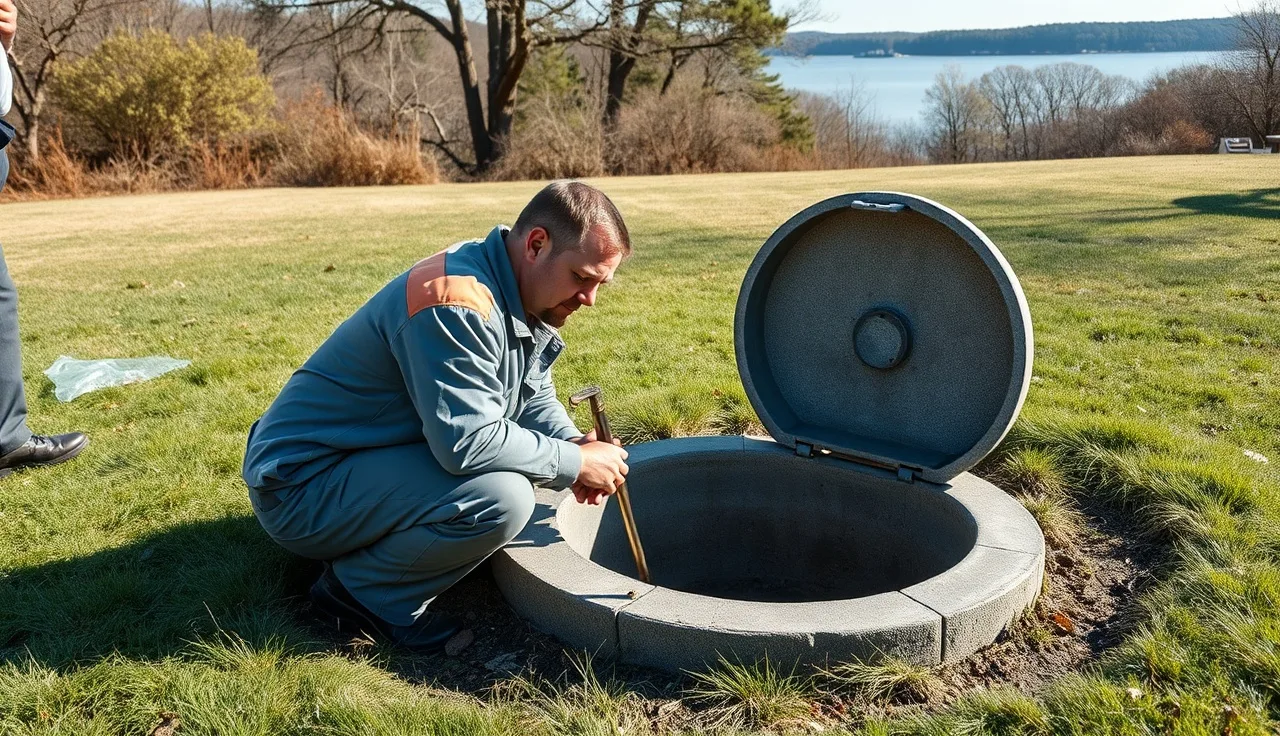
A standard Peconic septic inspection has three physical parts: the tank inspection, the distribution box inspection, and the leach field evaluation. Some inspectors add a dye test or a camera scope. Those cost more and tell you more.
The inspector starts by locating the tank, which on older North Fork properties can be surprisingly hard. Many tanks went in without permits in the 1950s and 1960s, and the records are thin. The inspector pops the lid, measures liquid level relative to the outlet baffle, checks for scum and sludge accumulation, and looks at the condition of the baffles. A tank where liquid stands above the outlet pipe invert is telling you the drainfield is backing up. Scum or sludge within 6 inches of the outlet baffle means pumping is overdue. See our full guide to [septic tank pump out for timing benchmarks.]
The distribution box (D-box) splits effluent flow from the tank into the leach field laterals. An unlevel D-box sends all the flow to one side of the field, which overloads it and shortens its life. Inspectors check level with a simple bubble level, look for cracks, and confirm the inlet and outlets are intact.
Leach field evaluation is where the judgment calls live. An inspector walks the field looking for soft spots, lush green stripes in dry conditions, sewage odors, or standing water. On a wet spring day those signs are easy to read. On a dry August afternoon a failing field can look almost fine. Some inspectors drive a thin probe rod into the ground at multiple points to feel for saturated soil. That's not a standardized procedure, but it's a real skill.
A dye test introduces fluorescent dye at the house and checks whether it surfaces at the field. A camera scope runs a flexible camera down the outlet line and into the tank. Both add $150, $400 to the base cost but catch things visual inspection misses, particularly cracked lines and root intrusion. For a pre-purchase inspection on a property with an older system, I'd pay for the camera every time.
What does a septic inspection cost in Peconic, NY?
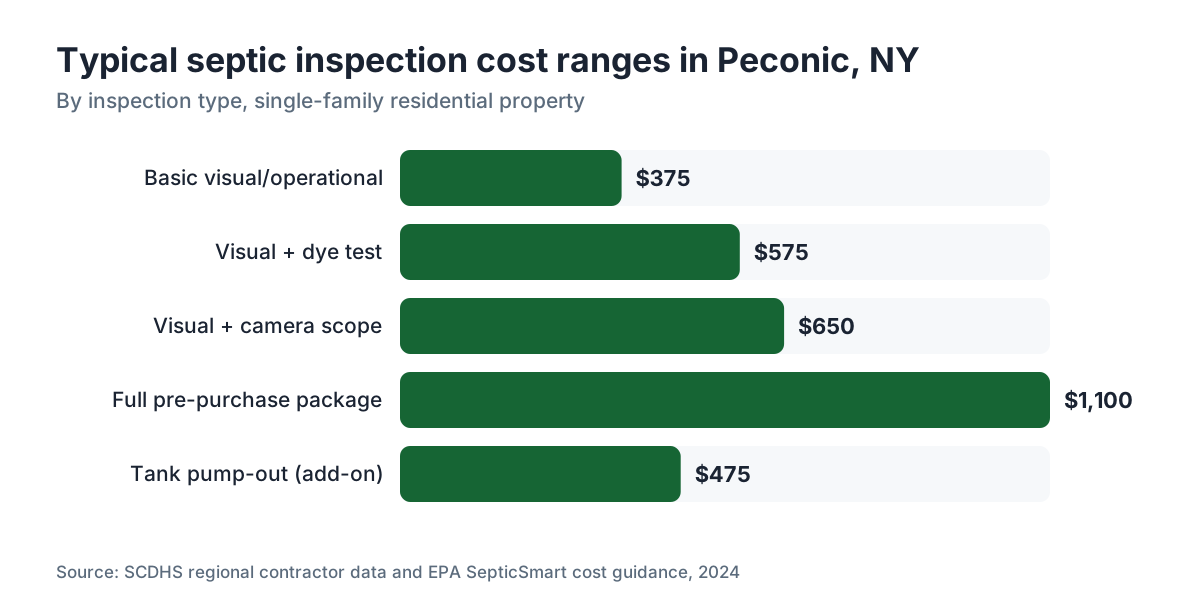
Exact pricing data for Peconic specifically is sparse, but the regional picture from Suffolk County and the broader Hamptons and North Fork market is consistent enough to work with.
| Inspection type | Typical cost range | What's included |
|---|---|---|
| Basic visual/operational | $300, $450 | Tank, D-box, field walk, report |
| Visual + dye test | $450, $700 | Above plus dye introduction |
| Visual + camera scope | $500, $800 | Above plus sewer camera on outlet line |
| Full pre-purchase package | $700, $1,500 | All of the above, written report, SCDHS records pull |
| SCDHS-required upgrade inspection | $200, $500 | Sometimes bundled with permit application |
The spread within each range comes from a few things: how deep the tank lid is buried (digging adds cost), whether the inspector pumps the tank as part of the visit (most don't, they contract separately), and whether the property is a straightforward ranch or a multi-building estate with two or three separate systems.
Pumping itself, which you should almost always do before or during a thorough inspection so the inspector can actually see the tank walls and baffles, runs $350, $600 for a standard 1,000 to 1,500 gallon tank in Suffolk County see [septic tank pumping for a full cost breakdown]. Bundle it with the inspection if you can. Some companies discount the pair.
One cost that surprises buyers: if SCDHS has no record of the system, or the record shows an unpermitted modification, you may owe a separate fee for a compliance inspection or variance application before the transfer can close. That can be $500, $2,000 on top of the inspector's fee, and it can delay a closing by weeks.
How long does a Peconic septic inspection take?
Plan on 1.5 to 3 hours for a typical single-family property. The range sounds wide, but it really does depend on whether the tank lid is accessible or buried under a foot of soil, whether the D-box is findable, and how complex the drainfield layout is.
For older properties in Peconic, Cutchogue, or Southold where original system drawings are missing, the inspector may spend 30 to 45 minutes just locating components. Probe rods, metal detectors, and SCDHS record lookups all help, but sometimes you're just probing with a steel rod.
If a camera scope is included, add 30 to 60 minutes. Dye tests require waiting for the dye to travel from the house to the field, which can take 10 minutes or 2 hours depending on soil conditions and recent water use. Most inspectors schedule those as full half-day appointments.
The written report typically lands 24 to 72 hours after the site visit. For a closing-driven timeline, build at least a week between scheduling the inspection and your contingency deadline. Inspectors in eastern Suffolk are busy from April through October, and next-day appointments are rarely available.
When do you legally need a septic inspection in Peconic?
Three situations reliably trigger a required inspection under Suffolk County rules.
First, a real property transfer. Suffolk County Local Law 12-2015, the groundwater and surface water protection law, effectively makes a system disclosure or inspection part of the transfer process for properties with on-site sanitary systems. SCDHS requires that sellers disclose the system type, age, and location. Many buyers, and nearly all lenders financing a purchase in this price range, require a third-party inspection as a condition of the deal.
Second, a change in use or expansion. Adding a bedroom, converting a guest cottage into a rental unit, or building an accessory dwelling unit all trigger SCDHS review, because those changes increase the design flow the system must handle.
Third, a permit for a new or replacement system. If you're applying for a permit to install, repair, or upgrade a septic system in Peconic, SCDHS will inspect the existing system and the proposed site as part of the permit process [2].
Beyond legal requirements, there are practical triggers: slow drains throughout the house, sewage odors in the yard, unusually lush grass over the drainfield, or a tank that hasn't been pumped in more than five years. The EPA SepticSmart program recommends inspections every one to three years depending on household size and system type [3]. For a system serving a year-round four-person household, every three years is the outer edge of reasonable.
What are the most common problems inspectors find on Peconic properties?
Cesspools instead of septic systems. This is the single most common finding on pre-1975 North Fork properties. A cesspool is a covered pit with perforated walls that receives raw sewage. Solids and liquids both leach into the surrounding soil. A septic system, by contrast, separates solids in the tank before sending effluent to the drainfield. Cesspools are technically legal if they predate modern codes, but SCDHS policy increasingly pushes owners toward replacement, especially near surface water.
Baffle failure. The inlet and outlet baffles inside the tank keep scum and solids from flowing into the drainfield. When they rot out (fiberglass and concrete baffles last longer than old metal ones, but nothing lasts forever), solids reach the drainfield and clog it. Baffle replacement is a relatively cheap repair, usually $150, $400, if caught early. Explore options at [septic tank repair.]
High groundwater intrusion. The water table on the North Fork is often within 3 to 5 feet of the surface, especially in low-lying areas near Peconic Bay or the Long Island Sound. A tank sitting in high groundwater can have groundwater seeping through cracks, which dilutes effluent and can actually float the tank if it's pumped while the water table is high. Inspectors look for waterline stains inside the tank above the normal liquid level.
Distribution box failure. D-boxes crack, settle, and flood with groundwater. An unlevel D-box is one of the most common causes of premature leach field failure because it concentrates all hydraulic load on one or two laterals. A new D-box costs $300, $800 installed.
Leach field saturation. In heavy clay soils, or in fields that have absorbed years of solids-laden effluent, the soil's ability to accept and treat wastewater drops sharply. There's no inexpensive fix for a fully failed leach field. Replacement runs $5,000, $25,000 or more depending on the site. See our overview of [leach field repair and replacement costs.]
How do you find a qualified septic inspector in Peconic?
New York State does not license septic inspectors as a separate trade category the way it does plumbers or electricians. In practice, qualified inspectors in Suffolk County fall into a few groups: licensed master plumbers, engineers licensed by NYSDEC or SCDHS to design on-site systems, and certified home inspectors who specifically advertise septic expertise.
For a pre-purchase inspection, I'd push toward either a professional engineer (PE) with on-site wastewater experience or a licensed master plumber who regularly works with SCDHS on system permits. They know the local code, they know what SCDHS reviewers actually care about, and their written reports carry more weight with lenders and attorneys than a general home inspector's narrative.
Ask any candidate three questions before booking. How many septic inspections have you done in Suffolk County in the past year? You want a number north of 20. Do you pull SCDHS records before the inspection? A good inspector does. What does your report include? You want tank condition and liquid levels, baffle condition, D-box condition, field observation, photos, and a recommendation on pumping frequency.
SCDHS itself maintains lists of engineers and firms that have submitted approved plans for on-site systems in the county. That's a reasonable starting point for finding someone who's actually worked with the local regulators. Word-of-mouth from a North Fork real estate attorney or an experienced buyer's agent is also reliable, because those professionals see inspection reports constantly and they remember who writes useful ones versus who writes liability-avoidance boilerplate.
If you run a septic service operation and manage inspections across multiple Suffolk County properties, software like SepticMind can track SCDHS permit timelines, inspection schedules, and system records for your client base without the usual spreadsheet chaos.
What happens if the inspection finds a failing or non-compliant system?
The answer depends heavily on how bad the failure is and where in the transaction you are.
For a pre-purchase inspection, a failed system finding hands the buyer real negotiating room. The buyer can ask the seller to repair or replace the system before closing, ask for a price reduction that covers the estimated repair cost, or walk away if the contingency is still in place. In Peconic's real estate market, where properties often run $700,000, $3,000,000, a $20,000 septic replacement is real money but rarely a deal killer if priced correctly.
For an existing homeowner, a finding of "imminent health hazard," which is the language SCDHS uses when raw sewage is surfacing or the system is actively polluting groundwater, can trigger a mandatory repair order with a fixed deadline. Non-compliance can result in fines and in extreme cases an order to cease use of the sanitary facilities. That's rare, but it happens.
For systems that are non-compliant but not actively failing (for example, a cesspool that predates regulations or a tank with no SCDHS permit on record), the county generally allows continued use but requires upgrading to a compliant system when a permit-triggering event happens, like a bedroom addition or a sale requiring full disclosure.
Repair costs vary so widely that it's hard to give a single number. A baffle replacement or D-box swap is hundreds of dollars. A new conventional septic system on a typical Peconic lot runs $15,000, $35,000. A nitrogen-reducing system, which the county increasingly requires near sensitive water bodies, can run $20,000, $50,000 or more depending on the technology see [cost to install septic system for a detailed breakdown]. septic system repair covers the middle-range repair options.
Does Suffolk County require nitrogen-reducing systems near Peconic?
Yes, and this is where Peconic differs from many other parts of New York in a concrete, expensive way.
Suffolk County adopted new on-site wastewater treatment standards in 2020 under its Subwatershed Wastewater Plan, which identified nitrogen loading from traditional septic systems as a primary driver of harmful algal blooms and water quality decline in Peconic Bay and the surrounding estuaries [4]. New systems, and replacement systems in designated "nitrogen-sensitive areas," are increasingly required to install advanced treatment units (ATUs) that reduce total nitrogen in effluent to 19 mg/L or less, compared to the 40 to 60 mg/L typical of a conventional system.
The county and state have offered rebate programs to offset the cost of these systems. The New York State Septic System Replacement Program, administered through SCDHS, has provided grants of up to $20,000 for homeowners replacing cesspools or conventional systems with nitrogen-reducing units [5]. Funding availability varies by year and appropriation, so check with SCDHS directly for current program status.
For a buyer or seller in Peconic, the practical implication is simple. If the existing system needs replacement, budget for an ATU, not a conventional tank-and-field system. The inspection report should flag whether the property is in a nitrogen-sensitive area and what SCDHS would require for any replacement.
How often should Peconic homeowners get their septic system inspected and pumped?
The EPA's SepticSmart guidance recommends inspecting a septic system every one to three years, and pumping every three to five years for a typical household [3]. Those are national averages. On the North Fork, I'd tighten them.
Here's why. Many Peconic properties are seasonal, which means a system that sits empty for months and then gets hammered by a full house of summer guests cycles through stress-rest-stress patterns that speed up scum layer buildup. A vacation property that's used heavily for eight weeks and lightly the rest of the year may not need pumping as often as a year-round household, but the tank should still be inspected before the summer rush.
For a year-round household in Peconic with a properly sized tank, pumping every three years is a reasonable starting point. Get the inspector to measure sludge and scum depth at each visit. If sludge is above 30% of tank depth or scum is within 6 inches of the outlet baffle, pump it regardless of calendar. Our guide on [how often to pump septic tank has a household-size calculator.]
For seasonal properties, inspect every two years and pump based on actual accumulation, not a fixed schedule. A tank with two adults using it eight weeks a year accumulates sludge slowly. A tank serving twelve people for eight weeks accumulates it fast. There's no substitute for actually measuring.
What should Peconic homeowners do to maintain their system between inspections?
The maintenance list for a North Fork septic system isn't exotic. Most of it is just avoiding the things that kill systems early.
Don't use a garbage disposal, or use it minimally. Garbage disposals increase solids loading to the tank by 50% or more, which shortens pumping intervals and can overwhelm a marginal drainfield [6]. On a tight lot near water, that's a real risk.
Spread water use through the day. Sending 200 gallons of laundry water to the tank in a single morning pushes effluent to the field faster than it can treat it. Run one load, wait a few hours, run another.
Keep the drainfield area clear of vehicles, heavy equipment, and deep-rooted plantings. Compaction damages the soil structure the field depends on. Tree roots from willows, maples, and even ornamental shrubs routinely invade older drainfields on North Fork properties. Keep the field planted in shallow-rooted grass and nothing else.
Don't pour fats, oils, grease, medications, or harsh chemical drain cleaners down any drain. Fats and oils form a scum layer that clogs the outlet baffle and reaches the field. Antibacterial chemicals kill the bacterial community inside the tank that does the actual treatment work.
Record your pumping and inspection dates. SCDHS may ask for maintenance history when you apply for a permit or sell the property, and having a clean record of routine service is genuinely useful. Some homeowners now use platforms like SepticMind to store those records digitally so they're not hunting through a filing cabinet when an attorney needs the dates in 72 hours.
For septic tank cleaning and septic tank emptying schedules specific to your tank size and household, those guides have the detail you need.
Frequently asked questions
Do I need a septic inspection to sell a house in Peconic, NY?
You're not legally required to provide a third-party inspection report, but Suffolk County requires disclosure of the sanitary system type and location. Most buyers in Peconic demand an inspection as a contract contingency, and most lenders require it. In practice, listing without one just delays the process. Budget for the inspection upfront and price accordingly.
How much does it cost to replace a septic system in Peconic?
A conventional septic system on a standard Peconic lot runs $15,000, $35,000 installed. If the property is in a nitrogen-sensitive area near Peconic Bay or the Sound, an advanced nitrogen-reducing system adds significant cost, typically $20,000, $50,000. Site conditions like high water table or tight lot coverage can push costs higher. New York State has offered grants up to $20,000 through the SCDHS septic replacement program.
What is the difference between a cesspool and a septic system in Suffolk County?
A cesspool is a single covered pit that receives raw sewage; both solids and liquids leach directly into surrounding soil. A true septic system has a tank that separates solids before sending effluent to a designed drainfield for further treatment. Most pre-1975 Peconic properties have cesspools. SCDHS considers cesspools legal if pre-existing but increasingly requires replacement when a permit-triggering event occurs.
Who can perform a septic inspection in Peconic, NY?
New York doesn't license septic inspectors as a specific trade. In practice, qualified options include licensed professional engineers with on-site wastewater experience, licensed master plumbers familiar with SCDHS requirements, and certified home inspectors with specific septic expertise. For a pre-purchase inspection, a PE or licensed master plumber who regularly files permits with SCDHS is your strongest choice.
How long does a septic inspection take in Peconic?
Expect 1.5 to 3 hours on-site for a single-family property. Older North Fork homes with no system drawings take longer because locating the tank and D-box requires probing. Add 30 to 60 minutes if a camera scope is included. Dye tests can run a half day. Written reports typically arrive 24 to 72 hours after the site visit. Book at least one week before your contract contingency deadline.
What is the Peconic sole source aquifer and why does it matter for septic systems?
The EPA designated the Peconic sole source aquifer in 1987 under the Safe Drinking Water Act. It's the primary drinking water source for much of eastern Suffolk County. Because there's no alternative water supply, regulators apply stricter standards to anything that could contaminate groundwater, including failing septic systems and cesspools. This is why Suffolk County's sanitary code is more demanding than most of upstate New York.
Does Suffolk County require nitrogen-reducing septic systems in Peconic?
For new or replacement systems in nitrogen-sensitive areas, which includes much of the Peconic watershed, SCDHS increasingly requires advanced treatment units that reduce nitrogen in effluent to 19 mg/L or less. New York State has offered rebates up to $20,000 to offset the cost. Check with SCDHS directly for current program funding, as availability changes year to year.
How do I find SCDHS records for a septic system on a Peconic property?
The Suffolk County Department of Health Services maintains permit and inspection records for on-site sanitary systems. You can request records through SCDHS directly, often online through their environmental portal, using the property address or tax map number. Many inspectors pull these records as part of their pre-inspection process. Systems installed before 1973 often have incomplete or no records.
Can a failing septic system stop a real estate closing in Peconic?
Yes. If an inspection reveals an actively failing system or a system with no SCDHS permit on record, most attorneys will not allow the closing to proceed until the issue is resolved or a repair escrow is established. An "imminent health hazard" finding from SCDHS can also trigger a mandatory repair order. Buyers should include a septic contingency in any offer on a property with an on-site system.
How often should I pump my septic tank at a seasonal Peconic vacation property?
Measure rather than schedule. Have the tank inspected every two years and measure sludge depth. If sludge exceeds 30% of tank capacity or scum is within 6 inches of the outlet baffle, pump it regardless of calendar. A lightly used vacation property might go five years between pumpings. A property hosting large groups each summer might need pumping every two years. Actual accumulation is the only honest guide.
What are the signs of a failing septic system in Peconic?
Watch for slow drains throughout the house (more than one fixture), gurgling sounds from drains, sewage odors inside or in the yard, unusually lush green grass over the drainfield area in dry conditions, and soft or wet ground over the field when it hasn't rained. Any single sign warrants a call to an inspector. Multiple signs together suggest the system is in or near failure.
Is a dye test worth paying for in a Peconic septic inspection?
For a pre-purchase inspection on any property with an older system, yes. A dye test can confirm that effluent is reaching the leach field and not surfacing in the yard or draining to an unpermitted location. It's not a perfect test; it can miss slow failures and doesn't assess treatment quality. But combined with a visual inspection and camera scope, it significantly reduces the chance of buying a property with a hidden system failure.
Sources
- EPA, Peconic River Sole Source Aquifer designation: EPA designated the Peconic sole source aquifer in 1987 under the Safe Drinking Water Act, making it the primary drinking water source for eastern Suffolk County
- Suffolk County Department of Health Services, Article 6 Sanitary Code: SCDHS administers Suffolk County Sanitary Code Article 6 and Title 22, setting minimum lot sizes, tank sizing rules, and setback distances for on-site systems including those in Peconic
- EPA SepticSmart, Homeowner's Guide to Septic Systems: EPA SepticSmart recommends inspecting a septic system every one to three years and pumping every three to five years for a typical household
- Suffolk County, Subwatershed Wastewater Plan 2019: Suffolk County's Subwatershed Wastewater Plan identified nitrogen loading from traditional septic systems as a primary driver of harmful algal blooms and water quality decline in Peconic Bay
- New York State, Septic System Replacement Program (SCDHS administered): New York State's Septic System Replacement Program has offered grants up to $20,000 for homeowners replacing cesspools or conventional systems with nitrogen-reducing advanced treatment units
- EPA, SepticSmart: Facts about Septic Systems: Garbage disposals increase solids loading to septic tanks by 50% or more, shortening pumping intervals
- New York State Department of Environmental Conservation, Onsite Wastewater Treatment: NYSDEC provides guidance on on-site wastewater treatment standards applicable to Suffolk County systems
- Suffolk County Local Law 12-2015, Groundwater and Surface Water Protection: Suffolk County Local Law 12-2015 makes sanitary system disclosure or inspection part of the property transfer process for properties with on-site sanitary systems
- Cornell Cooperative Extension of Suffolk County, Septic System Guidance: Cornell Cooperative Extension provides guidance for Suffolk County homeowners on septic system maintenance including pumping frequency and drainfield care
Last updated 2026-07-09