Leach field dimensions: what size do you actually need?
By the SepticMind Editorial Team

TL;DR
- A typical residential leach field runs 150 to 1,000 square feet of trench bottom area.
- Two numbers set the real figure: your daily wastewater flow (usually 150 gallons per bedroom per day) and your soil's percolation rate.
- Sandy soil absorbs fast and needs less area.
- Clay needs two to four times more.
- State codes set minimums, and a licensed designer runs the final math off a perc test.
What determines leach field size?
Two numbers drive every leach field calculation: how much water your household makes each day, and how fast your soil takes it in. Trench depth, pipe spacing, gravel depth, all of that is about code and installation method, not raw capacity.
Design flow is where you start. The EPA's 2002 Onsite Wastewater Treatment Systems Manual uses 150 gallons per bedroom per day as the standard residential figure for most states, though some peg it at 120 or even 100 gallons. [1] A three-bedroom home has a design flow of 450 gallons per day. That number gets divided by the soil absorption rate to give you required trench bottom area.
Soil absorption rate, sometimes called the long-term acceptance rate (LTAR), comes from a percolation test or, more often now, a soil morphology evaluation by a licensed soil scientist. The perc test measures how fast water drops through a test hole. Results read out in minutes per inch (mpi). Soil that takes 30 minutes to drop an inch has a very different sizing requirement than soil that drops an inch in 5 minutes. [2]
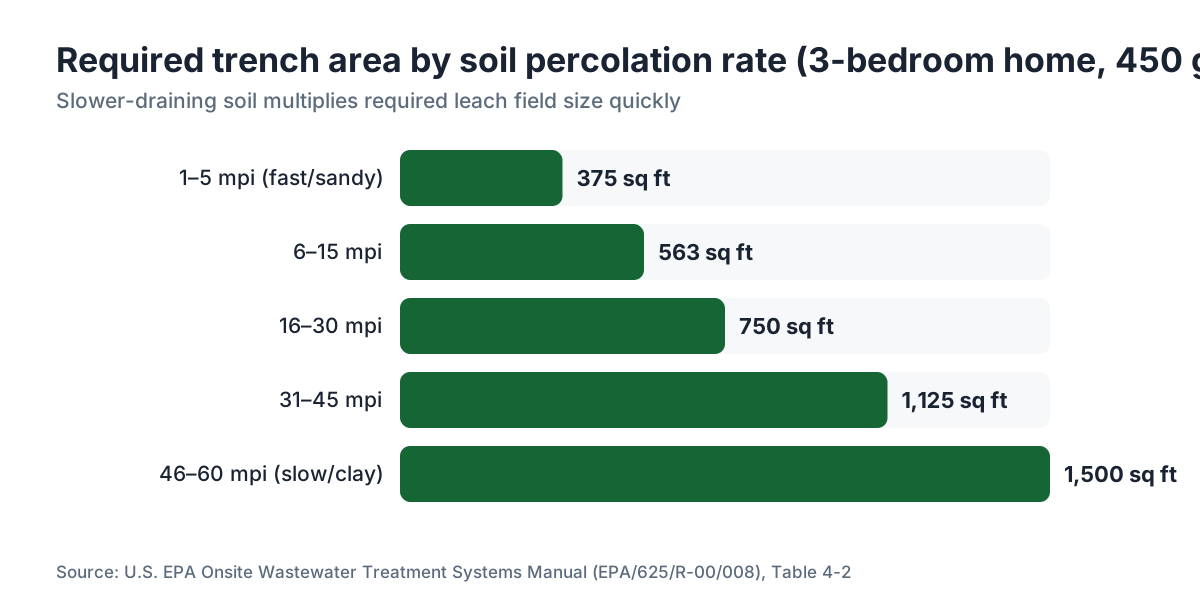
The relationship runs backward: faster soil needs less area, slower soil needs more. Sounds obvious. The math compounds fast, though. Going from a 10 mpi soil to a 60 mpi soil can more than triple your required trench footage, which can push a job from a simple trenched field to a mound system when the lot just runs out of room.
How do percolation rates translate to trench area?
You divide design flow by the soil's hydraulic loading rate. That loading rate comes straight off the perc test result. This is the formula in EPA guidance and most state codes.
Here is how typical perc rates map to loading rates and required trench area for a 450 gpd design flow (three-bedroom home):
| Perc rate (mpi) | Typical LTAR (gpd/sq ft) | Required trench area (sq ft) |
|---|---|---|
| 1 to 5 | 1.2 | 375 |
| 6 to 15 | 0.8 | 563 |
| 16 to 30 | 0.6 | 750 |
| 31 to 45 | 0.4 | 1,125 |
| 46 to 60 | 0.3 | 1,500 |
| >60 | typically not suitable | varies by state |
Those LTAR values come from the EPA Onsite Manual's Table 4-2, and most state onsite wastewater rules echo them. [1] States draw the cutoffs in slightly different spots, so confirm with your local health department or a licensed designer.
Here's the catch most people miss. Trench bottom area is not the same as total ground area. You lose ground to trench sidewalls, the setback between trenches, and equipment access paths. A field needing 750 sq ft of trench bottom might eat 1,500 to 2,500 sq ft of actual yard, depending on trench width and spacing.
What are the standard trench dimensions for a leach field?
Conventional gravity-fed trenches share a pretty consistent shape across state codes. The dimensions come from pipe size, biomat behavior, and the geometry of a backhoe bucket as much as from engineering theory.
Typical standard trench dimensions:
- Width: 18 to 36 inches (24 inches, or 2 feet, is most common)
- Depth: 18 to 36 inches to the bottom of the gravel bed; the pipe sits about 6 inches down from the top of the gravel
- Gravel below pipe: 6 to 12 inches
- Gravel above pipe: 2 to 4 inches
- Soil cover over gravel: at least 6 to 12 inches (varies by state; some require 18 inches for freeze protection)
- Spacing between parallel trenches: 6 to 10 feet, center to center
Pipe inside each trench is usually 4-inch perforated PVC or ADS. The perforations face down so effluent drains into the gravel instead of pooling in the pipe. [3]
Trench length per run is usually capped at 100 feet by code so effluent spreads evenly. Longer runs let it travel too far before soaking in, which overloads the far end. Need more total footage? You add parallel trenches, each fed from a distribution box or a manifold.
Narrow trenches (under 18 inches) show up in gravelless systems that use chambers or bundles. Those cut cost and excavated volume while hitting the same trench bottom area. Most state codes accept chamber systems, and in some soils they perform better because they leave an unsaturated air space above the soil interface. [4]
How big does a leach field need to be for a 3-bedroom house?
This is the question most homeowners walk in with. A 3-bedroom home has a design flow of 450 gpd (3 bedrooms x 150 gpd). If the perc test reads 20 mpi, the LTAR sits around 0.6 gpd per square foot. Divide 450 by 0.6 and you land on 750 square feet of required trench bottom. [1]
With 2-foot-wide trenches and 100-foot maximum runs, you need about 375 linear feet of trench total (750 sq ft divided by the 2-foot width). Call it four 94-foot trenches. With 6-foot spacing between centers, those four runs cover a footprint of roughly 18 feet by 94 feet, around 1,700 square feet of yard.
Now change the soil. Same house, 45 mpi perc rate, and the LTAR drops to 0.4 gpd/sq ft. Required trench bottom jumps to 1,125 sq ft, about 563 linear feet. That might take six trenches and over 2,500 sq ft of yard. At some point the lot runs out of good ground, and the designer switches to a mound, drip irrigation, or an aerobic treatment unit.
Bedroom count is only an approximation. Many states now also check actual fixture counts or occupant numbers, whichever gives the higher design flow. Adding a bedroom or converting a bonus room? Check with your local health department before you assume the existing field can carry it.
What setback distances apply to leach field placement?
Setbacks are often the real limit, not soil capacity. You could have perfect sandy soil, but if the only workable spot sits 40 feet from a well, you're stuck.
Common minimum setbacks (these vary a lot by state and county, always verify locally):
| Feature | Typical minimum setback |
|---|---|
| Drinking water well (private) | 50 to 100 feet |
| Property line | 5 to 10 feet |
| Foundation / basement | 10 to 20 feet |
| Swimming pool | 15 to 25 feet |
| Surface water (stream, pond) | 25 to 100 feet |
| Steep slopes (>15%) | 15 to 50 feet or prohibited |
| Trees (large root systems) | 10 to 25 feet |
| Driveways / paved surfaces | 10 feet |
These pull from the EPA Onsite Manual and line up with state rules across the Southeast, Midwest, and Mountain West, but some coastal and Great Lakes states run tighter. [1] California requires 100-foot setbacks from certain water bodies under some county rules. Florida's requirements shift by county and system type. [5]
Wells are the big one. Most states use 50 feet as a bare floor, but sandy soil and shallow groundwater can push that to 75 or 100 feet. Virginia's 100-foot well setback is a commonly cited benchmark, though every state sets its own threshold. [6]
Setbacks eat space fast on small lots. A half-acre lot with a well, a stream along the back, and a house near the center might leave only a thin strip of viable field area. That's exactly why a site evaluation comes before any design work.
How much space do you need for a reserve area?
Most state codes make you set aside a reserve area the same size as the primary field, often a full 100% of it. The reserve has to stay undisturbed, uncompacted, and free of structures. If the primary field fails, the reserve goes in without a scramble for new ground.
That doubles the land your drainfield ties up. The 1,700 sq ft primary field for a 3-bedroom house needs another 1,700 sq ft kept clear nearby. Total protected area runs past 3,400 sq ft, which matters a lot on a tight lot.
A few states only require a 50% reserve, and some alternative system types (aerobic systems with surface spray, for instance) may skip the reserve requirement if they have redundant components built in. Read your state's onsite wastewater code directly. The National Environmental Services Center at West Virginia University keeps a summary of state regulations that stays reasonably current. [7]
On septic system repair jobs, one of the most common headaches is a reserve area that got built over years ago. A shed, a pool, a garden with deep-tilled soil, any of those can wreck the reserve. Once that happens, a failing primary field turns into a much more expensive problem.
Does soil type affect the shape of the leach field more than the size?
It does, and this catches homeowners off guard. Sandy soil drains fast but spreads water sideways poorly, so some designers tighten trench spacing for even coverage. Clay drains slow but spreads moisture wider, which can sometimes allow slightly wider spacing.
Slope matters too. On a sloping lot, trenches run perpendicular to the slope (along the contour), never straight down it. Run them down the slope and effluent pools at the downhill end of every trench, which causes surface breakout and failure. Basic engineering, but it gets violated often enough that state codes spell it out. [3]
Bedrock depth changes your depth options. You typically need 18 to 24 inches of suitable soil below the trench bottom before you hit rock or a restrictive layer. In rocky ground, shallow systems (low-pressure distribution, drip) or mounds lift the treatment area above the bad soil instead of digging through it.
High groundwater works the same way. Most states want 2 to 4 feet of vertical separation between the trench bottom and the seasonal high water table. That gap lets effluent get aerobic treatment before it reaches groundwater. When the table sits too high, a mound raises the field artificially. [2]
What are the minimum leach field dimensions in major state codes?
State codes vary, but the patterns are recognizable. Here's a snapshot of minimums from several state onsite wastewater rules, all publicly available through their state environmental or health agencies.
| State | Min. trench width | Min. trench depth (to invert) | Perc failure cutoff | Source |
|---|---|---|---|---|
| Virginia | 18 inches | 18 inches | 60 mpi | 12VAC5-613 [6] |
| Florida | 18 inches | 24 inches | 60 mpi | FAC 64E-6 [5] |
| North Carolina | 18 inches | 18 inches | 60 mpi | 15A NCAC 18A.1900 [8] |
| Pennsylvania | 20 inches | 20 inches | 120 mpi (elevated) | Pa. Code Title 25, Ch. 73 [9] |
| California | 18 inches | varies by county | 60 mpi typical | varies by county [10] |
Pennsylvania stands out. Their code allows soils up to 120 mpi with an elevated or fill system, which most states don't permit at all. That's not better or worse engineering. It's a different regulatory philosophy about modifying a site.
EPA itself sets no binding minimums for trench dimensions. Onsite wastewater regulation lives with the states under the Clean Water Act framework. [11] EPA publishes guidance and research, and states then adopt, adapt, or add to it.
How do alternative leach field systems change the dimensions?
When conventional gravity trenches won't work, designers reach for alternative dispersal methods. Each one changes the geometry of what goes in the ground.
Chamber systems swap gravel and pipe for plastic arch-shaped chambers set right on the soil inside a trench. Trench width usually runs 34 to 53 inches depending on the chamber model, and with no gravel the trench can be shallower. Chamber systems often earn a 20% to 50% reduction in required trench bottom area under state code, because the air space above the soil promotes better treatment. Infiltrator Water Technologies, the dominant chamber maker, publishes sizing tables that most state codes reference or accept. [4]
Drip irrigation systems nearly do away with trenches. A pump pushes effluent through small-diameter tubing buried 6 to 12 inches deep, with emitters every 2 to 4 feet. The layout follows irregular lot shapes and dodges trees, slopes, and setbacks more easily than trenches can. Required square footage is close to conventional, but the distribution is more even, so some states grant a credit. Drip systems ask for more maintenance: filter cleaning and annual inspections.
Mound systems sit above grade on a built sand bed. The footprint runs larger than an equivalent conventional field because the design needs sloped sides for stability and drainage. A mound for a 3-bedroom house in moderately slow soil might cover 2,000 to 4,000 sq ft of ground, sideslopes included.
Low-pressure pipe (LPP) systems use small-diameter PVC with orifices every 4 to 6 feet, pumped under low pressure (a few feet of head) to spread effluent across all trenches at once. LPP allows longer runs (up to 150 feet in some states) and more layout flexibility, which helps on irregular lots. Required trench area is basically the same as gravity systems on the same soil.
How does septic tank size relate to leach field size?
The tank and the field get sized separately, but off the same design flow number. The tank has to hold enough volume to settle solids and let anaerobic digestion happen before liquid effluent moves to the field. A 3-bedroom home usually needs a 1,000- to 1,500-gallon tank; EPA recommends a minimum of 1,000 gallons for homes with up to three bedrooms. [1]
The tank does not set the field size. The field is sized from design flow and soil capacity alone. A giant tank won't buy you a smaller field, and a big field won't cover for an undersized tank that leaks solids downstream.
Maintenance is what ties them together. A tank pumped on schedule (every 3 to 5 years for most households) sends cleaner effluent to the field, which stretches field life. A neglected tank pushes sludge and scum into the trenches, clogs the soil-biomat interface, and can permanently drop the soil's permeability. That's when a working field dies early. [12]
Want the numbers on pumping intervals? The how often to pump septic tank guide covers frequency by household size and tank volume. Planning a new install? The cost to install septic system article breaks down what field size does to total cost.
What are the signs that a leach field is undersized or failing?
An undersized or overloaded field sends clear signals before it dies. The trouble is homeowners blame the signs on something else and burn months of response time.
The most common early sign is slow drainage all over the house, worst when several fixtures run at once. Toilets that gurgle when the washer drains, or showers backing up on laundry day, point to a field that can't absorb fast enough to keep up with peak flow.
Surface breakout is louder: wet, soggy ground over the field, often with a sewage smell, sometimes with a stripe of lush green grass in an otherwise dry yard. That means effluent is coming up instead of going down. It's a public health hazard and a code violation in every state.
High nitrate or bacteria readings in a nearby well can flag an overloaded field letting partly treated effluent reach groundwater. EPA calls septic systems a leading source of groundwater contamination in rural areas. [11]
Field failure doesn't always mean full replacement. Sometimes the culprit is a flooded inlet from a crushed pipe, a failed distribution box, or one trench offline while the others carry the load. A camera inspection or a dye test tells you whether the field itself failed or the distribution feeding it did. The septic tank inspection process usually includes a look at the outlet baffle and distribution box, where a lot of field problems actually start.
How much does leach field size affect installation cost?
Directly, and a lot. Field installation gets priced mostly by linear feet of trench or square feet of field, plus excavation, gravel, pipe, and labor. Bigger fields cost more. Tough soil or tight access runs the number up fast.
As a rough range (and these swing widely by region, access, and system type):
- Conventional gravel trench: $10 to $30 per linear foot installed, pipe and gravel included
- Chamber system: $15 to $40 per linear foot (higher material cost, sometimes lower gravel cost)
- Mound system: $8,000 to $25,000+ for a complete install, depending on size and fill volume
- Drip irrigation system: $10,000 to $25,000+ for residential, from the pump, tank, controls, and tubing
That 3-bedroom home needing 375 linear feet of conventional trench? The field alone might run $3,750 to $11,250. Add the tank, distribution box, header pipes, permits, and engineering, and total system cost often lands between $10,000 and $25,000 for a standard install. [13]
For the full breakdown, the cost to put in a septic tank article covers tank costs specifically, and septic tank installation covers the whole-system picture.
Septic operators running jobs across a county can track field sizing, permit history, and scheduled inspections in one place with tools like SepticMind, built for onsite wastewater businesses that juggle complex service records and field data.
Can you extend or repair a leach field that's too small?
Sometimes. It depends heavily on whether you have reserve area available, and whether the field is truly undersized or just failing from neglect.
If the system was always too small for the load, and the reserve area is intact, adding a second field through a diverter valve is straightforward in principle. Alternating between two fields (running one while the other rests) is actually recommended in some state codes, because it extends system life by letting the biomat dry and oxidize between loading cycles.
If the reserve got built over or compacted, the options get harder. You may have to find new ground, maybe with a variance, or switch to an alternative system that fits a smaller footprint.
If the field is clogging from neglect or heavy solids loading, resting it sometimes brings back partial function. There are commercial products that claim to biologically restore clogged soil, but the evidence is thin. The honest version: nobody has good peer-reviewed data showing consistent recovery of a truly failed biomat, and anecdotal results are all over the map.
For collapsed trenches or crushed laterals, repair usually means excavating and relaying the bad runs. The septic system repair and leach field articles go deeper on repair options and costs.
Frequently asked questions
How many linear feet of drain field do I need per bedroom?
A rough rule of thumb is 125 to 250 linear feet of trench per bedroom, but that only holds for average soils in the 20 to 30 mpi range. Fast sandy soils need less; clay-heavy soils need more. Your real answer comes from dividing design flow (typically 150 gpd per bedroom) by your soil's loading rate, then by trench width. A perc test is the only way to know your actual soil loading rate.
What is the minimum depth for a leach field trench?
Most state codes want the bottom of the gravel bed at least 18 to 24 inches below grade, with the 4-inch perforated pipe sitting 6 to 12 inches above the trench bottom. Total trench depth usually runs 24 to 36 inches. Deeper is not always better. You need the trench bottom in the most permeable soil layer and at least 2 to 4 feet above the seasonal high water table.
How wide should leach field trenches be?
Standard width is 18 to 36 inches, with 24 inches most common. Narrower trenches cut excavation volume but may need more total linear footage. Some gravelless chamber systems use wider trenches (34 to 53 inches) and get credit for the larger absorption surface. Your state code sets the minimum; a licensed designer picks the width that fits your soil and lot.
How far apart do leach field trenches need to be?
Most state codes require 6 to 10 feet of separation, measured center to center between parallel trenches. The spacing keeps adjacent trench zones from stepping on each other's absorption. On sloped lots, trenches run along the contour, and the horizontal spacing rules still apply. Closer spacing is sometimes allowed for narrow-trench systems or specific soils, but it always needs designer approval.
How long do leach field trenches need to be, and is there a maximum?
Individual runs are typically capped at 100 feet in most state codes. Longer runs distribute unevenly, with effluent pooling at the far end. Need more total footage? You add parallel trenches instead of stretching individual runs. Low-pressure pipe systems can sometimes use longer runs (up to 150 feet) because the pump spreads effluent evenly instead of relying on gravity.
What size leach field do I need for a 4-bedroom house?
At 150 gpd per bedroom, a 4-bedroom home has a 600 gpd design flow. In average soils (25 mpi, LTAR around 0.6 gpd/sq ft), that needs 1,000 sq ft of trench bottom. With 2-foot-wide trenches, that's 500 linear feet, or five 100-foot runs. Total ground footprint including trench spacing runs roughly 2,000 to 3,000 sq ft, plus a matching reserve area.
Can a leach field be too large?
Not really, in any practical sense. A larger field than required means lower loading per square foot, which slows biomat buildup and extends system life. The downsides are cost and land use. Some designers slightly oversize as a built-in buffer, especially when the household might grow or water use is hard to predict. Oversizing by 20 to 30% is common.
What happens if my lot is too small for a proper leach field?
A small lot may need a variance, a different system type, or sometimes it means the property can't legally support a septic system at all. Alternative systems like drip irrigation or mounds fit tighter or oddly shaped areas that conventional trenches can't. Some states allow reduced setbacks with engineered systems. The local health department makes the final call for a specific parcel.
How do I find out if my existing leach field meets current size requirements?
Start with your local health department, which should hold permit records including the original design specs. A licensed septic inspector can compare those specs to current soil loading rates and your actual household flow. If the system runs well with no signs of failure, it's probably adequate, whether or not it would meet today's exact sizing rules for a new install.
Does a garbage disposal affect the size of the leach field needed?
Yes. Garbage disposals add heavy solids loading to the tank, which speeds sludge buildup and can push more undigested solids toward the field. Many state codes require a larger tank (typically 250 to 500 gallons more) when a disposal is present, and some raise the design flow used for field sizing. EPA guidance recommends against disposals on septic systems, or at minimum more frequent pumping. [1]
How long does a properly sized leach field last?
A well-designed, well-maintained leach field should last 25 to 50 years or more. The main enemy is overloading, from too many occupants, heavy water use, or solids escaping a neglected tank. Fields that get properly treated effluent from a regularly pumped tank, and stay free of vehicle compaction and root damage, often outlast the houses they serve.
Does a perc test determine leach field size exactly?
A perc test gives you the soil absorption rate, the key input into field sizing. But it doesn't set the size by itself. You also need design flow (from bedrooms or fixture count), your state's loading rate table, and applicable setback constraints. Some states now prefer soil morphology evaluations by a soil scientist over perc tests, arguing they give more accurate long-term performance data.
Can I put a leach field under a lawn or garden?
Grass over a leach field is fine and actually helps the system by pulling moisture upward through evapotranspiration. Shallow-rooted garden plants are usually okay with some caution. What you can't do is plant trees or deep-rooted shrubs over or near trenches, install impermeable surfaces (concrete, asphalt), or drive vehicles over the field. Root intrusion and compaction are the two most common physical causes of field damage.
Sources
- U.S. EPA, Onsite Wastewater Treatment Systems Manual (EPA/625/R-00/008): 150 gallons per bedroom per day design flow standard and LTAR tables for percolation rates; Table 4-2 hydraulic loading rates; garbage disposal recommendations.
- Penn State Extension, Percolation Tests and Soil Evaluation for On-Lot Sewage Systems: Percolation test methodology, expression of results in minutes per inch, and minimum vertical separation from seasonal high water table.
- U.S. EPA, Septic Systems Overview (SepticSmart): Standard trench construction details, perforated pipe orientation, contour trench requirement on slopes.
- Infiltrator Water Technologies, Technical Specifications for Chamber Systems: Chamber trench widths (34 to 53 inches by model) and area reduction credits accepted by state codes.
- Florida Department of Health, Chapter 64E-6 Standards for Onsite Sewage Treatment and Disposal Systems: Florida minimum trench width, depth, and percolation failure cutoff at 60 mpi.
- Virginia Department of Health, Sewage Handling and Disposal Regulations 12VAC5-613: Virginia minimum trench width 18 inches, minimum depth 18 inches, 60 mpi perc failure cutoff, 100-foot well setback benchmark.
- National Environmental Services Center, West Virginia University, State Regulations for Onsite Systems: Summary of state reserve area requirements, ranging from 50% to 100% of primary field.
- North Carolina Department of Health and Human Services, Sewage Treatment and Disposal Rules 15A NCAC 18A.1900: North Carolina minimum trench width 18 inches, depth 18 inches, 60 mpi failure cutoff.
- Pennsylvania Department of Environmental Protection, Chapter 73 Standards for Sewage Disposal Facilities: Pennsylvania minimum trench width 20 inches, elevated system allowance for soils up to 120 mpi.
- California State Water Resources Control Board, Onsite Wastewater Treatment Systems Policy: California county-level variation in setback and perc failure standards.
- U.S. EPA, Septic Systems and Groundwater Contamination: Septic systems identified as a leading source of rural groundwater contamination; federal regulatory framework leaves onsite rules to states under Clean Water Act.
- U.S. EPA, How to Care for Your Septic System (SepticSmart): Recommended 3-to-5-year pumping interval and effect of solids carryover on leach field clogging.
- HomeAdvisor / Angi, Septic System Installation Cost Guide: Typical residential septic installation cost range of $10,000 to $25,000; per-linear-foot trench costs.
Last updated 2026-07-09