How to install a leach field: a complete step-by-step guide
By the SepticMind Editorial Team
TL;DR
- Installing a leach field means pulling a permit, passing a perc or soil test, trenching at the right depth and slope, laying perforated pipe in washed gravel, then covering it correctly.
- A conventional residential system runs $3,000 to $15,000 depending on soil, size, and local labor.
- Most states require a licensed installer.
- DIY is legal in a handful of states and carries real risk.
What is a leach field and how does it work?
A leach field takes the liquid effluent that leaves your septic tank and spreads it into the soil, where bacteria and the dirt itself finish treating it. Other names for the same thing are drain field and soil absorption system. Effluent leaves the tank, hits a distribution box or manifold, then runs into perforated pipes sitting in gravel-filled trenches. The liquid seeps out the holes, moves through the stone, and enters the native soil below.
The soil does the real work. Aerobic bacteria in the top few feet of soil eat pathogens and nutrients before the water ever reaches groundwater. That is why depth to groundwater and soil type matter so much. Put a field in the wrong soil, at the wrong depth, or with sloppy slope, and it fails. Sometimes within a few years.
For a wider look at how the whole system connects, see our leach field overview. If you are sizing up the tank side of the job too, the septic tank installation guide covers that piece.
Do you need a permit to install a leach field?
Yes, in every U.S. state. There is no jurisdiction in the country where you can legally put in a new leach field without a permit and an approved site evaluation. The EPA's SepticSmart program says local or state agencies must approve the design and installation of any new septic system before work starts [1]. A permit application usually needs a site plan, a soil evaluation (perc test or soil profile), and in most states a design stamped by a licensed engineer or soil scientist.
Most states also require the actual installation to be done by a licensed septic contractor. Some allow owner-builder exemptions for work on your own primary residence, but even those states make you pull the permit, pass inspections, and meet the same technical standards a pro would. California requires a licensed C-42 contractor unless you qualify for the owner-builder exemption under California Health & Safety Code Section 116760 [2]. Texas requires an Installer I or Installer II license issued by TCEQ [3].
The permit process usually takes two to eight weeks. In a backlogged rural county it can stretch to three months. Budget time here, more than money.
Skipping the permit creates real trouble down the road. You cannot sell the house without disclosing an unpermitted system, and unpermitted systems get flagged during septic tank inspections. Some counties order full removal and reinstallation on your dime.
What soil tests do you need before installing a leach field?
Two tests drive the whole design: the percolation test and the soil profile evaluation. Get these done first, because they decide whether you can even build a conventional system.
The percolation test measures how fast water moves through your soil. You dig test holes, soak them for 24 hours, then time how far the water level drops over a set window, usually 30 or 60 minutes. The result comes out in minutes per inch (MPI). Most state codes want soil that absorbs between 1 and 60 MPI for a conventional leach field [4]. Soil that drains too fast (sandy gravel under 1 MPI) does not treat effluent long enough. Soil that drains too slow (clay over 60 MPI) cannot swallow the daily flow.
The soil profile evaluation digs a test pit, usually 5 to 8 feet deep, and reads the soil layers for texture, structure, color (mottling means seasonal high water), and restrictive layers like bedrock or hardpan. Many states now lean on soil morphology as the main tool and treat the perc test as a backup check. The EPA's Onsite Wastewater Treatment Systems Manual says site evaluation should include "soil morphology, soil texture, structure, and consistency to determine the soil's long-term acceptance rate" [4].
A licensed soil scientist or engineer usually charges $500 to $2,000 for the site evaluation, depending on state and complexity [5]. That is separate from your permit fee, which runs $200 to $1,500 at the county level.
How big does a leach field need to be?
Size comes down to two numbers: daily wastewater flow in gallons per day, and the soil's long-term acceptance rate (LTAR) from the soil evaluation. Divide daily flow by LTAR and you get the square footage of trench bottom you need. That is the whole formula.
A typical three-bedroom home is rated at 450 gallons per day in most state codes (150 gallons per bedroom per day) [4]. If your soil has an LTAR of 0.5 gallons per square foot per day, you need 900 square feet of trench bottom. In a standard 3-foot-wide trench, that is 300 linear feet.
| Bedrooms | Est. daily flow (gpd) | Soil LTAR 0.5 gal/sf/day | Trench bottom needed |
|---|---|---|---|
| 2 | 300 | 0.5 | 600 sq ft |
| 3 | 450 | 0.5 | 900 sq ft |
| 4 | 600 | 0.5 | 1,200 sq ft |
| 5 | 750 | 0.5 | 1,500 sq ft |
These are ballpark. Your state code may assume different daily flows, and your LTAR shifts with your actual soil. Some states use loading rates as low as 0.2 gal/sf/day for marginal soils, which can double the area you need.
One more thing that catches people off guard: beyond the absorption area, you have to set aside a reserve area that never gets disturbed, driven on, or built over. Most codes require a 50% or 100% reserve. That means keeping half again or a full second field's worth of land clear.
What materials do you need to install a leach field?
Here is the shopping list for a conventional gravel-and-pipe system. Alternatives like chamber systems or drip irrigation use different parts, but gravel-and-pipe is still the most common build.
Pipe. Perforated 4-inch Schedule 40 PVC or SDR 35 pipe is standard. Some codes allow corrugated HDPE perforated pipe, so check locally. You also need solid pipe to run from the tank to the distribution box, and from the box out to each trench.
Distribution box (D-box). Precast concrete or heavy plastic, sized for the number of laterals. The D-box splits flow evenly to each trench. It has to sit dead level, which is the single most important detail in the whole install. A D-box even 1/4 inch out of level sends most of the flow to one trench and starves the rest.
Drain rock. Clean, washed crushed stone, 3/4 to 1.5 inch. Most codes want 12 inches under the pipe and 2 inches over it. Do not swap in pea gravel or road base. Dirty rock clogs the whole system.
Filter fabric (geotextile). Laid over the gravel before backfill so soil cannot wash down into the stone. Use nonwoven fabric rated for drainage.
End caps. Cap the downstream end of every lateral.
Inspection ports. Many codes now require clean-out ports at the end of each lateral that reach the surface. They cost almost nothing and make future troubleshooting easy.
For a three-bedroom system with 300 linear feet of trench, rough material cost runs $2,000 to $4,000, before equipment rental or labor [5].
How do you install a leach field step by step?
This is the sequence a licensed installer follows. If you are doing owner-builder work in a state that allows it, treat it as your checklist. If you are hiring out, knowing the steps lets you check the work.
Step 1: Mark the layout and call 811.
Before any digging, call 811 (the national Dig Safe line) at least 72 hours ahead so utilities get marked [9]. Then stake out the trench lines, the D-box, and the reserve area per your approved design.
Step 2: Excavate the trenches.
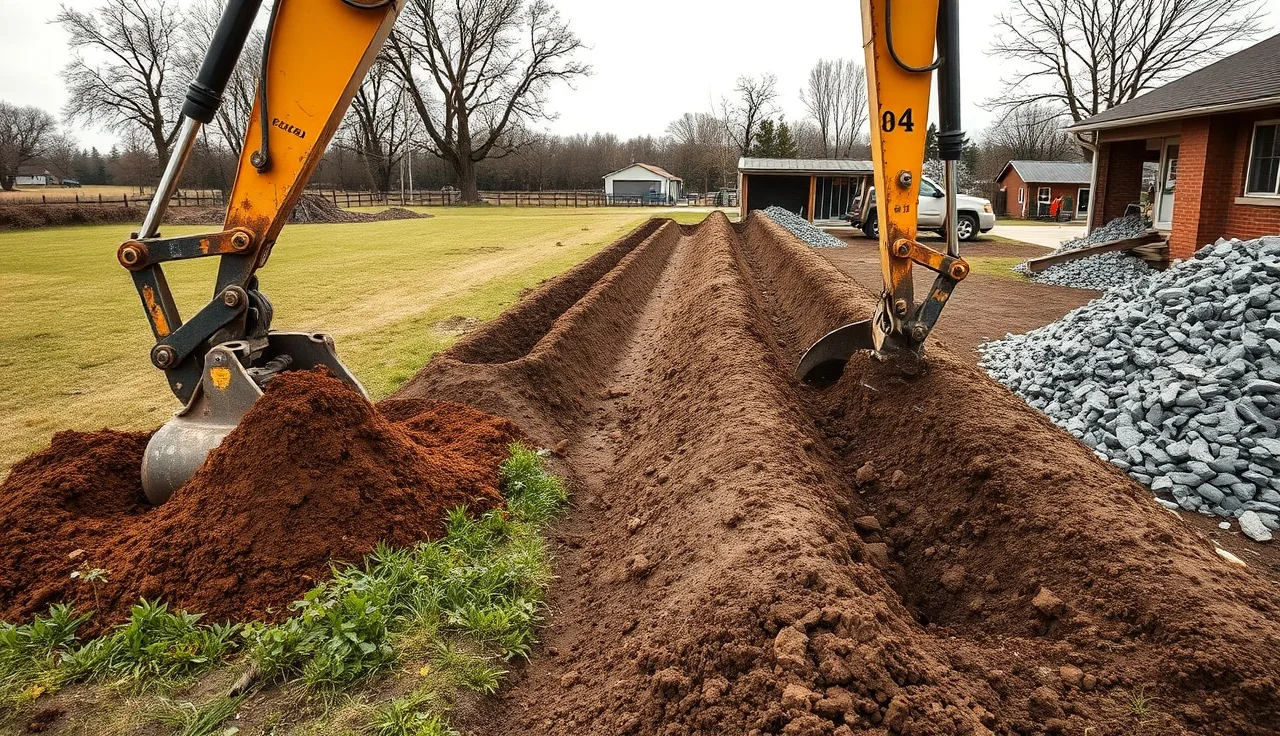
Typical trenches run 18 to 36 inches wide and 18 to 36 inches deep, depending on the design. Keep the trench bottom level side to side. Most codes allow a 2 to 4 inch drop per 100 feet of run (roughly 1/8 inch per foot) from the D-box toward the far end. Too much slope speeds flow and wrecks distribution. Rent a laser level. Worth it.
Step 3: Check the trench bottom.
Do not compact the trench bottom after digging. Walk it and look for smearing from the bucket, which glazes and seals the soil. If you see a shiny, smeared surface, scarify it with a rake or pick. Smearing tanks your infiltration rate.
Step 4: Install the drain rock base.
Pour 12 inches of washed drain rock into the trench. Level and rake it so the stone bed sits uniform.
Step 5: Set and level the distribution box.
Dig the D-box location. Set the box on a bed of compacted gravel. Check level in both directions. Run solid pipe from the tank outlet to the D-box inlet, with proper slope (1/8 to 1/4 inch per foot) from tank to box.
Step 6: Lay the perforated pipe.
Set perforated pipe on the gravel bed, holes facing down. Connect each lateral to a D-box outlet. Cap the downstream end of each one. Add inspection ports here if required or wanted.
Step 7: Cover the pipe with drain rock.
Pour 2 to 4 inches of drain rock over the pipe so stone surrounds it on all sides. Total stone depth from trench bottom to top of stone usually lands at 14 to 16 inches.
Step 8: Lay the filter fabric.
Roll geotextile fabric over the gravel the full length and width of the trench. Overlap seams by at least 12 inches. Careless contractors skip this, and missing fabric is one of the top reasons fields die early.
Step 9: Backfill.
Backfill with native soil, leaving a slight crown (2 to 3 inches above grade) for settling. Keep heavy equipment off the trenches during backfill. Compact gently in lifts.
Step 10: Final inspection and cover.
Call your inspector before and after each key step if your permit requires staged inspections. Nearly every jurisdiction wants an open-trench inspection before backfill. Get the final sign-off before you call it done, then seed the disturbed ground with grass to stop erosion.
What are the most common leach field installation mistakes?
An out-of-level distribution box is the biggest single mistake in this trade. A quarter-inch tilt can push 80% of the flow to one trench and almost nothing to the others. The loaded trench overloads early and fails. Fixing it after backfill costs real money.
Compacting or smearing the trench bottom is second. Any heavy machine sitting in the trench during digging can seal the native soil. Some installers actually drive a skid steer down the trench bottom to check it, which is exactly the wrong move.
Using the wrong gravel is next. Dirty stone, pea gravel, or crushed fines fill the void space fast and choke infiltration. Write "clean, washed crushed stone" on the order.
Not protecting the reserve area burns a lot of owners. Construction traffic, a garden, a shed, even mowing with a heavy tractor can compact that reserve until it fails a perc test right when you need it most. Mark it and protect it from day one.
Skipping inspection ports. You cannot diagnose a field without them. The roughly $30 per trench they cost is the best money in the project.
Too much slope in the laterals. If the design calls for level laterals and the crew adds 2% to speed things up, effluent runs to the far end and floods a small zone. Level, or close to it, spreads the load evenly.
When an install goes bad, the path forward usually starts with a septic system repair assessment.
How much does it cost to install a leach field?
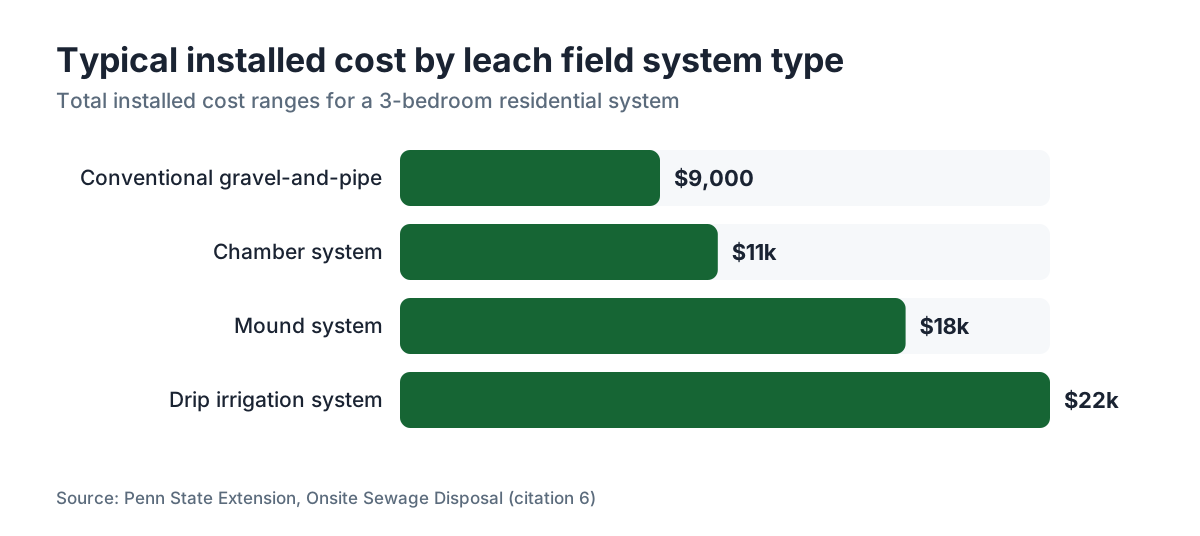
A conventional leach field runs $3,000 to $15,000 installed, and where you land depends on soil, system size, site access, and local labor. Based on contractor pricing and extension estimates, here are honest ranges [5][6]:
| Component | Typical cost range |
|---|---|
| Soil evaluation / perc test | $500 to $2,000 |
| Permit fees | $200 to $1,500 |
| Design (engineer or soil scientist) | $500 to $2,000 |
| Excavation and gravel (3-BR system) | $3,000 to $8,000 |
| Materials (pipe, D-box, fabric) | $1,000 to $3,000 |
| Installation labor | $2,000 to $6,000 |
| Total installed, conventional system | $3,000 to $15,000 |
Engineered systems cost more, sometimes a lot more. A mound system on marginal soil commonly runs $10,000 to $25,000, and a drip-irrigation system can hit $30,000 or beyond. Those numbers reflect the extra engineering, pumps, and controls those systems need [6].
The cost to install a septic system climbs if you are adding a new tank at the same time. Full breakdown is over there.
Pumping the existing tank before or during the work is often required. Septic tank pumping runs $300 to $600 and gives the installer a clean look at the outlet baffles and tank condition.
Can you install a leach field yourself (DIY)?
Technically yes, in some states. Practically, it is harder than most people expect, and getting it wrong is expensive.
States that allow owner-builder septic work include parts of Texas and some counties in Ohio, Missouri, and other rural states, but the exemptions are narrow. Usually it is your own primary residence only, not a rental or new construction for sale. Even where it is allowed, you still need the permit, the soil evaluation, and the inspections. You just do the physical labor.
Equipment is the first hurdle. Trenching 300 linear feet by hand is not realistic. You will rent a trencher or excavator, and running that machinery without experience near a D-box or live utilities is genuinely dangerous. Excavator rental runs $300 to $600 a day, and a trencher rental is $200 to $400 a day [5]. Then add the time to learn the machine safely.
The bigger risk is invisible. Get the D-box out of level or smear the trench bottom, and you will never see it once the trench is backfilled. Those mistakes cause failures that cost as much to fix as a full professional install would have cost in the first place.
My honest take. If you have real excavation experience and your state allows it, owner-builder makes sense on a simple, flat site with good soil. If the site has any wrinkle, the soil is marginal, or you have never run an excavator, hire a licensed installer. The savings almost never beat the risk.
How long does a leach field last and what shortens its life?
A well-built conventional leach field in good soil should last 20 to 30 years, sometimes more. The EPA notes that "a properly designed and normally operating septic system is odor-free and, besides periodic inspection and pumping of the septic tank, should last for decades" [1].
A few things cut that short in a hurry.
Infrequent tank pumping. When solids build up and spill into the field, they clog soil pores fast. This is the number one cause of early failure. The EPA recommends pumping every three to five years for a typical household [1]. See how often to pump a septic tank for the full breakdown.
Heavy water loading. Garbage disposals, a wall of laundry on one day, or a leaky toilet all push more water through the field than it was built for. Hydraulic overload saturates the soil and kills the aerobic bacteria that do the treating.
Driving or parking over the field. Compaction crushes the void structure and drops infiltration sharply. One incident with a heavy vehicle can leave lasting damage.
Deep-rooted trees or shrubs nearby. Roots hunt for moisture and will find perforated pipe. Keep trees at least 20 to 30 feet off the field edge.
Flushing junk. Wipes, medications, grease, and harsh chemicals kill the soil's microbial community. Once that community is knocked back, recovery is slow.
Operators who track service history and catch hydraulic overload patterns early can head off failures before a field dies. SepticMind's operations software gives service companies a way to flag systems with missed pump cycles and rising call frequency, both early warnings of a field headed for trouble.
What are alternative leach field systems for poor soil?
When your soil fails the perc test, or the water table sits too high for a conventional system, you have several engineered options. Each trades higher cost for the ability to work on ground a standard trench cannot.
Mound system. Effluent gets pumped up into an engineered mound of imported sand and gravel built above the native soil. The mound supplies the treatment depth the native soil lacks. Common across the Upper Midwest and in clay-heavy areas. Cost: $10,000 to $25,000 installed [6].
Chamber system. Plastic arch-shaped chambers replace the gravel-and-pipe trench. They create a bigger void for effluent storage and infiltration, install faster, and skip the gravel delivery. Infiltrator Water Technologies is a major manufacturer. Cost usually lands within 10 to 20% of a conventional gravel system [7].
Drip irrigation system. Effluent gets treated to a higher level (secondary or tertiary) and drip-emitted into shallow soil through small emitters. Works on sites too shallow for conventional trenches. Needs pumps, filters, controls, and a lot more maintenance. Cost: $15,000 to $30,000 or more [6].
Aerobic treatment units (ATUs). An ATU treats wastewater aerobically inside the tank before it hits the drain field, producing cleaner effluent that the soil handles more easily. Required in some states for certain marginal sites. ATUs need a service contract and electricity.
Constructed wetlands. Used in some rural and agricultural states as an alternative or add-on to a conventional field. Regulatory acceptance varies a lot by state.
If the existing system already failed and you are weighing replacement options, septic system repair covers how contractors diagnose the failure type before recommending a fix.
How do inspectors check a leach field installation?
Most county health departments require at least two inspections for a new leach field: an open-trench inspection before backfill, and a final inspection after backfill and seeding. Some add a third after the D-box is set and before laterals go in.
At the open-trench inspection, the inspector verifies:
- Trench dimensions match the approved design
- Trench bottom is not smeared or compacted
- Gravel depth meets code
- Pipe is perforated-down and at the correct elevation
- D-box is level (inspectors often bring their own level)
- Setback distances from wells, property lines, and structures are correct
Setback requirements swing hard by state. Common minimums are 50 to 100 feet from a potable well, 10 feet from property lines, 25 feet from a stream or surface water, and 15 feet from a building foundation. These are not universal, so check your local code [8].
At the final inspection, the inspector confirms the system is covered correctly, inspection ports are reachable, and the reserve area is marked and undisturbed. They may run water through the system to confirm gravity flow and watch for backflow to the tank.
A septic tank inspection of the existing tank often happens at the same time when this is a replacement field.
How do you maintain a leach field after installation?
The field itself needs almost no hands-on maintenance if you manage the tank right. The real work happens upstream, at the tank.
Pump the septic tank on schedule. For most three- to four-person households, that means every three to five years [1]. Run a garbage disposal? Pump closer to every two to three years. A pumped tank keeps solids out of the field, and solids carryover is the main cause of early failure.
Spread your water use out. One load of laundry a day beats six loads on Saturday. Stagger showers. Fix a leaky toilet right away. A running toilet can dump 50 to 200 gallons a day of cold, poorly treated water into your field.
Keep the area in grass and nothing else. Grass roots stay shallow and hold the soil without threatening pipe. Skip vegetable gardens (public health) and anything deep-rooted.
Skip the additives. The EPA does not recommend biological additives to boost a healthy system [1]. A working system already has all the bacteria it needs. Some products are harmless, others contain solvents that damage soil structure.
Check the inspection ports once a year. Drop a clean rod down each port and look for standing effluent near the surface. You should see liquid at the bottom of the port, not near the top. Liquid near the top means the field is taking on more than it can absorb, which points to a failing biomat, hydraulic overload, or a broken inlet pipe.
For a full pumping schedule and tank routine, see how often to pump a septic tank and septic tank cleaning.
Frequently asked questions
How deep should leach field trenches be?
Most state codes call for 18 to 36 inches of total trench depth, with the pipe set so there is at least 6 inches of native soil between the gravel and the seasonal high water table. The pipe sits on 12 inches of gravel, so the effective depth to the bottom of gravel is usually 24 to 30 inches. Check your specific state code, because minimums vary.
How far does a leach field need to be from a well?
Most state codes require at least 50 feet between a leach field and a potable water well, but many require 100 feet or more. New Hampshire requires 75 feet; Florida requires 75 feet. Always check your county or state onsite wastewater rules rather than a national average. The setback is measured from the nearest edge of the field to the well casing.
Can you install a leach field in clay soil?
Sometimes. Clay that percs between 31 and 60 minutes per inch can qualify for a conventional system with a larger absorption area. Clay over 60 MPI usually disqualifies a conventional trench, and you would need a mound system or another engineered alternative. A soil morphology evaluation by a licensed soil scientist tells you where you stand before you spend money on permits.
How long does it take to install a leach field?
The physical install of a conventional three-bedroom field usually takes one to two days with a two-person crew and an excavator. Add the permitting and soil testing timeline, which commonly runs four to ten weeks. If your county is backlogged or you need an engineering stamp, plan on three months from application to final inspection.
What slope should leach field pipes have?
Most codes require 2 to 4 inches of fall per 100 feet of pipe run, roughly 1/8 inch per foot. Some designers spec level laterals in systems with good distribution boxes. Too much slope (over 1/4 inch per foot) causes effluent to channel to the far end of the trench instead of spreading evenly along its length.
Can you add onto an existing leach field?
Yes, but it takes a new permit and a soil evaluation of the expansion area. Many older homes got undersized fields, and adding a bedroom or bathroom triggers a code requirement to bring the system up to current capacity. The expansion area has to pass the same percolation and soil profile requirements as the original field.
What type of pipe is used in a leach field?
Perforated 4-inch PVC pipe (Schedule 40 or SDR 35) is most common. Some codes also accept corrugated HDPE perforated pipe. The perforations face down in the trench so effluent drains into the gravel below the pipe before entering the soil. Solid pipe connects the tank to the distribution box and the box to each lateral.
How do you know when a leach field is failing?
Common signs are sewage odors in the yard, wet or spongy ground over the field, slow drains inside, and sewage backing up into fixtures. Lush, dark-green grass growing only over the field can also mean effluent is surfacing. A contractor confirms failure by checking effluent levels in inspection ports and running a dye test through the tank.
Can tree roots damage a new leach field?
Yes. Roots grow toward moisture and can enter perforated pipe joints or crush older pipe. Keep trees at least 20 to 30 feet from the nearest edge of the field, and aggressive-rooted hardwoods like willows, maples, and oaks even farther. Keep shrubs and deep-rooted ornamental grasses off the field area too.
Does a leach field need to be pumped or cleaned?
The field itself does not get pumped. The septic tank upstream does, usually every three to five years. When contractors say they are restoring a field, they mean treating the biomat layer with aeration, or resting one section while another carries the load. There is no routine pumping of the field trenches themselves.
What is the difference between a leach field and a drain field?
Nothing. They are the same thing. Regions just use different words: drain field is common in the Southeast, leach field in the Northeast and Midwest, and soil absorption system in regulatory documents. The EPA's technical guidance uses soil absorption system as the formal term but acknowledges all three names point to the same component.
How do you find a licensed septic installer?
Start with your county health department or state environmental agency, which often keep public lists of licensed onsite wastewater contractors. The National Onsite Wastewater Recycling Association (NOWRA) also has a member directory. Get at least three bids, ask each contractor for their license number and proof of insurance, and confirm they will pull the permit rather than pushing that job onto you.
Sources
- U.S. EPA, SepticSmart Program: EPA states local agencies must approve design and installation of new septic systems; recommends tank pumping every three to five years; does not recommend biological additives for healthy systems
- California Legislative Information, Health & Safety Code Section 116760 et seq.: California requires a licensed C-42 contractor for septic installation unless the owner-builder exemption applies
- Texas Commission on Environmental Quality (TCEQ), On-Site Sewage Facilities: Texas requires Installer I or Installer II license from TCEQ for septic system installation
- U.S. EPA, Onsite Wastewater Treatment Systems Manual (EPA/625/R-00/008): Most state codes require 1 to 60 MPI for conventional leach fields; site evaluation should include soil morphology, texture, structure, and consistency; daily flow estimated at 150 gpd per bedroom
- University of Minnesota Extension, Septic System Owner's Guide: Soil evaluation costs $500 to $2,000; material and equipment rental costs for owner-builder; excavator rental $300 to $600 per day
- Penn State Extension, Onsite Sewage Disposal: Mound systems cost $10,000 to $25,000 installed; drip irrigation systems $15,000 to $30,000 or more; total conventional system $3,000 to $15,000
- Infiltrator Water Technologies, Technical Resources: Chamber systems replace gravel-and-pipe trenches and are typically within 10 to 20% of conventional gravel system cost
- National Environmental Services Center (NESC) at West Virginia University, Septic System Fact Sheets: Setback requirements: 50 to 100 feet from potable wells, 10 feet from property lines, 25 feet from surface water are common minimums
- 811 (Common Ground Alliance), Dig Safe National Call Line: Call 811 at least 72 hours before digging to have underground utilities marked
- National Onsite Wastewater Recycling Association (NOWRA): NOWRA maintains a member directory of licensed onsite wastewater contractors
Last updated 2026-07-09