How much does it cost to put in a septic system in 2025
By the SepticMind Editorial Team
TL;DR
- A new septic system costs $3,000 to $15,000 for most homes, with a national average near $7,000 to $9,000.
- Conventional gravity systems run $3,000 to $7,000.
- Mound and aerobic systems push $10,000 to $20,000 or more.
- Soil conditions, tank size, local permits, and drainfield design drive most of the variation.
What does a new septic system cost in 2025?
The honest range is $3,000 on the low end for a basic concrete tank and simple gravity drainfield in good soil, up to $20,000 or beyond for an engineered system on a hard lot. Most homeowners putting in a conventional system land between $7,000 and $12,000 once you fold in permits, soil testing, and labor [1].
The spread is wide because the price rides almost entirely on your site. A sandy, flat lot with good percolation is cheap to build on. Dense clay, a high water table, a steep slope, or a lot sitting close to a well or a stream forces a more complex design that costs more to permit, engineer, and install.
The EPA's SepticSmart program puts it plainly: "proper installation and maintenance of your septic system protects your investment in your home," and costs vary by system type and local conditions [2]. That's a polite way of saying there's no single national price. Anyone who quotes you a number without seeing your soil test is guessing.
For a fast comparison of what different system types actually cost, see the table in the next section. If you only need a tank price and not the full system, the cost to put in a septic tank article breaks that out separately.
How do costs break down by septic system type?
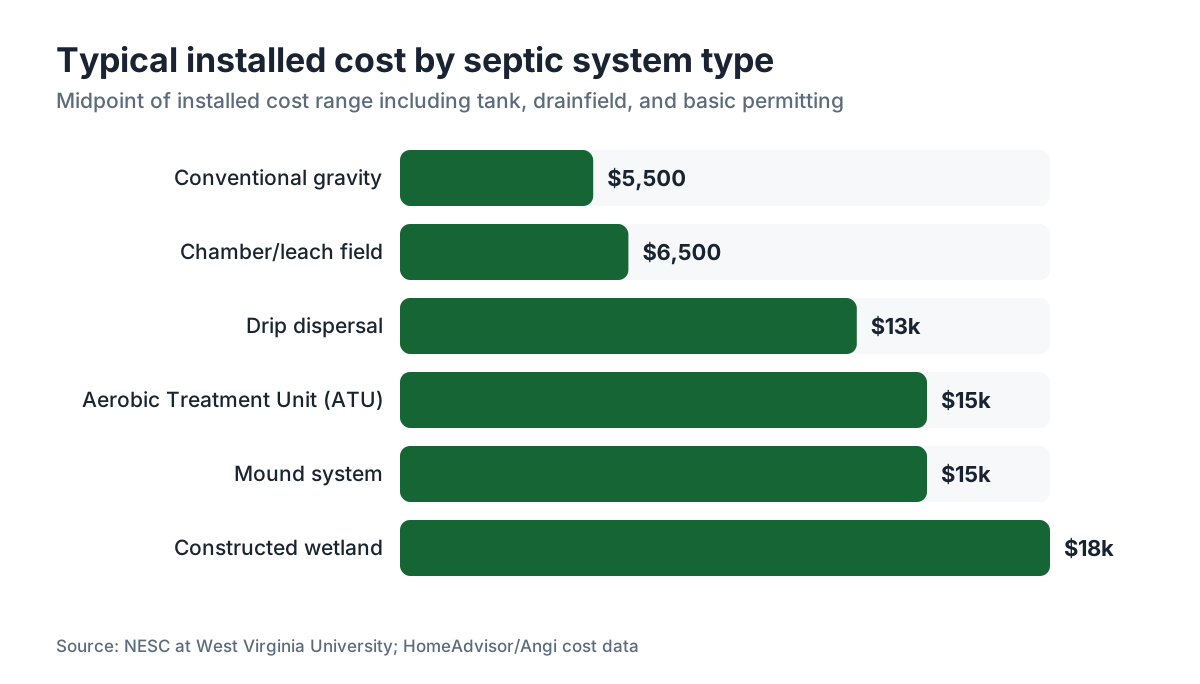
System type is the single biggest cost variable, more than tank size or even labor rates in most regions. Here's what each type usually costs installed, including tank, drainfield, and basic permitting:
| System Type | Typical Installed Cost | Notes |
|---|---|---|
| Conventional gravity | $3,500 to $7,500 | Best soil conditions, simple install |
| Chamber/leach field | $4,000 to $8,500 | Plastic chambers replace gravel |
| Mound system | $10,000 to $20,000 | Required for high water table or shallow soil |
| Aerobic Treatment Unit (ATU) | $10,000 to $20,000+ | Active aeration, requires service contract |
| Drip irrigation / drip dispersal | $8,000 to $18,000 | Pressurized, good for tight lots |
| Constructed wetland | $12,000 to $25,000 | Rare, high-regulation areas |
| Cesspool (replacement only) | $3,000 to $6,000 | Many states ban new cesspools [3] |
Conventional gravity systems still dominate new installs in rural areas with good soils. The design is simple: the tank settles solids, liquid effluent flows by gravity to a perforated-pipe drainfield, and soil microbes finish the treatment. The leach field does most of the actual treatment work, and it's where cost balloons if your soil profile is poor.
Mound systems add fill material above grade to build an artificial drainfield. That extra soil, plus the pump and pressure distribution system, roughly doubles the cost over a conventional system [4]. ATUs add mechanical aeration that treats effluent harder, but they need annual service contracts that run $100 to $300 per year on top of the install.
What does a septic system drainfield cost on its own?
The drainfield (also called a leach field) is roughly 30 to 50 percent of the total system cost on a conventional install. For a standard three-bedroom home, a new conventional drainfield runs $2,000 to $5,000. A mound drainfield runs $6,000 to $12,000 because of the engineered fill, pressure distribution lines, and pump chamber [4].
Drainfield cost scales with square footage of trench or bed, and that square footage is set by your state's minimum loading rates. Most state codes tie required drainfield size to the percolation rate of your soil and the estimated daily wastewater flow from your home. A one to four bedroom home might need 600 to 1,500 square feet of trench bottom depending on soil type and state rules [5].
Replacing just the drainfield on an existing system runs $3,000 to $10,000 depending on system type and site difficulty. Full septic system repair costs more if you're also dealing with a failed tank or crushed distribution lines.
Here's the part people miss. Drainfield failure is the most common reason a working system turns into a dead one. Overloading it with water (long showers, a leaky toilet, six loads of laundry in a day) is the top cause. The EPA estimates 25 percent of U.S. households rely on septic systems, and drainfield failure is the primary failure mode [10].
What other costs come with septic system installation?
The tank and drainfield are the big line items. They're not the whole bill. Here's what else shows up on a real invoice:
Soil and perc testing: $250 to $1,500 depending on the number of borings and whether you need a licensed soil scientist. Some states require a certified evaluator. Others let the installer do it [5].
Permits and inspections: $200 to $1,500 depending on the county. Some jurisdictions charge flat fees. Others charge per bedroom or by system type. Budget $400 to $800 for a typical rural county permit.
Engineering and design: Required for alternative systems and most mound systems. A licensed engineer or sanitarian drawing up a site plan runs $500 to $2,000 [1].
Site prep and excavation: Clearing vegetation, grading, and digging trenches adds $500 to $3,000. Rocky or wet sites cost more. If blasting is needed, add $2,000 to $5,000.
Pump and pump chamber: Pressure-dosed systems, mound systems, and any system pushing effluent uphill need a pump chamber and effluent pump. That adds $500 to $2,000 to the project.
Electrical: A pump needs a dedicated circuit and usually an alarm. Expect $300 to $800 for the electrical run and panel work.
Riser installation: If the tank lids sit below grade (they often do), concrete or polyethylene risers cost $100 to $400 each and make future pumping much easier. Worth it.
Add those line items up on a mound system and you're easily at $18,000 to $22,000 before any surprises. On a simple gravity system in good soil, you might get out at $5,000 to $7,000.
What factors make septic installation more expensive?
Soil is the biggest single driver. A percolation rate faster than 60 minutes per inch, or slower than 1 minute per inch, usually disqualifies standard drainfield designs under most state codes and forces an alternative system [5]. That's an immediate cost multiplier of 1.5 to 3 times a conventional install.
Lot constraints add up fast. Setback rules from wells, property lines, wetlands, surface water, and structures can squeeze where a drainfield can go, sometimes forcing a smaller, more heavily engineered system. Most states require 50 to 100 feet of separation between a septic system and a well [3].
Bedroom count matters. State sizing formulas assume roughly 75 to 150 gallons of wastewater per bedroom per day. A five-bedroom house needs a bigger tank and a longer drainfield than a two-bedroom cottage.
Remoteness drives up labor. A contractor hauling a 1,500-gallon concrete tank 90 minutes down a dirt road charges for that trip. Rural areas with few installers also tend to carry higher margins.
Existing system removal costs extra. If you're replacing an old system, demo and disposal of the old tank (especially a steel one) adds $500 to $2,000.
State rules are real cost drivers. Some states require specific system types in certain soil conditions or wellhead protection zones. Florida's Department of Health, for example, sets minimum setbacks and system types by soil profile that can force ATU installs even on lots that would otherwise take a conventional system [3].
How much does it cost to put in a septic system by state or region?
Labor costs, permit fees, and required system types swing enough by region that the same house on the same soil can cost 40 percent more in New England than in the rural Midwest. Even so, the biggest cost gaps come from soil and regulation, not geography.
Some rough regional patterns:
Southeast (FL, GA, SC): $6,000 to $15,000. Sandy coastal soils are often fast-perc, which can force advanced treatment near surface water. Florida requires ATUs in many areas close to water bodies [3].
Midwest (OH, IN, MO): $5,000 to $10,000 for conventional. Heavy clay soils push costs up. Ohio's environmental agency has specific requirements for alternative systems on low-permeability soils.
Northeast (MA, NY, NH): $8,000 to $20,000. High lot prices, strict Title 5 or equivalent codes in Massachusetts, and shallow bedrock across much of New Hampshire drive costs up. Massachusetts Title 5 requires a licensed inspector and specific setbacks [7].
Mountain West (CO, ID, MT): $6,000 to $14,000. Rocky sites, hard excavation, and long contractor travel add cost.
Southwest (TX, AZ, NM): $5,000 to $12,000. Texas regulates septic systems through TCEQ with county oversight, so costs move with county permit fees [8].
None of these ranges are precise. They're directional. The only way to get a real number is three competitive bids from local licensed installers after a soil evaluation.
Can you finance or get help paying for a new septic system?
Yes, and more options exist than most homeowners know about.
USDA Rural Development loans and grants: The USDA's Rural Development program offers Section 504 Home Repair loans and grants for very low-income rural homeowners. Septic installation qualifies. Grants go up to $10,000 for homeowners age 62 and older who can't repay a loan [9].
State revolving funds: Many states run Clean Water State Revolving Funds that loan money at below-market rates for septic repairs and replacements. Contact your state's environmental or health agency.
County programs: Some counties with documented water quality problems from failing septic systems run cost-share programs, mostly in Chesapeake Bay states and states near sensitive water bodies. USDA has also funded county-level work through its Environmental Quality Incentives Program.
Home improvement loans and HELOCs: Straightforward if you have equity. Interest may be deductible if the work qualifies as a home improvement.
FHA Title I loans: FHA-insured loans for home improvements, including septic, up to $25,000 for single-family homes without requiring equity.
SepticMind's homeowner tools track permit timelines and maintenance schedules once your system is in, which helps if you're running a financed project across several contractors.
The USDA program is underused. Plenty of rural homeowners with genuinely failing systems qualify for grants they've never heard of [9].
Is it cheaper to repair or replace a failing septic system?
It depends on what's failing. Tank repair, covered in septic tank repair, is often under $1,500 for cracks, broken baffles, or a bad lid. Full tank replacement runs $1,500 to $4,000. But if the drainfield is failed (biomat buildup, hydraulic overload, sewage surfacing on the ground), repair options are thin and replacement is often the only real fix.
A failed drainfield can sometimes be rested and partly rehabbed by diverting flow to an alternate field while the primary field dries out. Some installers try aeration or biological additives on borderline fields. The evidence on those additives is mixed, and I'd be skeptical of expensive proprietary treatments before checking whether a mechanical fix exists.
Full system replacement runs $7,000 to $15,000 for most homes. If your tank is still solid and the problem is the drainfield, you might get away with a drainfield replacement at $3,000 to $8,000. Get the tank inspected (see septic tank inspection for what that involves) before you assume you need to replace everything.
The math usually favors repair when the tank is intact and under 20 years old. If the tank is older than 30 years, made of steel (which corrodes), or actively collapsing, replacement beats patching.
What are the ongoing costs after a septic system is installed?
Installation is a one-time cost. The system carries a long tail of operating costs worth planning for.
Pumping: A conventional tank needs pumping every 3 to 5 years. Cost runs $250 to $600 depending on tank size and access. See how often to pump septic tank for the full breakdown. Skipping pumping is the fastest way to kill a drainfield. Septic tank pumping is the single best maintenance dollar you'll spend.
ATU service contracts: Aerobic systems need annual or semi-annual service by a licensed technician. Most contracts run $100 to $300 per year, and many states require them as a condition of the permit [3].
Inspections: A professional inspection costs $100 to $300. Some states require inspections on a fixed schedule. Massachusetts Title 5 requires inspection at point of sale [7].
Effluent filters: Most modern systems have an effluent filter at the tank outlet that needs cleaning every 1 to 3 years. Cleaning runs $50 to $150 if a pro does it, or nothing if you do it yourself.
Drainfield replacement: The most expensive item on this list. A conventional drainfield lasts 20 to 30 years if maintained. A failed one costs $3,000 to $10,000 to replace.
Over a 25-year horizon, a conventional system might cost $12,000 to $18,000 in maintenance and pumping on top of the install. An ATU adds another $2,500 to $7,500 in service contracts over the same window. These aren't trivial numbers.
How do you find and vet a septic system installer?
Licensing rules vary by state. Most states require installers to hold a specific onsite wastewater license, separate from a general contractor license. Your state's environmental or health agency keeps a list of licensed installers. Start there [5].
Get three bids minimum. Each bid should include a site evaluation, a proposed system design, permit fees (or a note about who pulls permits), and a full materials list. A bid that doesn't spell out tank size, drainfield square footage, and pipe material is incomplete.
Check who pulls the permit. A reputable installer almost always pulls their own. If they ask you to pull it yourself, that's a yellow flag.
Ask about the inspection process. Most jurisdictions require a final inspection before backfilling. You want documentation of that passing inspection. It protects you if you sell the home or hit a warranty dispute later.
For operators running several install projects or service routes at once, SepticMind's operations platform handles scheduling, documentation, and permit tracking across jobs without manual spreadsheets.
Don't let price be the only filter. The cheapest installer who cuts corners on drainfield depth or skips the gravel bedding will cost you far more in the next decade.
What permits and inspections does a new septic system require?
Every state requires a permit for new septic installation. The process usually runs through a site evaluation (perc test plus soil boring), a system design reviewed by the local health or environmental department, a construction permit, and a final inspection before the system is covered.
Timelines range from two weeks to six months depending on the jurisdiction. Some counties are understaffed and slow. Others have streamlined online permitting. Rural counties generally take longer than suburban ones because they process fewer applications with smaller health department staffs.
Some states require a second inspection mid-installation, typically after the tank is set and the trenches are dug but before any gravel or fill goes in. That lets the inspector verify trench dimensions and depth.
Skip the permit at your peril. Beyond the legal risk (fines of $500 to $10,000 in many states), an unpermitted system is a serious problem at sale. Most real estate transactions require disclosure of septic status, and a buyer's septic tank inspection often reveals whether the system was permitted and inspected.
The EPA's SepticSmart program recommends checking with your local health department before any septic work, and notes that improper installation can contaminate groundwater and create public health hazards [2].
Frequently asked questions
How much does it cost to put in a septic system for a 3-bedroom house?
For a three-bedroom house, expect $6,000 to $12,000 for a conventional gravity system in good soil. That covers a 1,000 to 1,250-gallon tank, a drainfield sized to roughly 600 to 900 square feet of trench bottom, permits, and labor. Poor soil or a high water table pushes costs to $12,000 to $20,000 for a mound or ATU system.
What is the cheapest type of septic system?
A conventional gravity-fed system with a concrete tank and perforated-pipe drainfield in gravel is the least expensive option, typically $3,500 to $7,500 installed. You can only use it where soil percolation is suitable, usually a rate of 1 to 60 minutes per inch and no seasonal high water table within a few feet of the trench bottom.
Does the septic system price include the drainfield?
It should, but verify with your installer. A complete system quote includes tank, distribution box, drainfield (labor and materials), permits, and site prep. Some contractors quote the tank and labor separately from materials. Always ask for an itemized bid that breaks out tank cost, drainfield cost, permit fees, and excavation.
How long does it take to install a septic system?
The physical install takes one to three days for a conventional system and two to five days for a mound or ATU. Permitting is the longer part. From application to approved permit can take two weeks to three months depending on the county. Total time from decision to working system is often six to twelve weeks.
Does homeowners insurance cover septic system installation or replacement?
Standard homeowners policies exclude wear-and-tear septic failures, which is most of them. Some policies cover sudden and accidental damage, like a tree root collapse or a vehicle crushing the tank. Dedicated septic or home warranty riders exist but are often expensive relative to their coverage. Read the exclusions carefully before paying for a rider.
How much does a septic system drainfield cost to replace?
Replacing just the drainfield on an existing system typically costs $3,000 to $8,000 for a conventional leach field and $6,000 to $15,000 for a mound drainfield. Cost depends on square footage required, soil conditions, and whether a pump and pressure distribution system are needed. If the tank still works, you may not need to replace it.
Can I install a septic system myself to save money?
Most states prohibit homeowners from installing their own septic systems without a licensed installer involved. Some states allow owner-builders to do their own work but still require a licensed designer and all the same inspections. Even where it's legal, the DIY risk is real: improper depth, wrong gravel sizing, or a missed inspection step can cause early failure, fines, and a costly redo.
How does lot size affect the cost of a septic system?
Lot size matters mainly as a constraint, not a direct cost driver. A larger lot usually gives you more flexibility in drainfield placement, which can lower cost by allowing a simpler design. A small lot may force a more engineered system with a smaller footprint but higher cost per square foot. Setbacks from property lines, wells, and water can constrain even a large lot.
Are there grants or loans to help pay for septic installation?
Yes. USDA Rural Development's Section 504 program offers repair grants up to $10,000 for rural homeowners age 62 and older who can't afford a loan. Low-interest loans are available for others who qualify. Many states also run Clean Water State Revolving Fund loan programs. Contact your county health department or USDA Rural Development office to find what's available locally.
What's the difference between a septic system and a cesspool?
A conventional septic system treats wastewater in a tank, then disperses liquid effluent to a drainfield for soil treatment. A cesspool is just a pit that collects raw sewage and lets it seep out untreated. Most states banned new cesspool construction decades ago, and many now require cesspool replacements over groundwater contamination risk. New York, for example, mandates cesspool upgrades under state law.
How much does a mound septic system cost compared to a conventional system?
A mound system costs roughly twice as much as a conventional system for the same house. Where a conventional install might run $6,000 to $9,000, a mound system on the same lot with high water table or poor soil runs $12,000 to $20,000. The extra comes from engineered fill, a pump chamber, pressure distribution lines, and more complex permitting.
Does a new septic system add value to a home?
A functioning, recently installed septic system is generally priced into the home value rather than adding a premium, but a failing system is a major detractor. Homes with documented failing systems sell for significantly less or require escrow holds. A new system removes a liability rather than creating an asset. Rural buyers treat a working, permitted septic system as a basic expectation.
How often does a septic system need to be pumped after installation?
Most residential tanks need pumping every 3 to 5 years. The EPA and most state health agencies recommend that interval for a standard household. Smaller tanks, more occupants, or a garbage disposal shortens it. Pumping cost runs $250 to $600 depending on tank size and access. Skipping pumping lets sludge build up and migrate to the drainfield, which causes expensive failure.
What happens if you install a septic system without a permit?
Fines are common, from $500 to $10,000 depending on the state and whether contamination occurred. You may be ordered to remove and replace the system at your cost, with inspections this time. An unpermitted system also causes serious problems at sale: it may need to be brought up to code before closing, and some lenders won't approve mortgages on homes with unpermitted septic systems.
Sources
- HomeAdvisor / Angi, Septic System Installation Cost Guide: National average septic system installation cost $7,000 to $12,000 including tank, drainfield, and permits
- U.S. EPA, SepticSmart Program: Proper installation and maintenance protects home investment and prevents groundwater contamination; costs vary by system type and local conditions
- Florida Department of Health, Onsite Sewage Program: Florida requires ATUs in certain zones near water bodies and specifies setback distances from wells and surface water
- University of Minnesota Extension, Mound Septic Systems: Mound systems cost roughly twice as much as conventional systems due to engineered fill, pump chambers, and pressure distribution requirements
- National Environmental Services Center (NESC) at West Virginia University, Onsite Wastewater Treatment: Drainfield sizing is set by state minimum loading rates based on soil percolation rates and estimated daily wastewater flow; percolation rates outside 1 to 60 minutes per inch often require alternative systems
- Massachusetts Department of Environmental Protection, Title 5 Program: Massachusetts Title 5 requires licensed inspectors and mandates inspection at point of sale; specific setbacks and system requirements apply
- Texas Commission on Environmental Quality (TCEQ), On-Site Sewage Facilities: Texas regulates septic systems through TCEQ with county-level oversight; permit costs vary by county
- USDA Rural Development, Single Family Housing Repair Loans and Grants (Section 504): USDA Section 504 grants up to $10,000 available for rural homeowners age 62 and older who cannot repay a loan; septic installation qualifies
- U.S. EPA, How Your Septic System Works: Drainfield failure is the primary septic system failure mode; overloading with excess water is the top cause; about 25 percent of U.S. households use septic systems
- New York State Department of Environmental Conservation: New York state law mandates cesspool upgrades to modern septic systems on a phased schedule due to groundwater contamination concerns
Last updated 2026-07-09