How to put in a septic drain field: a complete installation guide
By the SepticMind Editorial Team
TL;DR
- Installing a septic drain field means running perforated pipe through gravel-filled trenches so clarified wastewater from your tank can filter safely into the soil.
- The job needs a soil perc test, a county permit, and a licensed installer in most states.
- Expect to pay $3,000 to $15,000 depending on your soil, lot access, and system size.
What is a septic drain field and how does it work?
A septic drain field (also called a leach field or absorption field) is the last treatment stage of a conventional septic system. Wastewater flows from your home into the tank, where solids settle and anaerobic bacteria break them down. The clarified liquid then travels out to the field through a distribution box or manifold, spreads through perforated pipes buried in gravel trenches, and slowly soaks down into the soil. That soil does the real work. Billions of microbes in the top 18 to 24 inches of native soil digest pathogens and nutrients before the water reaches groundwater.
The EPA's SepticSmart program describes a conventional system as "a buried, watertight container made of concrete, fiberglass, or polyethylene" connected to "a shallow, uncovered excavation made in unsaturated soil" [1]. That second part is your drain field. Without it, the tank is just a holding tank, not a treatment system.
Soil type decides everything. Sandy soil drains too fast and treats too little. Clay drains too slowly and the field drowns. A loamy sand or silty loam with a percolation rate between 1 and 60 minutes per inch is the range most state codes target [2]. You find that out through a perc test before you ever break ground.
For more on what goes in ahead of the field, see our guide on septic tank installation.
Do you need a permit and a licensed installer to install a drain field?
Yes, in nearly every U.S. jurisdiction. All 50 states regulate onsite wastewater systems, and most require both a site evaluation permit (covering the perc test and soil assessment) and a construction permit before any digging starts. Many states also require the work to be done by a licensed septic installer or licensed contractor. Homeowner self-installation is legal in only a handful of rural counties, and usually only on the owner's own primary residence [3].
Penalties for skipping the permit are steep. Counties can order you to excavate and remove an unapproved field at your own expense, and some states can fine you $1,000 or more per day. There's a resale problem too. Real estate deals routinely require septic disclosure, and a buyer's lender often wants a passing septic tank inspection before closing.
The permit process usually runs like this. You or your installer applies to the county health department or environmental agency. A soil scientist or sanitarian visits to conduct or witness the perc test. They approve a system design, you pull the construction permit, and an inspector signs off on the installed field before you cover the trenches.
Do not backfill until the inspector signs off. That one mistake forces more homeowners to re-excavate than anything else on this list.
The EPA tells homeowners to "contact your local health department" to find the exact requirements in your area [1].
What soil tests do you need before installing a septic drain field?
Two tests decide whether your site can support a drain field and how big it has to be: the percolation test and the soil morphology evaluation.
Percolation test. A perc test measures how fast water moves through your soil. The installer or a licensed soil evaluator digs several test holes (typically 6 to 12 inches wide and 24 to 36 inches deep), pre-soaks them with water the day before, then times how many minutes it takes the water to drop one inch. Most codes express the result as MPI (minutes per inch). Faster than 1 MPI usually means the soil is too coarse for real treatment. Slower than 60 MPI (some states say 120 MPI) means the soil is too tight and a conventional field won't work [2].
Soil morphology evaluation. A licensed soil scientist or sanitarian examines the soil profile in a test pit, typically 48 to 60 inches deep. They read soil color, texture, and structure to find the seasonal high water table (marked by gray mottling), restrictive layers like hardpan or bedrock, and the depth of usable soil. Most states require at least 24 inches of suitable soil above a limiting layer and at least 24 inches (often more) between the trench bottom and the seasonal high water table [7].
A failed perc test or too little vertical separation doesn't end the project. Mound systems, aerobic treatment units (ATUs), and drip irrigation fields are built for tough soils. They cost more, but they work where a conventional field can't go.
How do you size a septic drain field correctly?
Field size comes down to two numbers: how much wastewater your home makes each day, and how fast your soil absorbs it.
Daily flow gets estimated from bedroom count, not from your actual water bill. Most codes use 75 to 100 gallons per bedroom per day as the design flow, so a three-bedroom house is designed for 225 to 300 gallons per day [3]. Some codes make you use fixture counts or square footage instead, so check your local rules.
With the design flow and the perc rate in hand, you calculate the absorption area. The formula is:
Required area (sq ft) = Design flow (gpd) / Loading rate (gpd/sq ft)
The loading rate comes from a table in your state's code that converts perc rate to an allowable application rate. A soil with a 30 MPI perc rate might carry an allowable loading rate of 0.4 gpd/sq ft, so a 300 gpd system needs 750 square feet of trench bottom area [2].
Trench dimensions follow from there. Trenches run 18 to 36 inches wide and 18 to 36 inches deep, and the usable bottom area is the width times the length. At 3-foot-wide trenches, 750 square feet of bottom means 250 linear feet of trench. That gets split into individual runs, usually 50 to 100 feet long at most, so effluent distributes evenly. Codes typically want at least 6 feet of undisturbed soil between trenches (measured center to center in many states).
Here's a rough rule of thumb: a three-bedroom house on average soil needs 300 to 500 linear feet of trench. Do not build off that number. Your real perc rate, your state's loading tables, and your inspector's sign-off are what count.
What materials do you need to install a septic drain field?
Here's what a conventional gravity-fed drain field takes.
| Material | Typical spec | Notes |
|---|---|---|
| Perforated pipe | 4" diameter PVC or HDPE, ASTM D2729 or F810 | Holes face down in some codes, up in others; confirm locally |
| Distribution box (D-box) | Concrete or PVC, sized to your trench count | Splits flow evenly |
| Drain field gravel | Clean, washed, 3/4" to 2.5" crushed stone | No fines; often called "septic stone" |
| Geotextile filter fabric | Non-woven polypropylene | Laid over gravel before backfill to keep soil out |
| Inspection ports | 4" capped riser at end of each trench | Required by many state codes |
| End caps | 4" PVC caps | Closes end of each lateral |
| Fittings | Tees, elbows, couplers | For the distribution manifold |
For the gravel layer: most codes call for at least 6 inches of stone below the pipe and 2 inches above it. The pipe sits on a level bed so effluent spreads across the whole trench length before it soaks down.
Chamber systems (plastic arch chambers like Infiltrator and similar brands) replace gravel and pipe. Materials cost about the same, but you skip the gravel hauling, which is a big deal on sites with hard access. Many county codes approve chamber systems. Check your local list before you spec one.
How do you actually install a septic drain field, step by step?
This is the build sequence for a conventional gravity-fed field, after permits are in hand and the design is approved.
Step 1: Stake the layout. Mark trench centerlines with stakes and string. Confirm setbacks. Most states want trenches at least 10 feet from property lines, 50 to 100 feet from wells, 10 feet from structures, and a set distance from streams, wetlands, and steep slopes [3]. Your approved design carries these numbers.
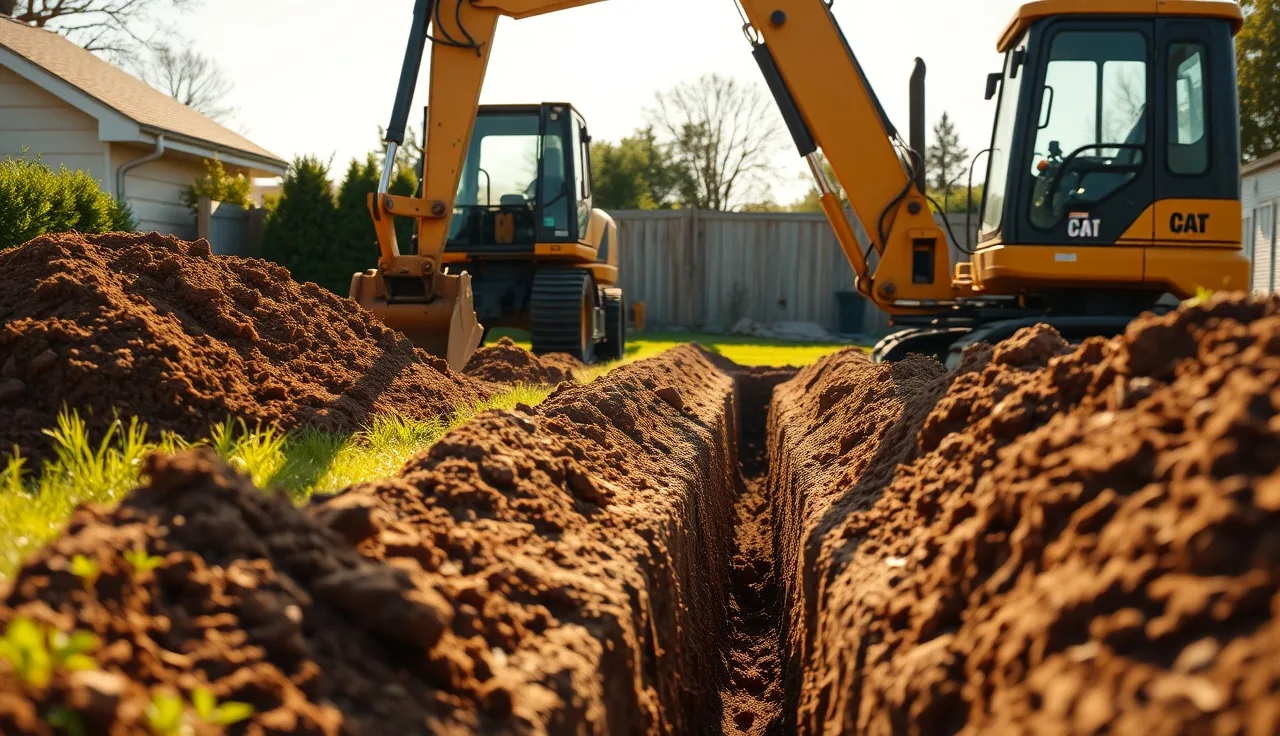
Step 2: Excavate trenches. Use a backhoe or trencher. Dig to the design depth, usually 24 to 36 inches. Keep the walls clean and vertical, because loose walls slough gravel and wreck the geometry. Do not dig during or right after heavy rain. Wet soil walls smear and seal ("glaze") the absorption surface, and that damage is permanent.
Step 3: Lay and level the gravel bed. Place at least 6 inches of clean septic stone in the trench bottom. Check for level along the run. Some codes allow a slight fall (2 inches per 100 feet maximum) toward the end; many want it dead level. Rent a laser level.
Step 4: Install the distribution box. Set the D-box on a compacted gravel pad between the tank outlet and the trench headers. The outlet pipes must sit at the same elevation so each trench gets equal flow. Adjustable baffles or leveling inserts help when the ground isn't perfectly flat.
Step 5: Lay the perforated pipe. Run pipe from the D-box headers through each trench, holes oriented per your local code. Hold the specified slope or level. Connect with approved fittings. Put an inspection port (capped riser) at the end of each trench line. Inspectors often want these to confirm effluent isn't backing up.
Step 6: Add gravel cover. Place at least 2 inches of clean stone over the pipe. Total gravel depth from trench bottom to top of stone runs 10 to 18 inches.
Step 7: Lay filter fabric. Unroll geotextile fabric over the gravel across the full trench width. It stops soil from migrating down into the stone over time. Don't skip it. It's cheap insurance against an early failure.
Step 8: Get inspected. Call for inspection before you backfill. Seriously. Backfilling first is the mistake that triggers mandatory re-excavation.
Step 9: Backfill and grade. Once you're approved, backfill with native soil to slightly above grade to allow for settling. Compact lightly by hand or with a plate compactor on a low setting. Heavy equipment over the field crushes pipe and compacts the soil.
Step 10: Establish a cover crop. Plant grass or shallow-rooted ground cover right away. Grass roots move water through evapotranspiration and hold the soil against erosion. Never plant trees or shrubs over the field. Roots destroy pipe.
Most professional installs on average ground take 2 to 4 days of field work once permits and materials are ready.
What does it cost to install a septic drain field?
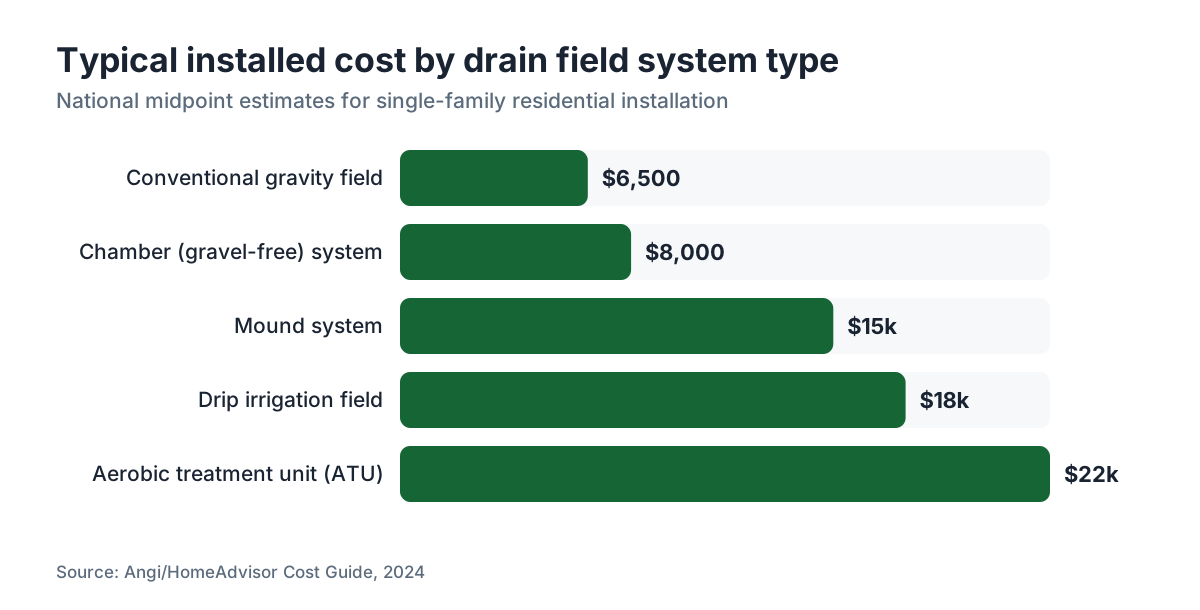
National cost data is thin and varies by state, but contractor quotes and industry reporting put a new conventional drain field at $3,000 to $15,000 for most single-family homes [4]. The spread comes from soil conditions, trench depth, rock removal, site access, and local labor rates.
| System type | Typical installed cost range | Why it varies |
|---|---|---|
| Conventional gravity field | $3,000 to $10,000 | Flat, accessible lot; good soil |
| Chamber system (gravel-free) | $4,000 to $12,000 | Higher material cost, lower gravel hauling |
| Mound system | $10,000 to $20,000 | Needed for shallow water tables or poor perc |
| Aerobic treatment unit (ATU) | $15,000 to $30,000 | Failing perc test; makes higher-quality effluent |
| Drip irrigation field | $10,000 to $25,000 | Poor soil or tight lot; pressure-dosed |
Permit fees usually run $200 to $1,500 depending on the county. Perc testing costs $150 to $500. Engineering or soil scientist fees for the design add another $500 to $2,500 on complex sites.
Replacing a failed field costs about the same as a new one, sometimes more, because the old material has to be dug out and hauled off. See our article on cost to install a septic system for a fuller breakdown that includes the tank.
For what just the tank runs, our cost to put in a septic tank article breaks that out on its own.
What mistakes cause drain field failures during or after installation?
Most drain field failures trace back to a short list of avoidable errors.
Soil compaction during construction. Running heavy equipment over the field area, before or after installation, squeezes the soil and cuts its permeability. Keep equipment on the trench lines only. If the site is wet, wait.
Installing in wet conditions. Digging saturated soil smears the trench walls and kills absorption capacity for good. Many state codes ban installation when soil is at or above field capacity. This isn't a permit technicality. It's physics.
Wrong gravel. Stone that hasn't been washed carries fines (sand and silt) that clog the void space. Always spec clean, washed crushed stone that meets your state's gradation.
An uneven distribution box. If the D-box outlets aren't level, one or two trenches take most of the flow while the rest sit dry. The overloaded trenches fail. The dry ones are wasted capacity. Set the D-box precisely.
No filter fabric. Soil migration into the gravel is slow and relentless. Within a few years, fines fill the void space and the field's ability to move water drops. Filter fabric adds maybe $200 to the job and buys years of field life.
Biomat overload from an undersized or unpumped tank. Even a perfect field fails if it gets poorly treated effluent. Grease and solids that should settle in the tank clog the trench bottom instead. Septic tank pumping every 3 to 5 years is what stops this. The EPA's SepticSmart program calls "having your system inspected and pumped regularly" the most effective step a homeowner can take [1].
Operators running multiple client sites can use SepticMind's scheduling tools to track pump-out intervals and flag overdue accounts, which protects the drain fields those clients spent thousands to install.
Tree roots. Roots from willows, poplars, silver maples, and other aggressive species can invade perforated pipe within 5 to 10 years. Keep the field clear of anything bigger than grass.
How long does a septic drain field last?
A well-built, well-maintained conventional drain field lasts 20 to 30 years. Some run 40 or more. Fields die early almost only from one of three causes: construction defects, soil overloading from a neglected tank, or physical damage.
The EPA notes that "most septic systems fail because of inappropriate design or poor maintenance" [6]. The design part is locked in at installation. The maintenance part is on you.
The biggest longevity lever you control after installation is how often you pump the tank. A three-bedroom household with average water use should pump every 3 to 5 years. The exact interval depends on household size and tank volume. See our article on how often to pump a septic tank for a detailed table.
You also control what goes down the drain. Fats, oils, grease, non-biodegradable wipes (even ones labeled "flushable"), and heavy garbage disposal use all shorten field life by loading the tank with solids and building biomat in the trenches.
Water conservation helps a lot. Spreading laundry across several days instead of ten loads on Saturday keeps a hydraulic surge from pushing partly treated effluent into the field.
Can you install a drain field yourself, or should you hire a contractor?
Some states allow homeowner installation on owner-occupied property. Realistically, you need a backhoe or track trencher, a laser level, the ability to read a perc test and turn it into trench geometry, and the skill to pass an inspection. If you've run heavy equipment and done excavation before, it's a learnable job on a simple site. If you haven't, a failed inspection, a re-excavation order, or a field that quits in five years wipes out any labor savings.
Get three quotes from licensed installers no matter what. Prices swing 30 to 50 percent between contractors in the same market. Ask each one how they set the distribution box and whether they use filter fabric as standard practice. The answers tell you a lot about quality.
For complex sites (high water tables, rocky soil, tight setbacks, alternative system requirements) hire a licensed professional every time. These aren't jobs where guessing goes well.
If your field is failing rather than being newly installed, read our septic system repair guide before you decide between a repair and a full replacement.
What are the setback requirements for a drain field?
Setbacks are the minimum distances your drain field has to keep from certain features. They vary by state and county, but these ranges cover most U.S. jurisdictions [3].
| Feature | Typical minimum setback |
|---|---|
| Private water well (existing) | 50 to 100 feet |
| Private water well (new) | 100 to 150 feet |
| Public water supply | 100 to 200 feet |
| Streams, lakes, wetlands | 25 to 100 feet |
| Property line | 5 to 25 feet |
| Buildings and foundations | 5 to 20 feet |
| Swimming pools | 15 to 25 feet |
| Driveways and parking areas | 5 to 15 feet |
These are floors, not ceilings. Your county health department or state onsite wastewater code has the exact numbers for your jurisdiction. The National Environmental Services Center at West Virginia University keeps a state-by-state summary of onsite wastewater regulations [5].
Small lots are where setbacks kill projects. If your lot can't meet setbacks with a conventional field, an alternative system with a smaller footprint (a drip field or a mound with a smaller absorption area) may be your only path.
Check for easements, buried utilities, and soil disturbance limits before you lock in the layout. Call 811, the national "call before you dig" number, at least a few business days before excavation [8]. It's legally required in every state.
How do you maintain a newly installed drain field?
The first year after installation matters more than most homeowners think. Soil settlement around the trenches, new biomat forming, and ground cover taking hold all happen in that window.
Year one checklist:
- Seed and establish grass within two weeks of backfilling. Keep foot traffic off the field through the first growing season if you can.
- Watch for wet spots or lush growth over the trenches after the first few months. Those are early signs of hydraulic overloading or surface breakout.
- Keep vehicles and heavy equipment off the field for good.
- Do your first post-installation tank inspection 12 months after startup. Some fields settle more than expected, and checking the distribution box and the first few inches of trench pipe is cheap compared to catching a problem late.
Long-term, the plan is simple: pump the tank on schedule, conserve water, and keep the field surface clear of anything that could disturb the soil or send roots down. A field in good shape has a flat grassy surface, no odor, no wet areas, and no plants growing faster than the surrounding grass.
If you notice soft spots, sewage odors, or backed-up drains, read our leach field troubleshooting guide before you assume the field is dead. Sometimes a rested field (diverting to an alternate field while the primary rests) recovers. Sometimes you need a full replacement. An inspection comes first.
SepticMind's maintenance tracking helps septic operators set automated reminders and keep service history for every client site, which earns its keep when you're managing a large book of drain field warranties and scheduled inspections.
Frequently asked questions
How deep should septic drain field trenches be?
Most state codes call for trenches 18 to 36 inches deep, measured to the trench bottom. The pipe sits on at least 6 inches of gravel and gets covered by 2 more inches of stone, then filter fabric, then native soil. Two limits pin the depth: you can't go so deep that you lose your required separation to the seasonal high water table (usually 24 inches minimum), and you can't go so shallow that frost becomes a risk in cold climates.
How many linear feet of drain field pipe does a 3-bedroom house need?
On average soil (a perc rate around 30 MPI), a three-bedroom house designed for 300 gallons per day usually needs 250 to 400 linear feet of perforated pipe. Your real number depends on your soil's perc rate and your state's loading tables. Fast-draining sandy soil may need less. Slow-draining silty soil may need much more, or a different system type entirely.
Can you install a drain field in clay soil?
Conventional gravity fields generally don't work in heavy clay because the absorption rate is too slow, typically worse than 60 minutes per inch. If your perc test lands in that range, most codes require an alternative: a mound system that lifts the field above the clay, an aerobic treatment unit with a pressure-dosed field, or a drip irrigation system. These cost more but are built for poor-draining soil.
How far does a drain field need to be from a well?
Most states require at least 50 to 100 feet between a drain field and an existing private well, and 100 feet or more from a new well. Some states set the bar as high as 150 feet. The exact number depends on your state's onsite wastewater code and the well type. Your county health department has the specific setback, and your system design must show compliance on the site plan.
What is the difference between a drain field and a leach field?
They're the same thing. Drain field, leach field, absorption field, and disposal field all name the network of perforated pipes in gravel trenches that takes clarified effluent from the tank and lets it soak into the soil for final treatment. Different states and regions use different words, but the engineering and function are identical in a conventional system.
How long does it take to install a septic drain field?
Field work on a straightforward site usually takes 2 to 4 days: one day to excavate, one for pipe and gravel, and partial days for the D-box and cleanup. Rocky soil, deep trenches, or hard site access can stretch it to a week. Permit review and the perc test process add 2 to 8 weeks before construction starts, depending on your county's workload and scheduling.
Can you add a second drain field if the first one fails?
Yes, if your lot has room. Many designs include a designated reserve area for exactly this reason, and some codes require it. If you have a usable reserve, connecting to it is usually simple and much cheaper than engineering a fresh site. If your lot has no room for a replacement field, you may be stuck with an alternative system that has a smaller footprint or an upgrade that makes higher-quality effluent.
What grass or plants should you grow over a drain field?
Shallow-rooted grasses are best: tall fescue, Kentucky bluegrass, or perennial ryegrass in cooler climates; Bermuda grass or zoysia in warmer zones. Grass moves water through evapotranspiration and holds the soil without sending roots into the gravel. Avoid anything with aggressive or deep roots: willows, poplars, silver maples, bamboo, and most shrubs. Skip vegetable gardens over drain fields, because edible crops can take up pathogens.
What happens if you don't get a permit for a drain field?
The consequences run from fines to forced removal. Most counties can order you to dig up and properly dispose of an unpermitted field at your expense, then apply for a permit and reinstall. Fines vary widely but can reach $1,000 per day in some places. An unpermitted system also creates resale trouble: it usually has to be disclosed in a sale and may fail a buyer's inspection, which can kill the deal or force expensive fixes at closing.
How do you know if your drain field is failing?
The common signs are slow drains or gurgling fixtures inside, sewage odors in the yard, unusually green grass right over the trench lines, wet or soggy ground over the field (especially when it hasn't rained), and in bad cases, sewage surfacing at ground level. Any one of these warrants an inspection right away. A failed field doesn't always need full replacement. Sometimes low-pressure jetting, resting the field, or treating a clogged biomat recovers some function.
Does a drain field need any electrical components?
A conventional gravity-fed drain field needs no electricity. Effluent flows by gravity from the tank through the distribution box and into the trenches. Alternative systems often do need power: pressure-dosed fields use a pump and timer, aerobic treatment units run aerators and pumps, and drip irrigation systems use dosing pumps and controls. If your system has electrical components, a licensed electrician must install them, and they get inspected separately from the septic permit.
Can you use a septic tank without a drain field?
No. A tank alone is a holding tank, not a treatment system, and discharging untreated effluent to the ground surface or a ditch is illegal in every U.S. jurisdiction. Some areas allow engineered holding tanks with pump-out service in place of a drain field, but they're expensive to run because every gallon of wastewater has to be trucked away. They're a last resort for sites where no soil treatment is possible.
How often should a septic tank be pumped to protect the drain field?
The EPA and most state health agencies recommend every 3 to 5 years for a typical household, though the right interval depends on household size, tank volume, and water use. A three-bedroom home with four people and a 1,000-gallon tank should plan on every 3 years. Skipping pump-outs lets solids build up and eventually carry over into the field, clogging the gravel and soil and causing early failure.
Sources
- U.S. EPA SepticSmart: How Your Septic System Works: EPA description of conventional septic system components and the statement that regular inspection and pumping is the most effective maintenance step
- U.S. EPA: Onsite Wastewater Treatment Systems Manual (EPA/625/R-00/008): Acceptable percolation rate ranges, loading rate tables converting perc rate to allowable application rate, and gravel bed specifications
- U.S. EPA: Onsite Wastewater Treatment Systems Manual (EPA/625/R-00/008): Minimum soil separation requirements, design flow estimates of 75-100 gallons per bedroom per day, setback requirements, and permit requirements
- Angi (formerly HomeAdvisor): Septic System Cost Guide: Conventional drain field installed cost range of $3,000 to $15,000 for single-family homes
- National Environmental Services Center, West Virginia University: State-by-state summary of onsite wastewater regulations and setback requirements
- U.S. EPA SepticSmart: Care and Maintenance of Your Septic System: EPA statement that most septic systems fail because of inappropriate design or poor maintenance
- North Carolina State University Extension: Soil morphology evaluation requirements including minimum 24 inches of suitable soil above limiting layer and seasonal high water table separation
- Common Ground Alliance: Call 811 Before You Dig: Requirement to call 811 before excavation in all 50 states
- Virginia Department of Health: Onsite Sewage and Water Services: Example state regulation requiring licensed installer and permit before drain field installation, with specific setback and trench depth requirements
Last updated 2026-07-09