Gravelless drain field pipe: what it is and how it works
By the SepticMind Editorial Team
TL;DR
- Gravelless drain field pipe replaces the crushed-stone trench of a conventional leach field with plastic chambers, fabric-wrapped corrugated pipe, or foam-aggregate units.
- It costs roughly $3,000 to $10,000 installed for a typical home, installs faster, and is approved in most U.S.
- states.
- Sized right and maintained, it performs as well as gravel.
What is a gravelless drain field pipe?
A gravelless drain field pipe is any leach-field technology that moves effluent from your septic tank into the soil without crushed stone around the pipe. A traditional field needs 2 to 3 feet of washed stone packed around perforated pipe in trenches. That stone is heavy, expensive to haul, and a pain to place on tight lots. Gravelless systems swap the stone for engineered plastic or fabric that creates equal or greater void space for effluent to spread before it soaks into native soil.
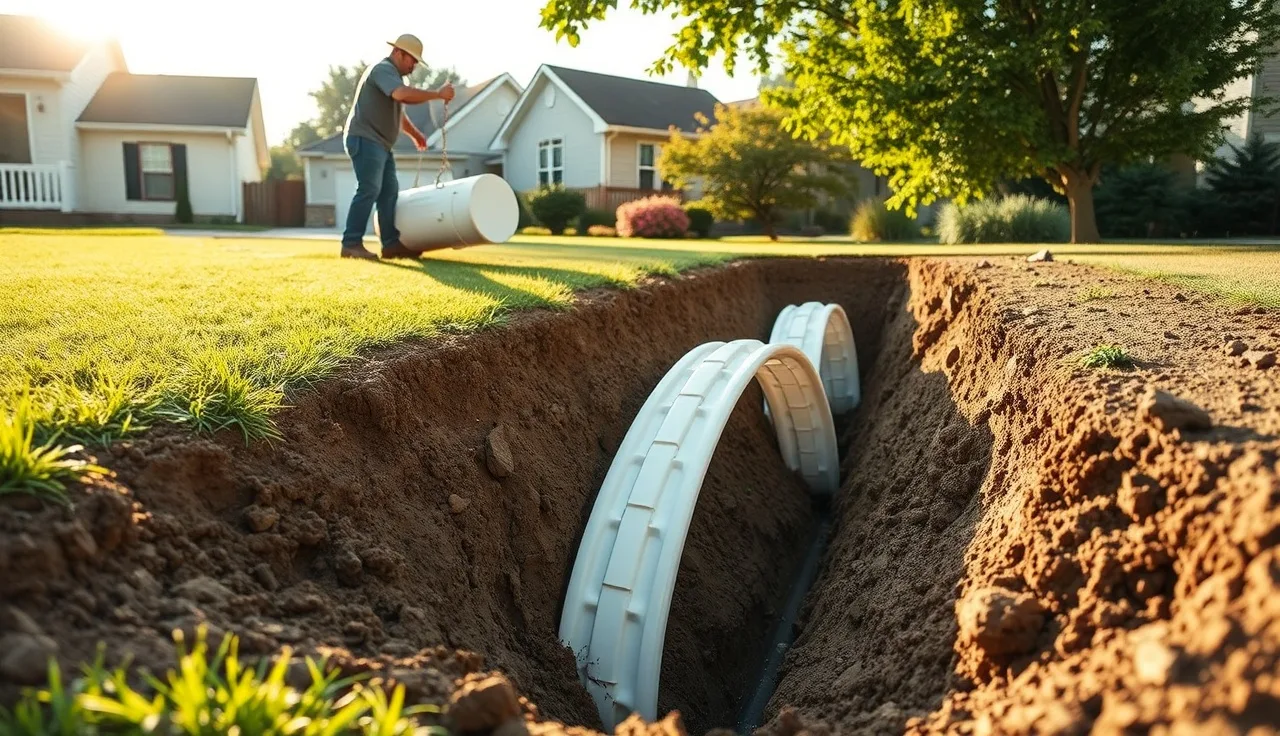
The form you'll see most is the open-bottom plastic chamber, a half-pipe arch you snap together end to end in a trench. Effluent runs from the tank into the chamber, spreads across the bare trench floor and walls, then percolates down. The chamber walls hold the soil from collapsing inward and give the run structure. Nothing absorbs or filters the liquid inside the arch. The soil does that work.
Two other products carry the gravelless label. Fabric-wrapped corrugated pipe (sold as EZflow and similar) is a mesh sock stuffed with expanded polystyrene beads wrapped around a standard 4-inch perforated pipe. It ships in lightweight rolls, so a crew can carry a whole trench's worth by hand where a gravel truck can't reach. The third type is bundled pipe: several small-diameter pipes inside a geotextile sleeve, laid in a narrower trench than usual.
All three do the same job. They spread pre-treated effluent across a soil interface big enough to absorb your household's daily flow without surfacing in the yard or backing up into the house.
How does a gravelless drain field actually work?
The treatment chain starts in the septic tank. Solids settle to the bottom, scum floats to the top, and clarified effluent (still full of nutrients and pathogens) leaves through the outlet baffle and heads for the distribution box or manifold. From there it enters the gravelless units in the trenches.
Inside a chamber, effluent pools briefly on the trench floor under the open arch, then soaks down. The zone just below the trench bottom does most of the treatment. Aerobic and anaerobic bacteria in a biomat layer convert nitrogen compounds and break down organics before the liquid reaches groundwater. A chamber exposes a wider strip of bare soil than a gravel trench of the same length, because the arch spans a broader swath of undisturbed ground. That extra contact area is why the EPA's Onsite Wastewater Treatment Systems Manual notes chamber systems can be designed with a smaller total footprint than equivalent gravel systems in many soil types [1].
With fabric-wrapped EZflow-type pipe, the polystyrene beads hold void space around the perforated pipe. Effluent weeps through the perforations, moves through the bead aggregate, and meets the soil through the geotextile fabric. The fabric keeps soil out and lets water through. Polystyrene doesn't compact or rot, so the void space stays open for decades.
Both designs live and die by the biomat. Too much flow overwhelms it and you get surfacing. Skip the tank maintenance and solids carry over and clog the soil interface. The gravelless part itself rarely fails. Tank condition and loading rate are almost always the real cause. See how often to pump septic tank for the maintenance side of this equation.
What types of gravelless drain field products exist?
Several distinct product lines share the market, and two things narrow your choice fast: your installer's local supplier and your state's approved product list.
Plastic chamber systems dominate North America. Infiltrator Water Technologies (owned by Advanced Drainage Systems) and Cultec are the two largest brands. Chambers snap together in 4-foot sections, come in widths from 12 to 60 inches, and are tested under NSF/ANSI Standard 40 for performance and NSF/ANSI 61 for material safety [2]. Most states publish an approved products list, and chambers from these makers show up on nearly all of them.
Expanded polystyrene (EPS) aggregate pipe wraps a standard 4-inch or 6-inch perforated pipe in a geotextile sock full of foam beads. EZflow is the name most people know. It ships in 10-foot sections or rolls. Crews hand-carry bundles into spots trucks can't reach, which is why it wins on hillside installs and lots with mature landscaping nobody wants to tear up.
Bundled pipe or multi-pipe systems nest several small-diameter pipes inside a fabric sleeve. They spread flow at multiple points along the trench, which proponents say loads the soil more evenly. You see these more in commercial and high-flow jobs than in houses.
Drip irrigation technically counts as gravelless since it uses no stone, but it's a different animal with its own pumps, filters, and timers. It belongs under advanced treatment systems, not passive gravelless pipe.
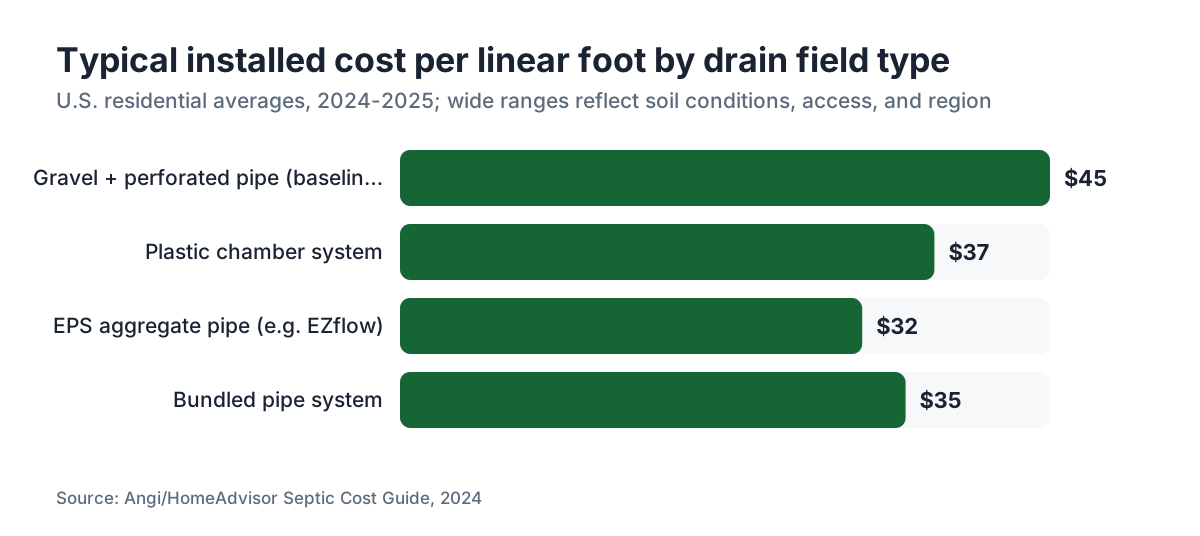
Here's how the main residential options stack up:
| Type | Typical installed cost per linear foot | Minimum trench width | Shipping weight per linear foot | Common brands |
|---|---|---|---|---|
| Gravel + perf pipe (baseline) | $30-$60 | 24 in | 80-150 lb (gravel) | N/A |
| Plastic chamber | $25-$50 | 12-36 in | 1-3 lb | Infiltrator, Cultec |
| EPS aggregate pipe | $20-$45 | 12-18 in | 2-4 lb | EZflow, Bord na Mona |
| Bundled pipe | $22-$48 | 10-16 in | 2-5 lb | WhisperFlow, others |
These are rough U.S. averages for 2024-2025 from contractor surveys. They swing a lot by region, soil, and whether a pump is needed [3].
Is gravelless pipe approved in all states?
Almost, but not everywhere. As of 2024, the large majority of U.S. states have approved at least one gravelless technology for residential use, and many list chamber and EPS aggregate systems in their onsite wastewater code as equal alternatives to conventional gravel [4].
Approval happens at two levels. The product itself has to sit on the state's approved product list, which usually means NSF certification or independent test data. Then the designer has to follow the state's sizing rules, which can differ from the manufacturer's generic guidelines. Some states let designers apply a "reduction factor" and use less total trench area with chambers, because the wider soil exposure per foot means you need fewer feet to treat the same daily flow.
A few states still want a variance or engineering sign-off for gravelless work outside standard gravel, especially in sensitive watersheds or for flows over a set threshold (often 1,000 gallons per day). Florida's onsite code approves chambers but requires a licensed engineer to design systems above 1,000 GPD. Texas allows several gravelless products under its OSSF rules through TCEQ, though the local authority having jurisdiction (AHJ) can pile on extra requirements [6].
The honest answer: check your state's current approved list and your county health department before you buy anything. Product approvals change, and the local inspector's sign-off is the only approval that counts on the day of your final inspection.
What does a gravelless drain field cost compared to a gravel system?
For a typical three-bedroom home putting out around 300 to 450 gallons per day, a complete gravelless drain field (tank not included) runs roughly $3,000 to $10,000 installed in most U.S. markets. Soil conditions, trench depth, site access, and local labor rates drive the spread [3].
A conventional gravel field for the same house often lands between $4,000 and $12,000 once you add crushed stone delivery. Stone gets brutally expensive far from a quarry or on lots where a loaded gravel truck can't maneuver. The material cost of gravel is one of the main reasons gravelless took off. In plenty of markets the stone and its delivery cost more than the plastic chambers or EPS pipe that replace it.
Labor usually runs lower for gravelless. A crew lays chamber sections or EZflow rolls a lot faster than they spread, grade, and compact gravel around pipe. On a 500-square-foot trench you might save two to four hours of crew time. At prevailing rates that's $300 to $800 in labor savings, which offsets part of any material premium.
For the full picture of a new system from tank to field, see cost to install septic system and cost to put in a septic tank.
Long-term cost is where gravelless sometimes pulls ahead. Gravel fields can clog over decades as fines migrate in from the surrounding soil, and replacing a gravel field means digging out and re-hauling stone. Chambers and EPS pipe don't compact and don't clog with fines the same way. I'm not aware of a large-sample, published long-term cost comparison, so treat this as directional. USDA and university extension follow-ups do show chamber systems installed in the 1990s still running normally, which is a decent sign [7].
How is a gravelless drain field sized?
Sizing starts with the same soil data that governs any leach field. A percolation test or soil morphology evaluation (a soil profile or perc test) tells the designer how fast your native soil absorbs water, measured in minutes per inch (MPI). Fast sandy soils get a quick perc rate and need less trench area. Slow clay needs more.
From the perc rate, the designer figures the required square footage of soil-effluent interface. In a gravel system, that interface is the trench bottom plus the lower sidewalls touching gravel. In a chamber system, it's the trench bottom exposed under the arch, which is wider than a pipe-and-gravel setup of the same linear length.
Most states allow a size reduction of 20% to 50% for chambers versus gravel, specifically because of that wider soil contact footprint [1]. So a gravel design calling for 400 linear feet of 24-inch trench might drop to 280 to 320 feet with chambers, depending on your state's factor.
The daily flow estimate usually comes from bedroom count. Many states design at 75 to 150 gallons per bedroom per day, so a three-bedroom home lands at 300 to 450 gallons per day. That number runs through the state's sizing tables to set final trench length and layout.
Get a licensed soil scientist or site evaluator to do this. A perc test done wrong, or an optimistic soil classification, is the single most common reason fields fail early. No pipe material saves you from undersized trenches.
What are the real advantages of gravelless drain field pipe?
Weight is the advantage you feel on day one. A gravel field for a four-bedroom home can need 15 to 25 tons of washed stone, several truck loads, and a lot of wheelbarrow work. The equivalent chamber system ships on a pallet or two, and two people carry it by hand. That matters on lots with limited truck access, steep grades, or mature trees you don't want to flatten with heavy equipment.
Speed follows from weight. Experienced crews report laying chamber systems 30% to 50% faster than equivalent gravel work, which cuts labor cost and shortens how long your yard sits torn up.
Consistent performance is the other real win. Crushed stone quality varies. Some shipments carry fines that migrate into the pipe perforations over the years. Some carry organic material that rots and eats into the void space. NSF-certified plastic chambers and EPS aggregate come out to the same spec every batch. What you buy is what you get.
Gravelless installs also go easier on the existing soil. Without spreading and compacting heavy stone, the trench sidewalls take less abuse, which preserves more of the soil's natural permeability right where the treatment happens.
And on remote or island sites, shipping plastic chambers by boat or helicopter is a real scenario where dodging tons of stone is what makes the project possible at all.
Are there any downsides or failure modes to know about?
The biggest weakness of gravelless pipe is root intrusion in chamber systems. The open bottom of a chamber arch is a warm, moist invitation for tree roots, and with no gravel bed to slow them, roots can fill a chamber run faster than they'd work through a dense gravel field. Keep aggressive-rooted trees (willows, silver maples, anything that chases water) 30 to 50 feet from the field, and plant only shallow-rooted grass on top.
Vehicle loading is a serious concern. Chambers carry a rated live load, and driving heavy equipment over an installed field can crush the arch and close off the void space entirely. This risk beats gravel, because gravel spreads load across a mass while a hollow chamber concentrates it. Mark your field boundaries clearly and keep delivery trucks parked far away.
EPS aggregate pipe can get damaged during backfill if the installer drops a heavy steel bucket right over the rolls. The beads are light enough that sloppy backfill can float or shift the product before soil covers it, leaving uneven grade. These are installer errors, not product flaws, but they're worth asking your contractor about.
Neither type of gravelless pipe fixes a failed or overwhelmed system. Saturated soil, a tank pushing solids, or a household using far more water than the design allows will kill gravelless pipe just as fast as gravel. It's a distribution medium, not a treatment upgrade.
If a field is already failing, you may be looking at septic system repair or replacement, more than a swap of pipe type.
Can gravelless pipe replace a failed drain field?
Yes, and this is one of the spots where gravelless earns its keep. When a conventional gravel field fails, digging out old stone and replacing it is a big job. Plenty of homeowners and installers abandon the failed field and put a gravelless system in a fresh part of the yard instead, which often saves real excavation money.
Some states also permit "field renovation." The old gravel comes out, the clogged soil interface (biomat) gets broken up and rested, and a new gravelless system goes in the same general area after a rest period. Extension literature commonly cites rest periods of 6 to 24 months, though the science on the ideal rest time isn't as precise as the guidance sounds [7].
Before you condemn any field, pump and inspect the tank first. A surprising share of "field failures" are really a full tank backing up, not a dead soil interface. Pump the tank, rest the field a few weeks, and re-evaluate before spending on replacement. The leach field article goes deeper on telling real field failure apart from tank overflow.
If you run a service operation and track many customer sites through replacement cycles, septic service software like SepticMind can flag sites by system age and failure history, so you're planning ahead instead of scrambling when a customer calls.
How do you maintain a gravelless drain field?
Maintenance is nearly identical to a conventional field, because the pipe material doesn't change what happens in the soil or the tank upstream.
Pump the tank on schedule. The EPA's SepticSmart program recommends inspection every 1 to 3 years and pumping every 3 to 5 years for a typical household, with the actual interval depending on tank size and how many people live there [8]. Solids that carry into a gravelless field clog the soil interface just as fast as they would in gravel, maybe faster in some chamber designs, since there's no gravel depth acting as a crude filter.
Keep the field in grass. No trees, no shrubs, no parking, no driving. Route roof drains, sump pumps, and surface water away from the field so you're not drowning soil that needs to breathe.
Watch for the warning signs: slow drains inside the house, sewage smell near the field, wet or spongy ground over the trench lines, or bright green stripes of lush grass over the trenches. That last one usually means effluent is surfacing.
One thing gravelless systems do not need, no matter what the label promises: septic additives. There's no evidence that bacterial additives or enzymes extend field life [9]. The EPA and most state extension programs actively discourage them. Skip that whole product category.
Keep records of your system layout, pumping dates, and inspections. When you sell, most states require you to disclose system condition and maintenance history. Good records also help you spot when the pumping interval should tighten because the household grew. See how often to pump septic tank for a plain guide to setting that schedule.
What should you ask a contractor before they install a gravelless system?
A handful of questions separate an experienced installer from someone who leaves you with a failing field in three years.
First: is this product on the state's approved list for my soil type and perc rate? Don't accept "it's fine." Ask to see the approval or the state code section.
Second: what sizing reduction factor are you using, and does the county allow it? Some contractors apply the manufacturer's published chamber reduction without checking whether the local AHJ accepts it. If the county wants full gravel-equivalent sizing and your contractor built at 50% reduction, you fail inspection.
Third: how deep is the trench, and how much cover goes over the chambers? Most chamber makers specify minimum cover (usually 6 to 12 inches of soil) to protect the arch from frost and surface load. Too little cover in a cold climate cracks the plastic. Too much cover on a system not rated for it collapses the arch.
Fourth: what's the warranty and who stands behind it? The manufacturer's material warranty is separate from the installer's workmanship warranty. Both matter. Infiltrator and other chamber makers offer limited warranties on the plastic itself (some as long as 20 years), but that never covers soil-related failure or bad installation [10].
Last: will you give me a system diagram with trench dimensions and GPS coordinates of the cleanouts? You need this for future inspections, maintenance, and a property sale. Any professional hands it over without a fight.
For the septic tank inspection that should ride along with any new field or replacement, make sure the inspector checks the outlet baffle. Its condition decides how much solid material can reach your new gravelless field.
How does gravelless pipe compare to advanced treatment systems?
Gravelless pipe is a passive distribution technology, not a treatment upgrade. It spreads effluent. It doesn't treat it any better than a conventional system does. That distinction matters on a lot that requires nitrogen reduction or in a nitrogen-sensitive watershed.
Advanced treatment systems (aerobic treatment units, drip irrigation, recirculating media filters) change the treatment level of the effluent before it hits the soil. Gravelless pipe works fine as the distribution component after treatment, but it doesn't replace the treatment.
If your state or county requires an enhanced nutrient-reduction system because you're near a sensitive water body (common in coastal states like Massachusetts, Maryland, and Florida), a chamber system instead of gravel does not satisfy that requirement [12]. You'd need an approved nitrogen-reduction technology on top.
For most inland residential lots with no special permit conditions, gravelless pipe is a full code-compliant alternative to gravel and needs no other change to the treatment train. The soil does the same work it always did. You're just changing the pipe that carries effluent to it.
The cost gap is large. A passive gravelless field runs $3,000 to $10,000 installed. Aerobic treatment units with drip distribution can run $15,000 to $30,000 or more, depending on size and state rules [3]. Don't pay for treatment capacity you aren't required to have, and don't assume gravelless pipe gives you treatment capacity it can't provide.
Frequently asked questions
Can I install gravelless drain field pipe myself without a permit?
Almost certainly not legally, and you shouldn't try. Nearly every state requires a permit, a soil evaluation, and a licensed installer or engineer for any leach field work, gravelless or not. Unpermitted work voids your system's compliance status, can void homeowner's insurance, and creates serious liability when you sell. Some states let homeowners do tank work but not field work. Check your county health department before touching anything.
How long does a gravelless drain field last?
A well-designed, properly maintained gravelless field should last 25 to 40 years or more, on par with gravel. Chamber systems installed in the early 1990s show up as still working in university extension follow-up studies. Lifespan comes down to soil condition, loading rate, and tank maintenance, not the pipe material. A field taking on solids because the tank never gets pumped fails regardless of pipe type.
Does gravelless pipe work in clay or slow-draining soil?
It can, but sizing gets very large in slow soils, and some states ban any passive leach field (gravelless or gravel) once the perc rate falls slower than a set threshold, often 60 to 120 minutes per inch. In those cases you need an advanced treatment system or a mound. A licensed soil evaluator has to test and classify your specific site before anyone picks a system type.
What is EZflow pipe and is it the same as a chamber system?
EZflow is a brand of expanded polystyrene (EPS) aggregate pipe: a perforated pipe surrounded by foam beads in a geotextile sock. It's a different product from a plastic chamber, though both are gravelless. Chambers use a hollow plastic arch over a bare trench floor. EZflow fills the trench with a lightweight aggregate substitute. Both are approved in most states, but your designer should specify which fits your soil and lot.
Can gravelless chambers crush or collapse under vehicle traffic?
Yes. Chambers have rated load limits, typically H-10 or H-20 truck loading if the product is engineered for traffic, but standard residential chambers are not rated for vehicles. Driving over an installed field, even with a small pickup, can collapse the arch and wipe out the void space effluent needs. Mark field boundaries with stakes or signs and tell anyone doing yard work or deliveries.
How does the EPA view gravelless drain field systems?
The EPA's Onsite Wastewater Treatment Systems Manual recognizes chamber and gravelless aggregate systems as accepted alternatives to gravel trench systems, and notes chambers can be designed with a reduced footprint in many soil types. EPA's SepticSmart program does not vary maintenance guidance by field type; the same tank pumping and inspection schedule applies whether your field uses gravel or gravelless components.
What is the minimum lot size needed for a gravelless drain field?
There's no single national minimum. Lot size requirements come from state and county codes and depend on soil type, setbacks from wells and property lines, and daily flow. Gravelless systems sometimes fit on smaller lots because the reduced-footprint factors some states allow mean shorter total trench length. A soil evaluation and site plan from a licensed designer is the only reliable way to know whether your lot can hold a new or replacement field.
Can tree roots damage a gravelless chamber system?
Yes, and the risk is real. The warm, moist inside of a chamber arch draws tree roots, which enter through the open bottom or end joints and fill the chamber over time. Willows, cottonwoods, and silver maples pose the most risk. Most codes and manufacturers say keep trees at least 20 to 50 feet from the field boundary. Once roots fill a chamber run, the only fix is excavation and replacement.
Does a gravelless system need a pump or a distribution box?
Not necessarily. Gravity-fed gravelless systems work the same as gravity gravel systems, with a standard distribution box splitting flow to multiple trench runs. You only need a pump when the field sits higher than the tank outlet, or when pressure dosing is specified for more uniform distribution. Your designer decides this from site topography. A pump adds $1,500 to $4,000 to the cost and one more thing to maintain.
Is a gravelless system better for the environment than a conventional gravel system?
Environmental performance, meaning how much nitrogen and pathogen reduction happens before effluent reaches groundwater, is essentially the same when both systems are sized right. Gravelless uses less quarried stone, which cuts quarrying impacts and trucking emissions. Some designs allow smaller footprints, which preserves more undisturbed native soil and vegetation. But neither passive system provides advanced nutrient reduction. That takes engineered treatment upstream of any distribution pipe.
How do I find out if a specific gravelless product is approved in my state?
Start with your state environmental or health department website. Most publish an approved onsite wastewater products list you can search by category. Your county health department or AHJ may keep a separate or supplemental list. Manufacturers like Infiltrator and EZflow post state approval maps, but confirm with your local authority independently, because approvals change and manufacturer maps aren't always current.
What happens to a gravelless drain field in a flood or high water table?
Flooding or a seasonally high water table that reaches trench depth shuts down treatment by wiping out the unsaturated soil zone where bacteria break down pathogens and nutrients. This isn't unique to gravelless; gravel fields fail the same way. Gravelless chambers can also float or shift if the trench fills with water before backfill is done, so timing installation around groundwater matters. A high seasonal water table is a site constraint no pipe type overcomes.
Do I need to replace the septic tank when I install a gravelless drain field?
Not automatically. If the existing tank is structurally sound, the right size for the household, and has a working outlet baffle, it can stay. A licensed inspector should evaluate tank condition as part of any field replacement. A cracked tank, missing baffle, or undersized tank should get fixed at the same time to protect the new field. Replacing a field while leaving a compromised tank is a common and expensive mistake.
Sources
- U.S. EPA, Onsite Wastewater Treatment Systems Manual (EPA/625/R-00/008): Chamber systems can be designed with a smaller total footprint than equivalent gravel systems in many soil types, and the manual recognizes them as accepted alternatives.
- NSF International, NSF/ANSI Standard 40 and 61 for onsite wastewater treatment products: Plastic chambers and gravelless systems are tested under NSF/ANSI standards for performance and material safety.
- Angi, Septic System Cost Guide (2024): Installed cost range for gravelless drain fields and conventional gravel systems in typical U.S. residential projects.
- Infiltrator Water Technologies, State Approvals Overview: Chamber systems are approved in the vast majority of U.S. states as alternatives to conventional gravel drain fields.
- Texas Commission on Environmental Quality (TCEQ), On-Site Sewage Facilities (OSSF) Rules: Texas allows several gravelless products under its OSSF rules, but local authority having jurisdiction can add requirements.
- U.S. EPA SepticSmart Program, Homeowner's Guide to Septic Systems: EPA recommends septic inspections every 1 to 3 years and pumping every 3 to 5 years for a typical household.
- U.S. EPA SepticSmart Program, Septic System Additives guidance: There is no evidence that bacterial additives or enzymes extend field life; EPA and state extension programs discourage them.
- Infiltrator Water Technologies, Product Warranty Information: Infiltrator offers limited material warranties on chambers, some as long as 20 years, separate from installer workmanship warranties.
- Massachusetts Department of Environmental Protection, Title 5 Onsite Sewage Regulations: Coastal states like Massachusetts impose nitrogen reduction requirements that passive gravelless systems do not satisfy on their own.
Last updated 2026-07-09