Gravel-less leach field pipe: what it is, how it works, and when to use it
By the SepticMind Editorial Team
TL;DR
- Gravel-less leach field pipe replaces the traditional perforated pipe-in-gravel trench with a self-contained plastic chamber, bundle, or foam-wrapped pipe that distributes effluent without crushed stone.
- Installation runs $8, $18 per linear foot.
- It's approved in most U.S.
- states, passes the same perc requirements, and often needs 30 to 40% less excavation than gravel systems.
What is gravel-less leach field pipe?
A conventional leach field buries perforated pipe inside a bed of crushed stone, usually 3/4-inch clean gravel, so effluent can drain from the pipe and spread through the gravel before soaking into native soil. Gravel-less pipe throws out the stone layer. The pipe sits inside a structure that does the same job: it creates void space around the perforations so liquid can escape and the surrounding soil can do the actual absorption.
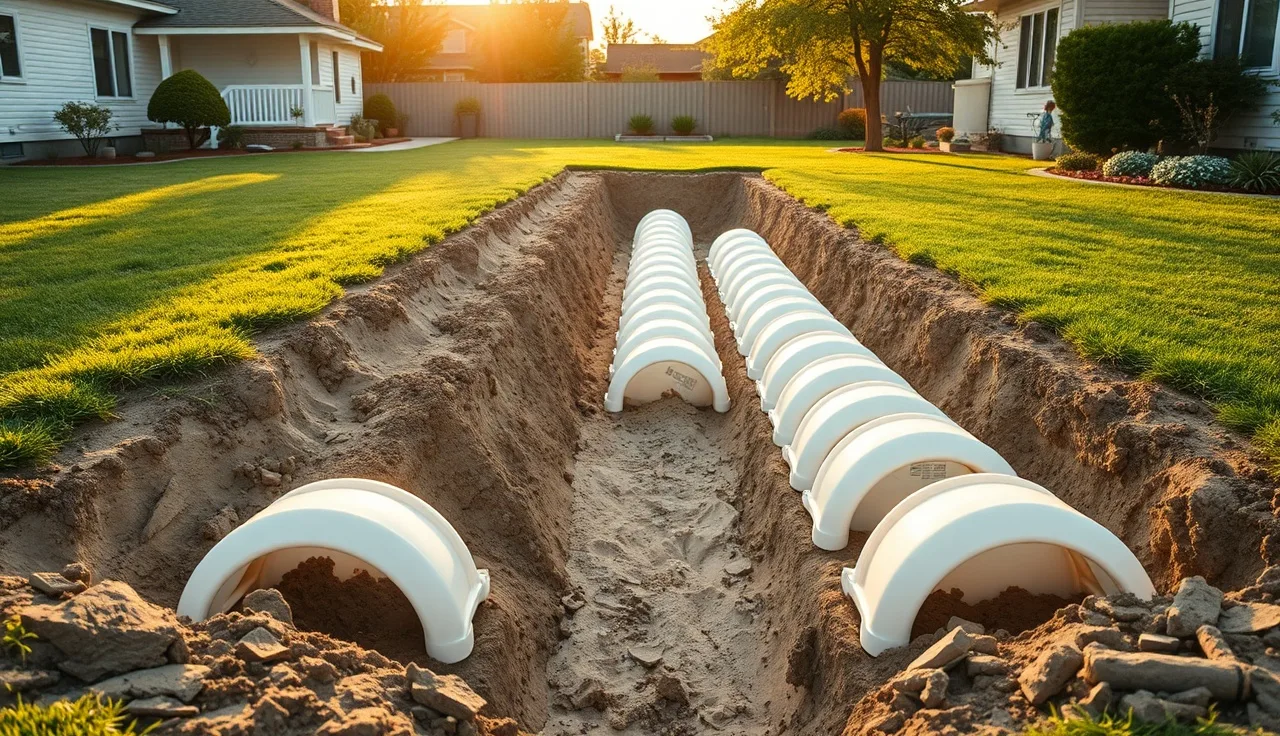
Three product families run the market. Plastic chambers (the most common) are arch-shaped corrugated shells that snap together end-to-end over a perforated or open-bottom pipe. Bundled synthetic aggregate products wrap a perforated pipe in a loose lattice of recycled polystyrene nodules, then sock the whole bundle in geotextile fabric. Foam-core wrapped pipe takes a single corrugated pipe and bonds a thick ring of open-cell foam directly to its exterior. All three give effluent somewhere to go while it waits for soil uptake.
The EPA's SepticSmart program lists chamber systems among the alternative drainfield designs that states may approve as equal to conventional stone-and-pipe systems [1]. By 2024, every state except a small handful of counties with unique codes had at minimum conditional approval for one or more gravel-less product lines. The specific brand and trench geometry vary by jurisdiction.
How does gravel-less pipe work compared to a traditional gravel system?
In a stone-and-pipe trench, effluent exits the perforations at low pressure, falls onto gravel, travels through the void spaces in the aggregate, then contacts the soil at the trench bottom and sidewalls. The gravel buys time, creates surface area, and spreads the hydraulic load along the trench. Biomat, the slime layer that forms at the soil interface, is normal and actually helps regulate flow.
Gravel-less systems mimic that void space differently. A chamber leaves the soil exposed directly below an arch, so effluent drips onto bare native soil from above. That gives the biomat a larger, more even formation zone. Bundled aggregate pipe builds a radial buffer of air pockets around the perforations the same way gravel does, just with lighter plastic beads instead of stone. Foam-wrapped pipe does the same with open-cell foam.
The hydraulic loading rate, the gallons per square foot of trench bottom per day the system is allowed to accept, stays the same no matter which product you use. Your soil's perc rate still sets how big the leach field needs to be. Gravel-less pipe doesn't let you skip the soil evaluation. It lets you hit the required square footage of infiltrative surface with less weight, less digging, and no gravel delivery trucks.
One concrete difference: chambers expose more soil per linear foot than a gravel trench does. A standard 12-inch-wide gravel trench counts only its bottom as infiltrative area, while most chamber products count both bottom and sidewall contact zones. So you can sometimes install fewer linear feet of chamber pipe and still meet the same hydraulic loading requirement. That's part of why labor costs drop.
What types of gravel-less leach field pipe are available?
Plastic chamber systems. Infiltrator Water Technologies and Cultec are the two names you'll see on most job sites. The Infiltrator Quick4 chamber is 53 inches long and creates 7.5 square feet of infiltrative area per chamber [2]. Chambers come in multiple widths (standard, plus, high, and low-profile), which lets engineers match chamber size to available trench depth and soil type.
EZflow bundled pipe. This is the product most people mean when they say "synthetic aggregate." A 4-inch perforated pipe sits at the center of a bundle of recycled EPS beads, all wrapped in geotextile. It ships in 10-foot sections, installs like conventional pipe (you can snake it around obstacles more easily than rigid chambers), and weighs about 20 pounds per 10-foot section vs. 300+ pounds of gravel for the same run [3].
Foam-wrapped pipe (e.g., Bio-Microbics, Orenco systems). Less common in standard residential installs, more often spec'd in engineered systems or when trench depth is very limited. The foam compresses slightly under backfill pressure, so some jurisdictions require specific minimum cover depths.
Drip irrigation tubing. Technically gravel-less, but it's a pressurized system that delivers effluent to shallow soil through small-diameter tubing with emitters. It needs a pump, a filter, and a control panel. It's its own separate topic, though it often comes up in the same conversation.
For standard residential new construction in most U.S. states, plastic chambers are the practical default. They're widely tested, their long-term performance data goes back to the early 1990s, and every state health department that accepts gravel-less pipe has specific chamber approval language in its code.
How much does gravel-less leach field pipe cost vs. gravel?
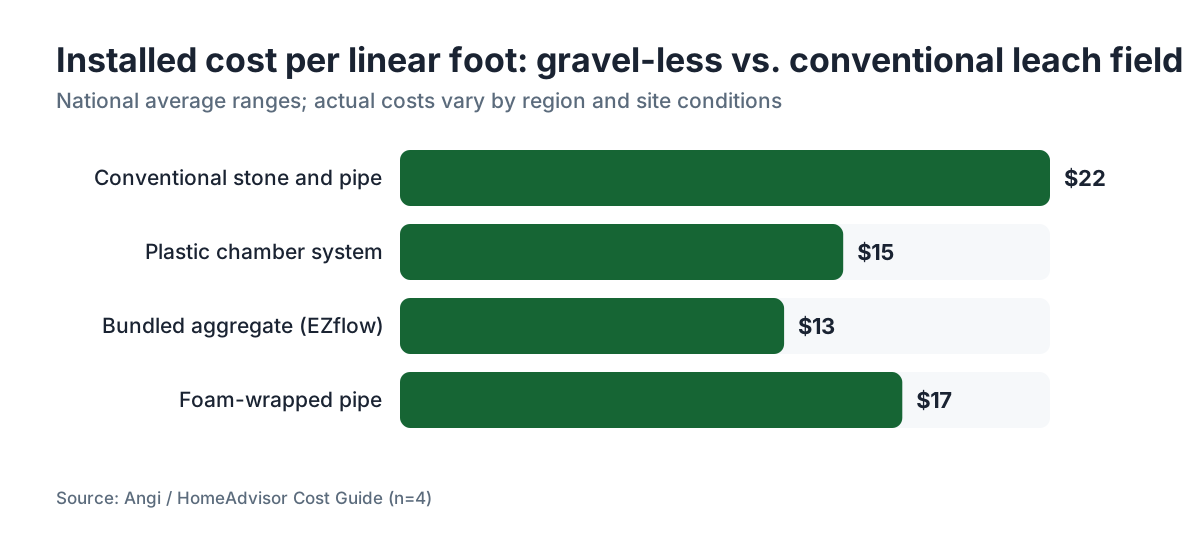
Costs move with region, soil conditions, system size, and whether it's new construction or a replacement. The table below shows national averages. Actual bids in your market can run 20% above or below these.
| System type | Material cost (per linear ft) | Installed cost (per linear ft) | Gravel needed |
|---|---|---|---|
| Conventional stone and pipe | $4, $8 | $15, $30 | Yes (1.5 to 3 tons per 100 ft) |
| Plastic chamber | $5, $10 | $10, $20 | No |
| Bundled aggregate (EZflow) | $6, $11 | $8, $18 | No |
| Foam-wrapped pipe | $8, $14 | $12, $22 | No |
The labor savings come from two places. First, no gravel to deliver, stage, or spread, which can save 4 to 8 hours on a 300-foot system. Second, excavation depth for chambers is often 6 to 8 inches shallower than a stone trench because the chamber arch provides the void space gravel normally occupies. Less digging means less soil disposal and a faster machine rental.
For a complete new drainfield on a typical 3-bedroom home (roughly 300 to 500 linear feet of trench depending on soil), expect a gravel-less install to run $5,000 to $12,000 for the leach field portion alone, not counting the tank, distribution box, or permits. A gravel system on the same footprint typically runs $7,000 to $18,000 once you add gravel hauling [4]. These are rough national ranges. A licensed installer's quote is the only reliable number for your site.
Permit fees add $200 to $1,500 depending on the county, and some jurisdictions bill a soil scientist's report as a separate line item.
Is gravel-less pipe approved in your state?
As of 2024, most U.S. states have either blanket approval for plastic chambers and bundled aggregate systems, or an equivalency pathway where a licensed designer submits the product's NSF/ANSI 61 or IAPMO listing to the local authority for acceptance.
States that use NSF/ANSI Standard 40 and related standards as their benchmark make the approval process straightforward. The National Sanitation Foundation's NSF/ANSI 40 applies mainly to treatment units, but NSF also runs a Septic System Component certification program that covers chamber and aggregate pipe products [5]. If a product carries that certification and your state code recognizes it, you're generally good.
A few states (Louisiana, parts of Florida, and some New England counties) still limit leach field materials to stone-and-pipe by default, with gravel-less allowed only on engineered designs reviewed by a professional engineer. Texas, through the Texas Commission on Environmental Quality (TCEQ), spells out chamber standards in its On-Site Sewage Facility rules under 30 TAC Chapter 285 [6]. California's Regional Water Quality Control Boards regulate septic systems at the region level, so approval in one region doesn't automatically mean statewide approval.
Here's the practical step: check your county or state health department's on-site wastewater rules before spec-ing any product. Your installer should know the local language, but homeowners doing their own research can usually find approval lists on the state environmental or health department's website. If you're managing multiple job sites across counties, tracking which product lines are approved where is the kind of thing that SepticMind built its permitting workflow tools around.
For federal guidance, EPA's SepticSmart initiative tells homeowners to verify that any alternative system component meets local approval before installation [1].
When should you choose gravel-less pipe over a conventional gravel trench?
There's no single right answer, but the conditions where gravel-less pipe wins on practical grounds are pretty consistent.
Tight lot access. Gravel delivery needs a large truck and a clear path to the field. On wooded lots, steep driveways, or properties with buried utilities near the surface, moving 20 tons of aggregate is sometimes impossible or very expensive. A pallet of chambers fits on a flatbed and a crew can carry them by hand.
High groundwater or shallow seasonal saturation. Shallow trench systems benefit from chambers because you can spec a wider, lower-profile chamber instead of going deeper. Some low-profile chamber products (like Infiltrator's LP-series) are designed for sites with 18 to 24 inches of seasonal high groundwater separation instead of the standard 24 to 36 inches, though this always needs engineer sign-off.
Replacement fields with limited space. When a gravel field fails, the replacement often has less room. Chambers can go in narrower or shorter configurations while still meeting loading requirements, because of their higher infiltrative surface area per linear foot.
Reducing load on the native soil. Chambers spread hydraulic load more evenly than a stone trench, which can help on marginal soils that sit right at the edge of acceptable perc rates.
Where gravel-less pipe sometimes loses: very rocky soils where excavation is costly no matter what fill you use, sites where the local inspector requires stone (and variance approval is uncertain), and situations where a homeowner is doing a DIY install and feels more comfortable with the familiar pipe-in-gravel method. Gravel-less products also demand careful trench alignment because you can't backfill chambers with large rocky spoil.
One note on replacement: if your current leach field has failed and you're weighing repair against replacement, the installed cost comparison above is the key financial input. A new chamber field often costs less than a full stone-and-pipe rebuild even before you count the labor savings.
What are the installation steps for gravel-less leach field pipe?
The sequence tracks a conventional install, with a few differences.
- Soil evaluation and system design. A licensed soil scientist or engineer runs a percolation test or soil morphology evaluation. This sets the required infiltrative area and trench geometry. Gravel-less products can't skip this step.
- Permits. File with the county or state health department. Approval timelines run from same-day to 8 weeks depending on jurisdiction.
- Excavation. Trenches are usually 2 to 3 feet wide and 18 to 36 inches deep, shallower than conventional gravel trenches by 6 to 12 inches depending on the chamber height. Trench bottoms must be level or on approved grade and not smeared by the bucket teeth. Smearing (compacting the soil surface with machine pressure) is the most common installation mistake and it directly cuts soil absorption capacity.
- Distribution. Effluent moves from the septic tank to a distribution box or manifold, then to the individual trench laterals. The pipe layout within chambers uses the same gravity or pressure-distribution engineering as any leach field.
- Chamber or pipe placement. Chambers snap together without adhesive. End caps seal the downstream end of each run. EZflow sections connect with sleeve fittings. Foam-wrapped pipe connects like standard corrugated pipe.
- Inspection. Most jurisdictions require a health department inspection before backfill. This is where you confirm the trench bottom isn't smeared, cover depth is adequate, and the product matches the permitted spec.
- Backfill. Soil goes over chambers carefully to avoid deformation. No large rocks, no heavy compaction directly over chambers. Minimum cover is usually 6 to 12 inches of native soil plus any topsoil needed for surface restoration.
The entire install for a 300-foot system with a two-person crew and a mini-excavator usually runs 1 to 2 days, against 2 to 3 days for a gravel system once you include gravel delivery and spreading.
How long does gravel-less leach field pipe last?
Plastic chamber manufacturers typically warranty their products for 25 to 50 years against structural failure under normal loading [2]. The chamber itself doesn't rot, corrode, or crush under typical residential soil cover. The thing that limits system life isn't the pipe or chamber. It's the soil.
Biomat accumulation at the soil interface is what eventually limits absorption in any leach field, gravel or gravel-less. Biomat develops when organic material in effluent colonizes the soil pores. With proper septic tank maintenance (pumping every 3 to 5 years for a typical household), biomat forms slowly and is often reversible. With a failing tank or infrequent pumping, solids escape into the field and speed up clogging no matter what pipe type you have.
The University of Minnesota Extension, which has tracked alternative onsite systems for decades, notes that properly maintained drainfields can work for 20 to 30 years or more, but that the single most predictable way to shorten field life is to let the septic tank go too long between pump-outs [7]. That holds for both gravel and gravel-less systems.
Here's the practical read: maintain the tank on schedule (see how often to pump septic tank), keep vehicles and deep-rooted plants off the field surface, and a chamber system installed today should outlast your mortgage. Field geometry, soil type, and household water use move longevity far more than the pipe product does.
Can you install gravel-less pipe yourself, or does it require a contractor?
In most states, on-site sewage systems require a licensed installer and a permit. DIY installation of a leach field, gravel or gravel-less, is not legal in most jurisdictions without at minimum a permit, soil evaluation, and a final inspection by the local health authority.
A handful of rural counties in states like Texas, Montana, and parts of the Southeast allow homeowner-installed systems on owner-occupied residential property, as long as permits are pulled and inspections pass. If you're in one of those places and you own a mini-excavator, gravel-less products are genuinely more DIY-friendly than gravel because there's no aggregate to move. The Infiltrator Quick4 chamber weighs 11 pounds per section. A 10-foot EZflow bundle weighs about 20 pounds. Both are manageable without heavy material handling.
The real complexity isn't the physical install. It's the design. Getting the trench length, loading rate, setbacks from wells and property lines, and distribution plumbing right takes someone who knows your soil, your local code, and how to read a perc test. Get it wrong and you get a field that fails in three years plus a second permit process that often costs more than hiring a professional the first time.
For most homeowners, the right move is simple: hire a licensed installer, confirm they're pulling a permit, attend the pre-backfill inspection if you can, and ask to see the as-built drawing. Keep that drawing. You'll need it if you sell the house or need septic system repair down the road.
What maintenance does a gravel-less leach field need?
Less than you might think, but not zero.
The chambers themselves need no maintenance. You can't snake a chamber system clean the way you might flush a gravel trench, but you'd rarely do that to a healthy trench anyway. The maintenance focus for any leach field lives upstream: keep solids and grease in the tank where they belong, so the effluent reaching the field is liquid, not sludge.
Pump the tank on schedule. For a 1,000-gallon tank serving a three-bedroom home with typical water use, that's roughly every 3 to 5 years [8]. If you run a garbage disposal or cook with a lot of fats, move toward the 3-year end. The EPA's SepticSmart program calls out tank pumping frequency as the primary maintenance action homeowners can take to extend field life [1].
Stay off the field with vehicles. Chambers are rated for H-20 loading in engineered applications, but the default residential product isn't built for repeated vehicle traffic, and compacted soil over the trench cuts evapotranspiration and can crack end caps.
Watch the surface. Soggy spots, lush grass stripes, or odors over the field lines mean effluent is surfacing. That's a system problem, not a chamber problem. It points back to hydraulic overload (too much water use), a failing tank, or a distribution imbalance between laterals.
Don't plant trees or large shrubs within 10 feet of the field. Root intrusion into chamber end caps and joints is a real failure mode, especially with willows, poplars, and silver maples. Grass or low groundcover is fine.
For a full tank maintenance schedule, the septic tank pumping guide covers timing, what happens during a pump-out, and how to read the condition of your tank.
What do the EPA and state codes say about gravel-less leach field systems?
The EPA does not regulate individual on-site septic systems directly. That authority sits with states and localities. What the EPA does through its SepticSmart program is provide guidance, educational materials, and a framework that states reference voluntarily [1]. The EPA's 2002 Onsite Wastewater Treatment Systems Manual, the main federal technical reference on the topic, covers alternative drainfield materials including chambers and synthetic aggregate at length and describes them as functionally equal to conventional stone when properly designed and approved [9].
State rules carry more weight. The most commonly cited state approval frameworks:
Texas (TCEQ 30 TAC Chapter 285): Addresses chamber system standards, required inspection, and equivalent area calculations [6].
Florida (Chapter 64E-6, Florida Administrative Code): Allows chamber systems as an approved alternative with specific chamber geometry requirements.
Minnesota (Minnesota Rules Chapter 7080): One of the more detailed state frameworks, maintained by the MPCA, with explicit loading rate equivalencies for chamber and aggregate systems [10].
North Carolina (15A NCAC 18A .1900): Allows gravelless pipe under the "innovative" and "alternative" system categories with local health department approval.
The consistent requirement across states is that the design must be stamped or signed by a licensed professional (engineer or soil scientist depending on the state), the product must appear on the state's approved materials list or carry an equivalent certification, and installation must be inspected before backfill.
If you run a service operation and track approvals across multiple counties and product lines, that's a paperwork and compliance grind. Tools like SepticMind are built for operators who need to track permit status, inspection windows, and approved product lists across jurisdictions.
What are the common problems and failure modes with gravel-less pipe?
The product itself rarely fails. The problems are almost always installation or maintenance errors.
Smeared trench bottom. This is the single most common installation defect. When the excavator bucket compacts the trench floor, it seals off the soil pores that absorption depends on. Proper practice is to either scarify (scratch up) the trench bottom before placing chambers, or dig 2 to 3 inches deeper than spec and replace with clean sand. Inspectors in states with mature programs check for this specifically.
Inadequate end caps. Open-ended chamber runs let effluent pond at the far end of the lateral and discharge unequally. Every run needs a properly seated end cap.
Root intrusion at connections. Chamber end caps and knockout ports are the primary root intrusion points. Tree roots don't destroy chambers the way they crack clay tile pipe, but they can enter through unseated end caps and create a monitoring headache.
Hydraulic overload. High-efficiency chambers don't make a small field accept more hydraulic load than the soil can handle. Homeowners who add a bedroom, install a hot tub, or host guests for months can blow past design capacity. The result is the same as overloading a gravel field: surfacing effluent and soggy ground.
Settlement over improperly backfilled chambers. If large rocks or frozen clumps go into backfill directly over the arches, chambers can deform. Proper backfill is fine-grained, placed in lifts, and hand-tamped rather than machine-compacted directly over the product.
If you suspect the field is failing, the diagnostic path is the same as for any leach field. Start by ruling out tank problems (a septic tank inspection tells you if solids are escaping), then check distribution box balance, then probe the field.
Frequently asked questions
Does gravel-less leach field pipe work in clay soil?
It can, but clay soil's perc rate is the constraint, not the pipe type. Clay that percs too slowly for a conventional system will also fail with chambers. Where chambers help in marginal-clay situations is by spreading hydraulic load more evenly and sometimes allowing a slightly shallower trench that stays above the seasonally saturated zone. Always require a current perc test or soil morphology evaluation before spec-ing any drainfield in clay.
Can gravel-less pipe be used for a replacement leach field when the old gravel field has failed?
Yes, and this is one of the most common uses. Chambers and bundled aggregate pipe are both approved for replacement installs in most states. The advantage is that a replacement chamber field sometimes fits in a smaller footprint than a new gravel field because of higher infiltrative area per linear foot. You still need a new soil evaluation and permit for the replacement site; you can't reuse the old perc test data from the original install.
How deep should gravel-less leach field trenches be?
Depth depends on your state code, soil type, and seasonal high groundwater elevation. Most chamber systems require 6 to 24 inches of cover above the chamber crown, and a minimum separation of 24 to 36 inches between the trench bottom and seasonal high groundwater. Typical trench depths run 18 to 36 inches from grade to trench bottom, which is 6 to 12 inches shallower than conventional gravel trenches. Your designer's plan governs; never assume without checking the permit drawings.
Is leach field gravel still better than gravel-less pipe in any situation?
Gravel still wins in a few spots: when local code requires it with no equivalency pathway, when the site already has abundant stone on hand, or when a very experienced installer strongly prefers the method they've used for 30 years on similar soils. Performance data doesn't show conventional stone outperforming chambers in long-term absorption. In most modern installs, gravel-less products are at least equal and often faster to install.
What is the minimum setback distance from a well for a gravel-less leach field?
Setback requirements are set by state and county code, not by the pipe product type. Typical minimums range from 50 feet (some Southern states) to 100 feet (most Northern and Western states) between any leach field trench and a drinking water well. Some states differentiate by well type and aquifer vulnerability. The pipe material, gravel or gravel-less, doesn't change the setback. Check your state health department's on-site wastewater rules for the exact number.
How wide should gravel-less leach field trenches be?
Width depends on the chamber or product you're using. Standard Quick4 chambers fit a 12-inch-wide trench. Wider chambers (Plus, High Capacity) need 18 to 24 inches. EZflow bundles come in 10-, 12-, and 18-inch diameters and need a trench matched to their bundle size plus a few inches clearance. Your system design specifies trench width; the product's installation manual specifies the minimum, and local code may set a maximum.
Can you add chambers to an existing failing gravel leach field?
Not as a direct repair to the failed portion. You can't rehabilitate clogged soil by installing chambers over it. What you can do is install a new chamber field in the designated reserve area or an alternate site on the property. Some designers use a resting-and-rotating approach, where the failed section goes offline and recovers while the new section carries the load, but this needs a new permit and engineer approval regardless of pipe type.
Do gravel-less systems require an inspection before backfill?
In most states, yes. The pre-backfill inspection is the health department's only chance to verify that trench depth, width, cover material, product type, and distribution plumbing match the permitted design. Skipping it or backfilling early is a common compliance problem that can trigger an order to excavate and re-inspect at the owner's cost. Schedule the inspection with your local authority before the crew shows up to backfill.
How many linear feet of gravel-less pipe does a 3-bedroom house need?
It depends on soil perc rate, state loading standards, and the specific product. A rough rule of thumb for a 3-bedroom home (assuming roughly 450 gpd design flow) in average-percolating soil is 250 to 500 linear feet of chamber trench, against 300 to 600 feet for a conventional gravel trench. Chambers can meet loading requirements with fewer linear feet because they count sidewall infiltration area on top of trench bottom area. Your designer calculates the exact number from the soil evaluation.
What brands of gravel-less leach field pipe are most widely approved?
Infiltrator Water Technologies (Quick4 and related chamber lines) has the most widespread state approvals in the U.S. Cultec chambers are the other major competitor. EZflow by Infiltrator is the dominant bundled aggregate product. Specific brand approval varies by state; the Infiltrator and Cultec product lines appear on more state approved-materials lists than any other manufacturer as of 2024. Always verify against your state's current approved list before buying.
Does gravel-less pipe meet the same NSF standards as conventional septic pipe?
NSF International certifies septic system components including gravel-less products under its Onsite Wastewater program. Infiltrator chambers, for example, carry NSF certification. Conventional perforated pipe meets ASTM F405 or F667 standards. The standards are product-specific rather than directly comparable, but state health departments that accept gravel-less products generally require NSF or IAPMO certification as part of the approval. Check the specific product's listing before spec-ing it.
Can gravel-less leach fields freeze in cold climates?
Shallow gravel-less trenches in cold climates need enough cover soil for insulation. The standard 6-inch minimum cover is enough in most of the continental U.S., but in Minnesota, Wisconsin, and similar climates, designers typically spec 12 to 18 inches of cover or mound the system above grade. Active septic systems generate enough heat from biological activity that complete freeze-up is rare in occupied homes, but vacation properties that sit empty all winter are a real risk regardless of pipe type.
How do you find out if gravel-less pipe is approved in your county?
Start with your state environmental or health department's on-site wastewater page. Most keep a downloadable approved-materials list or a searchable database. If you can't find it online, call the local county sanitarian's office directly and ask which chamber and aggregate products are on the current approved list. This is a quick call and the right professional answer; don't rely on the retailer or product manufacturer to confirm local approval.
Sources
- U.S. EPA, SepticSmart Program: EPA SepticSmart guidance on alternative drainfield designs and tank pumping as primary maintenance action
- Infiltrator Water Technologies, Quick4 Chamber Product Specifications: Quick4 chamber is 53 inches long and creates 7.5 square feet of infiltrative area per chamber; 25-50 year structural warranty
- Infiltrator Water Technologies, EZflow Product Information: EZflow bundles ship in 10-foot sections and weigh approximately 20 pounds per section
- HomeAdvisor / Angi, Septic System Installation Cost Guide: National average installed cost ranges for leach fields, gravel and gravel-less
- NSF International, Onsite Wastewater / Septic System Component Certification: NSF certifies septic system components including chamber and aggregate pipe products under its onsite wastewater program
- Texas Commission on Environmental Quality, 30 TAC Chapter 285, On-Site Sewage Facilities: TCEQ 30 TAC Chapter 285 specifies chamber system standards and equivalent area calculations for Texas on-site sewage facilities
- University of Minnesota Extension, Septic Systems and Their Maintenance: Properly maintained drainfields can function 20-30 years or more; infrequent tank pumping is the most predictable way to shorten field life
- U.S. EPA, How Your Septic System Works: Typical household septic tank should be pumped every 3-5 years
- U.S. EPA, Onsite Wastewater Treatment Systems Manual (EPA/625/R-00/008, 2002): EPA 2002 Onsite Wastewater Treatment Systems Manual describes chamber and synthetic aggregate drainfield products as functionally equivalent to conventional stone when properly designed and approved
- Minnesota Pollution Control Agency, Minnesota Rules Chapter 7080, Individual Sewage Treatment Systems: Minnesota Rules Chapter 7080 includes explicit loading rate equivalencies for chamber and aggregate drainfield systems
Last updated 2026-07-09