Septic tank grinder pump: what it is, when you need one, and what it costs
By the SepticMind Editorial Team
TL;DR
- A septic tank grinder pump is a submersible electric pump that shreds sewage into a slurry and forces it under pressure uphill or to a distant treatment point.
- You need one when your home sits below the sewer main or the septic tank.
- Replacement runs $800 to $4,000 installed.
- They need more upkeep than gravity systems and typically fail every 7 to 15 years.
What is a septic tank grinder pump and how does it work?
A grinder pump is a submersible sewage pump with hardened steel cutting blades mounted below its impeller. Raw sewage flows by gravity into a small holding tank, usually 30 to 100 gallons, buried near the house. When the liquid rises to a set float height, the pump kicks on, shreds everything in the tank into a fine slurry, then forces that slurry through a small pressure pipe to wherever the system sends it. The discharge pipe is typically 1.25 to 2 inches wide, far smaller than the 4-inch gravity pipe it replaces.
The cutting mechanism is what separates a grinder pump from a standard sewage ejector. An ejector handles soft solids but jams on fibrous material, baby wipes, or small hard objects. A grinder reduces everything to a particle size of roughly 1/8 inch or smaller before it enters the discharge line. That matters in pressure sewer systems, where a blockage in a 1.5-inch pipe can affect dozens of upstream homes.
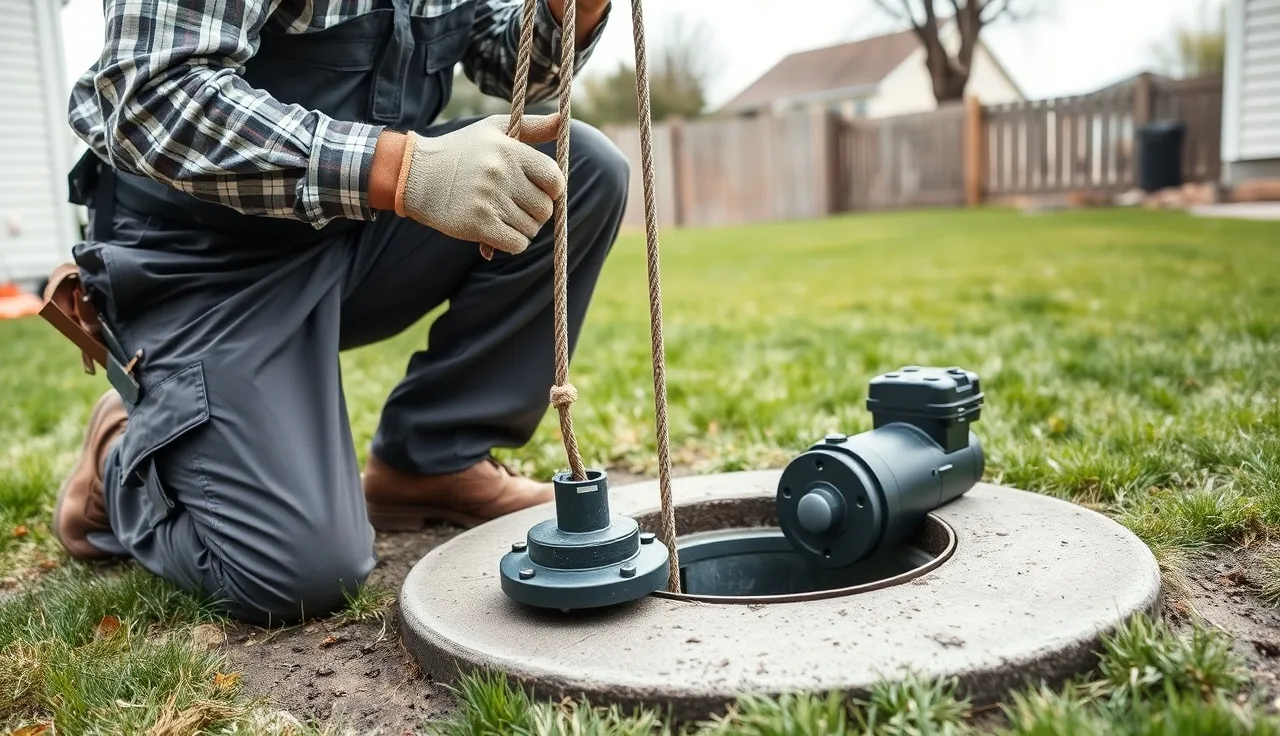
Grinder pumps run on 120V or 240V depending on motor size. Residential units are usually 1 to 2 horsepower. They move roughly 10 to 20 gallons per minute against heads of 30 to 150 feet, and the flow rate drops as head pressure climbs. The pump sits inside the wet well (the buried holding tank), accessible through a 24-inch riser and lid at grade [1].
What is the difference between a grinder pump and a regular septic system?
A conventional gravity septic system moves waste by gravity alone. Sewage leaves the house through a 4-inch pipe pitched downhill at 1/4 inch per foot, enters a septic tank where solids settle, and the clarified effluent flows to a leach field for soil treatment. No electricity. No moving parts in the tank. Sized and graded right, a gravity system runs for decades without much fuss.
A grinder pump system swaps that passive flow for an active, pressurized one. You add a motor, electronics, float switches, and a pressure vessel to a process that otherwise needs none of them. That complexity carries a real cost: power bills, alarm monitoring, periodic pump replacement, and the fact that a power outage or a dead motor stops sewage disposal cold.
So why use one? Because gravity does not always cooperate with geography. If your house sits in a low spot, on a hillside where the tank is above the house, or on a lot where the only sewer connection is uphill, you have to pump. Same goes for basement bathrooms below the tank inlet elevation. In those cases a grinder pump is not a preference. It is the only thing that works.
Say it plainly: if your lot can drain by gravity, build a gravity system. The grinder pump adds ongoing cost and failure risk that gravity avoids. If a contractor pushes a grinder pump on a site that could drain by gravity, ask for the site survey and elevation data before you sign anything.
When do you actually need a grinder pump?
The short answer: when sewage cannot reach its destination by gravity alone.
The most common case is a home sitting lower than the public sewer main in the street. Municipal systems use gravity mains and lift stations, but individual lots do not always have enough drop for a gravity service connection. In these neighborhoods, the utility may require each home to install a grinder pump feeding a low-pressure sewer (LPS) collection system. These systems show up in areas with flat terrain, high water tables, or rocky soil, where gravity sewer trenches would cost a fortune [2].
Within a private septic system, a grinder pump becomes necessary when the tank has to sit uphill from the house. That happens on steep lots where the tank needs the high side for access or code setback, or when a basement bathroom or laundry sits below the tank inlet invert. You cannot defy gravity with a 4-inch drain pipe. Either the pipe falls toward the tank or sewage backs up.
A third case is a pressure distribution septic system on a tough lot where the drain field sits higher than the tank. There, a pump at the tank outlet pushes effluent up to the field. A standard effluent pump often handles this, but if the head is large or the force main is long and small-diameter, a grinder pump gets specified instead.
Accessory dwelling units, guest houses, and outbuildings sitting far from the main system sometimes need a grinder pump to push waste back to the primary tank or sewer connection. Trenching a large gravity line over several hundred feet usually costs more than a small pressure line fed by a grinder pump.
How much does a septic grinder pump cost to buy and install?
The pump unit alone runs $300 to $1,200 for residential models. The common brands (Environment One, Zoeller, Liberty Pumps, Myers) land in the $400 to $800 range for 1 to 2 HP units. Commercial and high-head models push past $2,000 before installation.
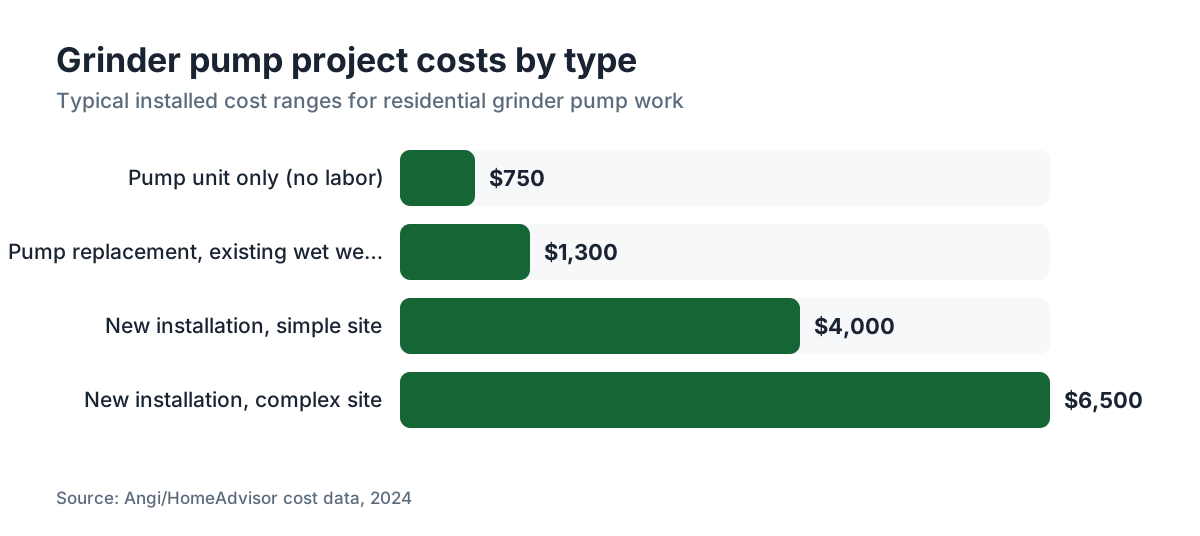
Installed cost is a different number. Replacing an existing pump in an existing wet well, a licensed plumber or pump contractor typically charges $800 to $1,800 all-in, depending on region and any electrical work. A full new installation with excavation, the fiberglass or polyethylene wet well, riser, lid, alarm panel, and electrical connection runs $3,000 to $6,000 or more in most markets, higher in areas with difficult soil or strict permitting [3].
The table below shows rough cost ranges by project type.
| Project Type | Low Estimate | High Estimate | Notes |
|---|---|---|---|
| Pump replacement only (existing wet well) | $800 | $1,800 | Labor + pump unit |
| New wet well + pump, simple site | $3,000 | $5,000 | Includes excavation, electrical |
| New wet well + pump, complex site | $5,000 | $8,000+ | Rocky soil, long trench, permit fees |
| Pump unit only (DIY-sourced) | $300 | $1,200 | No labor |
| Annual electricity cost (1 HP, avg. use) | $30 | $80 | Varies by local rate and household size |
Permit costs swing hard by state and county. Many jurisdictions require a permit for any new pump installation, and some make you pull a separate electrical permit through a licensed electrician. Budget $150 to $500 for permits in most areas, though you genuinely cannot predict this without calling your county health or building department.
For broader context on septic work pricing, the cost to install a septic system article has regional data worth a look.
How long does a grinder pump last and how often does it need maintenance?
Most residential grinder pumps last 7 to 15 years under normal household use. The wide range reflects real differences in water quality, usage volume, what gets flushed, and whether the pump runs dry or sits in corrosive conditions. Environment One, one of the dominant brands in low-pressure sewer work, states its units are "designed for a service life of 20 years" under normal operating conditions, though real-world replacement tends to center on 10 to 12 years for hard-used units [4].
What kills grinder pumps is predictable. Running dry, when a stuck float lets the pump run without liquid, burns out the motor. Hard objects, gravel, metal fasteners, and the endless category of things people should not flush damage or jam the blades. A failed seal lets water into the motor housing. Electrical surges take out pumps in areas with unstable power.
Maintenance splits into two piles: what a homeowner can do, and what needs a pump technician.
Homeowner tasks:
- Check the alarm light or audible alarm monthly to confirm the system runs normally
- Keep the area around the riser lid clear and accessible
- Do not flush wipes (even the ones labeled "flushable"), sanitary products, paper towels, or anything besides toilet paper and human waste
- Keep grease, cooking oil, and coffee grounds out of the drain
- Know where the pump breaker is and what to do when the alarm sounds
Technician tasks:
- Inspect the pump, float switches, and control panel every 1 to 3 years, per local code and manufacturer guidance
- Clean grit and debris out of the wet well
- Test the alarm
- Check and replace seals at any sign of water intrusion
Some municipalities that run low-pressure sewer systems own and maintain the grinder pumps for homeowners, covering repairs and replacement inside the sewer service fee. If you are on a municipal LPS system, check your service agreement before calling a private contractor. You may already be paying for maintenance you are about to pay for twice [5].
What are the most common grinder pump problems and how do you diagnose them?
The alarm is the first signal something is wrong. Most grinder systems include a float-triggered alarm (audible, visual, or both) that fires when the wet well level rises above normal. When it sounds, the first thing to figure out is whether the pump is running at all.
If the pump runs but the level does not drop, you likely have a blockage in the discharge line, a failed check valve letting pressure-line water back into the wet well, or a pump that has lost efficiency to blade wear or seal damage. If the pump does not run, check the circuit breaker first, then the float switch, then the control panel for fault codes.
Five problems cover most service calls:
- Float switch failure. The float gets tangled, coated in grease, or stuck in the up position, which either keeps the pump running nonstop or stops it running at all. Float switches cost $20 to $80 in parts but need wet-well entry to replace safely.
- Blade obstruction. A hard object wedges in the cutter, the motor draws excess current, and the overload protector trips. The pump has to come out of the wet well to clear it.
- Check valve failure. The check valve on the discharge line stops backflow when the pump shuts off. When it fails, every cycle first has to push back the water that drained into the wet well from the force main. That means short-cycling, more run time, and faster wear.
- Seal failure. Water gets into the motor housing and the pump eventually dies. Seal kits exist for most brands, but the labor to pull, reseal, and reinstall often costs more than a new unit depending on the pump.
- Control panel faults. The relay board, capacitor, or overload protector fails. Panel replacement runs $200 to $600 and is almost always a technician job.
If the alarm sounds and you cannot restore normal operation within a few hours, cut water use in the house. The wet well holds very little. A 30-gallon wet well with a household using 60 to 80 gallons per person per day overflows within hours once the pump is fully offline. Call a pump service company rather than waiting it out [6].
For broader repair context, see the septic system repair guide.
What should you not flush or drain into a grinder pump system?
Grinder pumps are tough, but they have limits. The blades are built for soft organic material and toilet paper. They are not built for steady contact with hard, fibrous, or chemically aggressive material.
Keep all of these out of a grinder pump system:
- "Flushable" wipes of any kind. The Federal Trade Commission has taken enforcement action against wipe makers over misleading "flushable" claims, and wastewater utility testing keeps finding that these wipes do not break down in pump wet wells [7]. They tangle in the cutter and jam the pump. Full stop.
- Paper towels, facial tissue, and napkins
- Feminine hygiene products, condoms, dental floss
- Coffee grounds, eggshells, food scraps from garbage disposals (minimize disposal use in any grinder pump home)
- Grease, cooking oil, and fat, which harden on the cutter blades and inside force mains
- Medications and harsh chemicals, which attack seals and disrupt the receiving treatment system
- Cat litter, including "flushable" varieties
- Aquarium gravel, sand, or any grit, which grinds down blades and impellers
The EPA's SepticSmart program says: "Only flush toilet paper. Never flush wipes, even ones labeled flushable," and specifically names grease, chemicals, and medications as items that damage both septic components and the wider treatment process [8]. That guidance covers conventional systems too, but it hits harder for grinder pumps, because a jam means a service call, an alarm, and possible sewage backup.
How do you choose the right grinder pump for your home?
Sizing a grinder pump is not something you eyeball. You need three numbers: the total dynamic head (TDH) the pump must overcome, the required flow rate, and the electrical supply available at the wet well.
Total dynamic head is the static lift (the vertical height the pump pushes fluid) plus friction losses in the discharge pipe. A 1 HP pump pushing waste 30 vertical feet through 100 feet of 1.5-inch pipe faces a very different TDH than one pushing 80 vertical feet through 300 feet. The manufacturer's curve chart maps flow rate against TDH, and your operating point has to land on the efficient part of that curve, not at the far end where the pump strains at the edge of its capacity [9].
For most single-family homes on a low-pressure sewer system, a 1 HP, 240V unit handles the load comfortably. Basement ejector applications or short runs sometimes use 1/2 HP units. Homes with several bathrooms, heavy daily water use, or unusually long force mains may need 1.5 or 2 HP.
Brand matters less than people think, because most residential grinder pumps share similar motor and cutter designs. What matters more is parts availability near you. If your local distributor stocks Environment One parts and your technician knows the brand, that is a real edge when you need a float switch at 10 pm on a Saturday. Ask your installer what they stock and service before you fixate on a name.
Alarm configuration is not optional. Most state codes and nearly all low-pressure sewer agreements require a high-water alarm. Make sure the alarm is audible from inside the house and sits on a circuit that does not switch off with the pump (a common wiring mistake). Some systems add phone or text alert modules, worth the $50 to $150 they cost if the pump serves a vacation property or a rental.
Does a grinder pump affect how often you need to pump the septic tank?
If the grinder pump feeds a conventional septic tank, that tank still needs pumping on the same schedule a gravity system would. The grinder changes the delivery, not the fact that solids build up in the tank. A typical residential septic tank needs pumping every 3 to 5 years, though the right interval depends on tank size and household occupancy [10]. See the how often to pump septic tank guide for the full sizing table.
One thing the grinder does do is shrink the particle size of the solids entering the tank. Finely ground material settles differently than whole solids, and some research suggests pressure sewer systems with grinder pumps may deliver more suspended solids per gallon to the receiving system than gravity systems, because the grinding creates fine particles that stay suspended longer. That is a reason to keep the tank on a regular pumping schedule instead of assuming "the grinder handles it."
If the grinder pump feeds a municipal sewer instead of a septic tank, there is no on-site tank to pump and this question does not apply. If you are not sure what your system discharges to, a septic tank inspection will settle it.
SepticMind's maintenance tracking tools let operators and homeowners log pump service dates, alarm events, and upcoming pump-outs in one place. Grinder pump systems carry more scheduled maintenance than gravity systems, and those dates are easy to lose track of over a decade.
What are the electrical and safety requirements for a grinder pump installation?
Grinder pumps are submersible electrical devices sitting in a wet space full of sewage. The code and safety requirements exist for good reasons.
National Electrical Code (NEC) Article 547 covers electrical installations in wet and agricultural locations, and most jurisdictions apply these or equivalent standards to wet well work. The key requirements: a dedicated circuit sized for the motor load plus a safety margin, a ground fault circuit interrupter (GFCI) or equipment protection device, proper conduit sealing so sewer gas cannot travel up the conduit into the home, and lockout/tagout provisions so technicians can de-energize the pump before entering the wet well [11].
Wet well entry by untrained homeowners is genuinely dangerous. Hydrogen sulfide gas builds up in pump wet wells. At low concentrations it smells like rotten eggs. Above roughly 100 ppm it paralyzes the olfactory nerve, so you stop smelling it right as it turns lethal. OSHA's permit-required confined spaces standard (29 CFR 1910.146) applies to any enclosed space with restricted entry and a hazardous atmosphere, which a pump wet well can become [12]. Homeowners should not climb in. Pulling the pump by its attached rope or chain from above grade for inspection is fine. Getting into the well is not.
Backup power deserves a mention. A grinder pump stops the moment the power drops. Lose power during a storm and your sewage disposal capacity is limited to the wet well volume, typically 30 to 100 gallons. For many households that is less than a day of use. A transfer switch and generator, or a battery backup unit matched to your pump's motor size, buys real time. Generator transfer switches for well and pump systems typically run $500 to $1,500 installed.
How do grinder pumps fit into low-pressure sewer systems?
Low-pressure sewer (LPS) systems are an alternative to conventional gravity sewer collection, used where terrain, soil, or cost make gravity impractical. In an LPS system, each home has its own grinder pump wet well. Every home pumps its sewage into a shared small-diameter force main, which carries the combined flow to a central treatment facility.
The EPA has documented LPS systems as a cost-effective option for unsewered communities where site conditions rule out gravity sewers. The agency's Onsite Wastewater Treatment Systems Manual notes that pressure sewer systems can cut collection system costs by 50 percent or more compared to gravity sewers in difficult terrain [2].
In an LPS system, ownership and maintenance is the question that matters. Some utilities own the grinder pump equipment and eat repair and replacement costs. Others make homeowners own and maintain their own pumps, with the utility owning only the mains. That distinction hits your wallet, because a pump replacement at $1,500 to $2,000 every 10 to 12 years is a real household cost. Read your connection agreement carefully and ask your utility directly who is responsible for what.
LPS systems also require every connected homeowner to follow the same use restrictions. One household flushing wipes can plug a force main that affects the whole neighborhood upstream. Some utilities write use-restriction clauses into their service agreements and can bill blockage removal back to the household that caused it.
For anyone weighing a new installation, the septic tank installation and cost to put in a septic tank articles help frame whether an LPS connection or a private septic system is the cheaper path for a given lot.
When should you repair a grinder pump versus replace it entirely?
This is a judgment call with real money attached. The rule most pump technicians use: if the pump is under 7 years old and the failure is a float switch, check valve, or control panel part, repair it. If the pump is over 10 years old or has motor or cutter damage, replace it.
The math is simple. A float switch replacement costs $150 to $300 with labor. A new pump and installation costs $800 to $1,800. If the pump is 4 years old, fixing the float switch and getting another 8 years of service makes clear sense. If the pump is 12 years old and the motor is drawing excess amperage (a sign of worn bearings or windings), sinking $800 into a repair that buys 18 months before full motor failure is a poor use of money.
Ask your technician for the motor amperage reading when they diagnose the problem. Most residential grinder pump motors carry a nameplate amperage. If the running amperage is 15 to 20 percent above nameplate, the motor is working harder than it should, and you should start planning a replacement even if the pump still technically runs.
Brand continuity is worth something during replacement planning. If the wet well was built for a specific brand's footprint (Environment One units, for example, use a specific 3-inch check valve and connector format), staying with the same brand simplifies the swap. Switching brands sometimes needs adapter fittings or wet well changes that add cost.
See the septic tank repair guide for more on when to repair versus replace other septic components.
Frequently asked questions
What is the difference between a grinder pump and a sewage ejector pump?
A sewage ejector lifts waste but does not grind it first. It handles soft solids in short-run, lower-pressure jobs like lifting a basement bathroom up to the gravity drain line. A grinder pump uses hardened steel cutters to shred everything to a fine slurry before pumping, so it can push waste through small-diameter pipes over long distances and big elevation changes. Ejectors are cheaper. Grinder pumps handle the tougher work.
Can I install a grinder pump myself?
Replacing an existing pump in an established wet well is within reach for a skilled DIYer who understands electrical safety, but most jurisdictions require a permit and licensed contractor for the electrical connection. A full new installation with excavation, wet well placement, and electrical work almost always needs licensed tradespeople and inspections. Working without permits can create problems at resale and may void your homeowner's insurance if something goes wrong.
How loud is a grinder pump when it runs?
A grinder pump is audible, typically 60 to 70 dB at the riser lid, about like a running dishwasher. Inside the house you usually will not notice it. A pump in a basement wet well, rather than a buried outdoor unit, is more audible, and vibration dampening pads help. Cycle times are short, typically 30 to 90 seconds per activation, so the noise is intermittent, not constant.
What happens to the grinder pump during a power outage?
The pump stops entirely. The wet well fills from continued household use, and once it is full, sewage can back up into the lowest drains in the house. Cut water use during an outage. Most wet wells hold 30 to 100 gallons, giving a household of four roughly 6 to 12 hours of very minimal use before overflow risk. A portable generator with the right transfer switch can run most 240V grinder pump motors.
Does a grinder pump require a permit?
Yes, in nearly all U.S. jurisdictions. New installations require both a plumbing permit and an electrical permit in most states. Pump replacement in an existing wet well sometimes falls under a maintenance exemption, but many counties still require a permit. Always check with your county health or building department before starting work. Operating without a permit can complicate home sales and insurance claims.
How do I know if my grinder pump is failing?
The clearest sign is the alarm going off. Others include the pump running longer than usual each cycle, slow drains throughout the house (more than one fixture), gurgling in the force main, or an unusually high electric bill. A technician can confirm failure by measuring motor amperage against the nameplate rating and checking the float switch. Do not ignore a high-water alarm. Sewage backup follows quickly.
Can a grinder pump handle a garbage disposal?
Most manufacturers and many state codes discourage or prohibit garbage disposals on grinder pump systems. Food waste adds high volumes of suspended solids that tax both the pump and the receiving septic tank or treatment system. If a disposal is already installed, use it sparingly. Some state environmental codes specifically ban disposals on pressure sewer systems. Check your local onsite wastewater code before assuming a disposal is fine to keep.
Who is responsible for maintaining the grinder pump on a municipal low-pressure sewer system?
It depends entirely on your utility's service agreement. Some municipalities own the pump and cover all repair and replacement costs. Others transfer ownership to the homeowner at installation, so all maintenance is yours. A minority use a shared-cost or warranty model. Read your connection agreement and call your utility's customer service line if the language is unclear. Resolve this before a pump fails, not after.
What brand of grinder pump is most reliable?
Environment One (E/One) and Zoeller have the longest track records in residential LPS and private septic work respectively. Liberty Pumps and Myers are also widely serviced. Reliability data across brands is not published in any rigorous way, so local parts availability and your contractor's familiarity with a brand matter as much as nameplate specs. Ask your installer what they stock and have actually serviced over the years.
How do I reset my grinder pump alarm?
Most control panels have a manual alarm silence or reset button. Pressing it silences the audible alarm but does not fix the underlying problem, and the alarm reactivates if the wet well level does not drop. After silencing, check whether the pump is running. If it is not, check the breaker. If the breaker is fine but the pump will not run, cut household water use and call a pump service company. Do not keep resetting the alarm without addressing the cause.
What is the typical wet well size for a residential grinder pump?
Residential grinder pump wet wells are commonly 30 to 100 gallons, with 30 to 50 gallons most common for single-family homes on low-pressure sewer systems. The small size is deliberate: the pump cycles often to keep solids suspended and prevent septicity in the well. Larger wet wells show up when peak flow rates are high or when storage reserve during power outages is a design priority.
Can a grinder pump replace a conventional septic tank?
No. A grinder pump moves sewage, it does not treat it. It carries waste from one point to another under pressure. Treatment still happens downstream, either in a conventional septic tank and drain field or at a municipal or community wastewater plant. If your lot has a grinder pump feeding a septic tank, that tank still needs regular pumping and the drain field still processes effluent. The pump removes no part of the treatment chain.
How much electricity does a grinder pump use per month?
A 1 HP residential grinder pump running 15 to 30 minutes a day (typical for a family of four) uses roughly 4 to 8 kWh per month. At the U.S. average residential rate of about 16 cents per kWh, that is roughly $8 to $15 per month, or $96 to $180 per year [13]. Larger households or pumps fighting high heads run longer cycles and use more. A sharp jump in your bill with no other explanation can signal a pump short-cycling or running nonstop from a float switch failure.
Sources
- EPA, Onsite Wastewater Treatment Systems (Septic Systems) program: Grinder pump wet wells are typically accessible through a riser and lid at grade; units submerse in the wet well holding tank.
- EPA, Onsite Wastewater Treatment Systems Manual (EPA/625/R-00/008): Pressure sewer systems can reduce collection system costs by 50 percent or more compared to gravity sewers in difficult terrain or flat areas with high water tables.
- Angi, Grinder Pump Installation Cost Guide: Installed grinder pump costs range from approximately $800 for a pump replacement to $6,000 or more for a complete new installation with excavation and electrical.
- Environment One Corporation, E/One Sewer Systems product documentation: Environment One states its residential grinder pump units are designed for a service life of 20 years under normal operating conditions.
- North Carolina Department of Environmental Quality: Some municipalities operating low-pressure sewer systems own and maintain grinder pump equipment on behalf of homeowners as part of the service fee.
- EPA SepticSmart program: EPA SepticSmart states: 'Only flush toilet paper. Never flush wipes, even ones labeled flushable' and identifies grease, chemicals, and medications as damaging to septic components.
- Federal Trade Commission: The FTC has taken enforcement action against wipe manufacturers for misleading flushable labeling claims.
- EPA SepticSmart, guidance on what not to flush or put down the drain: EPA guidance specifically identifies wipes, grease, medications, and harsh chemicals as harmful to septic system components including pumps.
- Hydraulic Institute, pump standards and engineering data: Pump selection requires matching the operating point (flow rate vs. total dynamic head) to the efficient portion of the manufacturer's pump curve.
- EPA, How to Care for Your Septic System: The EPA recommends septic tanks be pumped every 3 to 5 years for typical households, with frequency varying by tank size and number of occupants.
- National Fire Protection Association, NFPA 70 National Electrical Code, Article 547: NEC Article 547 governs electrical installations in wet locations including agricultural and pump wet well applications, requiring GFCI protection and dedicated circuits.
- OSHA, Permit-Required Confined Spaces standard (29 CFR 1910.146): OSHA 29 CFR 1910.146 defines confined space entry requirements applicable to pump wet wells where hydrogen sulfide accumulation creates a hazardous atmosphere.
- U.S. Energy Information Administration, Electricity data: The U.S. average residential electricity rate used for pump operating cost estimates is approximately 16 cents per kWh as of recent EIA data.
Last updated 2026-07-09