Septic tank aerator: how it works, costs, and whether you need one
By the SepticMind Editorial Team
TL;DR
- A septic tank aerator is the heart of an aerobic treatment unit (ATU).
- It pumps air into the treatment chamber so oxygen-loving bacteria break down waste faster and cleaner than a standard anaerobic tank.
- The aerator alone costs $500 to $2,000.
- A full ATU runs $10,000 to $20,000 installed.
- They make sense on lots too small or too wet for a conventional drain field, but they need real maintenance.
What is a septic tank aerator and how does it work?
A septic tank aerator is an electric pump or diffuser that forces air into one or more chambers of a wastewater treatment tank. That extra oxygen shifts the bacterial population from slow anaerobic microbes to faster aerobic ones. Aerobic bacteria eat organic matter roughly 20 times faster than their anaerobic counterparts, so the effluent leaving an aerobic treatment unit is much cleaner before it ever touches your drain field. [1]
The simplest aerators use a rotary vane compressor or a linear piston compressor to push air through a diffuser at the bottom of the treatment chamber. Some higher-end units spin the air in with a propeller-style agitator. The goal is the same either way: get dissolved oxygen high enough (usually above 2 mg/L) that aerobic bacteria thrive and anaerobic bacteria stay suppressed.
A full aerobic treatment unit (ATU) usually has three or four chambers. Solids settle out first in a trash tank or pre-treatment chamber, much like a conventional septic tank. The aerated chamber comes next. Then a clarification chamber lets remaining solids settle before the clarified effluent moves to a disinfection stage (usually a chlorine tablet feeder or a UV light) and finally to the drain field or, in some states, surface spray irrigation. [2]
Conventional anaerobic tanks never reach that disinfection step. That gap is why ATU effluent hits a much higher treatment standard, often on par with secondary treatment at a municipal plant.
What is the difference between an aerobic and anaerobic septic system?
The short answer is oxygen. A conventional septic tank is sealed, oxygen-free, and runs entirely on slow anaerobic bacteria. An aerobic system pumps air in around the clock, feeds faster aerobic bacteria, and produces effluent that meets a higher quality standard before it hits the soil.
Here is the two systems side by side:
| Feature | Conventional (Anaerobic) | Aerobic Treatment Unit (ATU) |
|---|---|---|
| Oxygen in tank | None | Continuous air injection |
| Bacteria type | Anaerobic | Aerobic (plus some anaerobic) |
| Effluent quality | Primary treatment | Secondary or better |
| Typical BOD removal | 30 to 50% | 85 to 98% [10] |
| Disinfection stage | No | Usually yes (chlorine or UV) |
| Drain field required | Yes, standard size | Often smaller, or spray irrigation |
| Moving parts | None (or just a pump) | Aerator motor, possibly UV, chlorine feeder |
| Monthly maintenance | Minimal | Required; often a service contract |
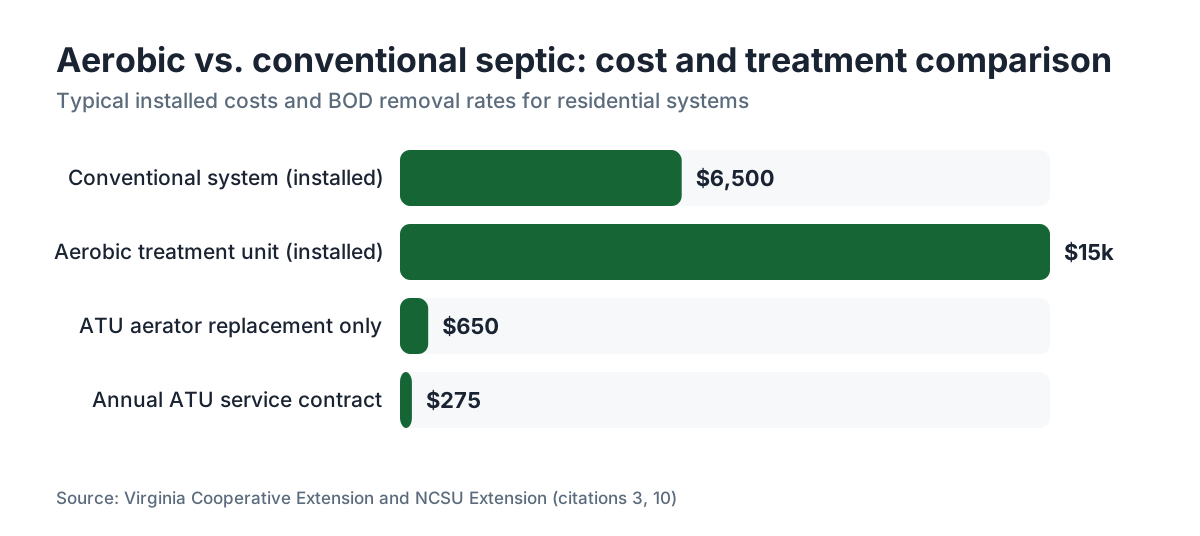
| Installed cost | $3,000 to $10,000 [3] | $10,000 to $20,000+ [3] |
| Aerator replacement cost | N/A | $500 to $2,000 |
For a lot that perc-tests fine and has room, a conventional system almost always wins on cost and simplicity. ATUs earn their price on hard sites: small lots, high water tables, setback problems, failing conventional systems that can't be repaired the usual way. [2]
What are the different types of septic aerators?
Not all aerators are alike, and the type installed drives your maintenance costs and how long the unit lasts.
Rotary vane compressors push air through an impeller and are the most common unit on residential ATUs. They run quietly and put out steady airflow, but the vanes wear down and need replacement, usually every two to three years. Replacement vane kits run $30 to $80.
Linear diaphragm (piston) compressors pump a rubber diaphragm back and forth with a magnet. Fewer moving parts, they run cooler, and the diaphragm swap costs less than vane kits. You'll find them on brands like Norweco Singulair and Jet ATU systems. Diaphragm replacement runs about $20 to $60. [4]
Shaft aerators and aspirators spin a propeller at the waterline to churn air into the liquid mechanically. These show up more on larger commercial ATUs than on typical residential systems.
Diffused aeration systems push compressed air through fine-bubble or coarse-bubble diffusers at the tank bottom. Fine-bubble diffusers transfer oxygen more efficiently but clog more easily. They need periodic cleaning, especially in systems treating high-strength waste.
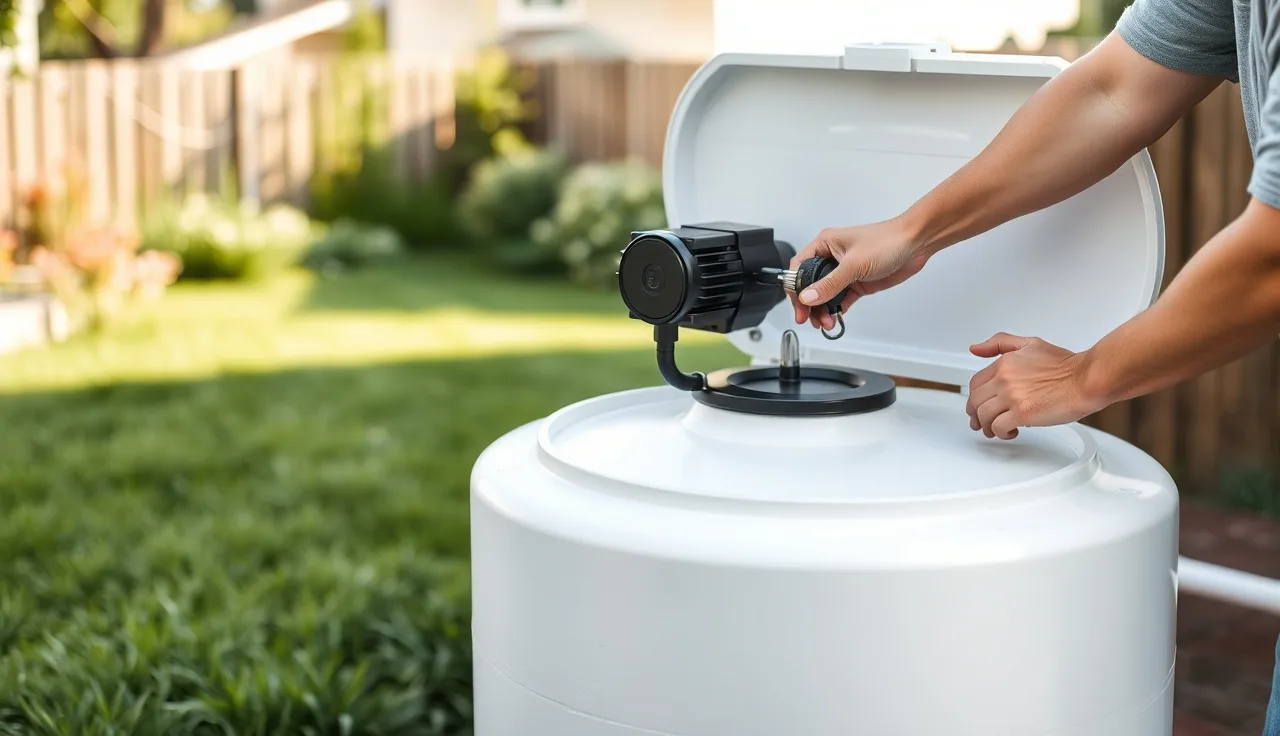
For most homeowners, the aerator is a black or gray motor housing bolted to the tank lid or sitting inside a riser. It hums quietly when it's working. Silence is the most common sign of trouble.
How much does a septic tank aerator cost to buy and replace?
Aerator-only replacement runs about $150 to $600 for the compressor itself, depending on brand and type. [4] Labor adds $100 to $400 depending on how easy the tank is to reach. A full aerator swap typically lands at $300 to $1,000.
If the entire ATU needs replacement because the tank shell failed or the system was never permitted right, the cost climbs fast. A new aerobic system installed from scratch runs $10,000 to $20,000 in most states, with outliers in both directions depending on soil, local permitting fees, and whether a new drain field or spray irrigation system has to come with it. [3]
Some brand costs (prices vary by region; get at least two quotes):
- Norweco Singulair aerator motor: roughly $400 to $700
- Jet ATU aerator: roughly $300 to $600
- Infiltrator AX-Series compatible compressor: roughly $200 to $500
- Generic linear diaphragm compressor (aftermarket): $100 to $250
Service contracts are often required by state rule for ATU owners. They run $150 to $400 per year and usually cover one to four maintenance visits. [2] Skipping the contract is tempting, but many states tie your operating permit to proof of an active service agreement. Skip it and you're looking at a permit violation, more than a mechanical risk.
For a full picture of what it costs to put a new system in the ground, see our guide to the cost to install a septic system.
When does a septic system actually need an aerator?
Most homes on septic don't need an aerobic system. A properly sized conventional system on a lot with decent soil absorption is cheaper, simpler, and has no motor to burn out at 2 a.m.
ATUs make the most sense in these specific spots:
Failing conventional system with no room for a new drain field. If your leach field has failed and the lot is too small or too boxed in by setbacks to install a replacement, an ATU producing high-quality effluent may get you a permit for a much smaller replacement area. [2] EPA's SepticSmart program points to alternative systems like ATUs as the answer on tight lots.
High water tables. If seasonal groundwater rises within a few feet of the surface, conventional drain fields can't hold the required separation distance. An ATU with surface spray irrigation may be permitted where a conventional system would not. [5]
Nutrient-sensitive watersheds. Some states or counties near lakes, estuaries, or drinking water sources require advanced treatment. Florida mandates nitrogen-reducing advanced systems in certain designated areas. [6] Check your county health department rules.
Lot size below the minimum for conventional systems. Many state codes set a minimum lot size for conventional drain fields. Fall below that line, and an ATU paired with a reduced-footprint dispersal area can sometimes clear a permit.
If none of those fit your situation, an aerobic system adds cost and complexity for very little in return. A septic tank inspection is the right starting point if you're not sure what your lot can support.
How do you maintain a septic tank aerator?
Aerators need more attention than anything in a conventional septic system. The motor runs 24 hours a day, 365 days a year. That duty cycle wears parts out, and ignoring it turns a $200 diaphragm replacement into a $15,000 system replacement.
Here is what regular maintenance looks like:
Monthly checks you can do yourself. Listen for the aerator hum. Watch for the alarm light or buzzer (most ATUs have one). Check the chlorine tablet feeder or UV system per your manual. Look for standing sewage or odd smells around the tank lid.
Annual or semi-annual service visits (often required by permit). A licensed technician checks dissolved oxygen in the aeration chamber, inspects and cleans the diffuser or aerator housing, tests chlorine residual in the final effluent, checks the clarifier for sludge buildup, and inspects the control panel and float switches. Some states require quarterly visits. [2]
Pump-out schedule. ATUs still build up solids in the trash tank. Most manufacturers recommend pumping every one to three years, same as a conventional tank. Neglect it and raw solids push into the aeration chamber and can wreck the aerator mechanism. See our guide on how often to pump a septic tank for benchmarks.
Aerator motor replacement. Plan on replacing the motor or compressor every three to seven years depending on brand and quality. Keep a spare diaphragm or vane kit on hand so you're not waiting on shipping when the alarm goes off.
For operators running multiple ATU accounts, tracking service contracts, visit schedules, and alarm history across dozens of properties is where software like SepticMind helps, since permit compliance rides on documented visit records.
One thing that kills ATUs fast: flushing anything that doesn't break down easily. Wipes, feminine products, heavy grease, and large slugs of household cleaner all disrupt the bacterial colony in the aeration chamber. The same rules that apply to conventional systems apply here, just with a shorter margin for error.
What happens when a septic aerator fails?
When the aerator motor stops, the aeration chamber reverts to anaerobic conditions within 24 to 48 hours. The aerobic bacteria crash. Treatment quality drops sharply, and you're running a conventional tank through a system built for higher effluent standards.
In the short term, this may not cause an immediate backup if your drain field has spare capacity. But if your ATU was permitted specifically because a conventional-sized field wasn't possible, degraded effluent hitting an undersized field can push it toward failure faster than on a properly sized system.
Most ATU control panels have an audible alarm and a warning light that fire when the aerator loses power or trips a circuit. Don't silence the alarm and walk away. In many states, failing to restore a working aerator within a set window (often 24 to 72 hours) is a permit violation. [2]
Common failure modes:
- Burned-out motor from continuous operation without adequate cooling, or from age. Replace the motor unit.
- Worn diaphragm or vanes cutting airflow below the treatment threshold. Replace the consumable parts.
- Clogged diffuser from calcification or biofilm. Clean or replace the diffuser.
- Tripped breaker from a power surge or water intrusion. Check the breaker, and inspect for wiring damage before resetting.
- Float switch failure causing the unit to run dry or cycle wrong.
If the aerator fails and the system needs broader repair, our septic system repair guide covers what to expect.
Does a septic aerator smell, and what can you do about it?
A working ATU should produce almost no smell at ground level. Aerobic treatment oxidizes the sulfur compounds that give conventional septic systems their rotten-egg reputation. If your ATU is running right, odor is not normal.
Odor from an ATU usually points to one of these problems:
Dead aerator. Anaerobic conditions return fast, and hydrogen sulfide (the rotten egg smell) follows. Check the alarm panel and listen for the motor.
Chlorine feeder empty or failed. Some odor from the final effluent shows up if disinfection is lost, though it smells different from the sulfur of a dead aerator.
Solids carryover from an overloaded trash tank. If the pre-treatment chamber hasn't been pumped in too long, solids carry into the aeration chamber and overwhelm it. Schedule a septic tank pump out.
Cracked or damaged riser lids. Even a working system leaks odor if the lids don't seal. Inspect them after heavy rain or a freeze-thaw cycle.
Improper venting. The plumbing vent stack on your house should carry odors up and away. A blocked vent can push sewer gas back toward grade.
Odor complaints are one of the more common reasons a neighbor calls the health department. Diagnosing and fixing it fast is worth it on several fronts.
Are septic aerators worth the cost?
That depends almost entirely on your situation. If you have a normal lot with working conventional septic, adding an aerator to your existing tank is almost never worth it. Some products get marketed as drop-in add-on aerators that "boost" treatment in a conventional tank. The evidence that these retrofits meaningfully improve performance or extend drain field life is thin. You'd get more value from a septic tank cleaning and a proper pump-out schedule.
Where ATUs genuinely earn the premium:
- Your lot can't support a conventional drain field and an ATU is the only permitted path to a working system.
- You're in a regulated watershed where advanced treatment is legally required.
- The alternative is connecting to municipal sewer at a cost higher than the ATU.
EPA's SepticSmart program frames alternative systems, including aerobic treatment units, as a good fit when site conditions limit conventional systems. [1] That framing is honest. They solve constrained situations. They're not an upgrade everyone needs.
For operators running ATU service routes, the recurring revenue from mandatory service contracts makes ATU accounts attractive. Tracking those contracts, inspection records, and alarm histories across a territory is where good operational software earns its keep. SepticMind was built partly around that kind of recurring service management.
Bottom line: don't buy an ATU because a salesperson says it will make your system "more efficient." Buy one because your local health department says you need it, or your site conditions leave no other option.
What do state regulations say about aerobic treatment units?
ATU regulation is almost entirely a state and local matter in the U.S. EPA sets broad guidance but does not directly regulate individual onsite systems. [5] State environmental or health agencies write the rules, and they vary a lot.
Common patterns:
Mandatory service contracts. Most states that permit ATUs require an active service agreement with a licensed professional as a condition of the operating permit. Texas requires a maintenance contract for ATUs under Title 30 of the Texas Administrative Code, Chapter 285. [7]
Nitrogen reduction requirements. Florida's Onsite Sewage Treatment and Disposal Systems program requires advanced nitrogen-reducing systems in certain sensitive areas, which usually means an ATU with enhanced nutrient removal. [6]
Inspection frequency. State rules typically require quarterly, semi-annual, or annual inspections by a licensed service provider, with documentation filed with the permitting authority.
Approval lists. Most states keep a list of ATU models approved for use. Using an unapproved unit can void your permit. Check your state's environmental or health department website before buying any system or replacement component.
Setback requirements. ATUs often allow reduced setbacks from property lines, wells, or surface water compared to conventional systems, but only if the system meets the state's treatment standard. Cutting setbacks without the right permit is a violation.
Buying a property with an existing ATU? Verifying a current operating permit and an active service contract belongs in your due diligence. A septic tank inspection by a licensed inspector who knows ATUs is the right tool for that.
How long does a septic tank aerator last?
The aerator motor or compressor typically lasts three to seven years under continuous residential use. The consumable parts, diaphragms and vanes, wear out faster, usually every two to four years. [4]
Tank life is a separate question. The fiberglass, concrete, or polyethylene tank that houses the ATU can last 30 to 50 years if installed right and never subjected to traffic loading or ground movement. The mechanical parts inside are what need regular attention.
Factors that shorten aerator life:
- High-strength waste (large households, heavy kitchen use)
- Power surges or outages that cause the motor to cycle wrong
- Water intrusion into the motor housing
- Running the aerator dry when liquid levels drop abnormally
- Deferred maintenance that lets solids pile up around the diffuser
Factors that stretch aerator life:
- Using a quality compressor from a reputable ATU manufacturer
- Installing a surge protector or UPS on the control panel
- Keeping to the manufacturer's maintenance schedule
- Cleaning the diffuser once a year
Budget for one aerator replacement every five years as a planning assumption. It's a cheaper bet than hoping the original unit lasts forever.
Can you add an aerator to an existing conventional septic tank?
You can physically drop a small aerator into an existing conventional tank, and several products are sold for exactly this. The real question is whether it accomplishes anything meaningful, or is even legal where you live.
On the mechanical side, a retrofit aerator can raise dissolved oxygen in the tank and shift the bacterial population toward aerobic species. Whether that measurably improves effluent quality or extends drain field life is unclear. Controlled studies on retrofit aerators in residential-scale tanks are sparse, and the industry has no solid field data. The closest analogy is research on small aerobic reactors, which shows aerobic treatment works well when it's designed in from the start, but retrofit conditions are far less controlled. [1]
On the regulatory side, most states treat an aerated conventional tank as a modified system that needs a new or amended permit. You can't bolt on a hardware-store aerator and claim your system meets ATU standards. If your goal is a smaller drain field or reduced setbacks, you need a properly engineered and permitted ATU, not a retrofit.
That said, if your conventional system works fine and you want to run a small submersible aerator to keep the tank active during a vacation property's off-season, the harm is low even if the benefit is marginal. Just don't let it stand in for proper septic tank pumping and maintenance.
For a drain field that's already struggling, read our leach field guide before spending money on aerator retrofits.
Frequently asked questions
How do I know if my septic aerator is working?
Listen for the quiet hum of the compressor motor near the tank lid. If the ATU has a control panel, no alarm light should be lit. A technician can confirm performance by measuring dissolved oxygen in the aeration chamber, which should sit above 2 mg/L for good aerobic activity. Silence from the motor or a lit alarm light are the two most common signs of failure.
What size aerator does my ATU need?
The ATU manufacturer specifies aerator sizing for each tank model and household size. Residential ATUs typically use compressors rated from 1 to 6 cubic feet per minute of airflow. Always replace with the same brand and model the system was designed for, or a verified compatible unit. An undersized replacement cuts treatment quality; an oversized one can disrupt clarification.
How often should a septic aerator be serviced?
Most state rules require at least annual service by a licensed technician, and many require quarterly or semi-annual visits. Manufacturers typically recommend inspecting the aerator every six months, cleaning or replacing the diffuser annually, and replacing diaphragm or vane parts every two to three years. Check your state's onsite wastewater rules and your ATU permit for the exact requirement in your area.
Can a septic aerator fix a failing drain field?
Not directly. An ATU produces cleaner effluent that's less likely to clog drain field soil over time, but it won't dissolve biomat already built up in a failed field. In some cases, resting the field while running an ATU allows partial recovery, though that strategy has limited evidence behind it. A failed field usually needs repair or replacement no matter how good the tank treatment is.
What brand of septic aerator is the most reliable?
Norweco, Jet, and Orenco are among the longest-established ATU manufacturers in the U.S., with wide availability of replacement parts. Infiltrator Water Technologies and Consolidated Treatment Systems also have strong market presence. No independent long-term study compares residential ATU brands head to head. The factor that matters most is whether parts and qualified service techs are available in your region.
Does a septic aerator use a lot of electricity?
Most residential ATU compressors draw 1.5 to 5 amps continuously, or roughly 150 to 600 kWh per year. At the U.S. average electricity rate of about 16 cents per kWh in 2024, that's $24 to $96 per year in power cost. [9] Linear diaphragm compressors tend to use less power than rotary vane models for the same airflow.
Is a septic aerator the same as a septic aerator pump?
These terms mean the same device. Aerator, aerator pump, and air pump are all names for the compressor or blower that forces air into the treatment chamber. Some people also call it an air compressor or diffuser pump. The wording changes by brand and region, but the job is identical: deliver oxygen to the aeration chamber to support aerobic bacterial treatment.
What happens if I don't replace a broken septic aerator quickly?
Without aeration, the treatment chamber reverts to anaerobic conditions within 24 to 48 hours. Aerobic bacteria die off and effluent quality drops to roughly conventional tank levels or worse. On systems with undersized drain fields permitted specifically for ATU-quality effluent, this can speed up field failure. Many state permits require restoring a failed aerator within 24 to 72 hours to stay in compliance.
Do I need chlorine tablets if my ATU has a UV system?
No. You use one disinfection method or the other, not both. UV and chlorine tablet feeders are alternative disinfection stages for ATU effluent. UV is chemical-free but needs a working lamp and regular lamp replacement. Chlorine feeders are simpler but need periodic tablet refills and monitoring for residual levels. Your permit will spell out which method is approved for your system.
How much does it cost to install a full aerobic septic system?
A complete aerobic treatment unit system installed from scratch typically costs $10,000 to $20,000 in the U.S., including the ATU tank, aerator, disinfection system, control panel, dispersal field, and permitting. Costs vary widely by state, soil conditions, lot access, and whether spray irrigation or a conventional drain field handles final dispersal. Some complex installations top $25,000.
Are aerobic septic systems required in some areas?
Yes. Some counties and states in nutrient-sensitive watersheds require advanced treatment systems for new construction or system replacements. Florida's program mandates nitrogen-reducing advanced systems in specific designated areas. Some Texas counties require ATUs broadly regardless of lot conditions. Check with your county health department or state environmental agency before designing or replacing any system.
Can I run my ATU without a service contract?
In many states, no. The operating permit for an ATU is often conditioned on keeping an active service contract with a licensed provider. Running without one can bring a permit violation, fines, or an order to stop using the system. Even where a contract isn't legally required, ATUs have enough moving parts and reporting requirements that professional service is practically necessary.
How deep is a septic tank aerator installed?
The aerator motor or compressor typically mounts above grade on the tank lid or inside a riser extension, with only the air tubing and diffuser dropping into the treatment chamber. The diffuser sits near the bottom of the aeration chamber, usually 3 to 6 feet below grade depending on tank depth. The motor housing itself should be reachable without excavation.
Sources
- U.S. EPA, SepticSmart Program: EPA SepticSmart acknowledges aerobic treatment units as an alternative for constrained sites and notes aerobic bacteria break down waste faster than anaerobic bacteria.
- U.S. EPA, Onsite Wastewater Treatment Systems Manual: EPA manual describes ATU treatment stages, effluent quality standards, and the requirement for maintenance contracts and periodic inspections.
- Virginia Cooperative Extension: Installed cost ranges for conventional and aerobic septic systems; conventional systems $3,000 to $10,000, ATUs significantly higher.
- University of Minnesota Extension, Onsite Sewage Treatment Program: Aerator motor and compressor types, expected service life of 3 to 7 years for motors, and consumable part replacement intervals.
- U.S. EPA, How Your Septic System Works: EPA notes onsite septic system regulation is primarily the responsibility of state and local governments; EPA sets guidance not direct regulation.
- Florida Department of Health, Onsite Sewage Programs: Florida mandates nitrogen-reducing advanced treatment systems in certain nutrient-sensitive designated areas.
- Texas Commission on Environmental Quality, On-Site Sewage Facilities: Texas requires a maintenance contract for all aerobic treatment units as a condition of the operating permit under Title 30 TAC Chapter 285.
- National Onsite Wastewater Recycling Association (NOWRA): Industry body for onsite wastewater; provides model performance standards and installer certification frameworks referenced by multiple state programs.
- U.S. Energy Information Administration, Electricity Data: U.S. average retail electricity price approximately 16 cents per kWh in 2024, used to calculate annual aerator operating cost.
- North Carolina State University Extension: Aerobic bacteria in ATUs achieve 85 to 98% BOD removal versus 30 to 50% in conventional anaerobic tanks; describes system components and maintenance needs.
Last updated 2026-07-09