Septic tank vs sewage treatment plant: which system do you have?
By the SepticMind Editorial Team

TL;DR
- A conventional septic tank uses anaerobic bacteria to settle and partially treat wastewater before releasing effluent to a drain field.
- A sewage treatment plant (also called an aerobic treatment unit) adds oxygen to speed up treatment and produce cleaner effluent.
- Septic tanks cost less upfront and have no moving parts.
- Treatment plants need electricity and a service contract.
- Both are regulated by state and local codes under EPA guidance.
What is the difference between a septic tank and a sewage treatment plant?
Here is the short answer. A septic tank is a passive underground vessel where solids settle and anaerobic bacteria partially break down waste. A sewage treatment plant, in a residential setting usually called an aerobic treatment unit (ATU) or packaged wastewater plant, pumps air into the treatment chamber to speed up and improve that biological process.
Both sit on private property and treat the wastewater from one home or a small cluster of homes. Neither connects to a municipal sewer. That is where the similarity ends.
In a conventional septic tank, wastewater enters, heavy solids sink to the bottom as sludge, fats and oils float to the top as scum, and the middle liquid layer (effluent) flows out to a leach field where soil finishes the treatment [1]. No electricity, no mechanical parts. It is simple, which is why tens of millions of U.S. households still run on it.
A residential sewage treatment plant runs an electric blower or diffuser that forces air into the treatment chamber. That oxygen feeds aerobic bacteria, which digest organic material faster and more completely than anaerobic bacteria can. The effluent leaving an ATU is clearer and has a lower biological oxygen demand (BOD) than what drains out of a conventional tank [2]. That cleaner output sometimes allows a smaller or alternative drain field, which matters on tight lots and near sensitive water.
How does a conventional septic tank work (the anaerobic process)?
Wastewater from your toilets, sinks, showers, and appliances flows into the tank through the inlet pipe. Three zones form almost immediately [1]:
- Scum layer (top): fats, oils, grease, and anything that floats.
- Effluent zone (middle): the liquid that moves toward the outlet.
- Sludge layer (bottom): heavy solids that settle and get slowly digested by anaerobic bacteria.
Anaerobic treatment is exactly what the name says: digestion without oxygen. Anaerobic bacteria break organic solids into gases (carbon dioxide, methane, hydrogen sulfide) and more stable byproducts. The process runs continuously as long as the tank is not overloaded and gets pumped on a reasonable schedule.
The effluent that leaves the tank is not clean water. It still carries pathogens, nitrates, and dissolved organics. The soil in the drain field does the final filtration, and that combined system is what the EPA means by "onsite wastewater treatment" [1]. The tank alone is only step one.
How fast sludge builds up depends on household size and what goes down the drain. A 1,000-gallon tank serving a family of four accumulates roughly 50 to 75 gallons of sludge a year, though nobody has clean data on this because every household is different. The EPA SepticSmart program tells most owners to inspect every three years and pump when sludge plus scum fills more than a third of the tank [1].
The septic tank pumping guide covers scheduling and costs.
How does a residential sewage treatment plant work?
A residential ATU usually has three or four chambers. Wastewater enters a pretreatment or trash trap chamber first, where large solids settle out, same as in a conventional tank. The liquid then moves into an aeration chamber where a compressor or blower forces air through diffusers or a spray nozzle [2]. That oxygen supports a dense colony of aerobic bacteria that digest organic waste far harder than anaerobic organisms do.
After aeration, the treated liquid passes into a clarifier or settling chamber where any remaining solids drop out. The final effluent, now much cleaner, flows to a smaller drain field or sometimes to a disinfection stage (a UV unit or chlorine tablet) before it reaches the ground [3].
The result is measurably cleaner output. A well-running ATU can cut BOD by 90 to 95 percent before the effluent ever touches soil, against roughly 50 percent for a conventional septic tank [2]. Some states require ATUs when lots are too small for a standard drain field, when soil drains poorly, or when the property sits near a water body.
The trade-off is maintenance. ATUs have moving parts, an electric motor, and components that wear out. Most state rules require a service contract with a licensed technician who inspects the system quarterly or twice a year [3]. That ongoing cost is real, and it surprises a lot of first-time ATU owners.
Should you choose a septic tank or a treatment plant for your property?
For most lots with decent soil and enough space, a conventional septic tank is the right call. It is simpler, cheaper to install and maintain, and has nothing mechanical to fail. The cost to install a septic system with a conventional tank and drain field runs $3,500 to $12,000 depending on soil, tank size, and local labor [4].
A residential sewage treatment plant makes sense in a few specific situations:
- Failing soil: if your perc test comes back too slow for a standard drain field, an ATU's cleaner effluent may open up an alternative dispersal system.
- Lot size: small lots in some states can use ATUs with a reduced drain field footprint.
- Proximity to water: shoreline properties and those near wellheads often face rules that effectively require advanced treatment [3].
- Replacing a failed system: if the old tank is shot and the soil has degraded, an ATU might be the only permitted path forward.
You do not get to make this call entirely on your own. State and county health or environmental agencies issue the permit, and they specify what type of system is allowed based on a site evaluation and soil test. Some states publish lists of approved ATU models. Others are looser.
My honest opinion: if a conventional system is permitted on your lot, take it. The ATU's cleaner effluent is genuinely better for the environment, but the mandatory service contracts, electricity, and higher repair frequency make it more expensive to own over 20 years. Go with the ATU when the regulations require it, or when your soil leaves no other viable option.
What does a septic tank or treatment plant cost to install?
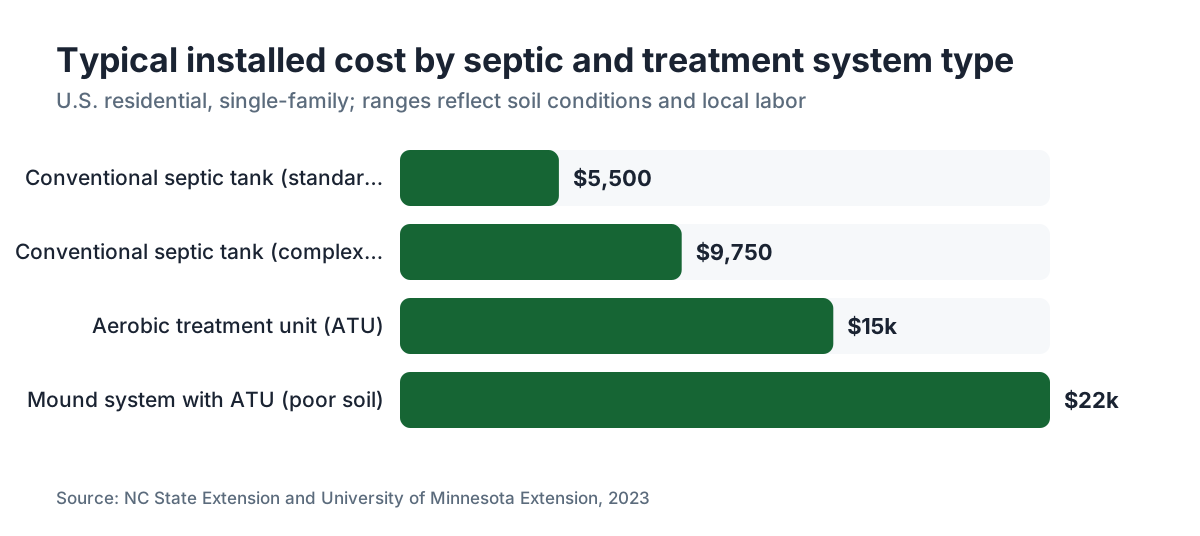
Installation costs vary enough that any single number lies to you, but here is the honest range based on contractor data and state extension research [4][5]:
| System type | Typical installed cost (U.S.) | Notes |
|---|---|---|
| Conventional septic tank (concrete, 1,000 gal) | $3,500 - $7,500 | Includes tank, inlet/outlet, basic drain field |
| Conventional septic tank (large lot, complex soil) | $7,500 - $12,000 | Deeper excavation, larger field |
| Aerobic treatment unit (ATU) | $10,000 - $20,000 | Includes blower, controls, service contract setup |
| Mound system with ATU | $15,000 - $30,000 | Poor soil, requires elevated drain field |
| Municipal sewage treatment connection fee | $5,000 - $30,000+ | Highly location-dependent |
Those ATU numbers assume a standard single-family home. Larger lots, rocky soil, or high groundwater all push costs up. The cost to put in a septic tank guide breaks down each line item.
Installation is only the start. A conventional septic tank costs roughly $300 to $600 to pump every 3 to 5 years and needs a septic tank inspection every 1 to 3 years. An ATU adds $150 to $500 a year in electricity plus $200 to $600 a year in mandatory service contract fees [4]. Over 20 years, those operating costs pile $7,000 to $22,000 onto the ATU's total cost of ownership compared to a conventional system.
What are the maintenance requirements for each system?
Maintenance is where conventional tanks and treatment plants split hard, in both effort and cost.
For a conventional septic tank, the EPA SepticSmart program lays out the core rule: "Inspect your system every 3 years and pump when solids reach one-third of tank capacity" [1]. In practice most households pump every 3 to 5 years, keep a record of pumping dates, avoid flushing anything that is not human waste or toilet paper, and keep vehicles and deep-rooted plants off the drain field. That is basically it. No service contract in most states, no electricity, no monthly tasks beyond watching what goes down the drain.
An ATU comes with a longer list:
- Quarterly or semi-annual inspections by a licensed technician (often required by permit [3]).
- Annual or biennial replacement of the air diffusers or splash plates inside the aeration chamber.
- Periodic sludge removal from the settling chamber (typically every 1 to 3 years).
- Monitoring the disinfection system if chlorine tablets or UV are part of the setup.
- Checking the blower motor and replacing it every 5 to 10 years.
Let any of those tasks slide on an ATU and you are looking at a permit violation, not only a performance problem. Many states require the service provider to file inspection reports with the county.
See the how often to pump septic tank guide for the pumping frequency math by household size and tank volume.
What regulations govern septic tanks and sewage treatment plants?
The federal baseline comes from the EPA, but permitting and enforcement live at the state and local level. The EPA's Office of Wastewater Management sets guidelines through its SepticSmart initiative and the Onsite Wastewater Treatment Systems Manual, and those are guidance, not federal law [1][6]. States adopt their own codes, and counties or municipalities pile more rules on top.
A few patterns hold almost everywhere in the U.S.:
- New systems and major repairs need a permit from the county health department or environmental agency.
- System design comes out of a site evaluation that includes a soil percolation test or soil morphology analysis.
- ATUs usually require a signed maintenance contract with a licensed service provider as a condition of the operating permit [3].
- Setback distances (from wells, property lines, water bodies, and foundations) are set by state code and vary a lot. Most states require at least 50 feet from a drinking water well, and some require 100 feet or more [6].
The EPA's 2002 Onsite Wastewater Treatment Systems Manual states that "the primary goals of onsite wastewater treatment are to prevent the transmission of disease and to protect water quality" [6]. That framing explains why regulators care so much about installation and maintenance: a failed system is a direct public health risk, not a nuisance.
If you are buying a home with either type of system, a septic tank inspection is non-negotiable. Some states require one at point of sale. All of them allow it.
What happens when a septic tank or treatment plant fails?
Failure looks different by system type, but both throw warning signs before they turn catastrophic.
For a conventional septic tank, failure usually means the drain field has saturated or clogged, not that the tank collapsed. Watch for soggy ground over the drain field, sewage odors in the yard or the house, slow drains everywhere, and in the worst case sewage backing up into floor drains. A single clogged pipe is a repair. A failed drain field can mean a full system replacement.
For an ATU, the failure modes include blower motor burnout (which kills aeration and lets the system slide back to anaerobic conditions), clogged diffusers, and sludge carryover into the drain field when the settling chamber is not cleaned on schedule. ATU failures often trip a permit compliance issue on top of the performance problem.
Septic system repair costs run from a few hundred dollars for a simple pipe fix to $5,000 to $15,000 for drain field rehab. Full replacement of a failed conventional system runs $8,000 to $20,000. An ATU replacement typically runs $12,000 to $25,000.
Operators managing multiple client properties use software like SepticMind to track service intervals and flag accounts overdue for inspection, which is one of the few reliable ways to catch ATU trouble before it becomes a permit violation.
The septic tank repair and septic system repair guides cover diagnosis and repair cost breakdowns in detail.
How does effluent quality compare between a septic tank and a treatment plant?
Worth understanding in real numbers, because it explains why regulators sometimes demand ATUs.
Raw residential wastewater has a BOD of roughly 200 to 300 mg/L and total suspended solids (TSS) around 200 to 250 mg/L. A well-maintained conventional tank and drain field together can drop BOD to 10 to 20 mg/L and TSS to 10 to 15 mg/L by the time effluent reaches groundwater, assuming healthy soil and proper loading rates [2][6].
A well-maintained ATU produces effluent with BOD under 30 mg/L before it even hits the drain field, often under 10 mg/L [2]. After soil treatment the numbers are similar to a conventional system, but the ATU gets there with a much smaller soil footprint. That is the engineering reason ATUs are allowed on smaller lots.
Nitrogen is a different story. Neither a conventional septic tank nor a standard ATU removes nitrogen well. Nitrogen passes through both as nitrate and can contaminate groundwater and surface water. In nitrogen-sensitive areas (the Chesapeake Bay watershed, Florida coastal zones, Cape Cod aquifer zones), states sometimes require enhanced systems with a denitrification stage that a basic ATU does not include [3][7].
Pathogens get reduced significantly by soil treatment downstream of a conventional tank, but only if the soil is doing its job: enough depth to groundwater, the right soil texture, and proper loading. An ATU's cleaner effluent buys you a buffer when the soil is marginal.
Can you convert a septic tank to a sewage treatment plant?
Yes, in most cases. It is not as simple as swapping in a new tank, though. A conversion usually takes one of two paths.
The first is replacing the existing septic tank with a new ATU. That means excavating the old tank (or decommissioning it in place per local code), installing the ATU with its blower and control panel, wiring in power, and possibly modifying the drain field or adding disinfection. Full replacement runs $10,000 to $20,000 for most residential properties [4].
The second is retrofitting an existing tank with an aeration system. Some manufacturers sell retrofit aeration kits that turn a conventional tank into a crude ATU. These are cheaper (roughly $2,000 to $5,000 installed) but generally produce lower effluent quality than a purpose-built ATU, and they may not be permitted where you live. Check with your county before buying a retrofit kit.
The reverse, converting an ATU back to a conventional septic tank, is less common but happens when owners want to shed the maintenance contract and electricity costs. Whether that is allowed depends entirely on whether your lot can support a conventional system under current rules.
Any conversion needs a new permit. Do not start excavating without one.
What should homeowners do right now to protect their system?
Whether you have a conventional septic tank or a residential sewage treatment plant, the actions that protect the system rhyme even when the specifics differ.
For conventional septic tanks:
- Know where your tank and drain field are and mark them so you do not drive over them or plant trees nearby.
- Get a septic tank inspection if you have not had one in three years.
- Schedule a septic tank pump out if you have no records showing it was done in the last 3 to 5 years.
- Stop flushing wipes (even the "flushable" ones), medications, and grease.
For ATU owners:
- Confirm your service contract is current and that inspections are actually being filed with the county.
- Listen for the blower. If it goes silent, the aerobic process stops. Call your service provider within 24 hours.
- Keep the area around the unit accessible and free of standing water.
SepticMind's maintenance tracking tools help homeowners log service dates, store inspection reports, and set reminders for the next pump-out. Sounds simple. It heads off the most common failure mode: forgetting until there is a problem.
Do not wait for the system to tell you something is wrong. By the time you smell it or see it, you are already in repair territory.
Frequently asked questions
What is the difference between a septic tank and a sewage treatment plant?
A septic tank uses passive anaerobic bacteria to partially treat wastewater, relying on the soil in a drain field to finish the job. A sewage treatment plant (aerobic treatment unit) adds electricity-powered aeration to support faster, more thorough aerobic bacterial treatment before effluent reaches the soil. ATUs cost more to install and maintain but produce cleaner effluent and can work on smaller lots.
Is a septic tank the same as a sewage treatment plant?
No. Both are onsite wastewater systems, but a conventional septic tank is a passive, unpowered settling and digestion vessel. A residential sewage treatment plant (ATU) is an active, electrically powered system with blowers, aeration chambers, and often a disinfection stage. The treatment levels differ significantly, and so do the maintenance requirements and operating costs.
Which is better, a septic tank or an aerobic treatment unit?
For most properties with adequate soil and lot size, a conventional septic tank is more practical: lower installation cost, no electricity, no mandatory service contract, and decades of reliable performance with basic maintenance. An ATU is better when poor soil, a small lot, or proximity to water bodies makes a conventional drain field impractical or unpermittable. Choose the ATU when regulations require it, not because it sounds more advanced.
How often does a residential sewage treatment plant need to be serviced?
Most state regulations require quarterly or semi-annual inspections by a licensed technician as a condition of the operating permit. Sludge removal from the settling chamber is typically needed every 1 to 3 years. The air diffuser or spray nozzle inside the aeration chamber usually needs cleaning or replacement annually. Blower motors last 5 to 10 years on average. Budget $300 to $1,000 per year in combined service costs beyond electricity.
Can a septic tank treat sewage as effectively as a treatment plant?
A conventional septic tank plus a properly functioning drain field together can produce groundwater-quality effluent with BOD under 10 to 20 mg/L, comparable to an ATU system after soil treatment. The difference is that an ATU reaches similar effluent quality before the drain field, which allows a smaller dispersal area. For nitrogen removal, neither a basic septic tank nor a standard ATU performs well without specialized enhancement.
What does anaerobic sewage treatment in a septic tank actually do?
Anaerobic bacteria in the septic tank's sludge layer break down organic solids without oxygen, converting them to gases (methane, CO2, hydrogen sulfide) and more stable byproducts. This process reduces the volume of solids and partially lowers the BOD of the effluent. It does not remove pathogens, nitrates, or dissolved organics reliably. The drain field's soil biome and filtration complete the treatment process.
How long does a septic tank or sewage treatment plant last?
A concrete septic tank typically lasts 30 to 40 years with proper maintenance. Plastic or fiberglass tanks can last as long if not structurally damaged. ATU systems have the same tank lifespan, but the mechanical components (blower, diffusers, controls) have shorter service lives, typically 5 to 15 years per component. Total system life depends heavily on soil conditions, loading rates, and how consistently maintenance is performed.
Do I need a permit to install or replace a septic tank or treatment plant?
Yes, always. Every U.S. state requires a permit from the county health department or environmental agency for new installations and major repairs. The permit process includes a site evaluation, soil test, and system design review. Installing without a permit risks fines, mandatory removal, and serious problems when you sell the property. ATUs additionally require an operating permit and usually a filed service contract.
Can I convert my conventional septic tank to an aerobic treatment unit?
Yes, two paths exist. You can replace the existing tank with a purpose-built ATU ($10,000 to $20,000 installed), or retrofit the existing tank with an aeration kit ($2,000 to $5,000) if local regulations allow it. Either path requires a new permit. Retrofit kits are cheaper but produce lower effluent quality and are not permitted in all jurisdictions. Always check with your county before buying any equipment.
What are the signs that a septic tank or treatment plant is failing?
For both system types: slow drains throughout the house, sewage odors indoors or in the yard, wet or spongy ground over the drain field, and sewage backing up into floor drains or toilets. ATU-specific warning signs include a silent blower motor and unusually dark or odorous effluent. Either system showing these signs needs professional inspection immediately, not a wait-and-see approach.
How much does it cost to maintain a septic tank versus a treatment plant annually?
A conventional septic tank costs roughly $75 to $200 per year when you amortize pumping ($300 to $600 every 3 to 5 years) and periodic inspections. An ATU costs $150 to $500 per year in electricity plus $200 to $600 per year in mandatory service contract fees, plus periodic parts replacement. Over 20 years, ATU operating costs typically exceed conventional septic costs by $7,000 to $22,000, not counting major component replacements.
Do septic tanks and treatment plants remove nitrogen from wastewater?
Neither a conventional septic tank nor a standard ATU removes nitrogen well. Both convert organic nitrogen to ammonia and then to nitrate, which passes through the drain field into groundwater. In nitrogen-sensitive watersheds such as the Chesapeake Bay area, Cape Cod, and parts of Florida, regulators may require enhanced treatment systems with a dedicated denitrification stage, which goes beyond what a basic ATU provides.
What setback distances are required for septic tanks and treatment plants?
Setback requirements vary by state and local code. Most states require at least 50 feet between a septic system and a drinking water well, but many require 100 feet or more. Setbacks from property lines are typically 5 to 10 feet; from water bodies, 25 to 100 feet depending on state. ATUs may have different setback rules than conventional tanks in some states. Always verify with your county environmental or health department before siting any system.
How do I find out what type of system my home has?
Start with the county health department or environmental agency: most keep records of permitted systems by address. The original permit, inspection report, or as-built drawing will identify the system type. If records are unavailable, a licensed septic inspector can identify the system by locating and opening the tank lids. ATUs are identifiable by their electrical conduit, blower unit, and multiple-chamber design.
Sources
- EPA SepticSmart: How to Care for Your Septic System: EPA recommends inspecting septic systems every 3 years and pumping when sludge plus scum exceeds one-third of tank volume; drain field soil completes the treatment process.
- EPA Onsite Wastewater Treatment Systems Manual (EPA/625/R-00/008): ATUs can reduce BOD by 90-95% before effluent reaches soil; conventional septic tank effluent BOD reduction is approximately 50%; aerobic treatment produces cleaner effluent allowing smaller drain fields.
- Florida Department of Health: Onsite Sewage Treatment and Disposal Systems: ATUs typically require a maintenance contract with a licensed provider as a condition of the operating permit, with quarterly or semi-annual inspection filings; states may require ATUs near water bodies.
- North Carolina State Extension: Septic System Installation and Repair Costs: Conventional septic system installation typically costs $3,500-$12,000; ATU systems typically cost $10,000-$20,000 installed; ATU electricity and service contracts add $350-$1,100 per year in operating costs.
- University of Minnesota Extension: Septic System Costs: Mound systems with ATUs on poor-soil sites range from $15,000 to $30,000 installed; conventional systems on suitable soils average $3,500-$12,000 depending on soil and lot conditions.
- EPA Onsite Wastewater Treatment Systems Manual: Regulatory Framework and Goals: EPA states the primary goals of onsite wastewater treatment are to prevent disease transmission and protect water quality; most states require setbacks of at least 50 feet from drinking water wells, with many requiring 100 feet or more.
- Massachusetts Department of Environmental Protection: Title 5 Onsite Wastewater Regulations: Nitrogen-sensitive areas such as Cape Cod aquifer zones may require enhanced treatment systems with denitrification stages beyond what standard ATUs provide.
- USDA Rural Development: Approximately 20% of U.S. homes use onsite septic systems; conventional septic tanks are the most common type in rural and suburban areas without municipal sewer access.
- Virginia Department of Health: Sewage Handling and Disposal Regulations: Chesapeake Bay watershed properties face enhanced nitrogen-removal requirements that exceed what standard septic tanks or basic ATUs can meet without additional denitrification stages.
Last updated 2026-07-10