Perc test and mantle test explained: what they measure and what they cost
By the SepticMind Editorial Team
TL;DR
- A perc (percolation) test measures how fast water moves through soil to size a septic drain field.
- A mantle test, used in some western states and California counties like Placer, measures the depth of the seasonal high water table.
- Both are required before a septic permit on most rural lots.
- Together they decide whether your site can support a system at all.
What is a perc test and what does it actually measure?
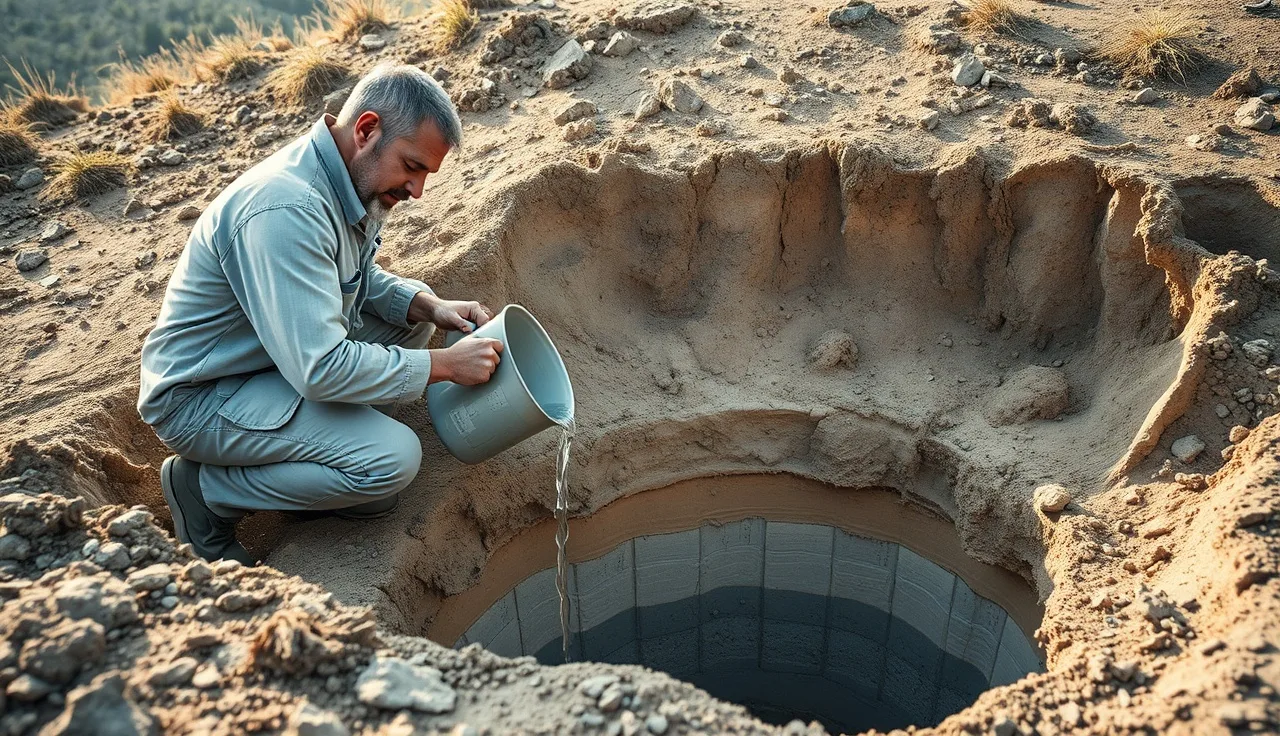
A perc test, short for percolation test, measures how fast water drains through native soil at the depth where a drain field will sit. A technician or licensed soil scientist digs or bores holes to the proposed leach field depth, soaks them with water, then times how many minutes it takes for water to drop one inch. That number is the perc rate, reported in minutes per inch (MPI).
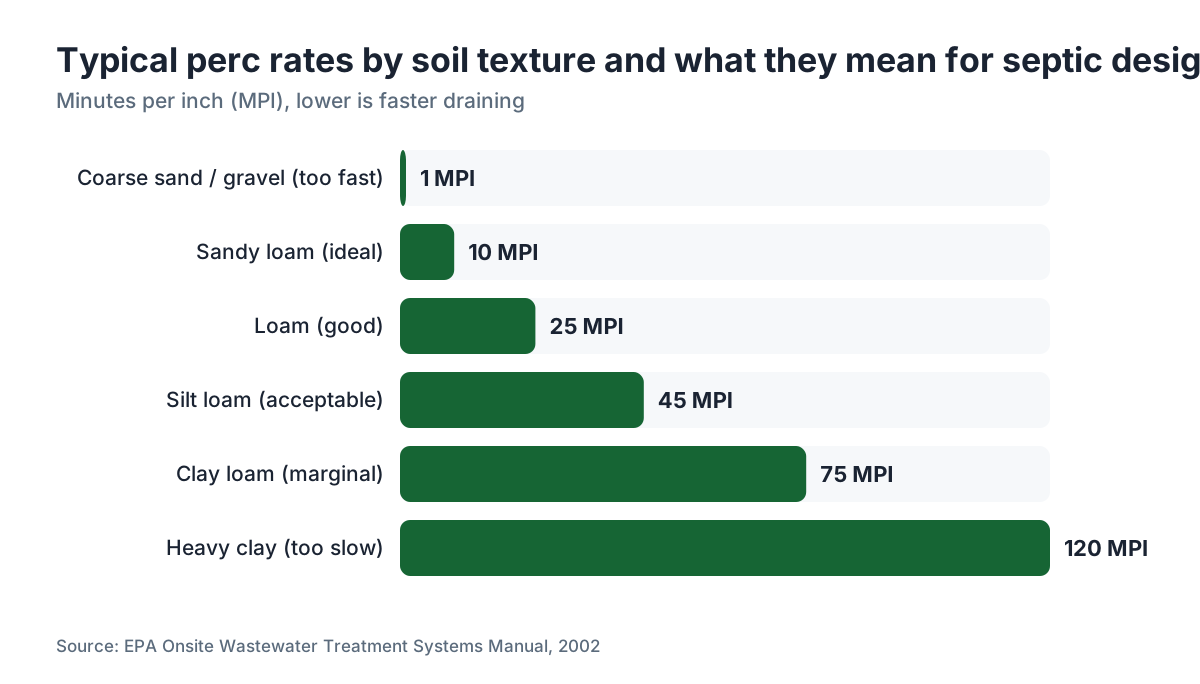
Most state codes accept soils with perc rates between about 1 MPI and 60 MPI for a conventional gravity drain field [1]. Faster than 1 MPI (extremely sandy or gravelly) and effluent drains so quickly it doesn't get treated before hitting groundwater. Slower than 60 MPI (dense clay) and the soil won't accept effluent fast enough, so sewage backs up.
The perc rate also drives the sizing formula. Faster-draining soil gets a smaller drain field per bedroom. Slower soil needs more linear footage of leach pipe. That math lives in each state's onsite wastewater code, not in some contractor's head. Check your state environmental agency's current absorption rate tables before trusting any ballpark number.
Perc tests are not the same everywhere. California county codes often require a specific pre-soak period, sometimes 24 hours, before the timed test runs. Other states follow the older EPA 1980 design manual methodology. The protocol matters because the same soil can produce wildly different MPI numbers depending on whether it was pre-saturated [2].
What is a mantle test and how is it different from a perc test?
A mantle test evaluates the seasonal high water table, meaning the depth and thickness of the saturated zone that appears in your soil during the wettest part of the year. It's most common in California and parts of the Pacific Northwest, where a perched water table (water sitting on top of a clay layer) can make an otherwise-fine perc rate irrelevant.
Here's the problem it solves. Say your perc rate is a perfectly acceptable 30 MPI. But every February, water perches on a clay pan just 18 inches below grade. A drain field sitting 24 inches down would be submerged half the year. The effluent wouldn't get treated. It would just mix with groundwater. Most codes require at least 24 to 36 inches of unsaturated soil below the bottom of the drain field trench as a setback from seasonal high groundwater [1].
The mantle test is done by boring or hand-digging observation holes, then watching them over several weeks during the wet season. A soil scientist reads the profile for mottling, a gray-orange streaking pattern that shows historical saturation even when the hole is dry the day of inspection [3]. In most California county codes, the depth of mottling is treated as reliable evidence of the seasonal high water table, including under Placer County's Environmental Health standards.
So the perc test tells you how fast the soil drains. The mantle test tells you how much vertical clearance exists between your drain field and saturated ground. Both dimensions matter. Passing one while failing the other still means no permit.
How does the perc and mantle test process work step by step?
The exact sequence varies by county, but here is how a typical California evaluation unfolds:
- Site application. You or your contractor submits a lot evaluation application to the county Environmental Health department with a site map and parcel information. Placer County Environmental Health, for example, requires a completed application and fee before scheduling any field work [4].
- Pre-soak period. Boring holes get dug to the proposed leach field depth and filled with water repeatedly, usually over 24 hours, to simulate wet-season soil conditions. Skipping this step is one of the most common reasons a perc test gets thrown out by a county reviewer.
- Perc rate measurement. The test holes get filled to a set depth and the water drop is measured at regular intervals over one to four hours. The average of the stable readings is the reported MPI.
- Mantle observation. Separate, larger observation holes (often 48 to 60 inches deep) get examined for mottling, stratification, and free water. In some counties a soil scientist must certify this portion in writing.
- County review. A sanitarian or environmental health specialist reviews the field data against the applicable design standards table. In Placer County this runs under the county's Sewage Disposal Ordinance, which references California Code of Regulations Title 27 and local modifications [4].
- Site classification. The county assigns a site classification (in California, roughly Class I through Class V) that dictates the minimum system type, drain field size, and setbacks. A Class I site gets a conventional system. A Class V site may require a mound system, a pressure-dosed field, or may be deemed unsuitable entirely.
The process from application to written results usually takes three to eight weeks. Longer in busy spring seasons, when every buyer with a rural lot is chasing the same test at the same time.
How much does a perc and mantle test cost?
County fee schedules are public records, and they're the honest starting point. In Placer County, California, the Environmental Health lot evaluation fee has run in the $500 to $900 range depending on how many test sites are required. Confirm the current fee on the county's published schedule, since it adjusts periodically [4].
Beyond the county fee, you pay a licensed contractor or soil scientist to dig the test holes and run the pre-soak. That field work runs $300 to $700 for a straightforward flat lot. Rocky terrain, steep slopes, or sites that need heavy equipment add cost fast. A site that needs a soil scientist's professional report (required for some alternative system permits) can push the total over $2,000.
Here's the realistic range across the country:
| Component | Low | Typical | High |
|---|---|---|---|
| County permit/application fee | $75 | $350 | $900 |
| Test hole excavation (contractor) | $150 | $400 | $800 |
| Soil scientist / licensed evaluator | $0 (DIY states) | $500 | $1,500 |
| Report preparation (alternative systems) | $0 | $300 | $800 |
| Total | $150 | $1,000 | $3,500+ |
Why such a wide range? States differ enormously. In Texas, a licensed site evaluator runs the whole process privately and files results with the county, so total cost is often $400 to $800. In California, the county sanitarian must personally observe the test in many jurisdictions, which means scheduling around government staff calendars and paying both the county fee and an outside contractor. Neither system is obviously better. They just cost differently.
One thing that's definitely a waste of money: paying for a perc test in summer on a site you suspect has a high water table. If mottling is present or the parcel sits in a known flood-prone area, you'll likely need a wet-season observation before any test data means anything. Talk to the county first.
What perc rate is needed to pass for a septic system?
The standard acceptable range for a conventional gravity-fed drain field is 1 to 60 minutes per inch, though some state codes stretch that to 120 MPI if the designer uses an alternative system [1]. Rates outside that window usually trigger a site classification that prohibits a conventional system.
Soil texture is a rough predictor of what you'll see. Coarse sand often runs under 5 MPI. Loamy soils land between 10 and 45 MPI. Silty clay loams push past 60 MPI. But there's no substitute for the actual test, because local mineralogy, compaction, and buried hardpan make texture a poor proxy.
On the mantle side, most California county codes require at least 5 feet of suitable soil depth above any unsuitable or mottled zone, measured from the native ground surface [3]. The drain field bottom must sit at least 2 feet above the seasonal high water table as marked by mottling. Some counties are stricter. If your soil profile shows mottling at 30 inches, you're essentially out of options for a conventional system.
Alternative systems (mound systems, drip irrigation, aerobic treatment units) can sometimes get a permit on marginal sites. They're not cheap. Mound systems in California routinely cost $20,000 to $40,000 installed, versus $8,000 to $15,000 for a conventional system [5]. The cost to install a septic system swings hard by region and soil. Your perc and mantle results decide which menu you're ordering from.
How does the perc and mantle test work specifically in Placer County, California?
Placer County is a useful case study because its soil diversity is extreme. The county runs from Sierra Nevada granite at elevation, through decomposed granite foothills, down to valley clay soils near Sacramento. You can have a Class I site and a Class IV site on adjoining parcels.
Placer County Environmental Health handles lot evaluations under the authority of the county's Sewage Disposal Ordinance. The county uses its own site suitability system that sorts each parcel into one of five general site classes, each with corresponding drain field sizing factors and system type requirements. The application, fees, and current wait times are posted on the Placer County Environmental Health website [4].
A common headache in foothill Placer County parcels (El Dorado Hills, Auburn, Foresthill areas): decomposed granite perc rates often come in very fast, below 5 MPI, which puts the site in the "too fast" category. The usual fix is a curtain drain or a design that adds a treatment layer above the soil, such as a sand filter or an advanced treatment unit, to make up for the short treatment distance before groundwater. The county sanitarian tells you which options fit your specific site class.
For Placer County parcels at elevation (the Tahoe area), the Lake Tahoe Basin carries its own overlay requirements administered through the Lahontan Regional Water Quality Control Board, which sets stricter standards than the base county code [6]. If your parcel sits in the Basin, plan on a longer, pricier evaluation.
Operators juggling multiple perc test schedules across Placer County sites can use scheduling software like SepticMind to track application dates, county review deadlines, and test window calendars in one place. That matters when wet-season observation windows and county calendar constraints collide.
What happens if you fail a perc or mantle test?
A failed perc or mantle test does not automatically mean the lot is unbuildable. It means a conventional system isn't approved. Here's what actually happens next.
First, you can request a second evaluation. Some counties allow a re-test at a different location on the parcel, in case you hit a localized bad spot. It costs another round of fees, but it occasionally saves a site.
Second, you look at alternative systems. A mound system raises the drain field above native soil, sometimes clearing the mantle constraint entirely. A drip irrigation system doses effluent in small timed pulses that slow-draining soils can accept. An aerobic treatment unit pre-treats effluent to a higher quality before dispersal, which some counties allow on soils that would fail for conventional use.
Third, if the lot is truly unsuitable, the county issues a denial and the parcel can't have a private onsite system. Then your options narrow to connection to a public sewer main (if one exists within reach), a holding tank (not a long-term solution, since tanks must be pumped often and permitted separately), or not building. This is exactly why you want perc and mantle results before you close on raw land, not after.
A failed result recorded with the county typically stays on the parcel's file permanently. Future buyers' title searches may turn it up. Don't try to hide it. In most states it's a material fact under real estate disclosure law.
How long is a perc or mantle test result valid?
Validity periods vary by state and county. In California, most county codes let perc and mantle results support permit applications for five years from the date of evaluation, provided site conditions haven't changed [3]. Placer County follows a similar standard, but confirm the current policy when you apply, because local amendments can shorten that window.
Why does it expire? Soils change with land use. If a lot was graded, cleared of trees, had a well drilled, or lived through a serious drought or flood after the original test, the data may no longer match reality. Counties can require a new evaluation if they believe site conditions have materially changed, even inside the validity window.
Buying a lot with existing perc data? Pull the county file yourself instead of trusting the seller's handout. Confirm the test date, the methodology, and whether the county reviewer signed off. Private tests done without county oversight may not count toward a permit. The county file is the authoritative record.
Who can perform a perc and mantle test, and do you need a licensed professional?
Requirements vary a lot. In some states, a licensed site evaluator, professional engineer, or registered sanitarian must conduct and certify the test. In others, a licensed septic contractor can do the field work under county observation. In a few jurisdictions, a homeowner can run a perc test on their own property, but the county sanitarian has to be present to validate it.
California generally requires county oversight. The perc test must be performed in the presence of, or at least reviewed and approved by, an authorized county Environmental Health representative [3]. A soil scientist's report is required on top of that for some system types (mound systems, alternative dispersal areas). The Soil Science Society of America maintains a directory of Certified Professional Soil Scientists if you need an independent evaluator [7].
For alternative system permits in Placer County and elsewhere, a licensed engineer (PE) often has to stamp the design. That's a separate cost from the site evaluation. Bundling the soil scientist evaluation with the engineer's design sometimes saves money versus hiring them one after the other, so ask upfront whether your evaluator has an engineering relationship or can refer one.
Don't hire anyone who offers to do a perc test without county involvement and promises you'll pass. That's not a perc test. It's a number on a piece of paper that a county reviewer will reject on sight.
What soil conditions cause perc or mantle test failures most often?
Based on the soil science literature and typical county evaluation records, five conditions cause most failures.
- High clay content. Clay soils with more than 40 to 50 percent clay by volume commonly produce perc rates over 60 MPI. Expansive clays (montmorillonite, common in California's foothill soils) swell when wet, essentially sealing the test hole.
- Shallow hardpan or caliche. In arid-climate soils, calcium carbonate or silica can cement a layer at 18 to 36 inches that's nearly impermeable. A perc hole bottomed in hardpan shows essentially zero drainage.
- Perched water table. As covered in the mantle section, a clay or silica layer can trap seasonal water above it. Sites with mottling above 36 inches are marginal at best for conventional systems.
- Extremely coarse soils. Gravelly alluvial soils or decomposed granite with large void spaces perc faster than 1 MPI, so effluent travels through without adequate treatment. The EPA's soil treatment guidance notes that at least two feet of unsaturated soil is needed below the infiltration surface for adequate pathogen removal [2].
- Soil layering. A fast-draining layer sitting above a slow one can produce misleadingly good perc readings in the test hole while the slow layer below causes seasonal ponding in a real drain field. A good evaluator bores to at least 60 inches and describes the whole profile, more than the test zone.
If the parcel sits in a flood plain, a seasonal wetland, or within 100 feet of a waterway, those are red flags before you even schedule a test. The leach field article covers drain field siting rules in more detail.
How does a perc test connect to the full septic system installation process?
The perc and mantle test is step one of a multi-step permit process. Passing gets you a site classification. That classification drives the permit application for the actual system design, including drain field size, system type, and setback distances from wells, property lines, and structures.
Once a permit is issued, installation follows. A typical timeline for a new-construction rural lot in California runs like this: perc/mantle evaluation (3 to 8 weeks), design and permit application (4 to 12 weeks), permit issuance, then construction (1 to 3 days for the field work itself). Total time from application to a working system: 3 to 6 months in normal conditions.
Buyers using the perc test as a contingency on a land purchase contract should build in at least 90 days and make sure the contract specifies that a failed test (more than a test done before a set date) triggers the contingency. Scheduling delays are not the same as a failed test.
After installation, a properly designed and permitted septic system on a suitable site should run for 20 to 30 years with routine septic tank pumping every 3 to 5 years [8]. The drain field itself, if you don't overload it, can last 30 to 50 years. Keep the perc test data from your permit file. It tells future buyers, installers, and repair contractors exactly what soil conditions the system was designed for.
Operators handling multiple lot evaluations and installation projects across a county can track permit milestones, test dates, and contractor schedules in SepticMind's project management tools, keeping everything from application fees to final inspection dates in one auditable log.
For existing systems, septic tank inspection and routine septic tank pump out records work with the original site evaluation data to give a full picture of system health.
Does the EPA have guidance on perc tests and soil evaluation for septic systems?
Yes. The EPA's Onsite Wastewater Treatment Systems Manual (2002) is the foundational federal reference for site evaluation methodology, including percolation testing procedures, soil morphology assessment, and the link between soil conditions and treatment performance [2]. The manual is available through EPA's water resources pages.
The EPA SepticSmart program, which runs public education campaigns for homeowners on onsite wastewater systems, argues that proper siting and soil evaluation are the foundation of a system that won't fail. EPA SepticSmart guidance states: "A properly designed, installed, and maintained septic system can provide long-term, effective treatment of household wastewater" [8]. The flip side is blunt. A system installed on improperly evaluated soil is likely to fail no matter how well you maintain it.
The EPA manual's design guidance has been updated at the state level in many places. California's approach, through the State Water Resources Control Board and individual county codes, often goes beyond the federal baseline, especially for lake- and coastal-adjacent parcels [6]. Always check your state and county code. Federal guidance is a floor, not a ceiling.
For the most technically detailed soil evaluation data, the USDA Natural Resources Conservation Service publishes soil survey information for most U.S. counties through the Web Soil Survey tool [9]. It won't replace a field test, but it tells you what soil series are mapped at your address, their typical perc rates, and whether there are known depth-to-water-table limitations. It's free, it's authoritative, and almost nobody buying rural land checks it before making an offer.
Frequently asked questions
How long does a perc test take on the day of the test?
The actual timed percolation measurement usually takes 1 to 4 hours on test day. But the pre-soak requirement, where holes must stay saturated for 24 hours before the timed test, means the full field process typically spans two consecutive days. Scheduling, county coordination, and report preparation add more time. Budget a full week from first field visit to written results under normal conditions.
Can I do a perc test myself to save money?
In a handful of states, yes, with the county sanitarian present to observe. In California and most western states, no. The test must be conducted by or under the direct observation of a licensed evaluator or county official. Even where homeowner testing is allowed, a DIY test that isn't properly documented and witnessed gets rejected when you apply for a septic permit. Saving $200 on a test that doesn't count saves nothing.
What is the difference between a perc test and a soil evaluation?
A perc test is one part of a broader soil evaluation. A full evaluation also includes a visual profile description (texture, color, mottling, layering) and the mantle or seasonal high water table assessment. Some jurisdictions have moved away from perc tests entirely toward morphological soil profile evaluation, which a trained soil scientist reads without running water through the hole at all. Check which method your county accepts.
What does mottling in soil mean for my septic test?
Mottling is a gray, orange, or rust-colored streaking pattern that forms when iron minerals alternately oxidize and reduce during wet-dry cycles. It's accepted as evidence of historical saturation, meaning the seasonal high water table reached that depth at some point. If mottling appears above 36 inches in most county codes, the site likely can't support a conventional drain field without some form of alternative system.
How much does a perc test cost in Placer County, California?
Placer County Environmental Health charges a lot evaluation application fee that has historically run $500 to $900 depending on scope, plus contractor costs for digging test holes, which add $300 to $700. Total all-in costs of $800 to $1,600 are typical for a straightforward site. Complex sites needing a soil scientist report or alternative system evaluation can exceed $2,500. Confirm the current fee schedule directly with Placer County Environmental Health before budgeting.
Do perc test results expire?
In most California counties, perc and mantle results are valid for five years from the date of evaluation, provided site conditions haven't changed. After five years, or if the parcel was graded, heavily landscaped, or otherwise altered, a new evaluation is usually required. Always pull the original county file to confirm the test date and whether the result was officially accepted, more than conducted.
Can a lot fail a perc test but still get a septic permit?
Yes, in many cases. A conventional gravity drain field requires a perc rate of 1 to 60 MPI, but alternative systems (mound systems, drip irrigation, aerobic treatment units) can be permitted on sites that fail for conventional use. The county assigns a site class based on results, and that class dictates which system types are allowed. Alternative systems cost far more, often $20,000 to $40,000 installed, versus $8,000 to $15,000 for conventional.
What happens if I build a septic system on land that never had a perc test?
Installing a septic system without a perc test and proper permit is illegal in every U.S. state. If discovered, you face fines, a mandatory system removal order, and potential liability for any groundwater contamination. Beyond the legal side, a system built without soil evaluation data is likely to fail within years rather than decades, because the design won't match actual soil conditions. Unpermitted systems also create serious title and disclosure problems when you sell.
Is a perc test required when buying an existing home with a septic system?
Not usually. Perc tests are required for new system installation or major repairs. When buying an existing home, you typically need a septic inspection, not a new perc test, since the system is already permitted and built. A septic tank inspection checks current system condition and includes a pump-out. A new perc test would only matter if you're replacing a failed drain field or adding square footage that changes loading.
What is the minimum soil depth required to pass a septic evaluation in California?
California's general standard, reflected in most county codes, requires a minimum of 5 feet of suitable soil depth from ground surface to any limiting layer (hardpan, bedrock, or mottled zone), and the bottom of the drain field trench must keep at least 2 feet of clearance above the seasonal high water table as identified by mottling or free water. Specific counties may require more. Consult Placer County's Environmental Health standards directly for current local requirements.
How does a perc test affect property value?
A successful perc test on undeveloped land is a major value driver, because it confirms the parcel can legally support a home with a private septic system. Raw land without a perc test, or with a failed result, trades at a steep discount, sometimes 30 to 60 percent less than a comparable permitted lot, because the buildability is uncertain. For a buyer, getting perc results before closing matters as much as a structural inspection on a built home.
Does a perc test need to be done during a specific season?
For the mantle (seasonal high water table) portion, yes. In most states testing must happen during the wet season, typically November through April in California, when the water table sits at or near its peak. Perc tests done only in dry summer months can produce artificially optimistic results that a county reviewer may reject or flag. Some counties explicitly prohibit wet-season exemptions for the mantle observation.
What's the difference between a percolation test and a hydraulic conductivity test?
A perc test is a field approximation of soil infiltration capacity, fast and cheap but not highly precise. A hydraulic conductivity test (often done in a lab on a soil core, or in the field with a permeameter) gives a more rigorous physical measurement of how water moves through soil. Most residential septic permits use the perc test because it's cheaper and jurisdictions have decades of design tables calibrated to it. Hydraulic conductivity testing shows up more on large-scale or commercial systems.
Sources
- EPA, Onsite Wastewater Treatment Systems Manual (EPA/625/R-00/008, 2002): Acceptable perc rates for conventional gravity drain fields are generally 1 to 60 minutes per inch; rates outside this range require alternative system designs.
- EPA, Onsite Wastewater Treatment Systems Manual, Chapter 4: Soil and Site Evaluation: At least two feet of unsaturated soil below the infiltration surface is needed for adequate pathogen removal; pre-soak protocol significantly affects measured perc rates.
- California State Water Resources Control Board, Onsite Wastewater Treatment Systems Policy: California codes require minimum 5 feet of suitable soil depth from ground surface and 2 feet clearance above seasonal high water table identified by mottling; perc test results valid approximately 5 years.
- Placer County Environmental Health, Sewage Disposal and Lot Evaluation: Placer County requires a completed lot evaluation application and fee before scheduling perc and mantle field work; results are governed by the county Sewage Disposal Ordinance.
- University of Minnesota Extension, Septic System Owner's Guide: Mound septic systems typically cost $20,000 to $40,000 installed; conventional gravity systems typically cost $8,000 to $15,000, with variation by region and soil conditions.
- Lahontan Regional Water Quality Control Board, Lake Tahoe Basin Onsite Wastewater Standards: The Lake Tahoe Basin imposes stricter onsite wastewater requirements than base county codes, administered through the Lahontan RWQCB in addition to Placer County.
- Soil Science Society of America, Certified Professional Soil Scientist Directory: The Soil Science Society of America maintains a directory of Certified Professional Soil Scientists available to conduct site evaluations for septic permitting.
- EPA SepticSmart, Homeowner Information: EPA SepticSmart states: 'A properly designed, installed, and maintained septic system can provide long-term, effective treatment of household wastewater'; routine pumping every 3 to 5 years is standard guidance.
- National Environmental Services Center, West Virginia University, Percolation Testing Fact Sheet: Percolation test methodology, pre-soak requirements, and state-by-state variation in acceptable MPI ranges for residential onsite wastewater systems.
- California Code of Regulations Title 27, Division 2, Onsite Wastewater Treatment Systems: Title 27 establishes the baseline statewide standards for onsite wastewater treatment in California, which counties may adopt and modify with local amendments.
Last updated 2026-07-09