How a perc test is performed: a step-by-step guide
By the SepticMind Editorial Team
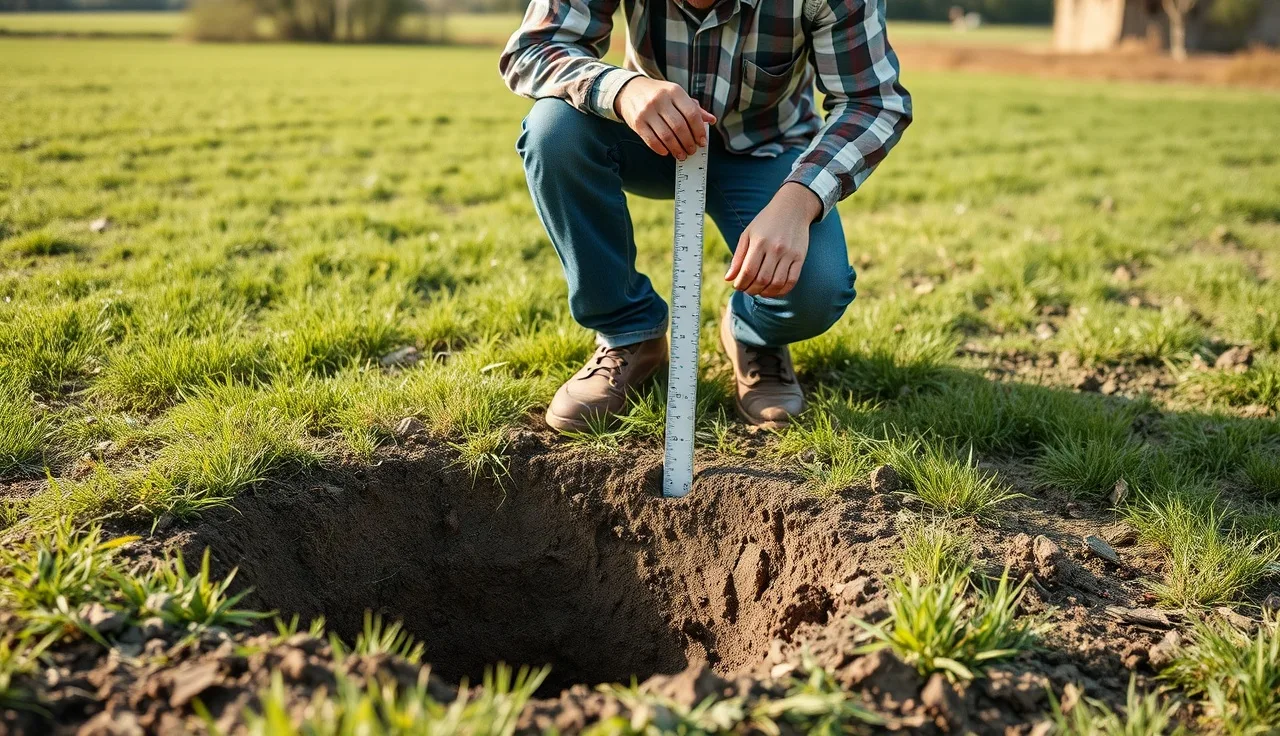
TL;DR
- A perc test (percolation test) measures how fast water moves through soil to decide whether a site can support a septic drain field.
- A licensed evaluator digs test holes, soaks them overnight, then times the water drop over 30 to 60 minutes.
- Most states approve a conventional system at a rate between 1 and 60 minutes per inch.
- The whole thing takes one to two days.
What is a perc test and why do you need one?
A percolation test, almost always called a perc test, measures how fast a set volume of water soaks into the soil at a proposed drain field site. The number you get, in minutes per inch (MPI), tells the county health department whether the ground can safely treat and disperse septic wastewater.
No passing perc test, no permit. Most counties in the United States won't issue a permit for a conventional septic system without one, and in rural areas without sewer access, that means no building permit at all. If you're buying raw land or tearing down an old structure to build new, the perc test is usually one of the first checks you pay for.
The EPA's SepticSmart program explains that soil absorbs and filters wastewater as it moves down toward groundwater [1]. Absorb too slowly and sewage backs up. Absorb too fast and wastewater reaches groundwater before the soil has treated it. Both outcomes foul drinking water and create a public health problem.
Perc tests also show up during a septic tank inspection when an old system gets evaluated for a real estate sale, especially if there's evidence the drain field is failing. They run alongside soil morphology (or soil profile) evaluations, which I cover further down.
Who is qualified to perform a perc test?
In nearly every state the person running the test has to be a licensed professional. That usually means a licensed soil scientist, a professional engineer (PE) with geotechnical or environmental credentials, a registered sanitarian, or in some states a certified septic system designer.
Many states also want a county health department official present during the test, or at least signing off on the results before they count. Virginia's Sewage Handling and Disposal Regulations (12VAC5-610) require percolation tests to run under the supervision of the local health department [2]. North Carolina requires a licensed soil scientist or licensed geologist to evaluate the site under its rules at 15A NCAC 18A .1900 [3].
Hiring an unqualified person to run the test is money down the drain. Counties won't accept results that weren't performed or witnessed by an approved professional. Ask before you pay anyone.
What equipment and materials does a perc test require?
The gear list is short. The evaluator needs a way to dig test holes (a hand auger, a bucket auger, or a small backhoe for deeper tests), a ruler or tape marked in inches, a stopwatch or phone timer, water hauled in a tank or large containers, and the state's required data form.
Some states spell out the exact hole diameter and depth in code. The EPA's onsite systems design manual suggests holes about 6 inches in diameter and at least 12 inches deep into the soil horizon being tested [4]. Your state's rule may differ, so read the local onsite wastewater code first.
There's no fancy instrumentation here. The test is a calibrated observation, which is part of why the evaluator's skill and honesty matter more than the tools.
How is a perc test performed, step by step?
Here's what actually happens on test day. I'm describing the process that matches EPA guidance and lines up with most state codes, but your state may add wrinkles [4].
Step 1: Site walk and hole placement
The evaluator walks the proposed drain field and picks hole locations. Most states want two to six holes spread across the leach field footprint, not bunched in one corner. Placement matters because soil permeability can shift hard across a few feet.
Step 2: Digging the holes
Holes go down to the depth of the proposed absorption trench, usually 18 to 36 inches below grade. The sides get scratched or scored with a knife or nail to strip off the smeared soil the auger leaves behind, which would fake a slow reading. About two inches of fine gravel or coarse sand goes in the bottom to protect the surface when water is added.
Step 3: Presaturation (the overnight soak)
This is the step people skip or rush, and it's the one that matters most. The holes get filled with water and left to soak for at least 4 hours, ideally overnight (12 to 24 hours). The point is to swell clay particles, wet the soil profile, and copy worst-case wet-season conditions. An evaluator who wants to skip presaturation is tilting your results in your favor, which is a favor you don't want.
The EPA states that tests should run after prolonged wet periods or after artificial saturation to represent the least favorable soil conditions [4]. Some states require presaturation the day before the test, which turns this into a two-day site visit.
Step 4: Setting the water level before timing
On test day, water goes into each hole to a standard starting depth, usually 6 inches above the gravel at the bottom. If the level dropped overnight, the evaluator refills to the mark and waits 30 minutes before official timing starts.
Step 5: Timing the drop
The evaluator measures how far the water level falls over a set interval. Most states use a 30-minute or 60-minute interval. The reading is taken at the end of each interval, water gets added back to the starting level, and the cycle repeats, typically three to six times per hole.
The final perc rate comes from the last (most stable) interval, not an average of every reading. The math is simple: a 1-inch drop in 30 minutes is a rate of 30 MPI.
Step 6: Recording and submitting results
The evaluator fills out the state form, which usually captures hole location, starting depth, each measured drop, water temperature, soil color and texture, and the calculated rate. The form goes to the county health department.
What perc rate is needed to pass?
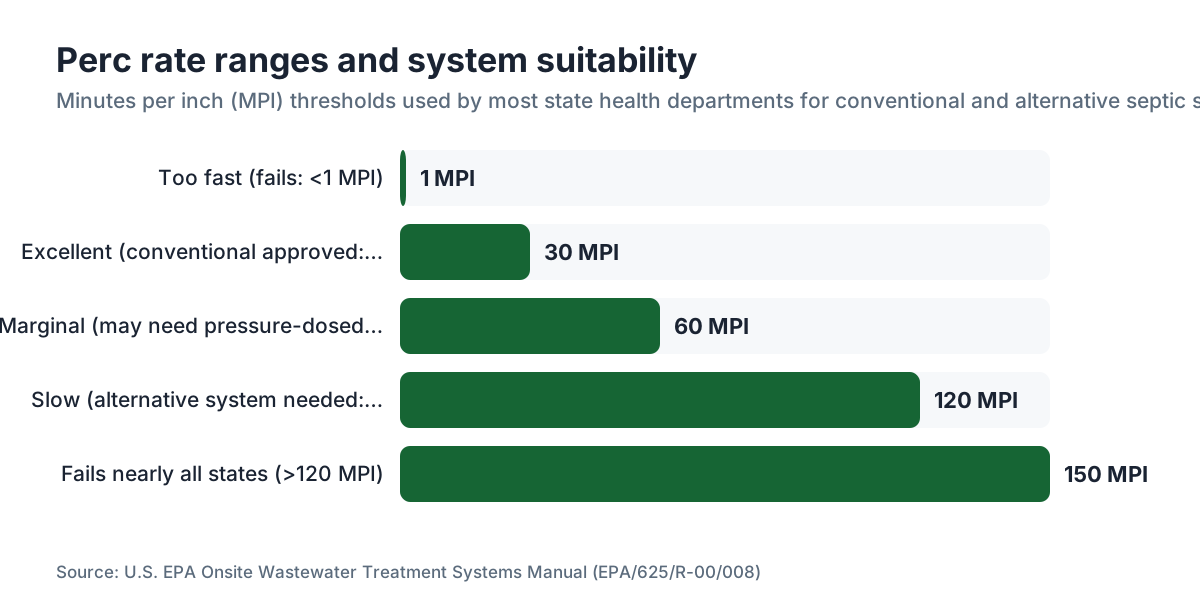
Most states define an acceptable range, not a single cutoff. The typical window for a conventional gravity-fed septic system runs from 1 MPI (very fast, sandy soil) to 60 MPI (slow, usually clay-heavy soil) [4][5].
Soil that drinks water faster than 1 MPI is too coarse to filter properly. Soil slower than 60 MPI can't take the daily wastewater load without surfacing or backing up. Some states set a tighter cap of 30 MPI for conventional systems and allow 31 to 60 MPI only with a modified or pressure-dosed design.
Here's how most states read the results:
| Perc Rate (MPI) | Typical Interpretation |
|---|---|
| Less than 1 | Too fast; inadequate filtration, typically fails |
| 1 to 30 | Excellent; conventional system approved in most states |
| 31 to 60 | Marginal; may need pressure-dosed or alternative system |
| 61 to 120 | Slow; usually requires an alternative system or mound |
| Greater than 120 | Fails in nearly all states; site may be unbuildable |
A failing perc test doesn't make the land worthless. It means a conventional system won't work. Mound systems, drip irrigation, or aerobic treatment units may still get a permit, though they cost a lot more. The cost to install a septic system climbs fast once you leave a conventional gravity drain field behind.
The USDA's Natural Resources Conservation Service treats soil texture and structure as the main factors controlling percolation, with clay content the single biggest predictor of slow rates [5].
How does a soil morphology evaluation differ from a perc test?
A soil profile evaluation (also called a soil morphology study or soil evaluation) is different from a perc test, and in many modern state codes it's the better tool. Instead of timing water absorption, a soil scientist digs a pit and reads the color, texture, structure, and mottling of each soil horizon to judge its treatment capacity.
Gray or yellowish mottled zones in a soil profile mark seasonally saturated ground, what soil scientists call redoximorphic features. They tell an experienced evaluator where the seasonal high water table sits without waiting for a wet year. That's a more reliable read on long-term system performance than one perc test run on a dry day.
States including North Carolina and Virginia have moved away from perc tests as the main approval mechanism and now lean on soil morphology evaluations done by licensed soil scientists [2][3]. Texas still uses both methods together under 30 TAC Chapter 285 [6]. Read your state's current onsite wastewater code, because the perc test may be secondary or even optional where you are.
For septic tank installation permits, some counties want both. If you're hiring a site evaluator, ask whether they hold a soil science credential, more than a septic installer license.
How much does a perc test cost?
Nationally, a perc test runs $150 to $800, and most homeowners pay somewhere in the $300 to $500 range [7]. The spread comes from a handful of variables:
- Location and state rules. States that require a licensed soil scientist or PE cost more than those that let a county sanitarian watch a simpler test.
- Number of holes. A site needing six holes costs more than one needing two.
- Equipment. Rocky ground or deep test horizons may add a backhoe rental on top of the professional fee.
- Bundled soil morphology. Many evaluators now quote a combined site evaluation that pairs the perc test with a soil profile analysis. That bundle usually runs $400 to $1,000 and gives you a fuller picture.
- Travel. Rural parcels far from the evaluator's base add cost.
The county health department's review fee is separate from the evaluator's fee, and it usually runs $50 to $300 depending on the jurisdiction.
Budgeting for the full system? See our breakdown of the cost to put in a septic tank once the perc test settles what type you need.
How long does a perc test take?
Plan on two days if your state requires overnight presaturation, one long day if the code allows same-day saturation.
Day one is digging the holes, scratching the walls, adding the initial water, and walking away. That field work takes two to four hours depending on hole count and equipment.
Day two is the timed test. Readings every 30 or 60 minutes across three to six cycles per hole, with refilling between cycles, usually eats two to four hours of on-site time. The evaluator then writes up the results and files the form with the health department, which may take a few more days to review and issue an approval letter.
From the day you hire the evaluator to the day you hold a county-accepted result, expect one to three weeks. In busy spring building seasons that stretches to four to six weeks in high-growth states.
Operators juggling several site evaluations at once track test dates, follow-up deadlines, and permit status in job management software. SepticMind is built for septic service businesses that need to run inspection workflows and documentation across many jobs without anything slipping through the cracks.
What can cause a perc test to fail?
The top cause of failure is clay-dominant soil. Clay holds water and swells when wet, which is exactly what drags percolation past the acceptable line. Tight clay soils across the Southeast, the upper Midwest, and the Pacific Northwest are a steady source of failed perc tests.
High seasonal water tables come second. If the soil horizon being tested sits within two feet of the seasonal high water table, most states won't approve a conventional system no matter what the raw MPI number says. That's why presaturation and wet-season testing carry so much weight.
Other conditions that commonly produce failing results:
- Bedrock or fragipan (a hard, brittle subsoil layer) within the required depth range
- Slowly permeable subsoil below more permeable topsoil
- Restrictive layers from agricultural compaction (common on old farm parcels)
- Proximity to wetlands, streams, or floodplains, where soil stays saturated much of the year
A failed test in one spot doesn't always sink the whole parcel. A second evaluation in a different area may hit better soil. Ask the evaluator whether any part of the lot is worth retesting before you give up.
What happens after a perc test passes or fails?
If the test passes, the evaluator submits the results to the county health department, which issues a site suitability letter or a septic permit depending on the jurisdiction. This approval is site-specific: it approves a system of a certain design and size at defined coordinates on your parcel. Move the drain field even 50 feet and you may need a new test.
Approval letters in most states last a set period, usually two to five years. Don't build inside that window and you may have to retest. The soil didn't go anywhere, but the paperwork expires.
If the test fails, you have a few options:
- Retest in a different spot on the same parcel. Sometimes the failing area is a small pocket of bad soil and a better site sits nearby.
- Hire a soil scientist to size up alternative systems. Mound systems, drip irrigation, and aerobic treatment units run under different criteria and may be permitted where a conventional system is not.
- Appeal or request a variance. Some counties have a formal variance process, but it rarely works unless there's a procedural error in the original test.
- Accept that the land can't support an onsite system. This happens. Undevelopable land with no municipal sewer is a real outcome.
For an existing property with a failing drain field rather than a new build, the path looks different. See our guides on septic system repair and leach field options for rehab strategies.
Do perc test results ever expire or need to be redone?
Yes, and this catches a lot of buyers off guard. A perc test approval is not a permanent record of the land's suitability. Most state and county jurisdictions set expiration periods of two to five years from the date of approval.
Common reasons you'd need a new perc test on a previously evaluated property:
- The original approval expired and construction never started
- The proposed design changed in a way that needs a different absorption area
- A real estate transaction requires a current site evaluation, not one from 15 years ago
- The property use is changing (adding a bedroom, converting a barn to a residence) in a way that raises the calculated wastewater load
In some states an expired approval can be renewed by a desktop review if soil conditions haven't changed. In others, a full new test is mandatory. Call the county health department before paying for anything; they'll tell you exactly what they require.
Check this during due diligence on vacant land too. An old perc approval in a listing may be expired and unacceptable to the current health department, especially if state rules changed since the original test.
How do perc tests vary by state?
More than you'd expect. The physics don't change, but states differ a lot on:
- Who can perform and witness the test
- Whether presaturation is required and for how long
- How many holes are required and at what depth
- Whether the perc test or the soil morphology evaluation is the primary approval mechanism
- The acceptable MPI range for different system types
- How long the approval stays valid
Florida largely replaced standalone perc tests with soil profile evaluations under Chapter 64E-6 of the Florida Administrative Code [8]. Texas requires both a site evaluation and a soil analysis under 30 TAC Chapter 285, with specific forms and procedures published by the TCEQ [6]. New York uses percolation tests alongside deep test hole observations under its onsite wastewater rules [9].
California varies by county, since the state defers heavily to local environmental health departments, though the California Environmental Health Association publishes standardized guidance [10].
Read your specific state's onsite wastewater code before hiring anyone or basing a land purchase on assumed testing rules. State code links are available through the National Onsite Wastewater Recycling Association (NOWRA) [11] and through EPA's SepticSmart program [1].
Can you perform a perc test yourself?
Technically, yes. Digging holes, adding water, and measuring the drop takes no special equipment. Practically, no. No county health department will accept the result unless it was conducted or directly witnessed by the qualified professional their regulations require.
There are two honest reasons to run a DIY perc test. First, as a preliminary screen before you hire a professional: if your backyard hole absorbs water in five seconds or takes two days to drop an inch, you have an informal signal before spending money on a licensed evaluation. Second, for your own understanding of the site before the formal test.
Neither DIY result substitutes for the real one. Save the professional fee, but budget for it. This is not a step you can skip in the permit process.
Frequently asked questions
How many test holes are required for a perc test?
Most state codes require between two and six test holes spread across the proposed drain field area, not a single hole. The exact number depends on the size of the proposed absorption area and the state's onsite wastewater regulations. Some jurisdictions add holes if the initial results vary a lot between locations, which signals inconsistent soil conditions across the site.
How deep are perc test holes dug?
Test holes are typically dug to the depth of the proposed absorption trench, usually 18 to 36 inches below the ground surface. The EPA's design manual recommends testing at the depth of the soil horizon that will actually receive effluent. Some states require testing at two depths if the proposed system uses shallow trenches above a restrictive layer.
What is a failing perc test rate?
Soil that absorbs water slower than 60 minutes per inch fails in most states for a conventional gravity septic system. Soil faster than 1 minute per inch also fails, because it doesn't provide adequate treatment. Exact cutoffs vary by state and system type; some states allow rates up to 120 MPI for alternative or pressure-dosed systems under a variance or engineered design.
How long does it take to get perc test results?
The field work takes one to two days. The county health department then reviews the submitted data, which typically takes a few days to two weeks depending on their workload. During busy spring building seasons, review can stretch to four to six weeks in high-growth counties. Expect one to three weeks from field test to written approval under normal conditions.
Does rain affect perc test results?
Yes, significantly. A test run after heavy rain often shows slower percolation because the soil is already near saturation, which tends to give a more conservative (protective) result. A test during a dry spell may show faster absorption than the site shows in a wet season. That's exactly why most states require overnight presaturation before the timed test, to standardize conditions regardless of recent weather.
What is the difference between a perc test and a soil test for a septic system?
A perc test measures the rate of water absorption in real time. A soil morphology evaluation assesses the physical and chemical properties of soil horizons visually, using color, texture, and structure to infer drainage and seasonal water table depth. Many states now rely mainly on soil morphology rather than perc testing, because a soil profile reveals year-round drainage patterns that a single timed test can miss.
Can a perc test be done in winter?
Frozen ground makes perc testing impossible or unreliable, since ice blocks pore spaces and produces artificially slow readings. Most northern states either prohibit winter testing or require the evaluator to confirm the test horizon isn't frozen. Spring testing after full thaw is generally preferred because it represents near-saturated soil, the worst-case scenario the test is meant to simulate.
What happens if my land fails a perc test?
A failed perc test doesn't always mean unbuildable land. Options include retesting in a different spot on the parcel, hiring a soil scientist to evaluate alternative systems (mound systems, aerobic treatment units, drip irrigation), or applying for a variance. In some cases, especially on small or wet parcels, no viable onsite system is possible and the land can't be developed without access to municipal sewer.
How much does a perc test cost in 2024?
Most homeowners pay between $300 and $500 for a perc test, with the national range running $150 to $800 depending on the state, number of holes required, soil conditions, and whether a soil morphology evaluation is bundled in. County review and permit fees typically add another $50 to $300 on top of the evaluator's fee and go directly to the health department.
Is a perc test required when buying land?
A perc test is required before a septic permit is issued, but not always before a land sale closes. Any buyer planning to build on rural land without municipal sewer should make a passing perc test a contingency in the purchase agreement. Buying land first and testing second is a common and expensive mistake. Some agents advise skipping the contingency to make an offer more competitive, which is bad advice.
How often does a perc test need to be redone?
Perc test approvals expire, typically in two to five years depending on the state. If construction hasn't started before expiration, a new evaluation is required. You may also need a new test if the proposed design changes, if the bedroom count increases (which changes the calculated waste load), or if a real estate transaction requires a current evaluation rather than an old one.
Can a mound septic system be installed on land that fails a perc test?
Often yes. Mound systems are designed for sites where the in-ground soil is too slow, too shallow above bedrock, or too close to the seasonal high water table for a conventional system. The mound imports engineered fill with known permeability, bypassing the poor native soil. They cost much more than conventional systems, often $15,000 to $30,000 or more, but they can make otherwise unbuildable land viable.
Who regulates perc tests and septic permits in the United States?
There is no single federal regulator. The EPA sets broad guidance through its SepticSmart program and design manual, but permitting authority rests with state environmental or health agencies, which usually delegate to county health departments. So rules differ county by county. The USDA's Natural Resources Conservation Service provides soil data that often informs state rules, but it doesn't issue permits.
Sources
- U.S. EPA, SepticSmart Program: Soil absorbs and filters wastewater as it moves toward groundwater; properly functioning soil treatment is the basis for onsite system approval
- Virginia Department of Health, Sewage Handling and Disposal Regulations 12VAC5-610: Virginia requires percolation tests to be conducted under the supervision of the local health department
- North Carolina Department of Environmental Quality, 15A NCAC 18A .1900 Wastewater Systems: North Carolina requires a licensed soil scientist or licensed geologist to evaluate sites under its onsite wastewater rules
- U.S. EPA, Onsite Wastewater Treatment Systems Manual (EPA/625/R-00/008): EPA recommends test holes approximately 6 inches in diameter, presaturation for prolonged periods to represent least-favorable conditions, and using the final stable interval reading for the perc rate
- Texas Commission on Environmental Quality, 30 TAC Chapter 285 (On-Site Sewage Facilities): Texas requires both a site evaluation and soil analysis under 30 TAC Chapter 285 for onsite sewage facility permits
- HomeAdvisor / Angi, Perc Test Cost Guide: National average perc test cost range of $150 to $800, with most homeowners paying $300 to $500
- Florida Department of Health, Chapter 64E-6 Florida Administrative Code (Standards for Onsite Sewage Treatment and Disposal Systems): Florida largely replaced standalone perc tests with soil profile evaluations under Chapter 64E-6 of the Florida Administrative Code
- New York State Department of Environmental Conservation: New York uses percolation tests in combination with deep test hole observations under its onsite wastewater regulations
- California Environmental Health Association, Onsite Wastewater Treatment Systems Guidance: California defers substantially to local environmental health departments for perc test procedures, with the California Environmental Health Association providing standardized guidance
- National Onsite Wastewater Recycling Association (NOWRA), State Regulations Directory: NOWRA provides links to state-by-state onsite wastewater codes and perc test requirements
Last updated 2026-07-09