Septic tank parts: what every component does and why it matters
By the SepticMind Editorial Team
TL;DR
- A conventional septic tank has six core parts: the tank shell, inlet baffle, outlet baffle (or effluent filter), riser and lid, access ports, and internal dividing wall if two-compartment.
- Each one controls how solids settle, how scum stays contained, and how only clarified liquid reaches your drain field.
- When any of these fail, sewage backs up or your drain field dies early.
What are the main parts of a septic tank?
A septic tank is more than a buried box. It's a sequenced settling chamber, and every part has a specific job. Miss one piece and the whole system degrades faster than you'd expect.
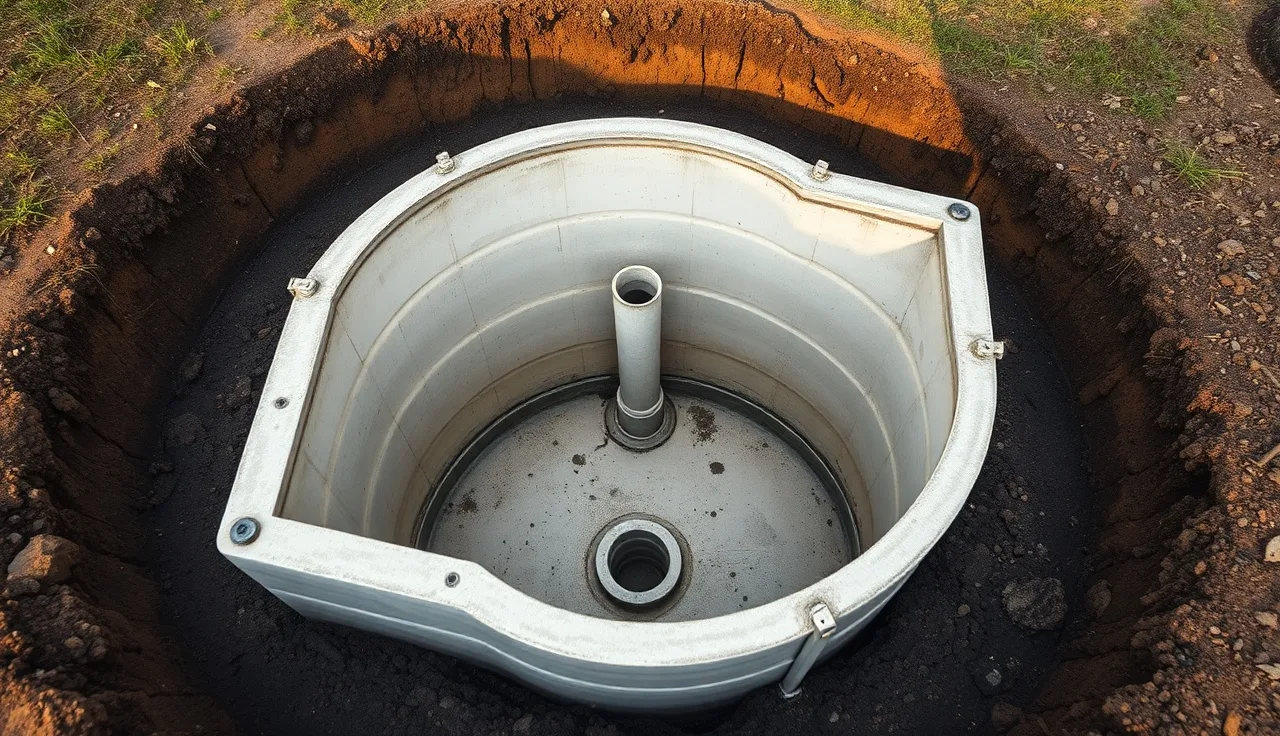
The six core components are: (1) the tank shell itself, cast from concrete, fiberglass, or polyethylene; (2) the inlet baffle, which slows incoming wastewater and directs it downward; (3) the outlet baffle or effluent filter, which keeps solids from leaving toward the drain field; (4) the access risers and lids at grade; (5) internal dividing walls or baffles in two-compartment tanks; and (6) the vent stack or gas baffle that handles methane and hydrogen sulfide. [1]
The EPA's SepticSmart program describes the tank's basic role this way: wastewater enters, solids sink to the bottom as sludge, grease floats to the top as scum, and the liquid layer in the middle (called effluent) flows out to the drain field. Every named component exists to make that three-layer separation work reliably for years at a time. [1]
Modern tanks, especially those installed after roughly 2000, may also include an effluent filter (a physical cartridge) at the outlet, inspection ports over both baffles, and in some states a required outlet tee made of sanitary PVC rather than cast-iron or concrete. State onsite wastewater codes govern which specific materials are required; Florida's Chapter 64E-6, for example, specifies inlet and outlet device requirements by tank age and soil type. [2]
What does the septic tank shell do and what materials are used?
The shell holds everything together under several feet of soil pressure, traffic loads, and decades of corrosive gas from inside. It sounds simple. It isn't.
Concrete is still the most common material in the United States. Precast concrete tanks are durable, widely available, and easy for installers to source locally. The downsides: concrete can crack from ground movement or corrosion by hydrogen sulfide gas, especially in the upper portion of the tank where the gas concentrates. Older concrete tanks sometimes have a corroded zone near the waterline that owners never know about until a lid collapses.
Fiberglass tanks are lighter, resistant to corrosion, and easier to install in tight access situations. They don't crack the way concrete does, but they can flex or pop under hydrostatic pressure if the surrounding soil becomes saturated and the tank is emptied. This is why a good pumper will warn you not to empty a fiberglass tank during wet conditions without adding ballast water.
High-density polyethylene (HDPE) tanks share the advantages of fiberglass: lightweight, corrosion-resistant, and available in one-piece molded construction. They're common for smaller systems and alternative installations. Maximum allowable depth of burial is shallower for plastic tanks than for concrete, so they're not always an option on lots with heavy traffic loading.
| Material | Typical lifespan | Corrosion risk | Weight (1,000-gal tank) | Notes |
|---|---|---|---|---|
| Precast concrete | 40+ years | Moderate (H2S at waterline) | 8,000-12,000 lbs | Most common in US |
| Fiberglass | 30-40+ years | Low | 400-600 lbs | Risk of uplift when empty in wet soil |
| HDPE/poly | 30-40+ years | Very low | 200-400 lbs | Shallower burial limits; one-piece molded |
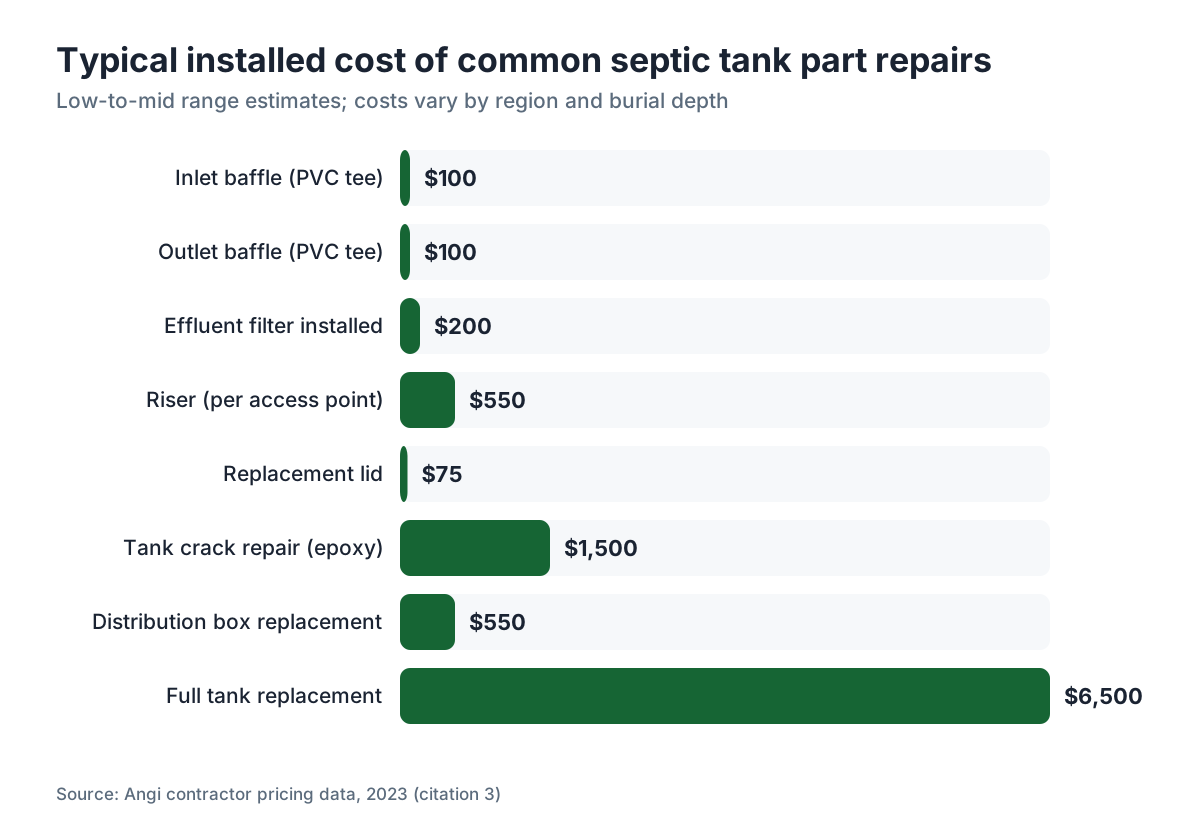
The tank shell itself rarely needs replacing if installed correctly and pumped on schedule. When it does fail, usually from a collapsed lid section or a cracked inlet wall, the repair cost runs roughly $500 to $2,500 depending on severity and access. Full replacement is a bigger project; see our guide on septic tank repair for what that actually involves. [3]
What is the inlet baffle and why does it fail?
The inlet baffle sits just inside the tank where the house sewer pipe enters. Its job is to slow incoming wastewater, direct it below the scum layer, and stop the flow from churning up the settled sludge at the bottom. Without it, every flush would mix solids back into suspension and push them toward the outlet.
In older tanks, the inlet baffle was often cast concrete or a cement tee. Concrete baffles degrade from hydrogen sulfide corrosion over 15 to 25 years. When they crumble, the scum layer breaks apart and solids travel toward the drain field much sooner than they should. In the worst cases, a failed inlet baffle pushes drain field failure forward by years.
Modern replacement baffles are almost always sanitary tees made from Schedule 40 PVC. They cost $5 to $20 for the tee itself; the labor to replace one during a pump-out runs $50 to $150 at most, making it one of the cheapest repairs in the septic world. Any pumper doing a thorough service should check the inlet baffle condition visually. If yours hasn't been looked at in 10 years or more, ask specifically.
A failed inlet baffle shows recognizable symptoms: slow drains that come and go, gurgling from the inlet side, and sometimes sewage odors inside the house. Those symptoms overlap with a dozen other problems, but a missing or broken inlet baffle is always on the inspection checklist.
What is the outlet baffle and how is it different from an effluent filter?
The outlet baffle or device is arguably the most important part of the tank, because it's the last line of defense before effluent leaves for the drain field. Its job: let only clarified liquid pass while blocking scum and floating solids.
Traditional outlet baffles are concrete tees or PVC sanitary tees that extend down into the liquid zone, below the scum layer, so effluent is pulled from mid-depth rather than from the surface. When a concrete outlet baffle corrodes away (and it will, given enough time), the scum layer can migrate straight to the drain field. Grease and solids clog the soil pores in a drain field, and once that happens, recovery is expensive or impossible.
An effluent filter is a more capable version of the outlet device. It's a slotted plastic cartridge that slides into a housing at the outlet tee and physically strains particles larger than roughly 1/16 inch to 1/8 inch. Orenco Systems, Zabel, and Polylok are common brands. The EPA recommends effluent filters as a way to extend drain field life, and many state codes now require them on new installations. [1]
The trade-off with effluent filters: they need cleaning. A filter that isn't cleaned every 1 to 3 years (or at every pump-out) can clog enough to back up the system. When a homeowner calls with drains backing up and a tank that was recently pumped, a clogged effluent filter is often the culprit. Cleaning one takes about 10 minutes; a pumper can do it during service for $50 to $100 extra, or a homeowner who doesn't mind the work can rinse it with a garden hose into a bucket. [4]
If your tank predates 2000 and has never had an effluent filter added, adding one now costs $100 to $300 installed. Set that against the cost of drain field replacement (often $5,000 to $20,000) and it's an easy call. See our overview of leach field problems for context on what drain field failure actually costs.
What are septic tank risers and lids, and are they worth installing?
In older installations, the tank is buried with only the concrete lid at grade, or buried entirely, so access means excavation every single time. Risers solve that problem. A riser is a vertical pipe, usually 12 to 24 inches in diameter, made from concrete, PVC, or HDPE, that extends the tank's access opening up to ground level. The riser gets a flat lid, either concrete, plastic, or ribbed polyethylene. [5]
Risers matter for three practical reasons. First, a pump truck can service your tank without digging, cutting the typical pump-out time from 90 minutes to 20. Second, you can inspect the tank yourself between pump-outs without renting an excavator. Third, some state codes now require at-grade access for all new tanks and for tanks being inspected at resale. [2]
Lids are the part everyone overlooks until something goes wrong. Cracked or missing lids are a real safety hazard. A 1,000-gallon tank is a confined space full of methane and hydrogen sulfide, and children or animals can fall in. The CDC documents septic tank entrapment as a recurring cause of death; OSHA rules treat tank entry as a permit-required confined space entry. [6]
If your existing lids are cracked, warped, or not secured, replace them. A replacement polyethylene lid for a standard 24-inch riser costs $30 to $80. A lid with a locking bolt costs $60 to $150. It's not a glamorous purchase, but it matters.
Retrofitting risers onto an existing tank that's buried deep typically costs $300 to $800 per access point, depending on tank depth and riser material. If you're scheduling a septic tank pump out anyway, ask for a riser quote at the same time; the excavation cost is already absorbed.
What is a two-compartment septic tank and when is it required?
A two-compartment tank divides the interior with a concrete or fiberglass wall that has a transfer port near mid-depth. Wastewater enters the first (larger) compartment, settles, then flows through the port into the second compartment for a second round of settling before exiting to the drain field.
The advantage is better effluent quality. Studies cited by the University of Minnesota Extension found that two-compartment tanks reduce suspended solids in effluent by roughly 25 to 50 percent compared to single-compartment tanks of equal volume. [7] That translates directly to a longer drain field life.
Many state codes require two-compartment tanks for new installations above a certain size, or for all new construction. Minnesota, Wisconsin, and Oregon, among others, have specific two-compartment requirements in their onsite wastewater rules. Some codes allow a second single-compartment tank in series as an alternative. [8]
For existing systems, retrofitting a second compartment isn't really practical. If your tank is aging and single-compartment, the better move is usually adding an effluent filter at the outlet and staying on a strict pumping schedule. Read more about how often to pump septic tank based on your household size, because the math changes if you're relying on a single-compartment tank.
What are the inlet and outlet pipes, and what sizes are required?
The inlet pipe carries wastewater from the house to the tank, and the outlet pipe carries effluent from the tank to the distribution box or straight to the drain field. Both are typically 4-inch diameter Schedule 40 PVC in modern installations, though older homes may have cast iron, Orangeburg pipe (a compressed-tar-paper product that deteriorates), or clay tile. [9]
Slope matters a lot. The inlet pipe should slope at roughly 1/4 inch per foot toward the tank. Too steep and solids get pushed past the baffle before they can settle. Too shallow and solids pile up in the pipe and cause backups upstream. The outlet pipe slope is similar: enough to drain freely without scouring.
Orangeburg pipe, installed from roughly the 1940s through the 1970s, is the problem child. It softens, collapses, and restricts flow over time. If your home dates from that era and you've had repeated slow-drain calls that didn't improve after tank pumping, camera-scoping the inlet line is worthwhile. Replacement runs $50 to $250 per linear foot, depending on depth and soil conditions. [3]
For the outlet side, the connection between the outlet baffle or filter and the distribution box (or drain field header) should be checked during any full inspection. A cracked or offset joint here lets solids bypass the filter and enter the drain field directly.
What is the tank vent and does every septic tank have one?
Septic tanks produce methane and hydrogen sulfide gas as a byproduct of anaerobic digestion. That gas has to go somewhere. In most residential systems, it vents back through the house plumbing stack (the vertical vent pipe that exits through your roof). The tank itself usually doesn't have a separate dedicated vent unless the installation or code requires one.
The roof vent connection matters. If the plumbing vent stack is blocked, gas backs up and can push through drain traps into the living space. A septic odor inside the house with no obvious drain backup is often a blocked vent or a dry P-trap, not a tank problem at all. Check the roof vent for debris or bird nests before calling for a pump-out.
Some advanced treatment units, aerobic septic systems, and holding tanks do have dedicated vents or air pumps. Those are more complex components with their own maintenance schedules, and they sit outside the scope of a conventional gravity-fed tank. If your system has an air pump or compressor motor above ground, you have an aerobic or ATU system, which has a different parts list entirely.
Which septic tank parts fail most often and what does repair cost?
Based on field inspection data and published extension service guidance, here's the realistic failure sequence for a conventional tank:
- Outlet baffle or effluent filter: fails or clogs most often, and earliest. A concrete outlet baffle in a tank installed before 1990 may already be corroded. Repair cost: $50 to $300.
- Inlet baffle: corrodes from hydrogen sulfide, typically within 15 to 30 years in concrete tanks. Repair cost: $50 to $150 for a PVC replacement tee.
- Riser lids: crack from UV exposure (plastic) or freeze-thaw cycles (concrete). Replacement cost: $30 to $150 per lid.
- Tank shell cracks or failed seams: less common, but serious. A hairline crack at the inlet can let groundwater in, which fills the tank faster and dilutes treatment. A major crack or crumbled wall section may require full tank replacement. Repair cost: $500 to $2,500 for epoxy injection or partial reconstruction; $3,000 to $10,000+ for full replacement. [3]
- Distribution box (D-box): technically outside the tank but closely related. The D-box spreads effluent evenly across drain field laterals and is a common failure point. Replacement: $300 to $800.
Operators tracking component failures across a large customer base often use software to flag tanks by age, material, and last inspection result. SepticMind's service management platform lets operators log baffle and lid condition at each visit so nothing falls through the cracks between pump cycles.
For a broader look at what can go wrong and what it costs to fix, the septic tank repair and septic system repair guides cover repair scenarios in detail.
How do septic tank parts connect to drain field health?
The connection is direct and consequential. Your drain field (leach field) works because soil microbes treat the effluent as it percolates through. But that only works if the effluent arriving at the field is relatively clear liquid, not solids-laden sewage.
Every part in the tank exists to protect the drain field. The inlet baffle protects it by keeping solids from churning. The outlet baffle or filter protects it by blocking the scum layer. The dividing wall in a two-compartment tank protects it by adding a second settling stage. When any of those parts fail and the tank is also overdue for pumping, solids reach the drain field, clog the soil pores, and build a biomat that can render the field permanently non-functional.
The University of Minnesota Extension states that "a properly maintained septic tank can significantly extend the life of the drainfield," and a failed outlet baffle is one of the most common causes of premature drain field failure they document. [7]
Drain field replacement is expensive: $5,000 to $20,000 for a conventional system, and considerably more for alternative systems on difficult soils. A $150 baffle replacement and a $200 pump-out every 3 to 5 years are not optional costs. They're the maintenance that makes the drain field last 20 to 30 years instead of 10. [10]
If you're already seeing wet spots over the drain field, sewage odors outside, or lush green grass over the laterals in dry weather, the field may already be stressed. The leach field article explains the symptoms and options.
What should a septic tank inspection cover for all these parts?
A thorough inspection goes past checking sludge and scum levels. A good inspector checks every named component: inlet and outlet baffle condition, effluent filter (clean it or note it's missing), riser and lid integrity, tank shell for cracks or shifting, and the liquid level. An unusually high liquid level relative to the outlet points to either a saturated drain field or a blocked outlet. [11]
In many states, a septic inspection is required at the point of home sale. The report should document the condition of each component, more than a pass/fail on whether the system is "working." A system can be technically functional while a corroded outlet baffle sets up a drain field failure two years out.
The EPA's SepticSmart guidelines recommend having your system inspected by a professional every 3 years, with pumping every 3 to 5 years depending on household size. [1] Some systems with mechanical components (pumps, aerators, float switches) require annual inspection.
If you're buying a home, push for a full inspection by a licensed inspector rather than a visual check by a general home inspector. A camera scope of the inlet and outlet pipes, a sludge and scum measurement, and a documented baffle check should all be part of the service. See the septic tank inspection guide for what to expect and what questions to ask.
For operators managing a service territory, logging component condition at each visit and flagging tanks approaching the end of concrete baffle lifespan is where digital tools earn their cost. The SepticMind platform structures this data so operators can prioritize outreach to at-risk accounts before failures happen.
How much do septic tank parts and replacements cost?
Here's an honest cost table for the parts most homeowners actually have to deal with:
| Part | DIY part cost | Installed cost (labor incl.) | Notes |
|---|---|---|---|
| PVC inlet baffle tee | $5-$20 | $50-$150 | Usually done at pump-out |
| PVC outlet baffle tee | $5-$20 | $50-$150 | Same as above |
| Effluent filter (Zabel, Polylok, Orenco) | $25-$80 | $100-$300 | Requires cleaning every 1-3 yrs |
| Riser (per access point, installed) | $150-$400 | $300-$800 | Cost varies with burial depth |
| Replacement lid (24" poly) | $30-$80 | $30-$80 | Usually homeowner-replaceable |
| Locking lid upgrade | $60-$150 | $60-$150 | Recommended with children or pets |
| Tank crack repair (epoxy) | N/A | $500-$2,500 | Professional only |
| Full concrete tank replacement | N/A | $3,000-$10,000+ | Site-dependent |
| Distribution box replacement | N/A | $300-$800 | Often needed alongside field repair |
These ranges come from contractor pricing surveys and published extension service guidance; actual costs vary a lot by region, depth, and soil conditions. [3][10]
For perspective on total system costs, the cost to put in a septic tank and cost to install septic system guides cover new installation pricing if you're facing a full replacement scenario.
Frequently asked questions
How do I know if my septic tank baffle is broken?
The clearest signs are slow drains that don't improve after pumping, sewage odors inside or outside the house, and solids or scum visible in the drain field area. A pumper can visually check the baffles during service. In concrete tanks older than 20 years, assume the baffles need inspection; corroded concrete tees are common and easy to miss if the tank isn't opened properly.
Can I replace a septic tank baffle myself?
Technically yes for the inlet baffle on an accessible tank with a riser, but it's not recommended without training. Septic tanks hold hydrogen sulfide and methane, which are toxic and flammable in confined spaces. OSHA classifies tank entry as a permit-required confined space. Most pumpers will replace a baffle for $50 to $150 at the same visit as a pump-out, which is the practical choice for most homeowners.
How often does an effluent filter need to be cleaned?
Most manufacturers and extension services recommend cleaning the effluent filter every 1 to 3 years, or at every scheduled pump-out. If your household uses the system heavily or runs a garbage disposal, lean toward annual cleaning. A clogged filter can back up the entire system, so if you've recently had drains slow after a tank pump, a clogged filter is the first thing to check.
What is the difference between a septic tank lid and a riser lid?
The tank lid is the structural cover cast as part of the original concrete tank, usually buried at or below grade. A riser lid sits at the top of a pipe riser that extends the access point up to ground level. Riser lids are typically round polyethylene or concrete discs, 12 to 24 inches in diameter, and are much easier to remove for service. Most modern installations and many retrofitted older systems use riser lids.
What material is best for a new septic tank?
Precast concrete dominates because it's locally available and well-tested over decades. Fiberglass and HDPE are better where corrosion or weight is a concern, but each has burial depth limits and needs care when emptied in wet conditions. For most residential installations on typical soils, concrete from a reputable precast supplier is the default. Check your state's onsite wastewater code for approved materials in your area.
What does a two-compartment septic tank do that a single-compartment can't?
A two-compartment tank provides two sequential settling stages, which cuts suspended solids in the outlet effluent by roughly 25 to 50 percent compared to a single-compartment tank of the same volume. That cleaner effluent is less likely to clog drain field soil pores. Many state codes require two-compartment designs for new construction because the drain field protection benefit is well documented.
Why does my septic tank have two lids?
A two-lid setup is normal and points to either a two-compartment tank (one lid over each compartment) or a single tank with separate access ports over the inlet and outlet ends. Both designs are correct. The inlet-side port lets a pumper check the inlet baffle and measure scum thickness; the outlet-side port is where the effluent filter or outlet baffle is inspected. Access to both ends allows a complete service.
Can a cracked septic tank be repaired or does it need replacement?
Hairline cracks in concrete tanks are often repairable with hydraulic cement or epoxy injection, costing $500 to $2,500. Cracks that let groundwater in (the tank fills faster than normal household flow would explain) or cracks near structural seams may mean the tank is beyond economical repair. A structural assessment by a licensed inspector tells you which situation you have. Full replacement runs $3,000 to $10,000 or more depending on size and site conditions.
What is Orangeburg pipe and why does it matter for septic systems?
Orangeburg pipe is a compressed-wood-fiber pipe used from the 1940s through the 1970s in sewer lines, including septic inlet and outlet runs. It absorbs moisture over time, softens, and collapses. If your home was built in that era and you have recurring slow drains or backups, Orangeburg on the inlet line is a real possibility. Camera scoping the line confirms it; replacement runs $50 to $250 per linear foot.
Do I need a septic tank vent on the tank itself?
Most conventional gravity-fed tanks vent gases through the house plumbing stack; a separate tank vent isn't required in standard installations. Aerobic treatment units, pump tanks, and advanced treatment systems typically have their own vents or air supply lines. If you smell sewer gas inside your home but the system is working, check the roof vent stack for blockage and check floor drain P-traps for dryness before assuming a tank problem.
How long do septic tank parts typically last?
The concrete or fiberglass tank shell can last 40 years or more with proper maintenance. Concrete inlet and outlet baffles often corrode within 15 to 30 years from hydrogen sulfide exposure. PVC replacement baffles and effluent filters can last 20 years or more if not mechanically damaged. Riser lids, especially UV-exposed plastic ones, may need replacement every 10 to 20 years. Pumping every 3 to 5 years and inspecting baffles at each visit catches problems early.
What happens if I skip pumping and the baffles are already corroded?
With no functional outlet baffle and sludge rising toward the outlet, solids migrate to the drain field with every flush. Grease and solids clog the soil pores, building a biomat layer. Once the biomat is established, sewage can surface, drains back up, and the field may be beyond repair. Drain field replacement costs $5,000 to $20,000. Corroded baffles plus missed pumping is the most common cause of premature drain field failure.
Where can I find the required parts specifications for my state?
Start with your state environmental or health department's onsite wastewater program. Most publish their rules online: Florida's is Chapter 64E-6, Minnesota's is MN Rules Chapter 7080, and Wisconsin's is SPS 383. The EPA's SepticSmart website links to state resources. Your local county health department is often the fastest contact for site-specific questions about replacement part approvals.
Sources
- US EPA, SepticSmart: How Your Septic System Works: EPA describes the three-layer tank separation process and recommends effluent filters and professional inspection every 3 years
- Florida Department of Health, Chapter 64E-6 Onsite Sewage Treatment and Disposal Systems: Florida specifies inlet and outlet device requirements by tank age and soil type in Chapter 64E-6
- HomeAdvisor / Angi, Septic Tank Repair Cost Guide: Septic tank repair costs range from $500 to $2,500 for cracks and $3,000 to $10,000+ for full replacement; inlet/outlet baffle replacement runs $50 to $300
- Orenco Systems, Biotube Effluent Filter Installation and Maintenance: Effluent filters require cleaning every 1 to 3 years to prevent clogging and system backup
- OSHA, Permit-Required Confined Spaces (29 CFR 1910.146): OSHA classifies septic tank entry as a permit-required confined space entry due to hydrogen sulfide and methane hazards
- University of Nebraska-Lincoln Extension, Septic System Components: Modern inlet and outlet pipes are typically 4-inch Schedule 40 PVC; older installations may contain Orangeburg, clay tile, or cast iron
- US EPA, Onsite Wastewater Treatment Systems Manual: Drain field replacement costs range from $5,000 to $20,000 for conventional systems; routine pumping every 3 to 5 years is the primary preventive measure
- National Onsite Wastewater Recycling Association (NOWRA), Septic System Inspection Standards: A thorough inspection documents inlet and outlet baffle condition, effluent filter status, lid integrity, tank shell condition, and liquid level relative to outlet
Last updated 2026-07-09