Septic tank maintenance: the complete homeowner guide
By the SepticMind Editorial Team
TL;DR
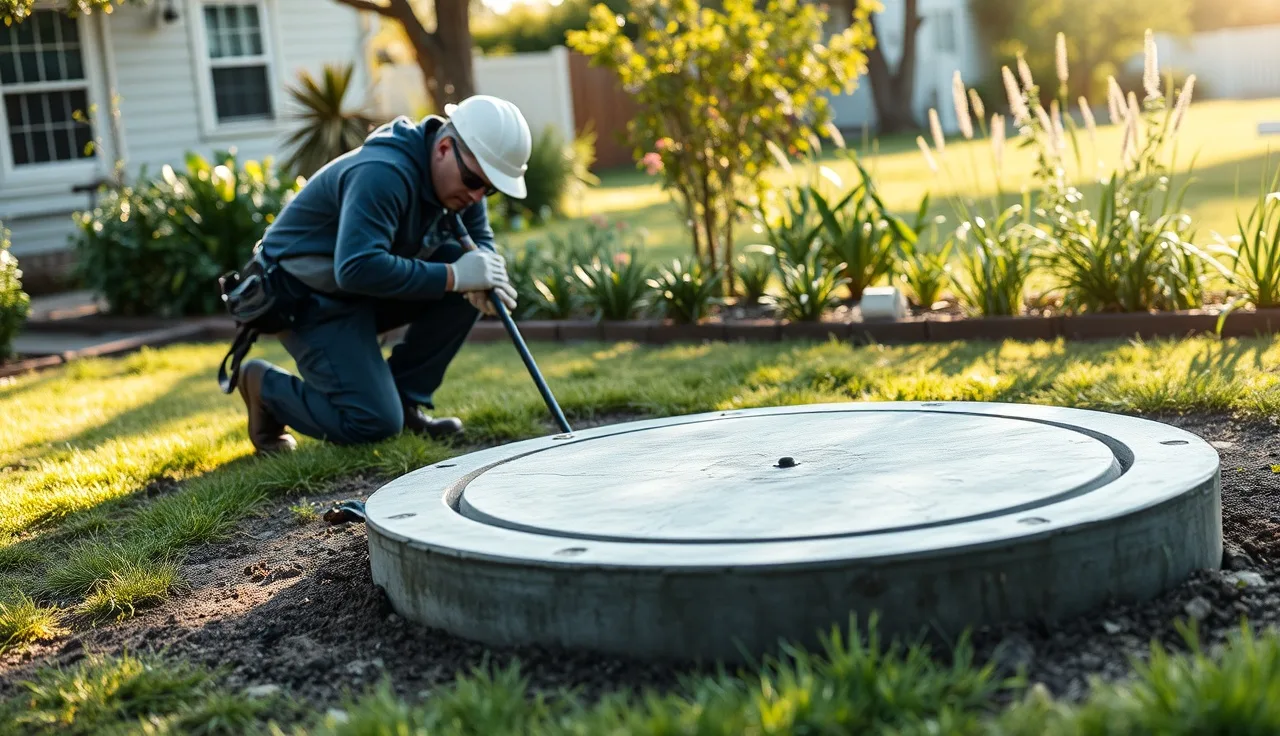
- Septic tank maintenance means pumping solids every 3 to 5 years, keeping harmful products out of the system, protecting the drain field from compaction and standing water, and inspecting components yearly.
- Skip it and the drain field fails, which costs $5,000 to $25,000 to replace.
- A pump-out runs $300 to $600 and prevents almost all of that.
What are septic tanks and how do they work?
A septic tank is a buried, watertight container, usually concrete, fiberglass, or polyethylene, that catches every drop of wastewater your house produces. Toilets, sinks, showers, laundry, dishwasher: it all goes in. Inside, heavy solids sink into a sludge layer at the bottom, grease and light material float as a scum layer on top, and the clarified liquid in the middle, called effluent, flows out to a drain field where soil microbes finish the job [1].
That separation is passive. A conventional gravity system has no moving parts. The tank just holds the wastewater long enough for physics to sort it out, usually 24 to 48 hours of retention time at design flow. The real work is done by bacteria already living in the tank. They digest organic solids around the clock, but they can't eat everything, so sludge and scum build up. Managing that buildup is the whole point of septic tank pumping.
Systems with a pump, a pressure-dosed drain field, or an aerobic treatment unit bolt mechanical parts onto that basic process. They need more attention because a pump, float switches, and sometimes chlorination gear can all fail [2]. A gravity system is simpler. Both still need routine care.
The drain field, also called a leach field or soil absorption system, is where most failures happen. Effluent spreads through perforated pipes into gravel trenches or a chamber system, then soaks through soil. Ignore the tank, let solids carry over into the field, and they clog the soil pores in a way that's nearly impossible to reverse. That's the failure that ends with a $10,000 to $25,000 replacement. The tank itself rarely dies on a pumped schedule.
How often should you pump a septic tank?
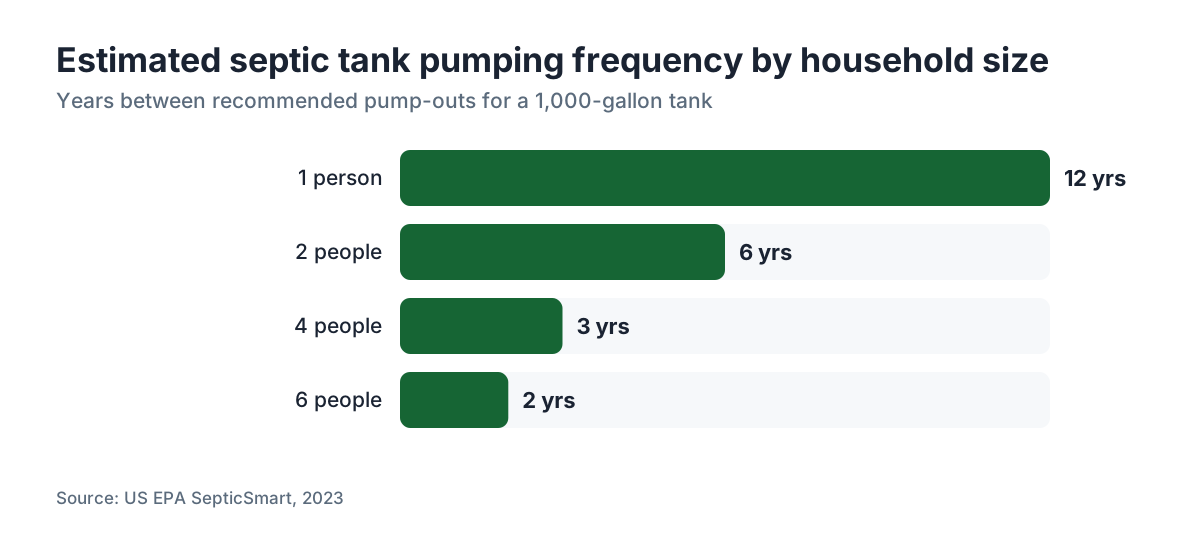
The EPA recommends pumping every 3 to 5 years for a typical household [1]. That range is real, not a hedge. Actual frequency turns on four things: tank size, household size, how much solid material enters the system, and whether you run a garbage disposal.
The table below shows the EPA's published pumping frequency estimates by tank size and household size [1] [11]:
| Household Size | 1,000-gal tank | 1,500-gal tank | 2,000-gal tank |
|---|---|---|---|
| 1 person | 12 years | 19 years | 25 years |
| 2 people | 6 years | 9 years | 12 years |
| 4 people | 3 years | 5 years | 7 years |
| 6 people | 2 years | 3 years | 5 years |
Those are maximum intervals, not targets. Most pumpers and state extension programs treat 3 to 5 years as the practical default for a family of four with a 1,000 to 1,500-gallon tank [3]. A garbage disposal roughly doubles the solids load, so halve your interval if you use one often.
Here's the honest way to dial in your interval: have the pumper measure sludge depth when they service the tank. If sludge fills more than a third of the tank's liquid depth, or scum creeps within a few inches of the outlet baffle, it's time no matter what the calendar says. Some homeowners stretch to 7 years. Some need service every 2. The variables beat any fixed rule.
For a deeper look at frequency decisions, see how often to pump septic tank.
What does septic tank maintenance actually cost?
Routine pumping in the US runs $300 to $600 for a standard residential tank, with a national average near $400 to $450 [4]. High-cost metro areas push toward $600 to $800. Rural areas with competition come in under $300. Tank size, access difficulty, and local labor rates drive the spread.
Add an inspection to a pump-out and expect $150 to $300 more, depending on whether the pumper runs a camera or just eyeballs it. Annual inspections on systems with pumps or aerobic components cost more because there's more to check.
The math makes itself obvious. A $400 pump-out every 3 years is $133 a year. A drain field replacement runs $5,000 to $25,000 depending on soil, system type, and local rules [4]. You can pump the tank roughly 75 times for the cost of one field replacement at the low end. Nobody in the trade argues with that arithmetic, yet about 30 percent of septic homeowners go more than five years between pumpings, according to survey data cited by the EPA [1].
Septic tank repair for a single part, like a cracked baffle or a broken riser, usually runs $150 to $500. A larger septic system repair involving drain field work or pump replacement can hit $1,500 to $10,000. Those mid-range repairs are often what deferred maintenance buys you: enough neglect to break something, not quite enough to kill the field outright.
The septic tank pump out itself is simple work. A vacuum truck pulls out the liquid and accumulated solids, and the crew hauls the septage to an approved disposal site.
What should you never put in a septic system?
The tank doesn't care what you flush or pour down the drain until it does, suddenly and expensively. Some substances kill the bacteria that digest solids. Others pile up as material that never breaks down. Others slip straight through to the drain field and wreck the soil.
Start with the things that kill tank bacteria or damage the system.
Antibacterial soaps, bleach, and disinfectants in large volumes suppress the microbes that make the tank work. A cup of bleach in a laundry load is fine. Dumping a bottle down the toilet to "clean the pipes" is not [5].
Prescription medications, antibiotics especially, pass through the body and land in the tank. It's rarely a one-time problem; it's a chronic-use problem. The EPA's SepticSmart program flags pharmaceutical disposal because drugs can inhibit biological treatment [1].
Paint, solvents, pesticides, and motor oil don't biodegrade in a tank. They travel through to the drain field or the groundwater.
Wipes labeled "flushable" are not flushable in a septic system. They don't break down the way toilet paper does, and they collect in the tank and in pump impellers. Ask any pumper, this is one of their most consistent complaints. Feminine hygiene products, paper towels, and cotton swabs go in the trash [5].
Garbage disposal solids add a heavy organic load. They aren't banned, but they speed up sludge buildup. The EPA notes that homes with disposals may need more frequent pumping [1].
Cooking grease poured down the drain builds scum fast and can overwhelm the outlet baffle.
One category deserves a blunt answer: septic additives. Bacterial additives, enzyme treatments, and "septic rejuvenators" are a big industry. The EPA is direct about it, stating that "the use of additives in septic tanks is not necessary" because a properly maintained system already has plenty of naturally occurring bacteria [1]. Extension programs in Virginia, North Carolina, and Minnesota agree [3]. A healthy tank doesn't need them. A failing tank won't be rescued by them.
How do you protect a septic drain field?
The drain field is the most expensive part of your system and the hardest to replace. Protecting it comes down to keeping three things off of it: extra water, physical weight, and roots.
Extra water is the threat most homeowners never see coming. Every gallon you send down the drain has to process through the field. In heavy rain, saturated soil can't take more liquid, so even a healthy system can back up for a while. Over the long haul, chronic overloading from a leaking toilet, a big household, or endless laundry days keeps the soil from drying between doses. Soggy soil grows biomat, a biological layer that seals the pores shut. Once biomat sets in, you can't reverse it without resting the field or replacing it [6].
Fix leaking fixtures. A running toilet can waste 200 gallons a day, a brutal load on a field sized for maybe 150 to 300 gallons a day for a family of four. Spread laundry across the week instead of cramming it all into Saturday. These habits are free and they work.
Compaction kills drain fields. Never drive over the field. Never park on it. Never let heavy equipment cross it. Compacted soil loses permeability, and you can't un-compact it without a backhoe. Keep the area in mowed grass, nothing else. Tree and shrub roots, willows, maples, and poplars especially, hunt for moisture and will grow straight into distribution pipes and chambers [6].
Send roof gutters and surface runoff somewhere else. A downspout draining near the field piles on hydraulic load the system was never built for.
For more on field-specific problems, see septic drain field.
What is a septic tank pump system and how do you maintain it?
Not every septic system uses a pump, but plenty do. A septic tank pump system, sometimes called a pump-to-drain or pressure-dosed system, uses a submersible pump in a separate chamber to push effluent from the tank to the drain field in timed doses. Other setups include aerobic treatment units (ATUs) with air pumps, lift stations that move effluent uphill, and mound systems that dose because the field sits above grade [2].
Maintaining a pump system means checking parts a gravity system simply doesn't have.
The pump has a motor and impeller that wear out. Submersible effluent pumps usually last 5 to 15 years depending on brand, duty cycle, and whether solids sneak into the pump chamber [7]. An annual check should confirm the pump kicks on with the float switch and moves fluid at its rated flow.
Float switches control when the pump runs. They're cheap parts that fail more often than the pump itself. A stuck float means the pump either runs dry or never runs, and either one ends badly: a burned-out pump or a flooded field. Parts cost $50 to $150, and a pumper can check them on a service call.
Alarm systems on pump chambers are required by most state codes, and they exist to warn you when the pump fails or the chamber floods. If the alarm sounds, don't ignore it and don't just reset it. Something broke. Call a service provider.
Aerobic treatment units add air compressors or diffusers. These need quarterly to annual service depending on the manufacturer and state rules. Many states require a signed service contract for an ATU [2].
The pump chamber collects some solids too, so it should be pumped periodically, usually every 3 to 5 years alongside the main tank, or on whatever schedule your pumper sets based on what they see.
Operators juggling pump maintenance across dozens of properties need scheduling, alerts, and service history in one place. That's the workflow SepticMind is built for.
What maintenance tasks can you do yourself vs. what needs a pro?
Homeowners can do more than they think on the inspection side and less than they sometimes attempt on the repair side.
The DIY tasks that genuinely help: conserve water, control what goes down the drain, keep vehicles and equipment off the drain field, redirect surface runoff away from it, and keep the ground around the access riser clear so a pumper can reach it. All free, all worth doing.
Check for wet spots or odors near the drain field every month, especially after heavy rain. Persistent wet ground or a sewage smell on a dry day is a symptom. Call a pro.
Locate your tank and drain field on a site map if you don't already have one. Your county health department or permitting office usually keeps the original permit on file with a system diagram [8].
If you have a pump system, you can often test the alarm and float yourself by briefly lifting the float and confirming the alarm sounds. Two minutes, no tools.
Now the work that needs a licensed pro.
Pumping requires a vacuum truck and a licensed pumper who can legally haul and dispose of septage at an approved facility. This is not DIY. Most states require a licensed operator [8].
Opening and entering a septic tank is genuinely deadly. Hydrogen sulfide and methane build up inside and can drop a person in seconds. Confined-space entry takes specific gear and training. Do not do it.
Baffle replacement, pipe repair, distribution box work, and anything touching the drain field belongs to a licensed installer. Repair work usually needs a permit [8].
Installing a septic tank riser to bring the access lid up to grade is a worthwhile upgrade a pro can knock out during a pump-out. It makes every future service faster and cheaper.
How do septic systems vary by state, and what regulations apply?
Septic systems are regulated mostly at the state and local level, not federally. The EPA sets national guidance through programs like SepticSmart and the National Pollutant Discharge Elimination System (NPDES), but the actual rules, permit requirements, inspection frequencies, and approved system types come from your state environmental agency or health department [1].
That matters for maintenance because required inspection intervals swing widely. Some states require an inspection at every property sale. Others require periodic inspections for systems near water bodies. A handful of counties in states like Massachusetts and New Jersey run mandatory inspection programs with enforceable deadlines. Most states leave it to the homeowner.
The EPA's SepticSmart guidance puts it plainly: "The average household septic system should be inspected at least every three years by a septic service professional." That's guidance, not law, but it's the most cited standard out there [1].
Aerobic systems carry stricter state rules. Texas, Florida, and other states with large ATU populations typically require a service contract with a licensed maintenance provider plus periodic effluent sampling. Running an ATU without a service contract can void your operating permit in those states [2].
For your exact rules, your county health department or state environmental agency website is the primary source. Several university extension programs publish plain-language homeowner guides worth reading: Virginia Cooperative Extension, the University of Minnesota Extension, and North Carolina State Extension all have solid ones online [3].
If you're installing a new septic system, or the cost to install a septic system matters to your plans, permit requirements will shape both the timeline and the price.
What are the signs that a septic system is failing?
Failing systems throw warnings before they turn into emergencies. Catching them early is the gap between a $500 repair and a $20,000 replacement.
Slow drains at more than one fixture point to the septic system. One slow drain is usually a household clog. Every drain crawling at once means the tank is full or the outlet is blocked.
Gurgling in drains or toilets, especially right after a flush, often means the tank is near capacity or the inlet baffle is damaged.
Sewage odors indoors, near the tank, or over the field are not normal. A working system shouldn't smell, aside from a brief whiff when a lid comes off.
Wet spots or a stripe of unusually green, lush grass over the drain field can mean effluent is surfacing instead of soaking in. Effluent nutrients fertilize grass, so a patch that stays greener than everything around it is worth a look.
Sewage backing up into the lowest fixtures, usually a basement drain or a first-floor toilet, means the system is surcharging. That's an emergency. Stop running water and call a pumper now.
High nitrate in a nearby well, if you test your water yearly as the CDC recommends, can signal that your septic system is reaching groundwater. That's a health issue, more than a property one [9].
If you see any of these, start with a pump-out to rule out a full tank, then get the system inspected. Septic tank cleaning and pumping will clear symptoms caused by overdue service. If that doesn't fix it, you're into septic tank emptying followed by a closer inspection of the tank and field.
What is a maintenance schedule that actually works?
Here's a practical schedule sorted by how often each task comes up. These are guidelines, not guarantees, because every system is a little different.
Every month: check for odors, wet spots, or unusually lush grass over the drain field. Confirm every fixture drains normally. If you have a pump alarm, confirm the light or buzzer works.
Every 6 to 12 months: make sure the ground over the tank and field is clear of vehicles, heavy equipment, and new plants. Redirect any gutters or drainage running toward the field. Test the float switches on a pump system.
Every 1 to 3 years: get a licensed inspection. It should cover the baffles, the distribution box, any effluent filter, and pump operation. Many pumpers fold an inspection into a pump-out for a modest add-on charge.
Every 3 to 5 years: pump the tank. Have the sludge and scum levels written down so you can calibrate your next interval. If you have a pump chamber, pump it and inspect the pump at the same time.
As needed: clean or replace effluent filters yearly, or whenever they show loading. The filter sits on the outlet baffle and traps fine solids before they reach the field. It's a $30 to $150 part and a real maintenance item, not a gimmick. Pump manufacturers and extension programs both recommend one for systems that don't already have it [3].
SepticMind offers homeowner maintenance tracking that sends reminders for pump-out and inspection due dates, handy if you tend to lose track of your last service.
For the full cost picture, the cost to put in a septic tank article covers capital costs versus maintenance costs over a system's life.
Does water usage really affect how fast a septic system fails?
Yes, directly. Septic systems are sized for a specific daily hydraulic load, usually figured at 50 to 75 gallons per person per day in most state codes, though real household use averages closer to 80 to 100 gallons per person per day in the US [10].
When a tank takes in more water than it can hold for adequate settling time, solids ride out into the drain field with the effluent. That's the exact mechanism by which too much water causes field failure.
A running toilet is the single worst offender. A flapper that won't seat can leak 200 to 400 gallons a day nonstop, nearly doubling the load on a field built for a family of four. Fix leaking toilets the day you notice them.
High-efficiency appliances genuinely help. A front-loading washer uses 15 to 25 gallons a load against 40 to 55 gallons for an older top-loader [10]. Spread that across several loads a week and the reduction in field loading is real.
Stagger laundry over multiple days. A house that runs 8 loads on Saturday sends the same total volume as one spreading them out, but that one-day surge can blow past the field's daily capacity. State extension programs recommend spreading loads out, and hydraulic modeling of drain field performance backs it up [3].
Water softeners deserve their own conversation. Brine regeneration cycles dump salt and extra water into the system. Many extension programs advise against in-line softeners on septic systems, or suggest routing the brine to a separate discharge point [3].
Frequently asked questions
What are septic tanks made of?
Most residential septic tanks in the US are precast concrete, durable and common in older installations. Fiberglass and polyethylene tanks are lighter and resist corrosion, and they show up more in new construction. Concrete tanks can crack over decades. Fiberglass tanks can shift in high groundwater. The material affects long-term maintenance needs but not how often you pump.
How long does a septic system last?
A well-maintained conventional system, concrete tank plus gravel drain field, can last 25 to 40 years. Tanks sometimes outlast the drain field by decades if the field is cared for. The drain field is the limiting part. Aerobic and mound systems have more mechanical components and may need partial replacement sooner. Neglect compresses everything; some systems fail within 10 to 15 years when maintenance is ignored.
Is it okay to use bleach if you're on a septic system?
Normal household use, about a cup per laundry load, is fine. The dilution through everyday water use keeps it from meaningfully harming tank bacteria. What you should avoid is dumping large volumes of bleach into drains as a DIY cleaning trick. Same with antibacterial cleaners used heavily and often. Occasional use is low risk. Chronic heavy use suppresses the biological activity the tank runs on.
Do septic additives actually work?
The EPA states additives are not necessary for a properly functioning system and that naturally occurring bacteria are enough. Extension programs in Virginia, Minnesota, and North Carolina reach the same conclusion. No peer-reviewed study shows commercial bacterial or enzyme additives reduce pumping frequency or extend drain field life. Save the money and put it toward your next pump-out.
What happens if you never pump your septic tank?
Sludge and scum keep building until they fill most of the tank's liquid capacity, then solids carry over into the drain field. The field's soil pores clog with organic material in a process that's largely irreversible. Eventually the field fails and sewage backs up into the house or surfaces in the yard. Replacement costs $5,000 to $25,000. Pumping every 3 to 5 years prevents nearly all of it.
How do you find your septic tank if you don't know where it is?
Start with your county health department or permitting office. Most keep original installation permits on file with a site diagram showing tank and field locations. You can also follow the main sewer line out from the house with a probe rod, or trace the pipe through the crawlspace or basement. A pumper can locate the tank with a probe too. Many counties now post this through online GIS permit portals.
How much does it cost to maintain a septic system per year?
Annualize a $400 pump-out every 3 years plus a yearly inspection at $150 to $200 and routine maintenance runs about $280 to $330 per year. Systems with pumps or aerobic components cost more, roughly $400 to $600 per year, because of service contracts and more frequent mechanical checks. That's still a fraction of a drain field replacement.
Can you put a garbage disposal on a septic system?
Yes, but it sharply increases solids loading. The EPA notes disposal use may require more frequent pumping, and most extension programs recommend cutting pump intervals by about half if you use one regularly. Some older guidance said to skip disposals on septic entirely. A moderate user on a 3-year schedule should probably move to every 2 years after adding a disposal.
What is an effluent filter and do you need one?
An effluent filter is a cartridge that sits inside the tank's outlet baffle, catching fine suspended solids before they reach the drain field. It's a real maintenance item, typically $30 to $150 in parts, and it extends field life by cutting the solid load the field receives. Many newer tanks come with one. If yours doesn't, a pumper can add it on a service visit. Clean or replace it yearly.
Does heavy rain affect a septic system?
Yes. Saturated soil can't accept effluent, so a heavy rain event can temporarily overwhelm the drain field and cause slow drains or surfacing. That's often temporary and clears once the soil dries. Chronic issues from poor surface drainage, gutters emptying near the field, or high groundwater are more serious and degrade the field over time. Sending surface water away from the field is one of the highest-value free steps you can take.
How do you know if your drain field is failing?
The clearest signs are sewage odors over the field, persistent wet areas or standing water even in dry weather, unusually lush grass over the field, and slow drains throughout the house. A pump-out rules out a full tank as the cause. If symptoms stick around after pumping, have the distribution box and field lines inspected. A dye test or camera inspection can confirm where the failure is.
What's the difference between septic tank pumping and septic tank cleaning?
Pumping removes the liquid and accumulated solids with a vacuum truck. Cleaning goes further, often including backwashing or jetting the tank walls and baffles, and sometimes inspecting or cleaning the outlet filter. In practice many pumpers use the terms interchangeably. When you get a quote, ask exactly what's included: full sludge evacuation, backwash, filter cleaning, and a baffle inspection are all fair to request.
Can tree roots damage a septic system?
Yes, and it's a common cause of pipe and field failure. Roots from willows, maples, poplars, and other moisture-seeking species grow toward the water inside distribution pipes and chambers. Once roots get into the lateral lines they block flow and can crack pipes. Keep trees at least 20 to 30 feet from the tank and field. If you suspect root intrusion, a camera inspection of the lateral lines will confirm it.
Do you need a permit to repair a septic system?
In most states, yes. Minor repairs like replacing a baffle or a pump may need a permit from your county health department or environmental agency. Any work involving the drain field almost always requires a permit and a licensed installer. Requirements vary by state and county, so check with your local health department before you start. Unpermitted repairs can create headaches when you sell the property.
Sources
- US EPA, SepticSmart: Maintain Your System: EPA recommends pumping every 3 to 5 years; states additives are not necessary; notes garbage disposals increase pumping frequency; average system should be inspected at least every three years
- US EPA, Types of Septic Systems: Aerobic treatment units, pressure-dosed systems, and mound systems require additional mechanical maintenance including air pumps and service contracts
- Virginia Cooperative Extension, Homeowner's Guide to Septic Systems: Staggering laundry loads, avoiding additives, and maintaining effluent filters are recommended practices; pump intervals should be shortened with garbage disposal use
- Angi, Septic Tank Pumping Cost Guide: National average septic tank pump-out cost is $300 to $600; drain field replacement costs $5,000 to $25,000
- US EPA, What Not to Put in Your Septic System: Wipes, medications, household chemicals, and large quantities of disinfectants should not enter septic systems
- University of Minnesota Extension, Septic System Care and Maintenance: Compaction, root intrusion, and excess water loading are primary causes of drain field failure; chronic overloading leads to biomat formation
- Purdue University Extension, Maintaining Septic Tank Pump Systems: Submersible effluent pumps typically last 5 to 15 years; float switch failure is a common maintenance issue
- North Carolina State Extension, On-Site Wastewater Systems: County health departments hold original installation permits; most states require licensed operators for pumping and repair work
- US CDC, Private Ground Water Wells: High nitrate levels in private wells near septic systems indicate groundwater contamination; annual water testing is recommended
- US EPA, WaterSense: Residential Water Use: Average US household water use is approximately 80 to 100 gallons per person per day; front-loading washers use 15 to 25 gallons per load vs. 40 to 55 for older top-loaders
- US EPA, A Homeowner's Guide to Septic Systems (pumping frequency table): Published table showing estimated pump frequency by household size and tank size, ranging from 2 years for 6 people with a 1,000-gallon tank to 25 years for 1 person with a 2,000-gallon tank
Last updated 2026-07-09