Septic Payment Processing: Collect Payments in the Field Instantly
By the SepticMind Editorial Team
Ask most septic company owners what their biggest cash flow headache is, and they'll tell you the same thing: the gap between when work is done and when money hits the account. Jobs completed on Monday. Invoices mailed Thursday. Payment received... eventually.
TL;DR
- Septic Payment Processing: Collect Payments in the Field Instantly is designed to address the specific workflow and compliance requirements of septic service operations.
- Purpose-built septic software handles permit tracking, state inspection report templates, and tank data management that generic platforms do not offer.
- Companies managing ATU contracts, multi-county permit portfolios, or real estate inspection volume need software designed around those workflows.
- Mobile access allows field technicians to complete and submit inspection reports before leaving a property.
- Cloud-based platforms ensure records are accessible from any device and backed up automatically.
- Switching costs from generic software are real, so evaluating septic-specific platforms early saves migration pain later.
Septic companies billing by mail average 28-day payment cycles. Companies collecting payment in the field average 4 days. That's 24 extra days of cash sitting in accounts receivable instead of in your operating account. For a company running $500K in annual revenue, that gap represents tens of thousands of dollars in float at any given time.
Companies collecting payment in the field have 74% fewer overdue accounts than mail billers. That's not a marginal difference, it fundamentally changes how you manage cash and how much time your office staff spends on collections.
The Billing-by-Mail Problem
The mail billing cycle has a lot of places to fail.
The tech completes the job. The paperwork comes back to the office. Someone enters the job data, generates an invoice, prints it, mails it. The customer receives it 3-5 business days later, hopefully. They write a check, if they still pay by check. They mail it back. It arrives, gets deposited, clears.
At every step, there's delay and there's opportunity for something to go wrong. Customers lose invoices. Addresses change. Checks bounce. Disputed jobs create back-and-forth. The longer the cycle, the more your staff is managing aged receivables instead of focusing on new work.
For septic companies, this is especially frustrating because the jobs themselves are often urgent. A customer called in a backup, you responded same-day, you fixed the problem. And then you wait a month to get paid for it.
Field Payment Collection Changes Everything
When payment is collected at job completion (before the truck leaves the driveway) you eliminate every step in that cycle after the service call. The customer has their receipt. You have your money. The invoice auto-generates and syncs with your accounting software. Done.
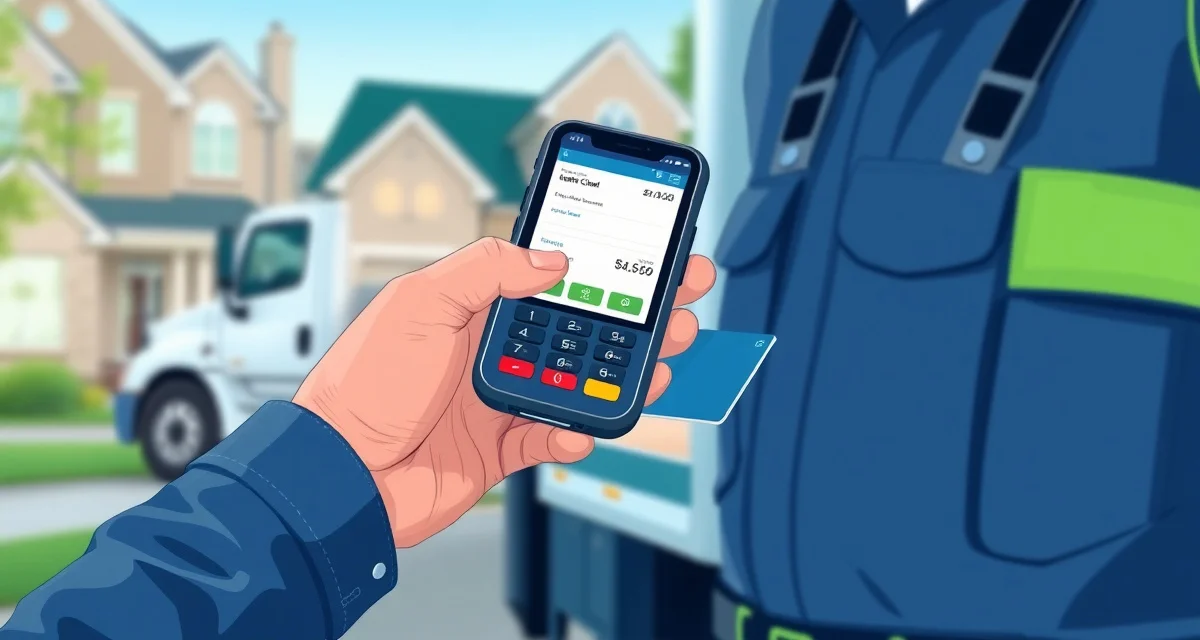
SepticMind processes field payments via card reader or digital link sent at job completion. The tech can run a card reader in the field, or send a payment link to the customer's phone that they tap to pay while the tech is still on site. Either way, the transaction closes the job.
How Septic Payment Processing Software Works
Septic payment processing software connects your invoicing to your field operations so payment can be collected the moment work is complete.
Card Reader Integration
SepticMind pairs with mobile card readers techs carry on the truck. When a job is complete, the tech generates the invoice from the completed work order, presents it to the customer, and runs the card on the spot. Credit cards, debit cards, and tap-to-pay all work. The payment posts immediately.
Digital Payment Links
For customers who prefer not to hand over a physical card, SepticMind sends a secure payment link by text or email at job completion. The customer pays on their phone. The transaction is captured, and the invoice marks paid in real time.
This method works especially well for customers who aren't home during the service, a common scenario for septic companies since many customers just leave access for the tech.
ACH and Bank Transfer Support
For commercial accounts or customers on service agreements, ACH payments eliminate the card processing fee while keeping payment digital. SepticMind supports ACH collection for both one-time and recurring invoices.
Automatic Accounting Sync
Every payment collected in the field syncs automatically to your accounting platform. If you're using QuickBooks, the invoice and payment post without anyone in your office re-entering anything. Reconciliation is clean. Aged receivables shrink. Your bookkeeper's life gets simpler.
The Impact on Accounts Receivable
Here's what changes when you shift to field payment collection:
Overdue accounts drop. When you collect at completion, there's no invoice in the mail that gets lost or ignored. The 74% reduction in overdue accounts isn't abstract, it's real dollars you don't have to chase.
Collections workload disappears. Most small septic companies spend 2-4 hours per week on some form of collections activity, reminder calls, second invoices, past-due notices. Field payment eliminates the vast majority of that work.
Cash flow becomes predictable. When you know that 85%+ of jobs are paid on the day of service, your cash position is directly tied to your daily job volume. That makes financial planning dramatically easier.
Disputes are resolved on the spot. If a customer has a question about what was done or what they're being charged for, the tech is standing right there. Disputes that would take days to resolve by phone get handled in a two-minute conversation.
Field Payment by the Numbers
| Metric | Mail Billing | Field Collection |
|---|---|---|
| Average payment cycle | 28 days | 4 days |
| Overdue accounts | ~18% of invoices | ~4-5% of invoices |
| Collections staff time | 2-4 hours/week | Under 30 min/week |
| Payment methods offered | Check, sometimes card | Card, ACH, digital link |
| Customer receipt | Mailed or emailed later | Instant |
| Accounting sync | Manual entry | Automatic |
What to Look For in Septic Payment Processing Software
Not all field payment tools are created equal. For septic companies specifically, you want a payment system that's integrated with your job management, not a standalone terminal bolted onto a separate workflow.
When a payment is collected, it should:
- Close the job in your dispatch system automatically
- Generate and send a receipt to the customer without separate steps
- Sync to your accounting platform without manual entry
- Capture the payment method for your records
Generic card readers that aren't connected to your job management create a different kind of manual work. You collect the payment, then someone still has to go back and mark the job as paid in a separate system. SepticMind's payment processing is built into the job workflow, so collection closes the loop on everything.
Security and Compliance
PCI compliance matters for any business taking card payments. SepticMind uses payment processing infrastructure that meets current PCI DSS standards. Card data is never stored on the device or in your customer records, only a tokenized reference that allows future transactions for returning customers.
Setting Up Field Payment Collection
The transition from mail billing to field collection doesn't require retraining your staff from scratch. It requires two things: a payment method for techs (card reader or digital link) and a change in the job completion workflow.
SepticMind's tech app makes payment collection part of the job close-out sequence. When a tech marks a job complete, they're prompted to collect payment or send a payment link. It's built into the flow rather than added as a separate step.
Most companies that switch see a measurable improvement in their accounts receivable aging within the first billing cycle.
Get Started with SepticMind
The right software for a septic company handles compliance and documentation alongside scheduling and billing. SepticMind is built specifically for septic operations, from county permit tracking to ATU maintenance management. Start a free trial to evaluate it against your workflow.
FAQ
How do I collect payment from septic customers in the field?
SepticMind offers two field collection methods. The first is a mobile card reader paired with the tech's phone, the tech generates the invoice from the completed work order and runs the customer's card on the spot. The second is a digital payment link sent by text or email at job completion; the customer pays on their phone before the tech leaves. Both methods close the job and sync payment to your accounting software automatically.
What payment methods does SepticMind support for field collection?
SepticMind supports credit cards, debit cards, tap-to-pay (Apple Pay, Google Pay), ACH bank transfer, and digital payment links. For commercial accounts or agreement customers, recurring ACH can be set up to pull automatically on the invoice due date. All payment methods are available through the same field app interface, techs don't need separate apps or terminals for different payment types.
Does SepticMind automatically sync field payment records with accounting software?
Yes. Payments collected in the field sync automatically to QuickBooks Online and other integrated accounting platforms. The invoice posts as paid, the payment amount and method are recorded, and the transaction is categorized. No manual entry is required in the office. If you're not yet using accounting integration, payments are also recorded in SepticMind's own reporting so you can reconcile manually or export for your bookkeeper.
Stop Waiting 28 Days to Get Paid
Your work is done. The truck is already rolling to the next job. There's no good reason the money should take a month to arrive.
With septic company invoicing software connected to field payment collection, and the whole operation running through your septic service management software, you get paid faster and spend less time managing the aftermath.
Try SepticMind free for 14 days. Collect your first field payment on day one.
What makes Septic Payment Processing: Collect Payments in the Field Instantly different from general field service software?
The primary differences are septic-specific features: county permit databases, state inspection report templates formatted for regulatory submission, tank size and system type records that drive service interval calculations, and ATU maintenance contract management. General field service platforms can handle scheduling and invoicing but require manual workarounds for every compliance and documentation task that purpose-built septic software handles automatically.
Is there a free trial available to test the software?
SepticMind offers a free trial period so you can evaluate the platform with your actual workflow before committing. The trial includes access to the permit database, inspection report templates, and scheduling tools. Most companies complete their evaluation within two to three weeks and have a clear picture of how the platform fits their operation before the trial ends.
Try These Free Tools
Sources
- National Onsite Wastewater Recycling Association (NOWRA)
- US EPA Office of Wastewater Management
- NSF International
- Water Environment Federation
- National Environmental Services Center (NESC)