Septic perc test cost: what you'll actually pay in 2025
By the SepticMind Editorial Team

TL;DR
- A septic percolation test costs $150 to $1,500 in most of the U.S., with a national average around $500 to $750 when a licensed soil evaluator runs the full test.
- Price depends on your state's required method, how many test holes you need, whether a soil scientist has to be present, and local permit fees.
- Failing soil pushes you toward alternative systems that cost far more.
What is a perc test and why does it determine your septic costs?
A percolation test measures how fast water moves through your soil. It tells the designer how many minutes it takes for water to drop one inch in a pre-soaked test hole. That number, the perc rate, decides whether a conventional gravity drain field will work on your land, and if it will, how many square feet of absorption area you need.
A slow perc rate leaves you with the expensive options: pressure-dosed systems, mound systems, aerobic treatment units, or drip irrigation fields. A rate that's too fast (sandy gravel) means the soil won't treat wastewater properly either. The test result shapes every dollar that follows.
The EPA's SepticSmart program describes site evaluation as the first real step before any design, noting that "a site evaluation determines the soil's ability to treat and disperse wastewater" [1]. That's not an exaggeration. Skipping it, or doing it wrong, is the most expensive mistake you can make on a property with no sewer access.
Most states have moved toward soil morphology evaluations alongside or instead of traditional timed perc tests. A soil scientist reads the color, texture, and layering of the soil profile to estimate hydraulic capacity without always timing water movement. Some places require both. Find out which your county demands before you hire anyone. That one question saves real money.
How much does a perc test cost on average?
A perc test averages $500 to $750 for a standard residential lot when a licensed evaluator does the work and files results with the county health department [2]. The full range is wide. It starts around $150 in rural areas with minimal requirements and climbs past $1,500 in states where a licensed professional engineer or certified soil scientist must run the test and file a detailed report.
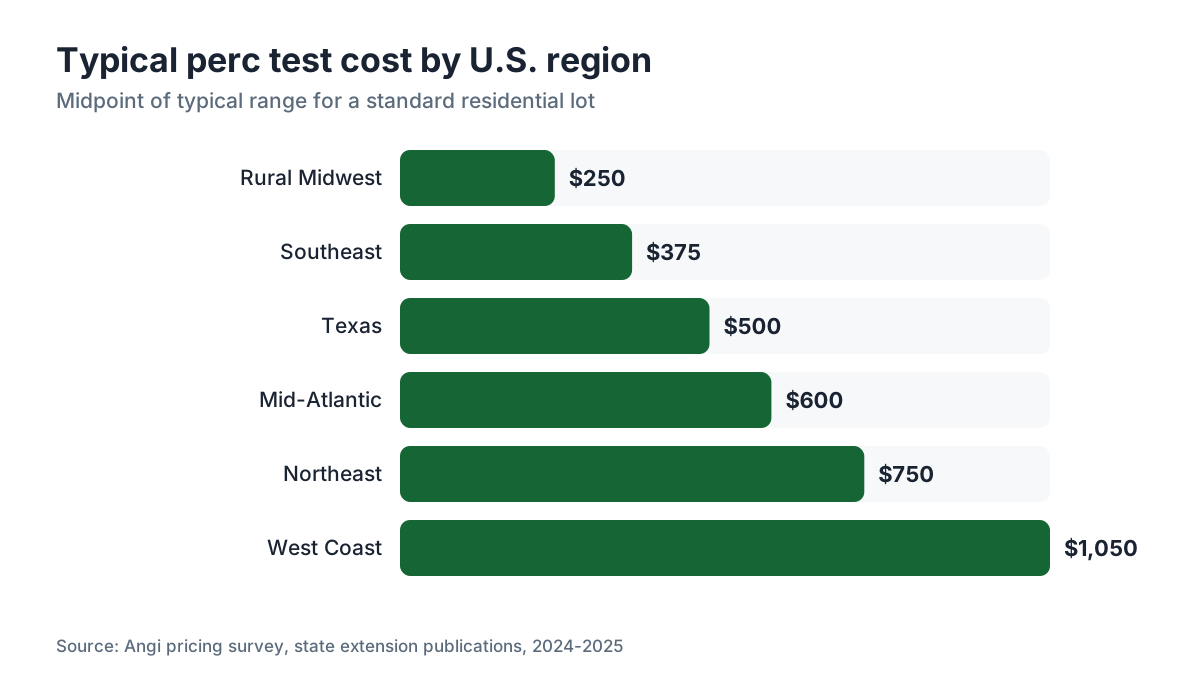
Here's what the price band looks like by region:
| Region | Typical Range | Notes |
|---|---|---|
| Rural Midwest | $150 to $350 | Fewer required holes, local health dept. may do it |
| Southeast | $250 to $500 | Varies sharply by county requirements |
| Mid-Atlantic | $400 to $800 | PA, VA, MD require licensed soil scientists |
| Northeast (MA, CT, NH) | $500 to $1,000 | State boards set strict protocols |
| West (CA, OR, WA) | $600 to $1,500 | Multiple agency approvals, geologic complexity |
| Texas | $300 to $700 | Authorized agent system, costs vary by county |
These ranges pull from state extension publications and industry pricing surveys [2][3]. Nobody has clean national survey data on this. The closest systematic look comes from state university extension services and the National Environmental Health Association's onsite wastewater guidelines.
The number climbs when your lot is large, when the health department wants more test holes (four to six is common in many states), or when the first test uncovers a problem and the evaluator has to probe other parts of the property.
What factors drive the price of a perc test up or down?
Five things move the number more than anything else.
Who has to perform the test. In some states, any licensed contractor can run a perc test. In others, a licensed professional soil scientist or PE must sign every result. Soil scientists typically charge $75 to $150 per hour [12]. A half-day site visit plus report reaches $600 to $1,000 by itself.
Number of test holes. Standard residential evaluations often call for two to four holes. Some codes require one hole per bedroom plus confirmation holes when results vary. Each hole adds time, and time adds money.
Soil and site conditions. Rocky ground means the evaluator may rent a mini-excavator or drill rig, which tacks on $200 to $500 or more. Steep slopes, high water tables, and shallow bedrock all require extra documentation and can trigger more testing.
Permit and filing fees. Most counties charge a separate fee to register the perc test with the health department. These run $50 to $300 and are sometimes bundled into the evaluator's quote, sometimes billed on the side. Always ask.
Combined site evaluation versus perc-only. Timing water alone is cheap but increasingly not enough. Many codes now require a soil profile analysis alongside the timed test. Digging a soil profile pit (often four feet deep or more) adds cost and sometimes needs an excavator.
NC State Extension notes that a complete soil evaluation "typically includes a soil morphological evaluation and may include a field percolation test," with costs that vary "based on complexity of the site and evaluator credentials" [3].
What does the perc test fee include, and what costs extra?
This is where homeowners get blindsided. A low quote often covers only the evaluator's time on-site. Costs that show up as separate line items:
- Excavation for test holes (if you don't provide it)
- County permit application fee
- Soil profile description or written report
- Re-testing if results are borderline or fail
- Staking and marking the approved drain field area
- Travel charges if the property is remote
When you call for quotes, ask flat out: does the price include the permit fee, the written report, and excavation? A $300 quote that leaves out excavation and the permit can land at $700 once everything is tallied.
Some evaluators bundle everything into a single site evaluation package that runs $800 to $1,200 and hands you a complete set of documentation ready to submit for a permit. For a first-time buyer of rural land, that package is often worth the premium because it removes the coordination headache.
If the test fails, most evaluators charge a reduced rate to re-test a different area, usually 50 to 75 percent of the original fee. A full re-test at a brand new location costs the same as the first.
How does a perc test cost compare to what comes next?
The perc test is almost always the cheapest item in the whole septic chain. Seeing it next to everything else helps:
| Item | Typical Cost Range |
|---|---|
| Perc / site evaluation | $150 to $1,500 |
| Septic design (engineer) | $500 to $2,500 |
| Septic permit | $200 to $1,000 |
| Conventional system installation | $3,000 to $15,000 |
| Mound or alternative system | $10,000 to $30,000+ |
| Annual maintenance | $200 to $600/yr |
Sources: EPA onsite wastewater program data, state extension cost surveys [1][4].
Here's why this matters. Some buyers try to cut corners on the site evaluation to save $300. They buy the land, then find out the soil demands a $25,000 mound system instead of an $8,000 conventional drain field. The cost to install a septic system depends almost entirely on what the perc test reveals. Paying for a thorough evaluation before you close on vacant land is money well spent nearly every time.
For the full picture on system costs, see our guides on septic tank installation and the cost to put in a septic tank.
Who performs a perc test and does it matter who you hire?
It matters a lot. The person who runs your perc test has to be acceptable to your county health department or state environmental agency. Hire the wrong credential and you pay twice.
Three parties usually handle residential perc tests:
- Licensed soil scientists or soil evaluators. Required in states like Virginia, Pennsylvania, and Massachusetts. They hold state-issued credentials and their results are legally binding for permit purposes.
- Professional engineers (PE) with a soils or environmental focus. Required or accepted in most states, often preferred when the test ties into a full system design.
- Registered sanitarians or environmental health specialists. In some counties, health department staff run the test themselves as part of the permit process. You pay the permit fee, not a private contractor.
Septic designers and contractors can sometimes do the evaluation in states with looser rules, but their results may get rejected where the state wants an independent soil professional.
Call your county health department before hiring anyone. Ask who is authorized to conduct a perc test in your jurisdiction. Get the answer in writing if you can, or at least note the date and the name of the person you spoke with. That five-minute call saves the cost of a do-over.
A septic tank inspection also requires specific credentials in many states, and the same rule holds: verify authority before you pay.
How do state regulations affect what a perc test costs?
State and county rules drive perc test cost more than anything else. More than soil. More than lot size. A few examples show how wide the gap gets.
Virginia requires a licensed Onsite Soil Evaluator (OSE) or Professional Engineer for every site evaluation. The OSE license is specific to Virginia's onsite wastewater program. A full evaluation with report runs $500 to $1,000 for a typical residential lot.
Texas uses an Authorized Agent system where the local county, not a state agency, sets the specific requirements. Some Texas counties accept results from a licensed professional engineer; others have their own staff run evaluations as part of the permit. Costs run $300 to $700 [7].
Massachusetts Title 5 requires a licensed Site Evaluator approved by the state Department of Environmental Protection. The percolation test has to meet a set protocol (minimum 4-hour pre-soak, witnessed by the local Board of Health agent in many towns). Add the Board of Health witness fee of $50 to $150 on top of the evaluator's charge [6].
California has no single statewide protocol. Each county operates under its Regional Water Quality Control Board's basin plan. Some coastal counties are extremely restrictive and require multiple rounds of testing plus peer review, pushing costs to $1,000 to $1,500.
The EPA's onsite wastewater page notes that "regulations governing onsite systems vary widely from state to state and locality to locality" [1]. Before you budget a dime, find your state's onsite wastewater or environmental health program page and download the evaluation requirements. Most states post them as PDFs.
What happens if your land fails a perc test?
A failed perc test doesn't mean the land is worthless. It means conventional gravity drain fields won't work, and you need to look at alternatives.
Very slow perc rates (over 60 minutes per inch in most states) point to tight clay soils with poor drainage. Options include mound systems, low-pressure pipe (LPP) systems, aerobic treatment units (ATUs), and drip irrigation. These run two to four times more than a conventional system. On a property where a standard leach field would cost $5,000 to $8,000, a mound might hit $15,000 to $25,000.
Very fast perc rates (under 1 minute per inch) mean highly porous soil that lets wastewater pass through before it's treated. Some jurisdictions allow engineered fixes with added treatment steps. Others deny the permit outright.
If one area fails, a second evaluation somewhere else on the parcel is common. Many lots have variable soils, and a soil scientist who knows the local geology can often point to where conditions are better before you spend money on formal testing.
If the whole parcel fails and no alternative system is approvable, you cannot develop the land with a septic system under current rules. That's a big deal in a sale. Insisting on a perc test contingency in the purchase contract is standard practice for any land without existing sewer service.
Can you do a perc test yourself to save money?
You can dig a hole and time how fast the water drains. As a preliminary check before you spend money on a formal evaluation, that's harmless and sometimes useful.
As a substitute for the official test? No. Every state requires that results used for a septic permit come from a credentialed evaluator using the prescribed method. A self-administered test has no legal standing and won't get you a permit.
Plenty of people use a DIY test to screen a property first. University of Minnesota Extension describes the basic method: dig a hole 12 inches deep by 12 inches wide, fill it with water, let it pre-soak for 24 hours, then refill and time how many minutes it takes for the water to drop one inch [10]. A rough result under 60 minutes per inch is hopeful. Over 90 minutes per inch is a warning sign.
That's a coarse screen, not a real evaluation. Soil scientists read profile layers, mottling, redoximorphic features, and other traits a timed drain test misses completely. Treat a DIY number as a preliminary signal, nothing more.
Operators who manage several site evaluations a year lose hours chasing test results, permit timelines, and client emails across scattered tools. Keeping all of it in one place is the kind of workflow septic service software like SepticMind is built for.
When do you need a perc test (and when don't you)?
You need a perc test (or equivalent site evaluation) whenever you're seeking a new septic permit. That includes:
- Building a new home on land without sewer service
- Adding bedrooms to an existing home in a way that increases septic loading
- Replacing a failed septic system, in many states
- Subdividing land and creating new parcels that will need septic
- Buying land with plans to build (get it before closing)
You generally don't need a new perc test if you're maintaining, repairing, or replacing parts of an existing permitted system without changing the footprint or loading. A septic tank repair or septic system repair on an already-permitted property rarely triggers a new evaluation.
Old perc test results can sometimes be reused. Most states let results stay valid for two to five years if site conditions haven't changed and the original test met current standards. Check with your health department. If you're buying land with an old perc test on file, ask the county whether that test still works for a current permit application. Sometimes it does, and you skip the cost of a repeat.
One common mix-up: a perc test is not the same as a septic inspection on an existing home. If you're buying a house with a working septic system, you want a septic tank inspection, not a new perc test.
How to get an accurate quote and avoid overpaying
Get three quotes. Obvious advice that people skip because they don't know who to call. Here's the specific version.
Start with your county health department's website. Most post a list of approved evaluators or licensed soil scientists. Call two or three from that list, and check whether the county itself offers the service as part of the permit process.
When you call each evaluator, give them the parcel address or APN and ask:
- What is your fee, and does it include excavation, the permit application, and the written report?
- How many test holes do you typically dig for a property this size?
- How long until I get results, and how long until the official report is filed?
- What happens if the test fails, and what do you charge for a re-evaluation?
- Are you licensed or approved to conduct evaluations in this specific county?
That last question earns its keep. Some soil scientists are licensed statewide but don't know the local county's quirks, which creates friction during permit review.
For a straightforward residential lot with good soils, you shouldn't pay at the top of the range. The high end is justified by unusual geology, steep slopes, potential wetland conflicts, or any parcel where the evaluator has to do heavy documentation to satisfy a skeptical reviewing agency.
SepticMind's operator network includes evaluators and pumpers across the country. If you run a service business and you're tracking evaluation jobs and permit workflows, pulling that into one platform cuts your admin time hard.
Perc test cost in a real estate deal: what buyers and sellers should know
In real estate the perc test shows up two ways: a buyer confirming a vacant lot can be built on, and a seller trying to make a parcel more marketable with results already on file.
Buyers should insist on a perc test contingency. If the lot fails and no alternative system is feasible, you want the right to walk away. Most purchase agreements for vacant rural land include language along these lines. The cost of the test, $500 to $800 in most markets, is nothing next to buying a parcel you can't develop.
Sellers benefit from a recent passing test on file. It speeds up transactions and can justify a higher asking price. Land with confirmed septic-suitable soils is worth more than land where the buyer carries that risk. If you're prepping land for sale, paying for the evaluation upfront can pay off.
Real estate agents sometimes quote perc costs badly. Agents where tests routinely run $400 will quote $150. Agents in states with licensed soil scientist requirements say "it's just a few hundred dollars" when the real number is $900. Get a quote from an actual evaluator, not an estimate off the listing agent.
When a septic system already exists on a property being sold, the document you want is a septic inspection, not a perc test. See how those costs and steps differ in our guide to septic tank inspection.
Frequently asked questions
What is the average cost of a perc test for a residential lot?
The average cost for a standard residential lot is $500 to $750 when a licensed evaluator runs the full test and files results with the county. The national range runs $150 to $1,500. Rural areas with simple county requirements sit near the low end. States like Massachusetts, Virginia, and California that require licensed soil scientists or multi-step protocols push toward the high end.
How long does a perc test take?
The on-site portion takes two to four hours for a basic residential test, but many protocols require a 24-hour pre-soak the day before the timed test. Budget two days for field work. Report preparation and county filing usually add another one to two weeks before you have official results in hand. Some counties offer rush processing for an added fee.
Does a perc test cost change depending on the size of the lot?
Yes, indirectly. Larger lots may need more test holes to characterize the full site, especially when soils vary across the property. More holes mean more evaluator time and possibly more excavation cost. A half-acre suburban lot with two to three test holes costs less than a five-acre rural parcel where the evaluator has to test several candidate drain field spots before recommending one.
Who pays for the perc test, the buyer or the seller?
It depends entirely on the contract. On vacant land sales, buyers usually pay because they're the ones seeking development approval. Sellers sometimes pay to make a parcel more attractive with a current, passing evaluation on file. In negotiations the cost is sometimes split or rolled into a price adjustment. There's no universal rule; it's a negotiated term like any other.
What is the difference between a perc test and a soil evaluation?
A perc test measures how fast water drains through soil, in minutes per inch. A soil evaluation is broader: it includes digging a soil profile pit, describing color, texture, and layering, and looking for signs of a seasonal high water table. Many states now require the full soil evaluation instead of just a timed perc test, because the profile gives more reliable information about long-term absorption.
Can an old perc test be reused for a new permit application?
Sometimes. Most states allow prior results for two to five years if site conditions haven't changed and the original test met current standards. You'll need to provide the original documentation to the health department and confirm the evaluator's credentials were acceptable under current rules. Always verify directly with the county; policies vary and some jurisdictions require a fresh evaluation regardless of prior results.
What happens if my land fails the perc test?
A failed test means conventional gravity drain fields won't work on that site. Alternatives include mound systems, aerobic treatment units, low-pressure pipe systems, and drip irrigation. These cost two to four times more than a standard system. If one area fails, testing a different spot is common. If the whole parcel is unsuitable and no engineered alternative is approvable, the land cannot legally get a septic permit, which severely limits its value.
Does the perc test fee include excavation of the test holes?
Not always, and this is one of the most common sources of surprise bills. Some evaluators quote a fee that assumes you'll have holes pre-dug by a backhoe operator you hire separately. Others include excavation. Ask explicitly before hiring: does your quote include digging the test holes? If not, budget another $150 to $400 for excavator time on a typical residential lot.
How many test holes are required for a perc test?
Requirements vary by state and county, but two to six holes are typical for a residential lot. Some states set a minimum of three; others require one per proposed bedroom plus confirmation holes when results are inconsistent. If soils vary across the property and the evaluator has to test multiple potential drain field locations, both the number of holes and the total cost go up.
Is a perc test the same as a septic inspection?
No. A perc test evaluates raw land to see whether soil conditions can support a new septic system. A septic inspection checks an existing system on a developed property, looking at the tank, distribution box, and drain field function. If you're buying a home with an existing septic system, you want an inspection. If you're buying vacant land to build on, you want a perc test.
Do you need a perc test to replace a failing drain field?
It depends on the state and the situation. In many places, replacing a drain field on an existing permitted property requires a new site evaluation to confirm the replacement area has suitable soils and to size the new field. Some states allow like-for-like replacements in the original design envelope without a full new evaluation. Check with your county health department before assuming either way.
How do I find a licensed perc test evaluator in my area?
Start with your county health department's website, which usually lists approved or licensed evaluators. Your state's environmental or health department may keep a directory of licensed soil scientists or onsite wastewater evaluators too. State licensing boards for soil scientists and the National Society of Professional Soil Scientists both have member directories. Always confirm the evaluator is specifically approved to work in your county.
Can I negotiate the perc test price?
To a degree. Evaluators have real cost floors from their time, licensing overhead, and travel. Getting multiple quotes works better than haggling with one. Bundling the perc test with a full septic design sometimes earns a modest discount. Scheduling during slower seasons (late fall and winter in northern states) may help. Expecting a big discount on a service that requires specialized credentials is usually unrealistic.
Sources
- U.S. EPA, SepticSmart Homeowner Program: Site evaluations determine the soil's ability to treat and disperse wastewater and are the first step before any septic design
- Angi, Perc Test Cost Guide (industry pricing survey): National average cost of a perc test is approximately $500 to $750 for a standard residential lot
- NC State Extension, Onsite Wastewater Treatment Systems: A complete soil evaluation for a septic site typically includes a soil morphological evaluation and may include a field percolation test; costs vary based on complexity and evaluator credentials
- U.S. EPA, Septic Systems (Onsite Wastewater Treatment): Conventional system installation costs and alternative system costs used for comparison table; EPA onsite wastewater program data
- Massachusetts, 310 CMR 15.000 Environmental Code Title 5: Massachusetts Title 5 requires a licensed Site Evaluator approved by the state DEP; the percolation test must meet a set protocol including pre-soak requirements and local Board of Health witnessing
- Texas Commission on Environmental Quality (TCEQ), On-Site Sewage Facilities: Texas uses an Authorized Agent system where local counties set specific evaluation requirements; authorized agents include licensed professional engineers and sanitarians
- Pennsylvania DEP, Onlot Wastewater Treatment Systems: Pennsylvania requires licensed soil scientists or qualified professionals to conduct percolation testing for septic permit applications
- National Environmental Health Association (NEHA): NEHA guidelines for onsite system evaluation protocols and professional credential requirements referenced for evaluator credential categories
- University of Minnesota Extension, Onsite Sewage Treatment Program: DIY percolation test methodology described: 12-inch hole, 24-hour pre-soak, timing water drop per inch; results under 60 min/inch generally suitable for conventional systems
- National Society of Professional Soil Scientists (NSPSS): Licensed soil scientists typically charge $75 to $150 per hour for site evaluation work; member directory used for locating licensed evaluators
Last updated 2026-07-09