Septic inspection on Shelter Island: what every homeowner needs to know
By the SepticMind Editorial Team
TL;DR
- Shelter Island, NY requires a septic inspection before any property transfer and recommends routine inspections every 1 to 3 years.
- Inspections cost roughly $300, $700 locally and cover the tank, distribution box, and leach field.
- Failing a Title 5-style inspection at sale can require a full system replacement costing $15,000, $40,000, so knowing what inspectors look for matters.
Why does Shelter Island require septic inspections at all?
Shelter Island sits in the middle of Peconic Bay, ringed by some of the most sensitive shellfish waters in New York State. Every drop of wastewater that doesn't get treated right ends up moving through sandy glacial soil toward those bays. The Suffolk County Department of Health Services (SCDHS) has documented nitrogen loading from septic systems as a primary driver of algal blooms and shellfish bed closures across the Peconic Estuary for decades [1].
That environmental reality is why the inspection rules here are stricter than in most of New York's inland counties. Suffolk County Local Law 13 of 2017, also known as the "SAVE Our Water" law, created the framework that pushed Shelter Island and other East End towns toward mandatory septic upgrades and tighter oversight [2]. Shelter Island Town also operates under Article 6 of the Suffolk County Sanitary Code, which governs the design, installation, and maintenance of every individual sewage disposal system on the island.
This isn't box-checking. A failing septic system on Shelter Island is a real environmental event, and local regulators treat it that way.
When is a septic inspection required on Shelter Island?
Two situations trigger a mandatory inspection. The first is a real estate transfer. Suffolk County requires that a property with an onsite sewage disposal system be inspected as part of any sale. The seller usually arranges the inspection and must give the buyer documentation confirming the system works. SCDHS enforces this, and it applies to all residential properties on Shelter Island.
The second is any building permit that expands how the property is used. Adding a bedroom, converting a space to living area, or changing the number of plumbing fixtures all require SCDHS to confirm the existing system has enough capacity. If it doesn't, you upgrade before the permit issues.
Outside those mandated moments, SCDHS and the EPA's SepticSmart program both recommend a routine inspection every 1 to 3 years [3]. Given the water quality stakes here and the cost of emergency repairs, the 1-to-3-year window is the right call. Waiting for a problem to surface almost always means you've already damaged the leach field, and that damage was preventable.
What does a Shelter Island septic inspector actually check?
A good inspection here follows a set sequence, and you should know each step so you can tell whether the inspector is doing the whole job.
Tank condition and capacity. The inspector locates and uncovers all access lids, checks inlet and outlet baffles for structural integrity, measures scum and sludge against the tank's working volume, and looks for cracks, root intrusion, and corrosion. The EPA's SepticSmart guidance states that "a household septic system should be inspected at least every three years by a qualified professional" and pumped when solids reach one-third of the liquid volume [3]. Many Shelter Island tanks date to the 1970s and 1980s, so baffle failure and concrete deterioration show up often.
Distribution box (D-box). The D-box is the concrete or plastic junction that splits effluent evenly among the leach field trenches. The inspector checks for level installation, equal flow to all outlets, sediment buildup, and cracks. A tilted or cracked D-box sends all the flow to one trench and kills the rest of the field within months.
Leach field. This is the part that decides pass or fail. The inspector looks for surface ponding, lush green stripes over specific trenches, odors, soil saturation, and in some cases probes the soil with a rod. On Shelter Island's sandy soils, a healthy field takes effluent fast, so visible saturation is a serious sign. Many inspectors also run a hydraulic load test, pushing water through the system at a controlled rate to confirm the field accepts flow without backing up.
Setback verification. The inspector confirms the system meets the setbacks from wells, property lines, and surface water that SCDHS Article 6 requires. Older systems installed before modern codes sometimes fail this check when nearby development changes the picture.
Pumping during inspection. Most qualified inspectors on Shelter Island will either pump the tank themselves or coordinate with a pumper, because you can't inspect baffle condition or tank integrity through six inches of sludge. If an inspector quotes a fee that leaves out pumping, ask exactly how they plan to assess the interior. See our guide to septic tank pump out for what that process involves.
How much does a septic inspection cost on Shelter Island?
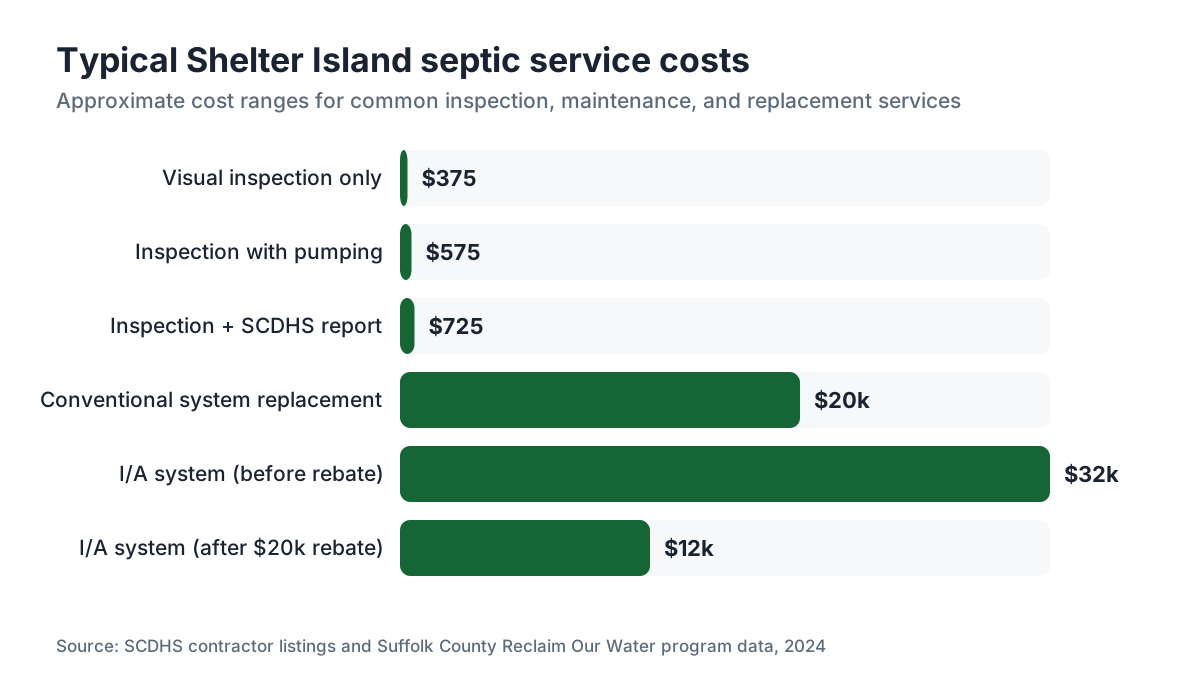
Expect $300 to $700 for a standard inspection that covers a visual assessment of the tank, D-box, and leach field. Bundle in pumping and add $150 to $400 depending on tank size and access. Island surcharges are real. Getting equipment out here on the North Ferry from Greenport or the South Ferry from North Haven adds time and fuel that contractors pass along.
For a real estate deal, some inspectors write a report formatted for SCDHS submission for $100 to $200 more. That documentation matters at closing, so don't skip it to save a little money.
| Service | Typical Shelter Island cost |
|---|---|
| Visual inspection only | $300, $450 |
| Inspection with tank pumping | $450, $700 |
| Inspection + SCDHS report | $550, $900 |
| Dye test (add-on) | $75, $150 |
| Camera inspection of lines | $150, $300 |
These ranges come from publicly available contractor listings and should be verified with individual providers. Shelter Island's small contractor market means pricing moves with demand, especially May through September when the seasonal population swells. If you're comparing quotes, make each one spell out whether pumping is included and whether the written report is formatted for SCDHS.
For what a failing inspection could cost, see our article on cost to install septic system.
Who can legally perform a septic inspection on Shelter Island?
In Suffolk County, septic inspections have to be done by a licensed engineer (PE) or a SCDHS-licensed inspector. Not every plumber or general contractor qualifies. For a real estate inspection that produces a report the county will accept, you need someone whose credentials SCDHS recognizes.
Shelter Island has a short list of contractors and engineers who do this work regularly, and during the busy summer selling season that list gets stretched thin. If you're planning to list a property or go under contract, line up the inspector four to six weeks out. Waiting until you're already under contract is one of the most common reasons closings get delayed on the island.
You can verify a contractor's license with SCDHS's Office of Wastewater Management. The county keeps a list of approved licensed inspectors, and anyone you hire should hand you their license number before you write a check.
One useful cross-check: operators who use SepticMind to run their service workflows can generate inspection documentation that meets county reporting formats, which speeds up the paperwork side of a transaction for both parties.
What are the most common reasons Shelter Island systems fail inspection?
Age is the single biggest factor. A large share of Shelter Island's residential septic systems went in between 1960 and 1990, under codes far weaker than current SCDHS Article 6 requirements. Many have seen no maintenance for years or decades.
Here are the failure points inspectors find most often on the island:
Saturated leach fields. The sandy soils that shape Shelter Island's geography can fool you. Sandy soil takes effluent fast early in a system's life, but biomat builds up in the trenches over time and cuts absorption capacity. Systems that never got pumped on a regular schedule are especially prone to this.
Failed or missing baffles. Concrete baffles break down in the presence of hydrogen sulfide gas, a byproduct of septic digestion. A shot inlet baffle lets solids run straight to the leach field. This one is fixable without replacing the tank. A licensed contractor can install a plastic tee or an effluent filter. See our article on septic tank repair for what that kind of targeted fix involves.
Undersized tanks. Older systems were sized to 1950s and 1960s household use. A three-bedroom house with a 500-gallon tank built for a summer cottage now gets used as a full-time four-person residence. SCDHS requires a minimum 1,000-gallon tank for a three-bedroom home [4]. Anything smaller almost always needs an upgrade.
Setback violations. Shelter Island has plenty of small, oddly shaped lots that pre-date modern sanitary codes. Wells and surface water bodies often sit closer to septic components than current rules allow. These violations show up during the permit or sale process.
High water table in low-lying areas. Parts of the island, especially near Fresh Pond and the tidal wetland areas, have seasonal high water tables that cut the effective soil depth for treatment. A system that passed inspection 20 years ago can fail now because the water table shifted or because the current inspector applies current standards.
What happens if a septic system fails inspection before a home sale?
This is the scenario that sends Shelter Island deals sideways. A failed inspection doesn't automatically kill the sale, but it does need resolving before the county signs off on the transfer.
The common resolution paths:
Negotiated credit. Seller and buyer agree on a dollar credit at closing, and the buyer handles the repair after the deal closes. This needs the buyer's lender to agree, which many won't do if the system is flagged as non-functional.
Seller repairs before closing. The seller hires a licensed contractor to fix the specific failure. A failed baffle or a D-box issue can be done in a week or two for a few hundred to a few thousand dollars. If the leach field needs replacing, you're looking at $10,000 to $25,000 and a four-to-eight-week timeline once permit approval is factored in. See our article on septic system repair for a breakdown of what different repair types involve.
Full system replacement. If the system is fundamentally inadequate, the county may require a conforming replacement instead of a repair. On Shelter Island, a new Title 6-compliant conventional system runs $15,000 to $30,000. If the site calls for an Innovative/Alternative (I/A) nitrogen-reducing system (which Suffolk County's Reclaim Our Water program now incentivizes), costs run $15,000 to $40,000 before incentives [5].
Suffolk County's Reclaim Our Water program provides rebates of up to $20,000 for I/A system installation in priority nitrogen-sensitive areas. Shelter Island's proximity to Peconic Bay means many properties qualify, which can change the net cost math for a seller facing a required upgrade.
The hardest conversations happen when neither party saw the problem coming. The surest way to avoid that is a pre-listing inspection.
What is an I/A system and does Shelter Island require one?
An Innovative/Alternative (I/A) onsite wastewater treatment system goes past conventional septic by adding treatment steps, usually a membrane bioreactor or another biological process, to cut total nitrogen in effluent by 70 percent or more compared to a conventional system [6]. Conventional septic tanks put out 40 to 60 mg/L of total nitrogen into the ground. A certified I/A system targets 19 mg/L or less under New York's approval standards.
Suffolk County Local Law 13 requires I/A systems for any new construction or full replacement in the county's designated "priority areas." The Peconic Estuary watershed that surrounds Shelter Island is a designated priority area. So if you're replacing a failed system entirely rather than repairing it, there's a strong regulatory push (and in many cases a legal requirement) toward I/A technology.
The upfront cost is real: $25,000 to $40,000 installed, versus $15,000 to $25,000 for a conventional system. The Reclaim Our Water rebates shrink that gap. A homeowner in a qualifying area can get up to $20,000 back, and the county program also offers low-interest financing [5]. The maintenance contract I/A systems require, usually $300 to $600 per year, is another cost to plan for.
I/A systems also hold up better for property value on an island where environmental compliance will only draw more scrutiny over time. If you're facing a required replacement anyway, the upgrade math is closer than it looks.
How often should you pump and maintain a Shelter Island septic system?
The EPA SepticSmart program recommends pumping every 3 to 5 years for a typical household [3]. For Shelter Island, the right interval is closer to every 2 to 3 years, for a few reasons.
Seasonal use creates irregular loading. A house that sits empty nine months and then hosts twelve people every August puts short-burst stress on a system designed for steady flow. The tank fills fast, and solids don't have time to settle before the next surge arrives.
Full-time residency has grown on the island. Systems sized for summer-only use are now serving year-round households. That's 3 to 4 times the annual hydraulic load the system was built around.
Pumping is cheap insurance. At $200 to $400 per pump-out, regular septic tank pumping is the single most cost-effective maintenance action you have. Letting solids build until they overflow into the leach field is one of the most common ways a serviceable system turns into a $20,000 replacement project.
Beyond pumping, have the risers and lids checked annually (they can sink or crack, creating odor and safety hazards), confirm the effluent filter is clean if your system has one, and keep records of every service visit. SCDHS may ask for maintenance history during a permit application or sale inspection, and a documented record makes that process smoother.
For a detailed breakdown of frequency recommendations, see how often to pump septic tank.
How do you find and hire a qualified septic inspector on Shelter Island?
Your options are more limited here than on the mainland, and that matters for scheduling.
Start with SCDHS's Office of Wastewater Management (at suffolkcountyny.gov) to confirm an inspector's license is current. Ask specifically whether the inspector knows Shelter Island site conditions, particularly high water table issues and the I/A system requirements that now apply to many replacement scenarios. Someone who works only on mainland Suffolk properties may not have current knowledge of the island's permit pathway.
Local real estate agents on Shelter Island are often a reliable referral source, not because they're recommending friends, but because they've watched inspectors work through actual closings and know whose reports hold up at SCDHS.
Get the inspection report in writing, in a format that names the specific components checked, their condition, and whether any immediate action is required. A one-paragraph summary is not enough for a property transfer. Ask upfront what the report will cover and whether it's formatted for SCDHS submission.
If you manage multiple properties or you're a contractor tracking inspection and service history across many Shelter Island accounts, SepticMind offers service management tools that help operators stay on top of inspection schedules, documentation, and follow-up work orders in one place.
Don't hire anyone who offers to inspect without physically uncovering the tank lid and probing the leach field area. Drive-by assessments that rely only on surface observation have no value for an SCDHS-acceptable inspection.
What records should a Shelter Island homeowner keep about their septic system?
Every piece of paper connected to your septic system should live in one folder, physical or digital. Here's the specific list:
Original permit and as-built diagram. SCDHS should have a record of your system's installation permit and approved design. If you don't have a copy, request it from the county. The as-built drawing shows the tank location, D-box location, leach field footprint, and setback distances. You need this for any permit application or pre-sale inspection.
Service and pump-out receipts. Document every pump-out, repair, and inspection visit with the date, service provider name, license number, and what was done. Dates matter. An inspector at a property sale will ask when the tank was last pumped.
Inspection reports. Keep every formal inspection report, including any that flagged problems and what was done to address them.
Any SCDHS correspondence. Notices of violation, permit approvals, variance decisions. These become essential context if you ever sell or apply to expand.
For a pre-listing inspection, having this documentation ready shortens the process and gives buyers confidence the system has been maintained. It also strengthens your hand in negotiation: a well-maintained system with documented history is a material asset.
See our guide on leach field maintenance for how to track field-specific symptoms over time.
Are there financial assistance programs for Shelter Island septic upgrades?
Yes, and they're worth understanding before you sign a repair or replacement contract.
Suffolk County's Reclaim Our Water program provides rebates of up to $20,000 for I/A system installation on qualifying properties [5]. The property has to sit in a designated nitrogen-sensitive area (most of Shelter Island qualifies), and the system has to be installed by a certified contractor using an approved I/A technology. Applications must go in before installation begins.
New York State also offers low-interest loans through the Environmental Facilities Corporation (EFC) for qualifying septic upgrades [7]. These are structured as liens on the property and can be paid back over 10 to 20 years, which makes the monthly cost of a $30,000 replacement much more manageable.
Shelter Island Town itself has discussed local assistance programs as part of its planning work around water quality. Check with Town Hall for any current local incentive or low-interest loan programs, since these change year to year.
One important note: do not start work before applying for rebate programs. Most programs require pre-approval and won't reimburse work already done. The rebate application typically takes four to eight weeks, so factor that into your timeline if you're working against a closing date.
Frequently asked questions
Is a septic inspection required to sell a house on Shelter Island?
Yes. Suffolk County requires an inspection of any onsite sewage disposal system before a property transfer. The seller is typically responsible for arranging it and providing documentation to the buyer. Without an acceptable inspection report, SCDHS will not sign off on the transfer. Line up the inspector at least four to six weeks before you expect to go under contract, since qualified inspectors on the island book up fast in the summer.
How long does a septic inspection take on Shelter Island?
A thorough inspection, including uncovering the tank, checking the D-box, and walking the leach field, takes two to four hours for a typical residential system. If pumping is done at the same time, add another hour. Systems with difficult access, buried lids, or complex designs with multiple tanks can run longer. Ask the inspector beforehand whether you need to locate the tank access lids or whether they'll do that as part of the job.
What is the difference between a septic inspection and a septic pump-out?
A pump-out removes accumulated solids from the tank. An inspection evaluates the structural condition and functional performance of the entire system: tank, baffles, distribution box, and leach field. They're related but separate services. A good pre-sale inspection usually includes or requires a pump-out, because you can't properly assess baffle condition or tank integrity with sludge in the way.
How much does a new septic system cost on Shelter Island if mine fails inspection?
A conventional replacement system runs $15,000 to $25,000 on Shelter Island. An Innovative/Alternative (I/A) nitrogen-reducing system, which Suffolk County now requires in many replacement scenarios near the Peconic Estuary, costs $25,000 to $40,000 installed. Suffolk County's Reclaim Our Water program offers rebates up to $20,000 for qualifying I/A installations, which substantially reduces the net cost. See our full article on cost to install septic system for a detailed breakdown.
Can I do a septic inspection myself on Shelter Island?
You can walk your leach field and look for ponding, odors, or unusually lush grass, and you can check that your tank lids are accessible and intact. But a legally acceptable inspection for a property sale or permit application must be performed by a SCDHS-licensed engineer or inspector. Self-inspection has no standing with the county and won't satisfy a buyer's lender.
What is an I/A septic system and why does it matter on Shelter Island?
An Innovative/Alternative (I/A) system uses advanced treatment technology to reduce nitrogen in septic effluent by 70 percent or more compared to a conventional system. Suffolk County Local Law 13 of 2017 requires I/A systems for new construction and full replacements in nitrogen-sensitive priority areas. Most of Shelter Island falls in those areas because of its proximity to the Peconic Estuary. If you're replacing a failed system, expect I/A to be required or strongly recommended.
How often should I pump my Shelter Island septic tank?
Every 2 to 3 years for a year-round household, and every 1 to 2 years if you have heavy seasonal use like summer guests. The EPA SepticSmart program recommends pumping every 3 to 5 years under typical conditions, but Shelter Island's combination of older systems, irregular seasonal loading, and environmental stakes makes a more frequent schedule the smarter approach. Pumping at $200 to $400 per visit is far cheaper than a field replacement.
What setbacks does Suffolk County require for septic systems?
SCDHS Article 6 sets minimum setbacks including 100 feet from a public water supply well, 50 feet from a private well, 100 feet from surface water bodies, and specific distances from property lines depending on system type. Older Shelter Island systems frequently don't meet current setback standards, which can trigger a required upgrade when the property sells or a permit application is filed. An as-built diagram from SCDHS will show your system's actual setbacks.
Does Shelter Island Town have its own septic rules beyond Suffolk County's?
Shelter Island Town operates under SCDHS Article 6 as its governing framework and does not maintain a fully separate local septic code. However, the town has adopted local environmental protection ordinances and has been active in pursuing nitrogen reduction as part of its planning. Always confirm current requirements with both SCDHS and Shelter Island Town Hall before starting any work, since local interpretations and permit processing can differ from county-only projects.
What financial help is available for Shelter Island septic upgrades?
Suffolk County's Reclaim Our Water program provides rebates up to $20,000 for certified I/A system installations in priority nitrogen-sensitive areas. New York State's Environmental Facilities Corporation offers low-interest loans for qualifying upgrades. You must apply before starting work; retroactive reimbursement is not available. Check with Shelter Island Town Hall for any current local assistance programs, which can change year to year.
What should I do before a scheduled septic inspection to prepare?
Locate and make sure all tank access lids are reachable, clearing any landscaping or structures over them. Pull together any records you have: original permits, as-built diagrams, past pump-out receipts, prior inspection reports. Avoid running large laundry loads or heavy water use for 24 to 48 hours before the inspection so the inspector sees the system under normal conditions. If you don't know where the tank is, SCDHS may have your as-built on file.
Can a septic inspection report from Shelter Island be used by both the buyer and seller?
The inspection is typically ordered by the seller but the report is shared with the buyer and their lender. Who pays for it is negotiable. In some Shelter Island transactions the buyer's agent requests an independent inspection even if the seller provides one. If you're a buyer, having your own inspector present during or after the seller's inspection gives you a second set of eyes without necessarily paying for a full duplicate report.
What happens if a septic system can't be replaced in place due to lot size or setbacks?
This is more common on Shelter Island than in many areas because of small and irregularly shaped lots. When a conforming replacement can't fit within the available lot area and setbacks, the property owner typically works with a licensed engineer to design a variance application to SCDHS. In some cases the only viable path is an I/A system with a smaller footprint, which is one reason I/A technology is increasingly the default on constrained island lots.
Sources
- Suffolk County Department of Health Services, Reclaim Our Water program overview: Nitrogen loading from septic systems is a primary driver of algal blooms and shellfish bed closures in the Peconic Estuary, as documented by SCDHS environmental quality monitoring.
- Suffolk County Local Law 13 of 2017, SAVE Our Water (Suffolk County Legislature): Suffolk County Local Law 13 of 2017 created the framework for mandatory I/A septic upgrades and tighter oversight on the East End, including Shelter Island.
- U.S. EPA SepticSmart: Caring for Your Septic System: EPA SepticSmart states that a household septic system should be inspected at least every three years by a qualified professional and pumped when solids reach one-third of the liquid volume.
- Suffolk County Sanitary Code Article 6, Standards for Approval of Plans and Construction of Sewage Disposal Systems: SCDHS Article 6 requires a minimum 1,000-gallon septic tank for a three-bedroom residential home.
- Suffolk County Reclaim Our Water I/A System Rebate Program: Suffolk County's Reclaim Our Water program provides rebates of up to $20,000 for certified I/A system installation on qualifying properties in nitrogen-sensitive priority areas.
- New York State Department of Health, Innovative and Alternative Onsite Wastewater Treatment Systems: New York-approved I/A onsite wastewater treatment systems must reduce total nitrogen in effluent to 19 mg/L or less, compared to 40 to 60 mg/L from conventional septic systems.
- New York State Environmental Facilities Corporation, Water Infrastructure Improvement Act financing: New York State EFC offers low-interest loans for qualifying septic system upgrades, structured as property liens repayable over 10 to 20 years.
- U.S. EPA, Septic Systems Overview: EPA recommends that most household septic systems be pumped every 3 to 5 years under typical conditions.
- Suffolk County Sanitary Code Article 6, Well and septic setback requirements: SCDHS Article 6 requires minimum setbacks of 100 feet from public water supply wells, 50 feet from private wells, and 100 feet from surface water for septic system components.
Last updated 2026-07-09