Septic inspection in Northport, NY: what to expect and what it costs
By the SepticMind Editorial Team
TL;DR
- A septic inspection in Northport, NY runs $300 to $600 for a standard visual and functional check, and $500 to $900 if the inspector pumps the tank first.
- Suffolk County regulates onsite systems under Article 19 of its Sanitary Code.
- Expect two to four hours on site.
- Pump the tank before the inspection for accurate findings.
What does a septic inspection in Northport actually involve?
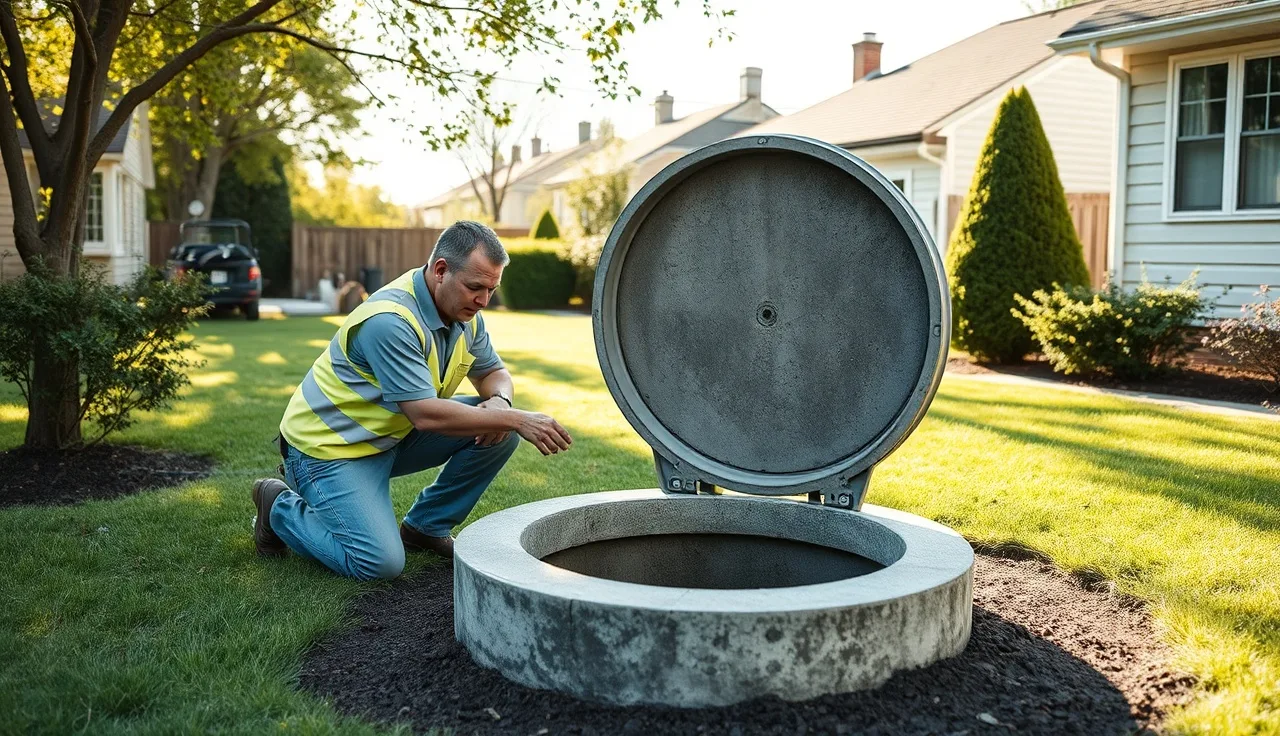
A septic inspection is more than someone poking around your yard. A licensed inspector, which in Suffolk County means a licensed engineer or sanitarian following Article 19 of the Suffolk County Sanitary Code [1], works a structured process: locating every system component, exposing the tank access lid, checking inlet and outlet baffles, probing the distribution box, and walking the drain field for wet spots, odors, or die-off patterns in the grass.
The functional test matters most. The inspector runs water through the house, watches how the tank takes it, and confirms effluent moves through the outlet the way it should. If the tank hasn't been pumped recently, sludge and scum depth readings tell the story: two years from trouble, or two months.
For a real estate transaction in Northport, the Suffolk County Department of Health Services requires a Title V-style inspection disclosure for property transfers in many cases, though the specific trigger rules depend on the year the system was installed and whether it sits near a sensitive water body like Northport Harbor or the Long Island Sound. Check with SCDHS directly for current transfer requirements [2].
East Northport inspections follow the same Suffolk County framework. The hamlet sits in the same county health jurisdiction, so a septic inspection in East Northport means the same licensed professionals and the same regulatory checklist.
How much does a septic inspection cost in Northport?
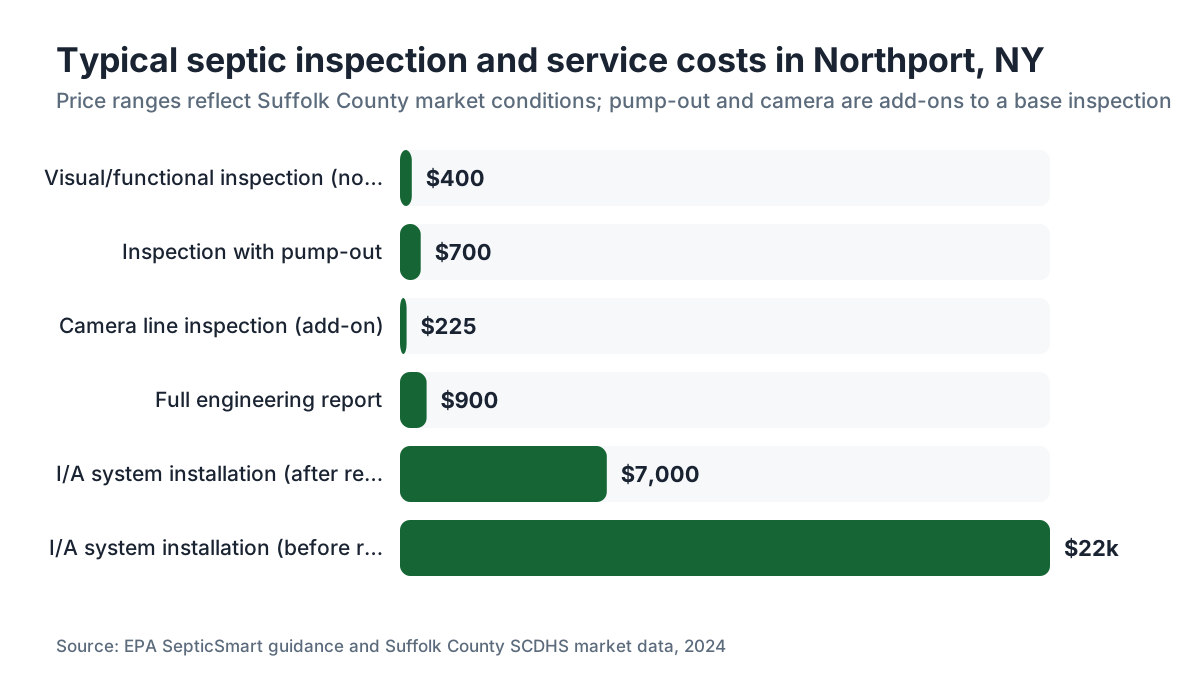
Cost tracks scope. Here's an honest breakdown based on typical Suffolk County pricing:
| Inspection Type | Typical Cost Range |
|---|---|
| Visual/functional inspection (no pumping) | $300 to $500 |
| Inspection with pump-out | $500 to $900 |
| Camera inspection of inlet/outlet lines | Add $150 to $300 |
| Full engineering report (for financing or legal) | $600 to $1,200 |
| Perc test for new installation or expansion | $500 to $1,500 |
These are ranges, not guarantees. A company driving 45 minutes from Hauppauge charges differently than a local Northport operator. Get at least two quotes. Ask specifically whether the price includes tank exposure (digging or lifting the lid) and whether you get a written report or just a verbal pass/fail.
Buying a home and your lender wants a septic inspection? The cheapest one is rarely the useful one. A $300 inspection that misses a cracked distribution box or a saturated drain field costs you far more than the $200 you saved. Pay for the pump-out. Every credible inspector agrees on this point: you can't read a tank you can't see the bottom of.
For context on what a failing system costs to fix or replace, the cost to install a septic system runs $10,000 to $30,000 or more in Suffolk County, where lot sizes, soil conditions, and permitting push the price above the national average.
What are Suffolk County's rules for septic inspections?
Suffolk County runs one of the more detailed local sanitary codes in the Northeast. Article 19 of the Suffolk County Sanitary Code governs individual sewage disposal systems [1]. A few points every Northport homeowner should know.
New construction or significant renovation needs a permit from the Suffolk County Department of Health Services before any septic work starts. The county has been pushing cesspools and older systems toward nitrogen-reducing technology under its Reclaim Our Water initiative and the nitrogen credit programs tied to SCDHS [2].
The county sets setback distances from wells, property lines, and surface waters. Northport's closeness to Northport Bay, Duck Island Harbor, and numerous tidal wetlands means inspectors watch closely for aging systems near sensitive water boundaries. The EPA SepticSmart program notes that "properly functioning septic systems are one of the most effective and least expensive ways to treat household wastewater," but systems that are old, undersized, or poorly sited are a primary source of nitrogen loading into Long Island's coastal waters [3].
For real estate transfers, Suffolk County has moved toward stricter disclosure and, in some zones, mandatory upgrades to innovative/alternative (I/A) systems. Buying or selling in Northport with an old cesspool or a pre-1980s tank? Budget time for the county health department review. It can add weeks to a closing.
The state-level framework comes from the New York State Department of Environmental Conservation and the NYS Department of Health, which set baseline standards that Suffolk County then adds its own requirements on top of [4].
When should you get a septic inspection in Northport?
Four situations demand an inspection. First, you're buying or selling a home. Full stop. Don't waive this inspection in a competitive market. A failed septic system can wipe out $20,000 to $50,000 in value or kill the deal outright.
Second, you notice symptoms: sewage smell in the yard or basement, slow drains in multiple fixtures at once, unusually green and lush grass over the drain field (often a sign of effluent surfacing), or gurgling in the plumbing when no one's running water. These aren't things to watch for a few more months.
Third, you haven't pumped the tank in three to five years. The EPA recommends inspecting septic systems at least every three years, with pumping every three to five years depending on household size and tank volume [3]. Plenty of Northport properties have tanks sized for two or three people now housing four or five. Frequency matters.
Fourth, you're planning an addition, a kitchen remodel that adds a dishwasher, or an accessory dwelling unit. Piling hydraulic load onto a marginal system is a fast way to fail it.
For owners near East Quogue or in the Hamptons area of Suffolk County, the same logic applies with one wrinkle: those areas sit closer to the Peconic Estuary and South Fork water bodies, which triggers even tighter SCDHS scrutiny for cesspools and older systems. A septic inspection in East Quogue should address proximity to groundwater and surface water setbacks head-on.
What do inspectors actually look for in a Northport septic system?
Good inspectors work from a checklist, but they're also reading the site. Here's what they evaluate.
Tank condition. Concrete tanks crack, fiberglass tanks can shift, and older steel tanks corrode from the inside out. The inspector checks structural integrity, baffle condition (a missing outlet baffle is one of the most common and damaging findings), and evidence of root intrusion.
Liquid level. At normal operating level, that's expected. Higher than the outlet, and something downstream is blocked or saturated. Lower than the outlet, and there may be a leak in the tank itself.
Sludge and scum depth. The inspector measures the bottom sludge layer and the floating scum layer. When sludge reaches within 12 inches of the outlet baffle, pumping is overdue. Techs use these numbers to estimate remaining useful life before solids carry over to the drain field, which is where real damage happens.
Distribution box. The D-box splits effluent evenly to the drain field lines. A tilted D-box, common on Long Island after decades of freeze-thaw, sends all the flow to one leg and kills that portion of the field while the others sit dry. It's repairable but often missed in a fast inspection.
Drain field. The inspector walks it, probes it, and looks for saturation, ponding, odor, or excessive vegetative growth. A leach field that's surfacing effluent is already failing. Sometimes you can rehabilitate a field through resting and aeration; sometimes you need a replacement. No honest inspector calls that over the phone.
If pumping is needed after the inspection, that service is straightforward. See our guide on septic tank pumping for what the process looks like and what it costs.
How do you find a licensed septic inspector in Northport?
In New York, septic inspections for real estate transactions require licensure from the Suffolk County Department of Health Services. Inspectors are usually licensed professional engineers (PE), licensed sanitarians, or home inspectors with a specialty certification in onsite systems. Plumbers can pump and do repair work, but they're not always qualified to write the report a lender or county health department will accept.
The SCDHS Office of Wastewater Management keeps a list of approved engineers and system designers [2]. That's your starting point. Ask any inspector you contact:
- Are you licensed in Suffolk County?
- Will you give me a written report, more than a verbal assessment?
- Does the price include pumping, or is that separate?
- Have you inspected systems of this age and type in Northport?
Local companies working the Northport, Huntington, and East Northport corridor know the soil types, the common system designs, and which neighborhoods run older cesspool setups versus newer two-compartment tanks. That local knowledge is worth paying for. A company based in Nassau County that rarely crosses into Suffolk's north shore may miss context that matters.
For septic service operators managing inspection scheduling and work orders across multiple Northport and Long Island territories, tools like SepticMind are worth a look. The software tracks inspection histories, permit dates, and pump-out cycles so nothing slips when you're running a busy route.
What happens if a Northport septic inspection fails?
A failed inspection doesn't automatically mean full replacement. It means something turned up that needs attention, and that attention ranges from a $150 baffle swap to a $25,000 system overhaul.
Common findings and their typical repair implications:
| Finding | Likely Action | Rough Cost |
|---|---|---|
| Missing or deteriorated baffle | Replace baffle | $150 to $400 |
| Cracked tank | Repair or replace tank | $1,000 to $5,000 |
| Tilted distribution box | Re-level or replace D-box | $300 to $800 |
| Saturated but not failed drain field | Rest field, add aeration | $500 to $2,000 |
| Fully failed drain field | New leach field installation | $5,000 to $20,000+ |
| Old cesspool requiring upgrade | I/A system installation | $15,000 to $30,000+ |
In a real estate deal, a failed inspection hands the buyer negotiating room. You can ask the seller to repair, credit you the repair cost, or drop the purchase price. Sellers sometimes push back with "we'll pump it and retest," which is valid only if the original failure was purely about sludge levels and not structural or field problems.
For repairs after a failed inspection, see our guides on septic tank repair and broader septic system repair for what different fix types involve.
If the system is truly at end of life, understanding the cost to put in a septic tank and the full cost to install a septic system in Suffolk County is your next step. Costs run higher than the national average because of permitting, lot coverage rules, and the county's push toward I/A nitrogen-reducing technology.
How often should you get a septic inspection in Northport?
The EPA recommends a full inspection at least every three years for conventional systems [3]. Pumping frequency depends on household size and tank volume. A 1,000-gallon tank serving four people usually needs pumping every three to four years; the same tank serving two people can go five.
A quick reference from the EPA's guidelines:
| Household Size | Tank Size (gallons) | Pump Frequency |
|---|---|---|
| 1-2 people | 1,000 | Every 5-7 years |
| 3-4 people | 1,000 | Every 3-5 years |
| 5-6 people | 1,500 | Every 3-4 years |
| 7+ people | 2,000 | Every 2-3 years |
These are estimates. The actual sludge accumulation rate depends on what goes down the drain. Garbage disposals speed it up a lot, as do certain medications, antibacterial soaps, and large volumes of grease.
For more on frequency, our article on how often to pump a septic tank works through the full variable list.
Northport homeowners with systems near the water should lean toward the shorter end of any maintenance range. Nitrogen loading from failing septic systems is a documented contributor to the algae blooms and shellfish bed closures that have hit Northport Harbor and nearby areas. That's more than an environmental worry. It's a property value worry for anyone whose yard backs up to the water.
What's the difference between a septic inspection and a septic pump-out in Northport?
Related, but not the same thing. A septic tank pump out is a maintenance service: a vacuum truck removes accumulated sludge and scum from the tank. It's not diagnostic by itself, though a good pump-out tech will note anything obviously wrong while the lid is open.
An inspection is diagnostic. It evaluates whether the system works correctly, identifies deficiencies, and documents the findings in a form useful for real estate, permits, or maintenance decisions.
You want both, done together. When the tank is pumped first, the inspector can see the tank walls, the baffle condition, and the floor clearly. An inspection on a tank that hasn't been pumped is like trying to examine your teeth through a glass of chocolate milk. Possible, but you'll miss things.
For septic tank cleaning and septic tank emptying specifically, those services are usually the pump-out plus any interior rinsing the tech does to clear residual solids. Some companies offer it as an add-on; others fold it into the standard pump-out price. Ask before you book.
The honest recommendation: schedule inspection and pump-out together. Adding the inspection while the pump truck is already on site costs little. Scheduling two separate visits because you did only the pump-out first costs a lot more.
What are the nitrogen-reduction rules affecting Northport septic systems?
This is where Northport gets more complicated than many parts of New York State. Suffolk County passed Local Law 38-2021, which set up a county-wide program to phase out traditional cesspools and septic systems in certain areas and replace them with innovative/alternative (I/A) systems that strip nitrogen from effluent before it reaches groundwater [5].
The county's Reclaim Our Water program offers rebates to homeowners who voluntarily upgrade to I/A systems, sometimes covering $10,000 to $30,000 of the installation cost depending on the property's location relative to sensitive water bodies [2]. Northport Bay and the surrounding watershed are high-priority zones.
Selling a property in Northport with an old cesspool? You may be required to upgrade before transfer depending on the age of the system and its proximity to surface waters. This requirement has rolled out in phases. Under recent SCDHS guidance, cesspools within 500 feet of surface waters in certain designated areas face mandatory upgrade requirements.
For homeowners with no plans to sell, the voluntary rebate program is genuinely worth investigating. A system that costs $18,000 out of pocket might net down to $6,000 to $8,000 after county and state credits. The nitrogen reduction also cuts your risk of feeding the shellfish bed closures and harmful algae events that have cost the region real money.
Operators running inspection and installation businesses on the north shore need to stay current with SCDHS phase-in schedules. SepticMind tracks regulatory deadlines and system ages in its operator dashboard, which helps when you're managing dozens of client properties across Suffolk County neighborhoods with different compliance timelines.
How does Northport compare to East Northport and East Quogue for septic inspections?
East Northport is a hamlet within the Town of Huntington, just like Northport itself. From a regulatory standpoint they're the same jurisdiction: Suffolk County Department of Health Services, same Article 19 rules, same licensed inspectors. Searching for a septic inspection in East Northport means the same services, the same price ranges, and the same county oversight.
Soil types do vary across the north shore. Northport has areas of deeper sandy loam with decent percolation, while some East Northport parcels, particularly older development near Duck Pond Road or the wooded interior, carry heavier clay-influenced soils that make field replacement harder and more expensive.
East Quogue is a different story geographically. It sits on the South Fork, in the Town of Southampton, closer to Shinnecock Bay and the Peconic Estuary. The regulator is still SCDHS, but the surrounding water bodies are even more sensitive, and Southampton Town's own zoning can add another layer. A septic inspection in East Quogue should flag groundwater depth (often very shallow on the South Fork) and proximity to tidal wetlands. Inspectors who work that area know this; someone from the north shore who rarely goes out there may not.
On price, East Quogue inspections run in the same general range as Northport, though travel fees from north shore companies can add $50 to $100 if they aren't local.
Frequently asked questions
Does Suffolk County require a septic inspection before selling a home in Northport?
Suffolk County requires disclosure of the septic system's existence and type, and for properties in certain zones near water bodies, SCDHS may require inspection or upgrade as a condition of transfer. The rules depend on the system's age, type, and location. Consult the SCDHS Office of Wastewater Management before listing to know exactly what applies to your property.
How long does a septic inspection take in Northport?
Plan on two to four hours on site. Locating the tank lid can take 30 to 60 minutes if no records exist. The functional test, probing the drain field, and writing field notes add another hour. If the inspector pumps the tank first, add 45 to 90 minutes for that service. Schedule the full half-day and don't rush it.
Can a home inspector do a septic inspection in Northport, or do I need a specialist?
A general home inspector can flag obvious symptoms like slow drains, odors, or wet spots in the yard. For a formal septic inspection that satisfies a lender, an attorney, or the Suffolk County Department of Health Services, you need a licensed professional engineer or a sanitarian with specific onsite wastewater credentials. Don't rely on a general home inspection report for septic system decisions.
What is an I/A septic system and do I need one in Northport?
An innovative/alternative (I/A) system adds a treatment step that removes nitrogen from wastewater before it reaches groundwater. Suffolk County's Local Law 38-2021 mandates or incentivizes these systems in nitrogen-sensitive zones. Northport's proximity to the harbor makes it a likely candidate for phased upgrade requirements. Suffolk County offers rebates that can cover a large chunk of the $15,000 to $30,000 installation cost.
How do I find my septic tank if I don't know where it is?
Start with the Suffolk County Department of Health Services. They keep records of permitted systems going back decades. Your home's as-built drawings filed with the county may show the tank location. If records don't exist, a septic company can use a probe rod and, in some cases, a pipe locating transmitter to trace the line from the house. Expect a small fee for the locate if it takes more than 20 to 30 minutes.
What happens if the drain field is failing during a Northport property sale?
If inspection reveals a failing drain field, the deal doesn't have to die. Buyer and seller can negotiate a price reduction, a repair credit, or a requirement that the seller fix the field before closing. In some cases the parties agree on an escrow holdback until repair is complete. A failing field in Northport can cost $8,000 to $20,000 to replace; that number becomes the center of the negotiation.
Is a septic inspection required for a refinance in Northport?
Most conventional refinances don't require a septic inspection unless the property is flagged during appraisal or the lender has a specific requirement. FHA and USDA loans carry more stringent property condition standards that can trigger a septic inspection requirement. Check with your lender before assuming you're clear. If your last inspection is more than two or three years old, scheduling one proactively is smart regardless.
How much does it cost to replace a septic system in Northport, NY?
Full system replacement in Northport runs roughly $15,000 to $35,000 depending on lot conditions, soil percolation, system type, and permitting costs. Suffolk County's push toward I/A systems adds to the cost, but county rebates can offset $10,000 to $30,000 of it. Tight lots near the water with poor perc rates and setback challenges land at the higher end. Get two or three bids from SCDHS-approved installers.
Can I use a garbage disposal if I have a septic system in Northport?
You can, but the EPA and most septic professionals advise against it, or at least recommend cutting use way back. Garbage disposals add substantial solid waste to the tank and speed up sludge accumulation. Studies show homes with garbage disposals need pumping roughly 50% more often. In Suffolk County, where older and undersized systems are common, adding a disposal to a marginal system is a bad idea.
What is the Suffolk County Reclaim Our Water rebate program?
Reclaim Our Water is a Suffolk County initiative that gives homeowners rebates for upgrading from cesspools or conventional septic systems to nitrogen-reducing I/A systems. Rebates range from roughly $10,000 to $30,000 depending on the property's location and the system chosen. Applications go through SCDHS. The program has been active since around 2017 and has funded thousands of upgrades across the county.
What should I do to prepare my Northport home before a septic inspection?
Locate any system records you have: permits, prior inspection reports, pump-out receipts. Clear access to the ground above the tank and along the drain field. Skip laundry, the dishwasher, and long showers the morning of the inspection so the tank isn't artificially surcharged. If you know the tank lid location, mark it. Don't add septic additives in the days before; they don't help and can mask conditions.
How do I know if my Northport septic system is a cesspool or a true septic tank?
A cesspool is a pit, usually brick or block, that both holds solids and lets effluent seep through its walls into the surrounding soil. A septic tank is a watertight vessel that separates solids from liquid before sending effluent to a separate drain field. Suffolk County records show which type was permitted. Many older Northport homes, especially those built before the 1970s, have cesspools rather than true septic systems.
What are signs that a Northport septic system is failing?
Watch for sewage odors inside the house or near the yard, slow drains across multiple fixtures at once, gurgling in the pipes when toilets flush, unusually lush green grass directly over the drain field, wet or soggy ground above the tank or field when it hasn't rained, and sewage backups. Any one alone warrants a call to a licensed inspector. Several at once mean the situation is urgent.
Sources
- Suffolk County Department of Health Services, Article 19 of the Suffolk County Sanitary Code: Suffolk County regulates individual sewage disposal systems under Article 19 of the Suffolk County Sanitary Code, including permitting, setbacks, and system standards.
- Suffolk County Department of Health Services, Office of Wastewater Management / Reclaim Our Water: SCDHS oversees septic permits, inspection requirements for property transfers, and the Reclaim Our Water rebate program for I/A system upgrades.
- U.S. Environmental Protection Agency, SepticSmart: Maintaining Your Septic System: The EPA recommends septic system inspection at least every three years and pumping every three to five years depending on household size and tank volume; the EPA also states properly functioning septic systems are among the most effective and least expensive ways to treat household wastewater.
- New York State Department of Health, Individual Household Sewage Treatment Systems: New York State Department of Health sets baseline standards for onsite sewage treatment that local jurisdictions including Suffolk County must meet or exceed.
- Suffolk County Legislature, Local Law 38-2021: Suffolk County Local Law 38-2021 established a phased program to replace cesspools and conventional septic systems with nitrogen-reducing innovative/alternative systems in designated sensitive zones.
- EPA, How to Care for Your Septic System: EPA guidance on household size vs. tank size and recommended pump-out frequency, and the impacts of garbage disposal use on sludge accumulation rates.
- Cornell Cooperative Extension of Suffolk County, Septic System Management: Cornell Cooperative Extension provides regional guidance on Long Island septic system management, nitrogen loading concerns, and coastal water quality impacts from onsite wastewater systems.
- National Environmental Services Center, Onsite Wastewater Treatment Systems: A Technical Compendium: Technical reference for inspection checklists, tank sludge and scum depth thresholds, distribution box failure modes, and drain field assessment methodology.
- Suffolk County Reclaim Our Water, Homeowner Rebate Program Details: The Reclaim Our Water program offers homeowner rebates ranging from approximately $10,000 to $30,000 for installation of approved I/A nitrogen-reducing septic systems in Suffolk County.
Last updated 2026-07-09