Septic inspection in North Babylon, NY: what to expect and what it costs
By the SepticMind Editorial Team
TL;DR
- A septic inspection in North Babylon, NY runs $300 to $600 and follows Suffolk County Department of Health Services rules.
- Inspectors check the tank condition, the inlet and outlet baffles, and the cesspool or leach field for signs of failure.
- Real estate deals need a county-approved engineer to file Form WWM-073.
- Plan on 2 to 4 hours on site.
What is a septic inspection and why does it matter in North Babylon?
North Babylon is a hamlet in the Town of Babylon, Suffolk County, New York. Like most of Long Island's south shore communities, it sits over a sole-source aquifer. The EPA designated the Long Island aquifer system a sole-source aquifer under the Safe Drinking Water Act in 1984, meaning it is the only practical drinking water source for roughly 3 million people [1]. That designation is why Suffolk County takes septic oversight seriously, and why a failed or neglected system here has consequences that go well beyond one property.
A septic inspection is a physical examination of your entire on-site wastewater system: the tank or cesspool, the inlet and outlet pipes, the distribution box, and the absorption area (leach field or cesspool rings). The inspector looks for structural cracks, failed baffles, groundwater intrusion, and evidence that the absorption area is saturated or backing up. A thorough inspector does more than check a box. They probe the soil near the leach field, measure scum and sludge layers inside the tank, and run water through the system to watch how it responds.
Why does it matter specifically in North Babylon? The water table in this part of Suffolk County is shallow, sometimes less than 6 feet below grade. A failing system can reach groundwater and add nitrogen to the aquifer much faster than it would in an area with deep soils. Suffolk County has documented that roughly 74 percent of nitrogen entering Long Island's groundwater comes from septic systems and cesspools [2]. That number puts the stakes in plain terms.
Buying a home, refinancing, or just keeping up with maintenance, a septic inspection tells you the true condition of an asset that can cost $15,000 to $50,000 to replace if it fails completely.
What rules apply to septic systems in North Babylon and Suffolk County?
North Babylon falls under the jurisdiction of the Suffolk County Department of Health Services (SCDHS), Division of Environmental Quality. The governing code is the Suffolk County Sanitary Code, Article 6, which sets minimum standards for the design, installation, and maintenance of individual sewage disposal systems [3]. New York State adds another layer through the State Environmental Quality Review Act and Title 6 of the New York Codes, Rules and Regulations (6 NYCRR), though day-to-day enforcement in Suffolk County flows through the county code [8].
For real estate transfers, Suffolk County requires what the SCDHS calls a "subsurface sewage disposal system inspection" performed by a licensed professional engineer or licensed architect who is on the county's approved list. The inspector submits a report on SCDHS Form WWM-073. The seller usually arranges and pays for this inspection, though that is negotiable. The report stays on file with the county.
The Suffolk County Cesspool and Septic System Service Contractor Registration program also requires anyone pumping or servicing systems in the county to hold a valid county registration, beyond any state license [3]. That distinction matters when you hire someone. Ask to see their SCDHS registration number, more than a generic plumber's license.
Suffolk County passed Local Law 13-2020, the county's groundwater protection law, which created the Septic Improvement Program (SIP). That program offers rebates of up to $30,000 for homeowners who replace conventional cesspools or septic systems with Innovative/Alternative Onsite Wastewater Treatment Systems (I/A OWTS) [4]. North Babylon properties are eligible. The rebate does not apply to a routine inspection, but a failing inspection result is often the first step toward a SIP application.
What does a septic inspector actually check at a North Babylon property?
A good inspector follows a sequence, and knowing that sequence helps you read the report you get afterward.
First, they locate and uncover all access points. Many older North Babylon homes have cesspools rather than modern septic tanks, and some properties have multiple cesspool rings that were added as the original system reached capacity. The inspector identifies every component and maps them.
Inside the tank or cesspool, they measure the scum layer at the top and the sludge layer at the bottom. The EPA's SepticSmart program says a tank should be pumped when the combined scum and sludge layers occupy more than one-third of the tank's liquid volume [5]. They also inspect the inlet baffle (which slows incoming flow) and the outlet baffle or effluent filter (which keeps solids from escaping into the drain field). Cracked or missing baffles are one of the most common findings in older Suffolk County systems.
Next, they assess the distribution box, if present. A tilted or cracked D-box spreads effluent unevenly across leach lines, which overloads one side and starves the other, speeding up failure.
The absorption area gets close attention. The inspector looks for surface breakout (sewage surfacing on the lawn), lush green stripes over leach lines that hint at heavy nutrient loading, and wet or spongy soil. They may probe or observe the soil profile.
Last, they run a hydraulic load test. They flush or run a measured amount of water through the system and watch whether the tank level drops back to normal within a set window. A tank that stays high after the test suggests the absorption area is not accepting flow.
The full written report should include the system location sketch, component conditions, measurement readings, test results, and a recommendation: pass, conditional pass, or fail.
How much does a septic inspection cost in North Babylon?
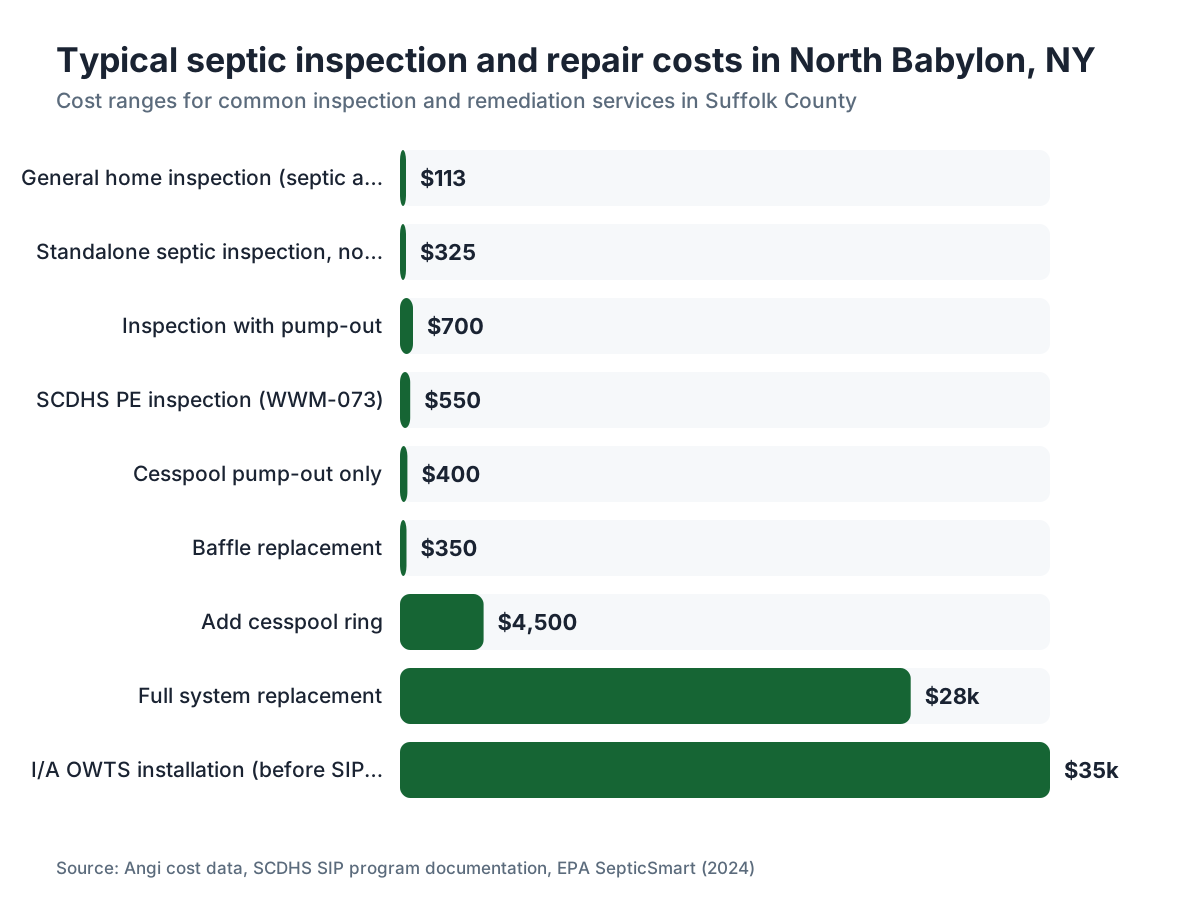
Expect to pay $300 to $600 for a standard inspection in North Babylon. The range reflects a few variables: whether the system needs pumping first (which most inspectors require before they can accurately measure sludge layers), how many cesspools are on the property, and whether the inspector is a licensed PE filing with SCDHS or a home inspector doing a general visual.
Pumping before inspection is common here. Pumping alone runs $300 to $500 in Suffolk County for a standard 1,000-gallon cesspool, sometimes more for multiple rings [6]. Combine an inspection with a pump-out and the total package often lands between $500 and $900 from a full-service company. That still beats discovering a problem at closing when you have no room to negotiate.
For a county-required real estate inspection with SCDHS Form WWM-073 submission, a licensed PE usually charges $400 to $700 on top of any pumping cost. Some firms bundle everything.
The table below shows typical cost ranges for inspection-related services in the North Babylon area.
| Service | Typical Cost Range |
|---|---|
| Visual / general home inspection (septic portion only) | $75, $150 (add-on) |
| Standalone septic inspection, no pumping | $250, $400 |
| Septic inspection with pump-out | $500, $900 |
| SCDHS real estate inspection (PE, WWM-073) | $400, $700 + pumping |
| I/A OWTS design for SIP application | $2,000, $5,000 |
These ranges come from publicly reported contractor pricing in Suffolk County and the SCDHS SIP program documentation [4]. Individual quotes vary. Get at least two written quotes before committing, and confirm the quote includes the SCDHS report filing if that is what you need.
See our guide to septic tank inspection costs for a broader national comparison.
How do I find a qualified septic inspector in North Babylon?
Start with the SCDHS list of registered cesspool service contractors and licensed engineers. The county maintains this list because Suffolk has its own registration requirement beyond the state. Request the list directly from the SCDHS Division of Environmental Quality in Hauppauge, or search the New York State Department of State's licensed engineer database for PEs practicing in Suffolk County [7].
A few practical filters. Ask whether the firm has done SCDHS Form WWM-073 submissions before. If they look blank at that form number, they are not the right firm for a real estate transaction inspection. Ask how they handle the pump-out coordination, whether they subcontract it or do it in-house, and whether the quote is all-in.
The Town of Babylon does not keep its own separate inspector list, so the county resources are your primary source. Online reviews on Google Maps and the Better Business Bureau can help you screen out firms with pattern complaints about late reports or missed components, but reviews are no substitute for verifying the county registration.
Avoid any inspector who quotes a price without asking how many cesspools or tanks are on the property. The number of components directly determines how long the inspection takes and what the county filing requires. A quote that ignores that detail is probably a lowball that will grow once they arrive.
If you run a septic service business doing inspections across Suffolk County, tools like SepticMind can handle the scheduling, report generation, and county filing workflow so inspectors spend less time on paperwork and more time in the field.
What are the most common septic problems found in North Babylon homes?
North Babylon's housing stock is mostly post-World War II construction, with many homes built between 1950 and 1970. That means a lot of original cesspools that are now 55 to 75 years old. They were not designed for today's water usage, and they have had decades to accumulate grease, bio-mat, and structural wear.
The most common findings:
Failed or missing baffles. The concrete or sanipak baffles inside older cesspools degrade over time. Without a working outlet baffle, raw solids migrate toward the absorption area and speed up clogging. This is fixable without a full replacement, usually $200 to $500 for baffle replacement.
Over-full cesspools with no absorption capacity left. When the soil around a cesspool ring becomes saturated with bio-mat, it stops accepting liquid. The cesspool fills to the surface. The fix is either a new cesspool ring added to the system (if there is space) or a full system replacement. Adding a ring runs $3,000 to $6,000 in Suffolk County. Full replacement is $15,000 to $40,000 or more depending on soil conditions and system type [6].
Groundwater intrusion. In low-lying parts of North Babylon near the Connetquot River corridor and the barrier beaches, the water table sits very close to the surface. Inspectors sometimes find cesspools that are essentially submerged during wet seasons, which means effluent is mixing with groundwater directly. That is both an environmental and a public health concern.
Cracked tanks from vehicle traffic or tree root intrusion. Concrete tanks crack, especially when vehicles park over them or large tree roots grow through them. A cracked tank leaks untreated sewage straight into the soil.
See our related articles on septic tank repair and septic system repair for cost breakdowns on common fixes.
How often should North Babylon homeowners get a septic inspection?
The EPA recommends inspecting a conventional septic system every 3 years and pumping it every 3 to 5 years depending on household size and usage [5]. Suffolk County does not mandate a specific inspection frequency for homeowners outside of real estate transactions, but the SCDHS SepticSmart educational materials line up with the EPA's guidance.
For North Babylon specifically, given the shallow water table and the age of most systems, I would shorten that cycle. An inspection every 2 to 3 years makes sense for a system more than 30 years old. Annual visual checks (look for wet spots, odors, slow drains) cost nothing.
Pumping frequency depends on household size. A family of four with a 1,000-gallon tank should pump every 3 to 4 years. A couple in the same house might go 5 to 6 years. Nobody has great local data for North Babylon specifically, but the EPA's usage charts are the closest reliable reference [5].
Read our full guide on how often to pump a septic tank for the complete breakdown by household size.
One practical note. If you have never had your system inspected since you bought the house and you have lived there more than 5 years, schedule an inspection now. Do not wait for a symptom. Symptoms in a septic system usually mean the problem is already expensive.
What happens if a North Babylon septic inspection fails?
A failed inspection in Suffolk County triggers a required repair or replacement timeline. For real estate transactions, a failed WWM-073 report usually means the deal cannot close until the issue is remediated or the parties negotiate an escrow arrangement for the repair cost. Some lenders will not fund a mortgage on a property with a failed septic report regardless of any escrow agreement.
For non-transaction inspections, the SCDHS can issue a Notice of Violation requiring remediation within a set timeframe, usually 60 to 180 days depending on severity. Ongoing violations can result in fines.
The remediation path depends on the failure type. A failed baffle is a minor repair. A saturated cesspool or a cracked tank with surface breakout is a major repair or full replacement. If the property is in a nitrogen-sensitive area designated by the county (many parts of North Babylon qualify), the SCDHS may require an I/A OWTS rather than a like-for-like cesspool replacement. That is where the SIP rebate program becomes relevant [4].
Remediation costs range from a few hundred dollars for a baffle swap to $40,000 or more for a full I/A system installation. See our guides on cost to install a septic system and cost to put in a septic tank for detailed breakdowns.
If the failure involves a cesspool that is actively surfacing sewage, contact SCDHS immediately. Surface breakout is a public health emergency under the Sanitary Code and requires immediate action, not a 180-day timeline.
What is Suffolk County's I/A OWTS program and does it affect inspections?
The Suffolk County Septic Improvement Program (SIP) is a county-funded rebate program that encourages homeowners to replace conventional cesspools and septic systems with Innovative/Alternative Onsite Wastewater Treatment Systems, which remove nitrogen from wastewater before it enters the ground [4]. The program launched after Local Law 13-2020 and is run jointly by the SCDHS and the Suffolk County Department of Public Works.
An I/A OWTS is a treatment unit that typically achieves total nitrogen levels of 19 mg/L or lower, compared to 40 mg/L or higher for a conventional system [10]. The Suffolk County Environmental Health website says the SIP provides rebates of up to $30,000 for income-qualifying households and up to $20,000 for standard applications, though the program's funding and rebate levels have changed periodically, so verify current amounts with the county directly.
How does this intersect with inspections? A failed inspection on a property in a nitrogen-sensitive area (which includes much of North Babylon based on proximity to groundwater recharge zones) can trigger an SCDHS requirement to install an I/A OWTS rather than a conventional replacement. If you are facing that situation, file a SIP application as part of your remediation plan. The rebate can offset a big chunk of the $20,000 to $50,000 installation cost.
Even if your system passes inspection, you can join SIP voluntarily. Some North Babylon homeowners are doing proactive replacements ahead of a potential mandatory upgrade, which makes financial sense when the SIP rebate is available and the existing system is aging.
How should homeowners prepare for a septic inspection in North Babylon?
Preparation makes the inspection faster and more accurate, and sometimes cheaper.
Locate your system records first. The SCDHS keeps records of permitted systems going back decades. Request your property's sewage disposal system records from the SCDHS Division of Environmental Quality. The records show the original design, the number and location of cesspool rings, tank size, and any prior inspection reports. If you have those in hand when the inspector arrives, they spend less time hunting for components and more time actually inspecting them.
Mark the access points if you know them. Concrete lids buried under a few inches of soil are easy to expose in advance with a shovel. Inspectors often charge by time, so a 30-minute excavation you do yourself saves money.
Avoid heavy water use the day before and morning of the inspection. Do not run the dishwasher overnight, do not do laundry, and keep showers short. A saturated tank from overnight water use makes it harder to judge absorption capacity accurately.
Clear vehicle parking from the area above the system. Inspectors need to probe the soil, and they cannot do that if a car has been compacting the ground over the leach field all week.
Know your household history: how many people live in the house, roughly how much water you use, when the system was last pumped, and any symptoms you have noticed (slow drains, odors, wet spots). This context helps the inspector read borderline findings.
After the inspection, keep a copy of every report. Suffolk County keeps records, but you want your own file. Those records become valuable if you ever sell, apply for a SIP rebate, or need to dispute a violation.
What does a septic inspection report in Suffolk County need to include?
For a county-required real estate inspection, the report must go in on SCDHS Form WWM-073 filed by the licensed PE or architect of record. The form requires: property address and tax map number, description of all system components found, dimensions and condition of each component, sludge and scum measurement readings, hydraulic load test results, a sketch showing the system layout and setbacks, and the inspector's professional seal and signature [3].
For a non-required maintenance inspection, there is no mandatory form, but a competent inspector should still give you a written report covering all of the above. If the inspector hands you a one-page checklist with checkboxes and no measurements, that is not a useful document. Push for actual numbers: sludge depth in inches, water level before and after the hydraulic test, distance from components to the property line and any water features.
The report should state clearly whether the system passed, conditionally passed (needs a specific repair within a timeframe), or failed. Vague language like "system appears functional" is not a professional finding. Ask the inspector to be explicit.
Suffolk County retains submitted WWM-073 forms on file. Request copies of prior inspection records for a property through a Freedom of Information Law (FOIL) request to the SCDHS. That is handy if you are buying a property and want to see the inspection history before you make an offer.
How does septic maintenance reduce inspection failures over time?
Regular maintenance is the single most effective thing a North Babylon homeowner can do to avoid a failed inspection. The relationship is direct. Systems that are pumped on schedule have lower sludge accumulation, which reduces the load on the absorption area, which extends the life of the leach field or cesspool.
The EPA SepticSmart program puts it this way: "Properly maintained septic systems protect public health and the environment and prevent expensive repairs" [5]. That is more than a slogan. A well-maintained system in North Babylon can last 25 to 40 years. A neglected one can fail in 10 to 15.
Specific habits that reduce inspection failures: pump on schedule (every 3 to 5 years for a typical household), keep fats, oils, and grease out of the drain, go easy on the garbage disposal if you are on a cesspool system, spread laundry loads across the week instead of five loads in one day, and skip harsh chemical drain cleaners that kill the bacteria inside the tank.
Water softener backwash is a particular concern in Suffolk County. SCDHS discourages routing water softener discharge into the septic system because the brine can disrupt the bacterial community and add sodium to the groundwater [2]. Many North Babylon homeowners connect water softeners to a separate drywell, which is the preferred approach.
For ongoing maintenance scheduling and records, our septic tank pumping and septic tank cleaning guides cover the process in detail. If you manage properties in Suffolk County and want to automate maintenance tracking and inspection scheduling across a portfolio, SepticMind's operator platform handles that workflow.
The leach field article is worth reading if your property has a true leach field rather than a cesspool, since the maintenance approach differs somewhat.
Frequently asked questions
Do I need a septic inspection to sell my house in North Babylon?
Yes. Suffolk County requires a septic inspection as part of a real estate transfer for properties with on-site sewage disposal. The inspection must be done by a county-approved licensed professional engineer or architect using SCDHS Form WWM-073. The seller typically arranges and pays for it. The report must go to the Suffolk County Department of Health Services before closing.
How long does a septic inspection take in North Babylon?
Plan on 2 to 4 hours for a complete inspection of a typical North Babylon property with one or two cesspool rings. Homes with multiple rings, a distribution box, and a leach field take longer. If pumping is included, add another 30 to 60 minutes. The written report from a licensed PE usually follows within 3 to 7 business days after the site visit.
What is the difference between a cesspool and a septic tank, and which does my North Babylon home have?
A cesspool is a buried perforated concrete ring that receives both solids and liquids directly, relying on the surrounding soil for treatment. A septic tank is a sealed two-chamber tank that separates solids from liquid before sending effluent to a drain field. Most North Babylon homes built before 1975 have cesspools. Your SCDHS property records will confirm what is on your lot.
Can a home inspector do the septic inspection, or does it have to be an engineer?
For a routine maintenance inspection, a qualified home inspector with septic training can do a general visual assessment. But for the legally required real estate transfer inspection in Suffolk County, the inspector must be a licensed professional engineer or architect on the SCDHS approved list, and they must file Form WWM-073. A standard home inspector's report does not satisfy the county requirement.
What is the Suffolk County Septic Improvement Program and how do I apply?
The SIP is a rebate program that offsets the cost of replacing old cesspools or septic systems with Innovative/Alternative Onsite Wastewater Treatment Systems that remove nitrogen. Rebates can reach up to $30,000 for qualifying households. Applications go through the Suffolk County Department of Health Services. A system failure found during inspection is a common trigger for starting the SIP application process.
How much does it cost to replace a septic system in North Babylon if my inspection fails?
A full cesspool replacement in North Babylon runs $15,000 to $40,000 for a conventional system, depending on soil conditions, the number of rings needed, and permit fees. An I/A OWTS required in nitrogen-sensitive areas can cost $20,000 to $50,000 or more before any SIP rebate. Adding a single cesspool ring to an existing system is less, usually $3,000 to $6,000, if the existing components are sound.
How do I find my septic system records for my North Babylon property?
Contact the Suffolk County Department of Health Services, Division of Environmental Quality, in Hauppauge. Submit a FOIL (Freedom of Information Law) request for your property's sewage disposal system records. The county keeps design permits, inspection reports, and pump-out records going back decades for most permitted systems. Having those records before your inspection appointment saves time and money.
Does the shallow water table in North Babylon affect my septic system?
Yes, significantly. Parts of North Babylon have a water table as shallow as 3 to 6 feet below grade, especially near the Connetquot River and the south shore wetlands. A shallow water table limits the vertical separation between your cesspool bottom and groundwater, which reduces treatment effectiveness and raises the risk of direct contamination. Inspectors should note the seasonal high water table depth in their reports.
How often should I pump my cesspool in North Babylon?
Every 3 to 5 years for a typical two- to four-person household is the EPA's general guidance, and it is a reasonable baseline for North Babylon cesspools. Smaller tanks or larger households should pump more often, closer to every 2 to 3 years. A pump-out is also good preparation before any formal inspection, since it lets the inspector measure sludge accurately and read the absorption area more clearly.
What should I do if sewage is surfacing in my yard in North Babylon?
Surface sewage breakout is a public health emergency. Stop using water in the house immediately to reduce flow to the system, keep people and pets away from the affected area, and call the Suffolk County Department of Health Services to report it. You will also need an emergency service contractor to pump and contain the situation. Do not cover the area with soil or treat it with chemicals on your own.
Are there any grants or financial assistance for septic repairs in North Babylon?
Yes. The Suffolk County Septic Improvement Program offers rebates up to $30,000 for I/A OWTS installation, with income-based tiers that can add assistance. The Town of Babylon and some state programs may also offer low-interest loans or extra rebates. Check the SCDHS website and the New York State Environmental Facilities Corporation for current program availability, since funding is renewed periodically.
Does a septic inspection cover the sewer connection or just the tank?
In North Babylon, most residential properties are on private septic or cesspool systems with no public sewer connection. The inspection covers the complete on-site system: inlet and outlet pipes from the house, the tank or cesspool, the distribution box if present, and the absorption area. If your property has been connected to public sewer, you would not have an active septic system to inspect, though the old cesspool may still be on the property and should be properly decommissioned.
Sources
- EPA, Sole Source Aquifer Program: The Long Island aquifer was designated a sole-source aquifer by the EPA under the Safe Drinking Water Act.
- Suffolk County Department of Health Services, Environmental Quality: Approximately 74 percent of nitrogen entering Long Island's groundwater comes from septic systems and cesspools; water softener brine guidance.
- Suffolk County Sanitary Code, Article 6, SCDHS: Suffolk County Sanitary Code Article 6 governs on-site sewage disposal system standards, contractor registration, and the WWM-073 inspection form requirement.
- Suffolk County Septic Improvement Program (SIP), SCDHS: Local Law 13-2020 created the SIP program offering rebates up to $30,000 for I/A OWTS installation; North Babylon properties are eligible.
- EPA SepticSmart Program: EPA recommends inspecting conventional septic systems every 3 years; pump when scum and sludge exceed one-third of tank volume; proper maintenance prevents expensive repairs.
- HomeAdvisor / Angi, Cesspool and Septic Cost Data, Suffolk County: Cesspool pumping costs $300 to $500 in Suffolk County; adding a cesspool ring costs $3,000 to $6,000; full replacement ranges $15,000 to $40,000.
- New York State Department of State, Division of Licensing Services: Licensed professional engineers practicing in New York State, including Suffolk County, are searchable through the NYS Department of State licensing database.
- New York State DEC, 6 NYCRR Onsite Wastewater Rules: New York State regulates on-site wastewater under Title 6 of the New York Codes, Rules and Regulations, layered with Suffolk County Sanitary Code enforcement.
- New York State Environmental Facilities Corporation, Septic Financing: The NY EFC administers state-level financing programs that can supplement Suffolk County SIP rebates for septic system improvements.
- EPA, Septic System Performance and Nitrogen Removal: Conventional septic systems achieve total nitrogen levels of roughly 40 mg/L or higher; I/A systems typically achieve 19 mg/L or lower.
Last updated 2026-07-09