Leach field chambers on Amazon: what you can buy, what you can't
By the SepticMind Editorial Team
TL;DR
- You can buy leach field chambers (plastic arch units from Infiltrator and ADS) on Amazon, but you cannot legally install a drain field without permits and a licensed installer in almost every U.S.
- county.
- Chambers run $8 to $25 each; a full system costs $3,000 to $15,000 installed.
- Use Amazon for small repairs and replacement pieces, not full system builds.
What are leach field chambers and how do they work?
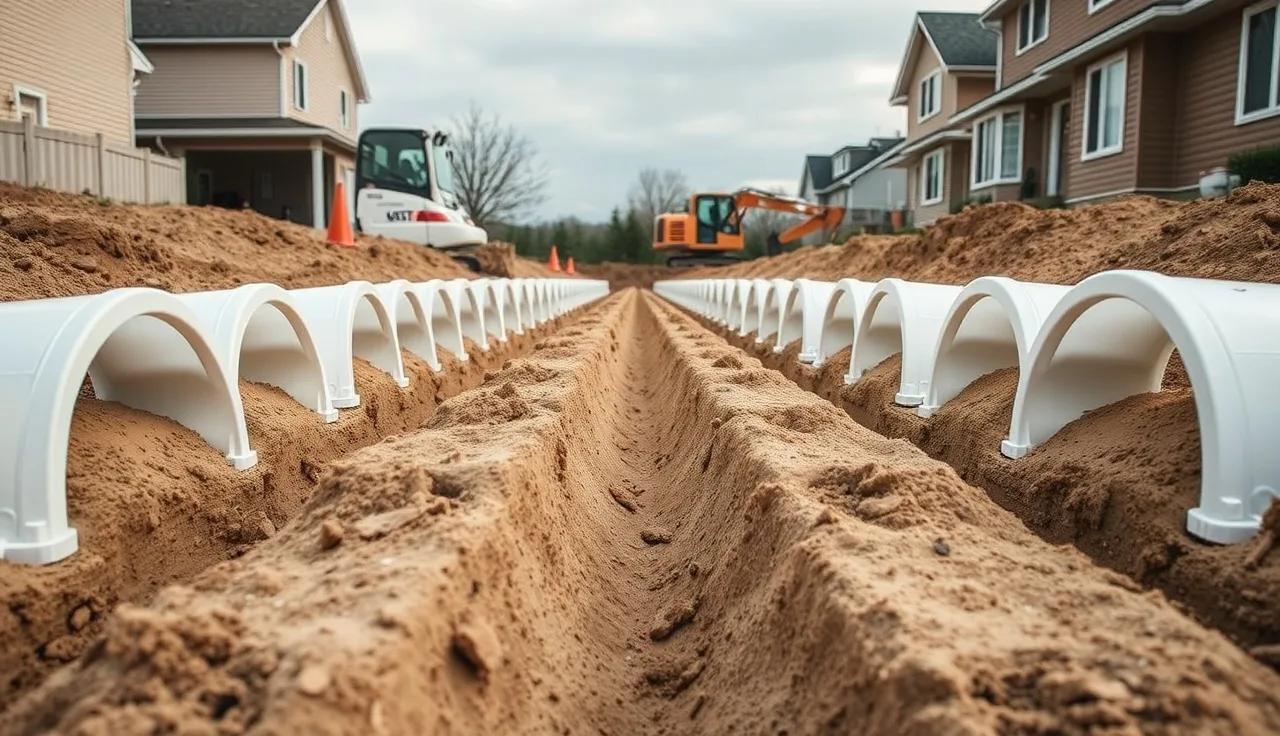
A leach field chamber is a hollow, arch-shaped plastic unit that replaces the old gravel-and-perforated-pipe method of dispersing septic effluent into soil. You set the units end to end in a trench, snap them together, cover them with geotextile fabric and soil, and the open-bottom arch lets wastewater seep into the ground without gravel clogging over time.
The dominant design in the U.S. market is the Infiltrator Quick4 series. Advanced Drainage Systems (ADS) and a few smaller brands make compatible units. They all work on the same principle: effluent flows from the septic tank into the chambers, spreads along the trench, and percolates through the native soil below.
Chamber systems have mostly replaced gravel systems since the 1990s because they install faster, disturb less soil, and the EPA's SepticSmart guidance lists them as an accepted alternative technology [1]. A standard chamber is 34 inches wide and 12 inches tall. Low-profile and high-capacity variants exist for tight sites or high-flow homes.
The soil below the chamber does the real work. If your soil holds too much clay, percolation fails no matter how good the chamber is. That's why a percolation test (perc test) always comes before design, and why no chamber product on any platform replaces that step.
What leach field chamber products are actually available on Amazon?
Amazon stocks a surprising range of chamber-related products, from individual end caps and connectors to full pallet quantities of arch chambers. Here's what shows up:
Infiltrator Quick4 Standard Chambers: The most commonly listed item. Individual units run roughly $18 to $25 each depending on seller and quantity. Pallets of 30 to 50 units appear too, sometimes from third-party sellers with uneven reliability.
End caps and inspection ports: The most sensible Amazon purchase for a homeowner. If one end cap cracks or a port cover breaks, buying a replacement online and having a contractor swap it is reasonable.
Septic tank risers and lids: These ship well and are straightforward to install by a homeowner in most jurisdictions. Not technically a chamber product, but often listed alongside them.
ADS EZflow chambers: Another brand you'll see. These wrap geosynthetic aggregate around a perforated pipe and sell in shorter sections suited to repair jobs [11].
Geotextile fabric (non-woven): Sold by the roll. A legitimate purchase, since you need it over any chamber installation.
What you won't find reliably: proper quantities for a real system (a 3-bedroom home typically needs 200 to 400 linear feet of chamber trench, which means 100 to 200 units or more), same-day availability, or any guarantee the units are current-production stock that meets your state's code version.
Amazon prices tend to run 10 to 20 percent higher than buying direct from a septic supplier or through a licensed installer who gets contractor pricing. Pricing a full system? Call a local distributor first [2].
Can you legally buy and install leach field chambers yourself?
This is where most DIY enthusiasm hits a hard wall.
In the vast majority of U.S. counties, any new septic system installation, replacement drain field, or major repair requires a site evaluation and perc test by a licensed soil scientist or engineer, a design by a licensed designer, a permit from the county health department or environmental agency, installation by a licensed septic contractor, and a final inspection before cover [3].
Some rural counties in states like Texas, Montana, and parts of the Midwest run lighter rules that let homeowners install their own systems on their own land if the design is approved first. But lighter still means permits and inspections almost everywhere. The EPA's onsite wastewater manual is blunt about the local nature of these rules, describing regulation as a state and local function that governs siting, design, and installation [3].
The real risk isn't just a fine. An unpermitted drain field that fails can contaminate a well, sicken a family, and trigger an enforcement order to remove and rebuild the whole thing at your cost. Title insurance and property sales surface unpermitted septic work all the time, and it can sink a closing.
Here's the exception. Buying chambers on Amazon for a permitted project where you handle prep work (excavation, site prep) and a licensed contractor does the final install and sign-off is a real cost-saving move in some states. Confirm two things first: that your contractor accepts owner-supplied materials, and that your county allows it.
For background on what a proper install involves, see our guide to septic tank installation and cost to install a septic system.
How much do leach field chambers cost, with and without Amazon?
The chamber unit itself is a small slice of total project cost. Here's an honest breakdown:
| Item | DIY supply (Amazon/retail) | Contractor supply | Installed cost estimate |
|---|---|---|---|
| Infiltrator Quick4 chamber (each) | $18-$25 | $10-$15 | Bundled into system |
| 100-unit pallet (single trench, ~170 ft) | $1,500-$2,200 | $900-$1,400 | N/A |
| Geotextile fabric (100 sq ft) | $30-$60 | $20-$40 | Bundled |
| Full drain field (labor + materials) | N/A | N/A | $3,000-$15,000+ |
| Perc test + design fees | $500-$2,000 | $500-$2,000 | Required regardless |
| Permits | $200-$1,500 | $200-$1,500 | Required regardless |
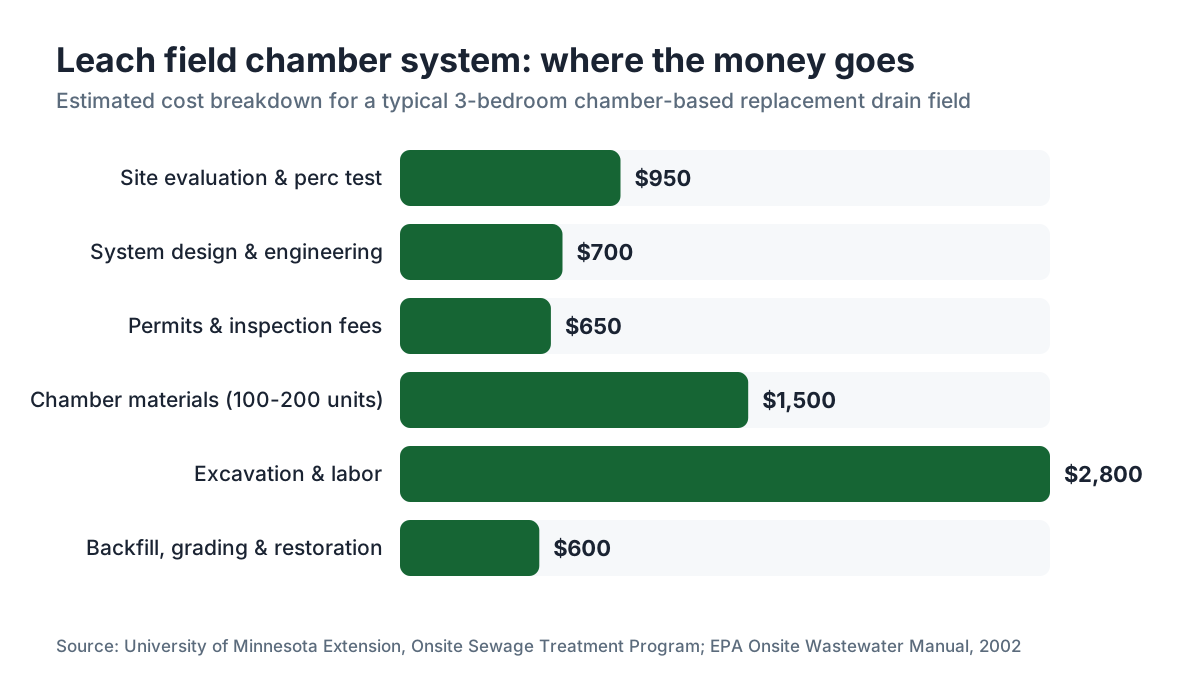
That installed range ($3,000 to $15,000 and up) is wide because it moves with field size (driven by bedroom count and soil type), site access, local labor rates, and whether you're replacing an old field or building new [4].
For a typical 3-bedroom home with decent soil, expect $4,000 to $8,000 for a chamber-based replacement field. Gravel systems in the same scenario cost about the same or a touch less, though chamber systems often need less trench length because they expose more infiltrative area per foot.
Supplying your own chambers to a contractor saves at most $400 to $800 on a mid-sized job. Some contractors refuse owner-supplied materials or add a handling fee that eats the savings. Have one conversation with your contractor before you add 200 arch chambers to a cart.
What chamber size and quantity do you actually need?
You don't size a leach field by counting bedrooms and guessing. It takes a soil evaluation and a perc test. Still, the relationships that drive the math are worth knowing, because they help you read any quote or product listing.
The key number is the long-term acceptance rate (LTAR) of your soil, measured in gallons per day per square foot of infiltrative area. Sandy loams might run an LTAR of 0.6 to 0.8 gpd/sq ft. Silty loams sit at 0.2 to 0.4. Heavy clay soils often fail to qualify at all [5].
An Infiltrator Quick4 Standard chamber, 4.2 feet long, gives about 6.5 sq ft of effective infiltrative area per unit. With a daily flow estimate of 150 gallons per bedroom per day (a common state standard), a 3-bedroom home makes about 450 gpd. At an LTAR of 0.4, you need 1,125 sq ft of infiltrative area, which works out to roughly 173 chambers.
Your state's onsite wastewater code carries the specific sizing tables, the reduction credits for chamber systems versus gravel, and minimum trench length rules. North Carolina, for example, allows a reduction multiplier for qualifying chamber products in its onsite wastewater rules [6]. Check your own state's code, not a general guide.
That's also why buying a 20-pack of chambers and building a starter field is not a real option. The system is sized to the load, the soil, and the code. Undersize it and it fails, often in under five years.
What can you legitimately buy on Amazon for leach field maintenance or repair?
Here's where Amazon earns its place for homeowners with an existing chamber system.
Replacement end caps are the top legitimate purchase. They crack from lawn mowers, root intrusion, and freeze-thaw cycles. Infiltrator end caps fit Quick4 series chambers and swap in directly. Match the generation of your chamber first (Quick4 Standard, Quick4 Plus, and Quick4 Low Profile are not all interchangeable).
Inspection port caps and risers are the next most common repair item. They sit above grade and take UV and physical damage. Buying a replacement cap and installing it yourself is a few screws, not a permit.
Non-woven geotextile fabric is useful for minor surface repairs or covering a repaired section. Get 4-oz or 6-oz non-woven. Avoid woven fabric, which restricts water movement.
Septic tank risers and lids (for the tank, not the field) ship well and are reasonable to buy and have a plumber or septic contractor install. Our guide on septic tank pumping explains why easy access to your tank lid matters.
Effluent filters and float switches for pump chambers are well represented too. Real maintenance parts with real part numbers.
What to skip: septic treatment products, enzyme additives, and bacterial supplements. The EPA's SepticSmart program states that a properly working septic system does not need additives, and that some products can harm the system [1]. Amazon is packed with these. They're a waste of money at best.
If your field is failing, the cause is almost always hydraulic overload, biomat from years of neglect, or physical damage. Additives fix none of those. A septic tank pump out and an inspection are the starting point.
How do Infiltrator Quick4 chambers compare to other brands?
Infiltrator leads the U.S. market with the widest code acceptance. Here's how the main options stack up:
| Brand/Product | Width | Effective area/unit | Code acceptance | Amazon availability |
|---|---|---|---|---|
| Infiltrator Quick4 Standard | 34" | ~6.5 sq ft | Accepted in all 50 states [7] | Yes, individual and pallet |
| Infiltrator Quick4 Plus | 34" | ~7.2 sq ft | Accepted in all 50 states | Spotty |
| Infiltrator Quick4 Low Profile | 34" | ~5.4 sq ft | Most states | Spotty |
| ADS EZflow | 12" bundle | Varies by trench | ~40 states | Some sellers |
| Cultec Contactor | 42" | ~8.2 sq ft | Most states | Rare |
| Hancor / NDS | Various | Various | Regional | Rare |
For most homeowners, Infiltrator Quick4 is the right pick. Parts are everywhere, every contractor has set them, and code approval is universal. Cultec makes a high-capacity chamber some engineers prefer for high-flow sites, but it's harder to source and rarely shows steady Amazon availability.
Buying replacement parts? Match the brand and model exactly. Infiltrator end caps do not fit Cultec chambers. Read the embossed model number off your as-built drawing or dig up an end cap before ordering.
What does the installation process look like from start to finish?
Knowing the sequence tells you where your purchased chambers fit.
Step 1: Site evaluation and perc test. A licensed soil scientist or engineer walks your lot, digs test holes, runs a perc test, and writes a site evaluation report. This drives everything downstream. Cost: $400 to $1,500 depending on state and parcel complexity [4].
Step 2: System design. A designer (often the same person who did the evaluation) produces a plan with trench layout, depths, chamber model, quantity, and the connection to the tank. That plan goes in with the permit application.
Step 3: Permit. The county health or environmental department reviews the design, may ask for revisions, and issues a permit. Fees run $150 to $1,500. Timeline: 1 day to 6 weeks depending on the jurisdiction.
Step 4: Excavation. A contractor digs the trenches to design depth, usually 18 to 36 inches, and grades the bottom level. The trench bottom matters a lot. A smoothed, compacted bottom seals the soil interface and kills the field early, so it gets scarified instead.
Step 5: Chamber installation. Chambers go in end to end with connectors, end caps set, inspection ports installed, and geotextile fabric laid over the top. This part is quick. A two-person crew can set 100 chambers in a few hours.
Step 6: Inspection. The county inspector visits before cover. No cover without approval. This is the legal gate.
Step 7: Backfill. Soil goes in and compacts in lifts. Final grade should slope away from the field.
For leach field design details and how to read an as-built drawing, we have a full guide. For how often to service the upstream tank once the field is running, see how often to pump septic tank.
What are the biggest mistakes people make when buying chambers online?
The mistakes fall into a few buckets.
Wrong model. Infiltrator makes several Quick4 variants with different heights and footprints. Quick4 Plus chambers won't take Quick4 Standard end caps interchangeably. Buy 50 Standard chambers when your system used Plus chambers and you're shipping a large, heavy pallet back.
Buying without a permit plan. No approved design means you don't know what you need. Buy chambers on a guess, then find out the engineer specified a different product or a mound system (which doesn't use standard chambers the same way), and you've spent money you can't recover cleanly.
Assuming Amazon always beats contractor supply. For single replacement parts, it might. For bulk quantities, it often doesn't once you add freight. Arch chambers are light but bulky, so shipping a pallet is expensive, and some listings use inflated retail prices that make the margin look bigger than it is. Always get a quote from a local septic supply house.
Ignoring seller quality. Amazon's marketplace lets third-party sellers list septic products. Check whether you're buying from the manufacturer (Infiltrator sells direct on Amazon) or a reseller with no clear return policy. A damaged pallet returned through Amazon is a painful process.
Using Amazon instead of a diagnosis. If your drain field is backing up or wet spots are surfacing over the trenches, no product purchase fixes that. You need a septic system repair assessment first. New chambers dropped in next to a failing field don't help the failing field.
For operators managing multiple properties, keeping track of what's been bought, installed, and permitted across a portfolio is where SepticMind's service management tools save real time. Permit numbers, as-built drawings, and part records attach directly to a service location.
How do you know if your existing chamber system needs replacement vs. repair?
This is the question that decides whether you should be looking at Amazon at all.
A failing drain field shows a few warning signs: sewage odors outside over the field, soft or spongy ground above the trenches, sewage backing up into the lowest drains in the house, and wet or bright green grass over the field during dry weather.
A failed field usually comes down to biomat, a layer of biological slime that seals the soil interface. Biomat builds up when the tank isn't pumped often enough (sending solids into the field) or when the system takes on too much water. See our guide to septic tank cleaning for the upstream maintenance that prevents it.
Before condemning a field, a qualified inspector will pump the septic tank and watch the outlet, camera the distribution system, and probe or dig to check trench conditions. Sometimes what looks like a dying field is a broken distribution box or a clogged effluent filter, a few-hundred-dollar fix instead of a few-thousand-dollar replacement.
Truly failed fields, where the biomat is irreversible and the soil stays saturated, need full replacement. No additive or chamber product restores a biologically sealed soil horizon. Some contractors try resting and aerobic treatment to bring fields back, and some states allow it, but results are uneven [8].
If replacement is confirmed, the process from the earlier section applies, and that's when buying your own chambers (with your contractor's blessing) makes sense. A septic tank inspection before any field work always earns its cost.
What do state and EPA codes say about chamber system requirements?
The EPA doesn't set installation codes directly. Onsite wastewater regulation is a state and local function. But the EPA's Office of Water published the Onsite Wastewater Treatment Systems Manual, which gives the technical guidance most state codes lean on [9].
That manual treats chamber systems as accepted alternatives to conventional aggregate systems when they meet equivalent hydraulic and structural performance. Nearly every state has taken the same position.
State codes still vary a lot on specifics:
Setback distances: Most states require drain field trenches at least 10 feet from property lines, 25 to 100 feet from wells, and 5 to 10 feet from structures. Check your state's table [3].
Minimum depth to limiting layer: Most states want 2 to 4 feet of unsaturated soil below the chamber bottom. In high water table areas, a mound system or drip irrigation may be required instead.
Product approval: States either accept NSF-listed products or keep their own approved product lists. Infiltrator Quick4 chambers appear on every state list I'm aware of. Less common brands may need verification [12].
Licensed installer requirements: All 50 states require licensed contractors for new system installation. Some states run a separate drain field contractor license; others fold it into a plumbing or septic contractor license.
For your state's rules, go to your state environmental or health department website. Don't trust Amazon product descriptions, which say a product is suitable for residential use without any state-specific code detail.
SepticMind keeps a growing library of state code summaries for service operators managing permitted work across jurisdictions, which helps contractors bidding across county or state lines.
Is buying leach field chambers on Amazon ever the right call?
Yes, in specific situations. Here's the honest read on when it works and when it doesn't.
Makes sense:
- You need 1 to 5 replacement end caps or inspection port covers for an existing system.
- Your contractor is doing a permitted repair and told you to supply your own Infiltrator Quick4 Standard chambers, and quoted the job minus materials.
- You need geotextile fabric, a replacement effluent filter, or a tank riser lid.
- You're buying a single chamber for a university or demonstration project.
Doesn't make sense:
- You want to build a new drain field without permits. Illegal in virtually every jurisdiction, and the liability is severe.
- You think buying chambers will beat having a contractor supply them on a full job. It often won't, once freight is in.
- You're trying to fix a failing field by adding more chamber capacity. Without addressing the biomat or the hydraulic overload, new chambers next to old failed ones fail too.
- You're in a rural county and assume lighter rules mean no permit. Check first. The fine for an unpermitted system can top the cost of the permitted install.
The bottom line: Amazon is a legitimate source for septic parts and accessories. For full leach field chamber systems, it's a secondary option that works best as a supplement to a permitted, contractor-installed job, not a way around the permitting process.
Frequently asked questions
Can I buy Infiltrator chambers on Amazon and install them myself?
You can buy them on Amazon, but self-installation without a permit is illegal in nearly every U.S. county. Almost all jurisdictions require a licensed contractor, an approved design, and a final inspection before soil cover. Some rural counties allow owner-installation on owner-occupied property with an approved permit, but that's the exception. Confirm with your county health department before buying anything.
How many leach field chambers do I need for a 3-bedroom house?
Roughly 150 to 200 Infiltrator Quick4 Standard chambers for a typical 3-bedroom home with average soil (LTAR around 0.4 gpd/sq ft), but the real number comes from a perc test and a licensed designer applying your state's sizing formula. Sandy soil could cut that in half. Poor-draining soil might disqualify a standard chamber system entirely.
What is the price of leach field chambers on Amazon?
Individual Infiltrator Quick4 Standard chambers list at $18 to $25 each on Amazon depending on seller and quantity. A pallet of 30 to 50 units runs $800 to $1,500 plus shipping. Local septic supply distributors often sell the same units at $10 to $15 each in contractor quantities. For a full system, contractor pricing through a licensed installer usually beats Amazon once freight is counted.
Do Amazon leach field chambers meet code?
Infiltrator Quick4 chambers are accepted in all 50 states for permitted septic construction. But a code-accepted product doesn't make your installation legal. You still need a permit, an approved design, and a licensed installer. Cross-check your state's approved products list, especially if you're buying a less common brand.
What is the difference between leach field chambers and leach field gravel systems?
Gravel systems use perforated pipe surrounded by washed aggregate in a trench. Chamber systems replace the gravel with hollow arch units that create a void for effluent distribution. Chambers install faster, need less excavation, and most states give a sizing credit because chambers expose more soil surface per foot. Gravel systems cost about the same but need aggregate delivery and have more failure modes from fines migration.
Can I use Amazon chambers to repair a failing leach field?
Adding new chambers next to a failing field won't fix the root problem, which is almost always biomat sealing the soil surface or hydraulic overload from a neglected tank. A real repair starts with pumping the tank, inspecting the distribution system, and getting a licensed assessment. If replacement is warranted, new chambers in a new trench (with a permit) are the right tool.
What septic parts from Amazon are actually worth buying?
Replacement end caps, inspection port covers, tank riser lids, effluent filters, non-woven geotextile fabric, and float switches for pump chambers are all legitimate Amazon purchases. Skip septic additives, enzyme products, and bacterial treatments. The EPA's SepticSmart program states that properly functioning septic systems do not need additives, and some products can damage drain fields.
How deep do leach field chambers need to be buried?
Most state codes require the top of the chamber at least 6 to 12 inches below finished grade for traffic protection, with the bottom sitting at least 2 to 4 feet above any limiting layer (bedrock, seasonal high water table, or restrictive horizon). Your approved design specifies the exact depth. Minimum cover and setback requirements vary by state.
Will homeowners insurance cover a failed leach field?
Standard homeowners policies usually exclude septic failure from wear, neglect, or gradual damage, which is how most drain field failures get classified. Some policies cover sudden and accidental damage, like a vehicle crushing a chamber. Endorsements specifically for septic systems exist but are uncommon. Read your policy's exclusions section directly. An unpermitted system adds further complications.
How long do leach field chambers last?
Infiltrator states a design life of 50 or more years for its polyethylene chambers under normal loading, and the plastic itself is durable. The limiting factor is almost never the plastic. It's biomat forming in the soil below, driven by poor septic tank maintenance. A field served by a regularly pumped tank (every 3 to 5 years) routinely lasts 20 to 40 years. Neglected tanks cut that to under 10.
What is the difference between Infiltrator Quick4 Standard and Quick4 Plus?
The Quick4 Plus is taller than the Standard, giving roughly 10 percent more storage volume per unit and a larger effective infiltrative area. The Plus suits high-flow applications or sites needing extra storage for peak flow events. End caps and connectors are not interchangeable between Standard and Plus models, so identify your existing chamber type before buying replacement parts.
Do I need a perc test before buying leach field chambers?
Yes. A perc test determines whether your soil can accept effluent at all and at what rate, which directly sets the number of chambers you need. Buy chambers before the perc test and you may get the wrong quantity, the wrong product, or waste money on a system your soil can't support. The perc test and site evaluation come before any material purchases.
What are the setback requirements for leach field chambers?
Setbacks vary by state, but typical minimums are 10 feet from property lines, 10 feet from the foundation, 25 to 100 feet from private wells (100 feet is common), 50 to 100 feet from surface water, and 5 feet from trees. Your county health department or state environmental agency keeps the exact table. These setbacks apply no matter what brand or purchasing channel you use.
Sources
- EPA SepticSmart Program, U.S. Environmental Protection Agency: EPA accepts chamber systems as alternative technology and states that properly functioning septic systems do not need additives; some additives can harm the system.
- Infiltrator Water Technologies, product specifications and distributor network: Infiltrator Quick4 chambers are available through distributor networks at contractor pricing typically lower than retail or Amazon listings.
- EPA, Onsite Wastewater Treatment Systems Manual (EPA/625/R-00/008): Onsite wastewater regulation is state-administered; most jurisdictions require licensed installation, permits, and inspections for any septic system work.
- University of Minnesota Extension, Onsite Sewage Treatment Program: Perc test and design fees range $400-$1,500; full installed drain field costs vary from $3,000 to over $15,000 depending on soil, field size, and site conditions.
- NC State Extension, Soil Facts and onsite wastewater soil evaluation: Long-term acceptance rate (LTAR) for sandy loams is approximately 0.6-0.8 gpd/sq ft; silty loams run 0.2-0.4 gpd/sq ft; heavy clay soils may not qualify.
- North Carolina Department of Environmental Quality, onsite wastewater rules 15A NCAC 18A: North Carolina allows a reduction multiplier for qualifying chamber systems versus conventional aggregate trench sizing.
- Infiltrator Water Technologies, State Approvals Documentation: Infiltrator Quick4 chambers are approved for use in all 50 U.S. states.
- University of Minnesota Extension, Onsite Sewage Treatment Program (failing systems guidance): Biomat formation in the soil is the primary cause of drain field failure and is not reliably reversed by additives; resting and aerobic treatment have variable results.
- EPA Office of Water, Onsite Wastewater Treatment Systems Manual (2002): Chamber systems are described as acceptable alternatives to conventional aggregate systems when they meet equivalent hydraulic and structural performance standards.
- CDC, Septic Systems guidance, Centers for Disease Control and Prevention: Approximately 1 in 5 U.S. households relies on a septic system or other onsite wastewater treatment system; proper maintenance is essential to protecting groundwater.
- Advanced Drainage Systems (ADS), EZflow Product Information: ADS EZflow chambers integrate geosynthetic aggregate around a perforated pipe and are available in sections suited to repair applications.
- NSF International, wastewater product certification information: Most state codes accept septic and drain field products that meet NSF listing standards as part of the approval pathway.
Last updated 2026-07-09