Is Rid-X good for a septic system? What the science says
By the SepticMind Editorial Team
TL;DR
- Rid-X adds bacteria and enzymes to a septic tank, but a healthy tank already makes those organisms on its own.
- The EPA says biological additives are not necessary for a properly functioning system, and no additive removes the need for pumping every 3 to 5 years.
- Rid-X is unlikely to harm your system.
- The evidence it meaningfully helps is weak.
What is Rid-X and what does it claim to do?
Rid-X is a consumer septic additive sold in powder, liquid, and dissolvable pod form. Each dose contains a mix of bacteria (mostly Bacillus species) and four enzymes: cellulase, lipase, protease, and amylase. The maker claims these organisms break down solids faster than a tank's own microbes can, cutting sludge and protecting the drain field.
The product has been on shelves since the 1950s. That buys it strong name recognition. Most homeowners buy it because someone told them it keeps the tank healthy between pumpings, or because the marketing hints it stretches the time between pump-outs.
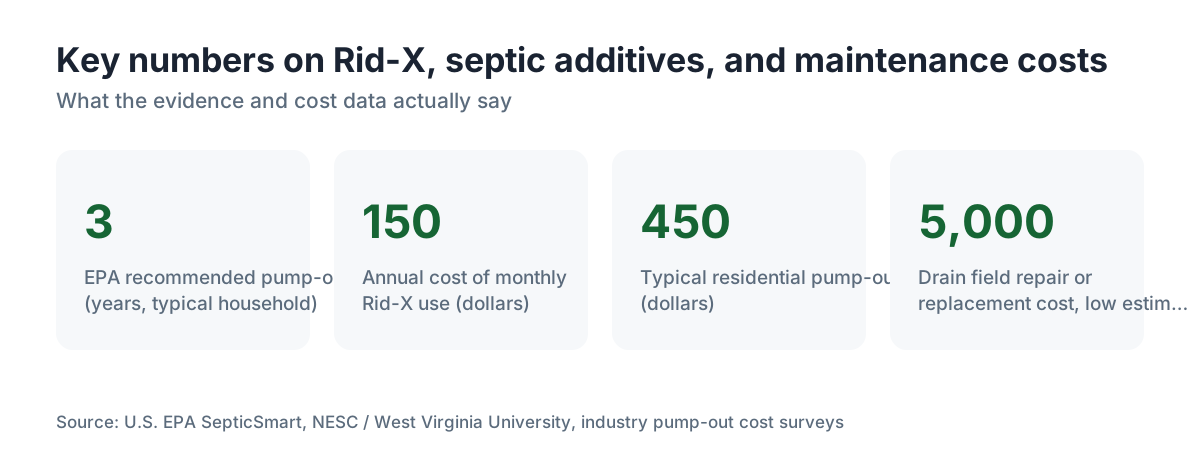
A standard monthly dose runs about $10 to $15 per packet. Follow the label's monthly schedule and you're looking at $120 to $180 a year. That's not much money on its own. It adds up over decades, though, and the real question is whether you get anything for it.
What does the EPA actually say about septic tank additives like Rid-X?
The EPA looked at biological and chemical septic additives through its SepticSmart program and homeowner guidance. Its position is blunt: "Biological additives ... introduce bacteria and/or enzymes to jump-start or supplement the bacterial ecosystem in the septic tank. They are generally not harmful to the septic system but are also generally not necessary." [1]
Read "not necessary" carefully. A properly maintained conventional system already has the microbial community it needs, delivered continuously by human waste. Every flush seeds the tank with billions of anaerobic and facultative bacteria. There's no biological gap for a store-bought product to fill.
The EPA's SepticSmart campaign points homeowners at three maintenance behaviors that matter: pump on schedule, conserve water, protect the drain field. Additives don't make that list. [1]
Some state agencies say more. Wisconsin's Department of Natural Resources tells homeowners not to rely on additives as a substitute for pumping, and notes that no additive approved for home use has been shown to eliminate the need for pump-outs. [2]
What does independent research show about septic additives?
The most cited independent work is a 2000 review by the National Small Flows Clearinghouse (now the National Environmental Services Center at West Virginia University), which examined 13 commercial septic additives, biological products among them. The review found no consistent evidence that biological additives improved tank performance, cut sludge, or protected drain fields compared to untreated control tanks. [3]
A later review from North Carolina State University Cooperative Extension reached the same place: biological additives showed no meaningful improvement in tank performance under controlled comparison, and some chemical additives (solvents in particular) can damage a system by pushing fats and solids into the drain field. Biological products like Rid-X sit in the safer category, but "safer than the bad ones" is a long way from "effective." [8]
Nobody has good long-term randomized trial data here. The best studies sample tanks before and after additive use, and the results run mixed to null. Rid-X's own website cites its internal testing, not peer-reviewed independent research.
One honest hedge. There may be edge cases where a tank has been hammered with bleach or antibiotics and the microbe population is genuinely knocked back. Adding bacteria might help it recover. For the average household running a normal cleaning routine, though, the tank's native ecosystem is fine without help.
Does Rid-X reduce how often you need to pump your septic tank?
This is the claim that matters most to homeowners, and the answer is almost certainly no.
Pumping frequency is driven by how fast non-decomposable solids pile up as a sludge layer at the bottom and a scum layer on top. Biological additives might speed the breakdown of organic matter into liquid effluent, but they can't eliminate inorganic solids (grit, synthetic fibers, microplastics) or fully mineralized sludge. That material is physical, not biological. It has to be pumped out.
The EPA recommends pumping a typical household septic tank every 3 to 5 years. [6] That schedule tracks household size, tank volume, and waste load, not whether you've been dosing bacteria. A 1,000-gallon tank serving a family of four builds up roughly 50 to 70 gallons of sludge and scum a year under normal conditions. Even generous assumptions about additive performance don't move that math enough to defer pumping by more than a few months. Skipping pump-outs on the hope that Rid-X has it covered is how systems fail.
Want a pumping schedule tuned to your house? A real pump-out log tracked over years beats anything in a box. [See: /how-often-to-pump-septic-tank]
Can Rid-X harm your septic system or drain field?
Rid-X itself, as a biological product, is unlikely to cause direct harm under normal use. The bacteria strains are non-pathogenic Bacillus species, and the enzymes belong to the same broad classes at work in normal digestion. Decades of widespread residential use haven't produced documented system-level damage from the product.
The risk isn't the box. The risk is behavioral. Homeowners who dose monthly sometimes talk themselves into believing the tank doesn't need pumping. That belief has a price. A tank that goes 10 or 15 years without a pump-out because someone figured the biology was handled will nearly always build sludge that pushes solids into the leach field, forming biomat and eventually killing the field.
Field failure is expensive. Repair or replacement runs $5,000 to $20,000 or more depending on region and soil. [See: /septic-system-repair] No $15 product is worth that bet.
Chemical additives are a different animal. Solvent products using methylene chloride or 1,1,1-trichloroethane have been shown to mobilize solids, kill anaerobic bacteria, and contaminate groundwater. Several states banned them outright. Rid-X isn't in that group, but read any additive label to confirm it's biological, not chemical.
Are there situations where Rid-X or a similar additive might actually help?
Yes, a few. They're real, and they're narrow.
First, after a restart. If a vacation property has sat closed for six months or more, the tank's microbe population can drop hard. Seeding with bacteria before heavy use resumes might speed the digestion ecosystem back up. A biological additive is reasonable here, though plain human waste from regular use gets you to the same place in a few weeks.
Second, after heavy antibiotic use or a chemical hit. A household with someone on long-term broad-spectrum antibiotics, or one recovering from a major disinfectant event (a big cleaning that sent concentrated product down the drain), can run a temporarily suppressed tank population. Supplementation could bridge that gap.
Third, some older or undersized systems with slower natural digestion might see a modest benefit from added enzymes, though there's no strong published data on that specific case.
In these edge cases, a one-time or short-term dose is a reasonable, cheap hedge. Signing up for a permanent monthly habit on a normal, working system is a different question, and the evidence for routine use isn't there.
How does Rid-X compare to other septic additives on the market?
The septic additive market is big and barely regulated. Products run from simple Bacillus-based powders (Rid-X, Green Gobbler, Cabin Obsession) to enzyme-only products to yeast treatments to multi-strain probiotic formulas sold at premium prices.
| Product type | Active ingredients | Evidence for efficacy | Harm risk |
|---|---|---|---|
| Rid-X (biological) | Bacillus bacteria + 4 enzymes | Weak to none in independent studies | Very low |
| Generic Bacillus powders | Similar to Rid-X | Similar to Rid-X | Very low |
| Enzyme-only products | Cellulase, lipase, protease | Limited, enzymes denature quickly in tank | Very low |
| Yeast-based products | Active dry yeast | Anecdotal; not independently studied | Very low |
| Solvent-based products | Methylene chloride, TCE | Evidence of harm; banned in some states | High |
| Probiotic "premium" products | Various; 10x the price of Rid-X | No better evidence than Rid-X | Very low |
The honest read: biological products in this category are roughly the same, and none has strong independent efficacy data. If you decide to use one, the cheaper option makes more sense than the premium. Rid-X's main edge over generics is that you can buy it at every hardware store and gas station in the country.
Operators managing multiple systems can use tools like SepticMind to track which properties lean on additives and flag the ones swapping products for pumping, which sharpens site-visit priorities.
What should you actually do to keep your septic system healthy?
The EPA, state extension programs, and every experienced pump-out contractor land on the same short list. These things have real evidence behind them.
Pump on schedule. Get on a septic tank pumping cycle matched to your tank size and household. A 1,000-gallon tank with two people can go 5 to 6 years. The same tank with five people may need pumping every 2 years. The only way to know is to have the tank inspected and the sludge level measured. [See: /septic-tank-inspection]
Watch what goes down the drain. Wipes (even "flushable" ones), feminine hygiene products, grease, coffee grounds, and heavy garbage disposal use all build sludge faster than any additive can offset.
Conserve water. Hydraulic overloading is one of the most common causes of field failure. Spacing out laundry, fixing running toilets, and using efficient fixtures cuts daily flow and gives solids time to settle.
Protect the drain field. Keep vehicles off it, skip the deep-rooted trees nearby, and steer surface runoff away. A wrecked field is costly to fix. [See: /leach-field]
Get inspections. Most state codes recommend or require a septic tank inspection at property transfer and periodically during ownership. Catching a problem early beats paying for a failure.
Those five behaviors do more for your system than any monthly additive. If you're already doing them, Rid-X is redundant. If you're not, Rid-X is no substitute.
What do state regulations say about septic additives?
Federal law doesn't regulate septic additives as a product category. The EPA offers guidance but does not approve or ban specific biological additives under the Safe Drinking Water Act or Clean Water Act in a way that directly governs residential use.
State by state, the picture varies. Several states wrote rules that address additives head-on.
Wisconsin's Administrative Code Chapter COMM 83 covers onsite wastewater treatment and states that additives may not be used in place of required maintenance, pumping included. [2]
Washington State's Department of Health guidance says no additive is approved as a substitute for routine inspection and pumping. [5]
Some states, Michigan and New Jersey among them, have at times published lists of approved or prohibited additive ingredients, mostly aimed at chemical solvents.
The practical takeaway for a homeowner: even in states without explicit additive rules, your septic permit and system approval are tied to the maintenance schedule in your local code, not to whether you've been dosing bacteria. Inspectors will look at your pump-out records, not your Rid-X receipts, to judge compliance.
Operators building service routes can use SepticMind's scheduling tools to track which customers are on compliant pump cycles, which matters more as state inspection rules tighten.
Is Rid-X worth the money?
At roughly $130 to $180 a year for monthly use, Rid-X is a cost that compounds over the life of a system. Thirty years of homeownership runs $3,900 to $5,400 on the additive alone, before any price increases.
The evidence for that spending is weak. Independent studies haven't confirmed the product cuts pumping frequency or measurably improves performance in a normal tank. The EPA doesn't recommend it. No state code requires it.
That said, it won't hurt anything, and for some people the peace of mind has real value. In an edge case (restarting a dormant system, recovering from a chemical hit), short-term use is a fair, cheap hedge.
For a normal household on a proper pumping and inspection schedule, the money goes further elsewhere. Put it toward one extra partial pump out inspection every few years, or toward a real septic tank inspection if you've never had one. Those buys have documented returns.
My honest opinion: Rid-X is a well-marketed answer to a problem that doesn't really exist in a well-maintained system. You don't need it. If you already buy it and it makes you feel better, the harm is mostly to your wallet. Just don't let it replace the fundamentals.
Frequently asked questions
Is Rid-X good for a septic system?
Rid-X is unlikely to harm a septic system, but independent research and EPA guidance consistently show it isn't necessary for a properly functioning tank. A healthy tank already produces the bacteria and enzymes it needs from household waste. The product may help in narrow situations like restarting a dormant system, but it should never replace regular pumping every 3 to 5 years.
Does Rid-X actually work?
Independent studies, including a National Small Flows Clearinghouse review of 13 commercial additives, found no consistent evidence that biological additives like Rid-X improve tank performance or reduce sludge accumulation compared to untreated tanks. The EPA characterizes biological additives as generally not necessary. Rid-X's own efficacy data comes from company testing, not peer-reviewed independent research.
Can Rid-X replace septic tank pumping?
No. Nothing replaces pumping. Sludge contains inorganic solids, synthetic fibers, and fully mineralized material that biology cannot break down. EPA recommends pumping every 3 to 5 years based on household size and tank volume. The Rid-X label itself doesn't claim to eliminate pumping. Skipping pump-outs on the assumption that additives are handling it is one of the most common paths to expensive drain field failure.
How often should you add Rid-X to a septic tank?
The manufacturer recommends monthly use, with a larger initial dose. At roughly $10 to $15 per packet, that's $120 to $180 per year. Since independent evidence for routine monthly dosing is weak, many wastewater professionals see no scientific basis for this schedule. If you use it at all, situational use (after a system restart or after heavy chemical exposure) is more defensible than permanent monthly dosing.
Is Rid-X safe for septic systems and pipes?
Yes, biological additives like Rid-X are generally considered safe for both septic tanks and plumbing. The Bacillus bacteria and enzymes it contains are non-pathogenic and don't corrode pipe materials. The safety concern with septic additives applies mainly to solvent-based chemical products, not biological ones. Rid-X's long history of widespread use has not produced documented cases of system damage from the product itself.
Can you use too much Rid-X?
Overdosing a biological additive is unlikely to cause direct harm; excess bacteria simply die off when they run out of substrate. The more realistic concern with overuse is false security: homeowners who add large doses may feel they've done their maintenance and skip pumping. That behavioral consequence is more dangerous than any direct effect from the product. Follow label directions if you use it, and keep pumping on schedule regardless.
What happens if you never pump your septic tank but use Rid-X?
Eventually the system fails. Sludge and scum layers grow regardless of additive use. When they reach roughly one-third of the tank's liquid capacity, solids begin exiting into the drain field, causing biomat buildup that clogs the soil and prevents effluent from percolating. Drain field failure typically costs $5,000 to $20,000 or more to repair or replace. No biological additive prevents that outcome when pumping is neglected.
Does the EPA recommend Rid-X?
No. The EPA's SepticSmart program does not recommend any specific additive brand. The agency's guidance states that biological additives are "generally not harmful" but also "generally not necessary" for a properly functioning system. EPA's recommended maintenance actions are pumping on schedule, conserving water, and protecting the drain field. Additives don't appear in that list.
What is the best septic tank treatment, Rid-X or alternatives?
Independent evidence doesn't clearly favor any biological additive brand over another, including Rid-X. Generic Bacillus-based powders contain similar ingredients at lower prices. Enzyme-only products have even less evidence behind them. Premium probiotic septic treatments cost 5 to 10 times more with no demonstrated advantage. If you're going to use a biological additive at all, a lower-cost generic is functionally equivalent to Rid-X.
Should you add Rid-X after having your septic tank pumped?
It's not necessary. After a pump-out, the small amount of sludge left in the tank (pumpers intentionally leave a thin layer as a bacterial seed) is enough to re-establish the microbial ecosystem within days to weeks of normal household use. Adding a biological product post-pump-out won't hurt, but it provides no documented benefit over simply resuming normal use of the system.
Does Rid-X help a slow draining septic system?
Probably not. Slow drains in a septic system usually indicate one of three things: a clogged inlet or outlet baffle, a full tank requiring pumping, or a failing drain field with biomat buildup. None of these problems is solved by adding bacteria. A biological additive might modestly improve digestion rate in a full tank, but the correct first step is a tank inspection and pump-out, not a box of powder.
Can Rid-X harm a drain field or leach field?
Direct harm from biological Rid-X is not documented. The product itself doesn't mobilize solids or kill beneficial microorganisms in the drain field soil. Indirect harm is the concern: if using Rid-X leads a homeowner to defer pumping, the resulting sludge overflow into the field causes biomat damage. The product doesn't fix a failing field and shouldn't be used as a substitute for addressing field problems properly.
Is Rid-X required by any septic system warranty or local code?
No state or local onsite wastewater code requires the use of Rid-X or any commercial biological additive. Some installer warranties specify maintenance requirements, but these focus on pumping schedules and prohibited inputs, not additive use. Using Rid-X monthly will not satisfy any maintenance requirement under a system warranty or permit condition that calls for periodic pumping.
How much does Rid-X cost per year versus the cost of skipping a pump-out?
Annual Rid-X use runs $120 to $180. A standard septic pump-out costs $300 to $600 for most residential tanks, spread over 3 to 5 years, so roughly $60 to $200 per year amortized. Drain field repair or replacement after neglected maintenance runs $5,000 to $20,000. The math strongly favors spending money on actual pump-outs rather than on additives that defer nothing.
Sources
- U.S. EPA, SepticSmart: How to Care for Your Septic System: EPA states biological additives are 'generally not harmful to the septic system but are also generally not necessary' and recommends pumping every 3-5 years as core maintenance.
- Wisconsin Department of Natural Resources (dnr.wisconsin.gov), septic system homeowner guidance: Wisconsin DNR states homeowners should not rely on additives as a substitute for pumping and that no approved additive eliminates pumping needs.
- National Environmental Services Center (formerly National Small Flows Clearinghouse), West Virginia University: A review of 13 commercial septic additives found no consistent evidence that biological additives improved tank performance or reduced sludge accumulation compared to untreated controls.
- University of Minnesota Extension (extension.umn.edu), septic system guidance: University of Minnesota Extension concluded biological additives do not reliably reduce pumping frequency; some chemical additives can damage systems by mobilizing solids into the drain field.
- Washington State Department of Health (doh.wa.gov), on-site sewage systems guidance: Washington DOH states no additive is approved as a substitute for routine inspection and pumping.
- U.S. EPA, Septic System Maintenance: EPA recommends pumping a typical household septic tank every 3 to 5 years depending on household size and tank volume.
- U.S. EPA, Nonpoint Source: Agriculture and Onsite Wastewater: Solvent-based septic additives including methylene chloride and TCE have been documented to contaminate groundwater and harm anaerobic treatment bacteria.
- North Carolina State University Cooperative Extension (content.ces.ncsu.edu), Septic System Additives: Are They Beneficial?: NC State Extension review found that biological additives showed no meaningful improvement in tank performance in controlled comparisons and are not recommended as routine maintenance.
- Penn State Extension (extension.psu.edu), septic system guidance: Penn State Extension notes that a well-functioning septic tank receives sufficient bacteria from household waste alone and that biological additives provide no documented performance benefit.
- U.S. EPA, Onsite Wastewater Treatment Systems Manual (EPA/625/R-00/008): EPA manual states that conventional septic tanks rely on naturally occurring anaerobic bacteria supplied by wastewater influent and that supplemental biological products have not been shown to improve effluent quality.
Last updated 2026-07-09