How much does it cost to clean a septic system in 2025
By the SepticMind Editorial Team
TL;DR
- Most homeowners pay $300, $700 to have a septic system cleaned, which usually means pumping the tank plus a quick inspection.
- Bigger tanks, buried lids, heavy sludge, or add-ons like hydro-jetting push the bill toward $1,000, $1,500.
- Drain field work or system upgrades are priced separately and run $5,000, $30,000.
What does 'cleaning' a septic system actually mean?
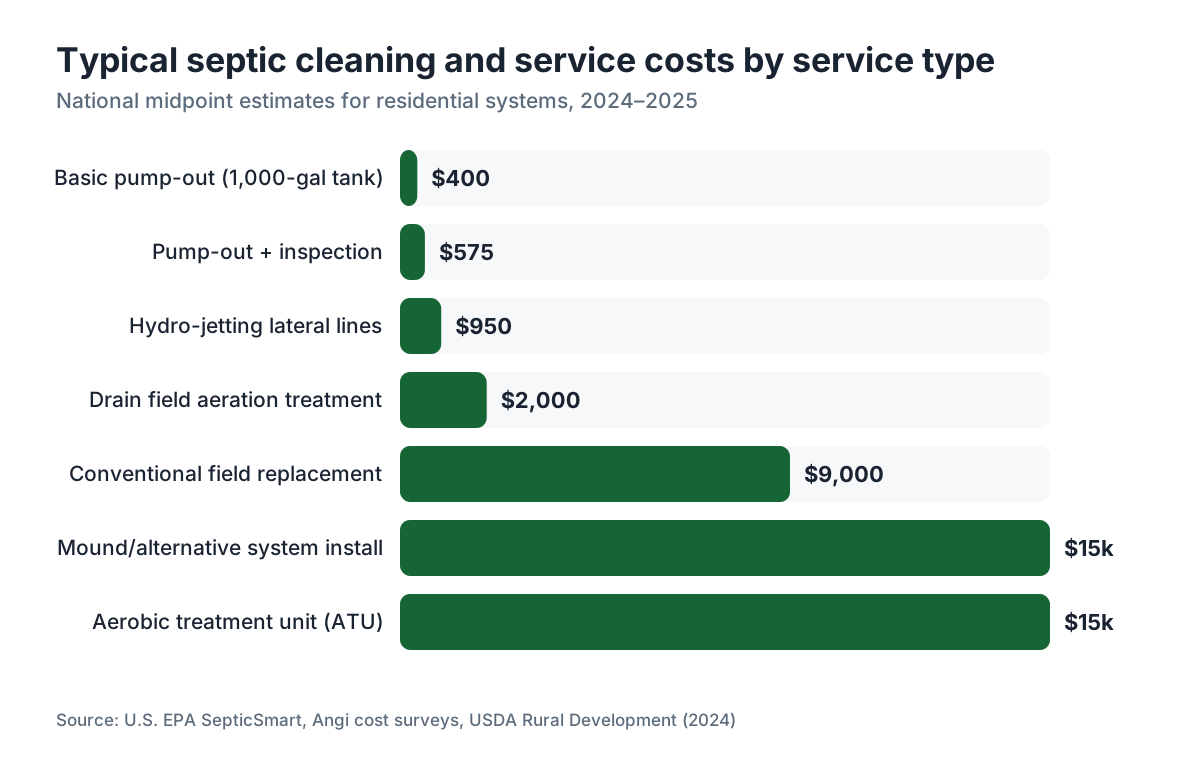
When most people ask about cleaning a septic system, they mean pumping the tank. A vacuum truck pulls out the liquid effluent, the floating scum layer, and the settled sludge at the bottom. That's the core service, and it's what the $300, $700 range covers for a typical 1,000- to 1,500-gallon tank.
But "cleaning" means different things depending on who you're talking to and what your system needs. Some contractors use the term loosely to include a full pump-out plus a rinse of the tank walls. Others use it to describe hydro-jetting the inlet baffle or distribution box, which is a separate and more expensive step. A few companies quote "cleaning" as a bundled package that adds a camera inspection of the outlet pipe.
Before you accept any quote, ask specifically: are you pumping the full tank (more than skimming the liquid layer), are you removing all three layers (scum, effluent, sludge), and is there a separate charge for the inspection? If a company quotes you $150 to $200, they're almost certainly only pumping the liquid layer. That's not a full clean, and it leaves the sludge that actually causes odors and baffle damage.
For more detail on what the process looks like step by step, see our guide to septic tank cleaning.
What is the average cost to clean a septic system?
The national average for a full septic tank pump-out and cleaning runs $300 to $600 for a standard residential system, with the midpoint around $400, $450 for most single-family homes. That's the number you'll see from Angi, HomeAdvisor, and regional contractor surveys, and it matches what licensed pumpers report charging in mid-cost-of-living markets.
The range shifts hard by region. Rural areas in the Midwest and South often see prices closer to $250, $350. Dense metro markets in the Northeast and Pacific Coast run $500, $800 routinely, mostly because of labor rates and disposal tipping fees at treatment plants.
Here's a simple breakdown by tank size, which is the single biggest driver of base price:
| Tank size (gallons) | Typical pump-out cost |
|---|---|
| 750 or less | $200, $350 |
| 1,000 | $300, $450 |
| 1,250 | $350, $525 |
| 1,500 | $400, $600 |
| 2,000 | $550, $800 |
| 2,500+ (commercial/large home) | $800, $1,500+ |
These are real pump-out prices, not bundled packages with repairs. If your contractor quotes you within these ranges and is licensed in your state, that's a fair market price. [1]
For a deeper look at what pumping specifically costs and what's included, the septic tank pumping guide covers the mechanics and pricing in more detail.
What factors make the price go up (or down)?
Tank size is the floor, not the ceiling. A dozen other variables move the final number.
Access difficulty is the biggest wildcard. If your tank lid is buried more than a foot deep, the crew has to dig by hand or with a small machine. That can add $50, $200 to the bill. Some contractors include one lid dig in their base price. Others charge per lid, and a two-compartment tank has two lids. Ask before they arrive.
Sludge volume matters more than most homeowners expect. The EPA's SepticSmart guidance says tanks should be pumped when solids fill more than one-third of the tank volume [2]. If you've gone 10 years without service, the sludge layer may be so thick that the truck has to make multiple pulls or run longer. Some contractors charge by the gallon of waste hauled. If your 1,000-gallon tank is mostly sludge, expect to pay more than the base rate.
Add-on services that show up on quotes:
- Hydro-jetting the outlet baffle or distribution lines: $100, $400
- Camera inspection of outlet pipe: $150, $350
- Filter cleaning (if you have an effluent filter): $50, $100, sometimes included
- Riser installation (so next time is easier): $200, $500 per riser, labor included
- Baffle inspection and written report: sometimes free, sometimes $75, $150
Location drives disposal costs directly. Pumpers have to haul the waste to an approved septage treatment or disposal facility. In some rural counties those facilities are far away, and the tipping fee gets passed to you. In New York, for example, septage disposal regulations under 6 NYCRR Part 364 require licensed haulers to use approved facilities, and disposal fees vary by county. [3]
Time of year can push prices 10 to 20% higher in spring, when everyone calls after winter. Schedule in late fall or mid-winter in a non-freezing climate and you'll often get the better rate and more of the crew's attention.
Does cleaning include a septic inspection, or is that separate?
Usually separate, though some contractors bundle a basic visual check at no extra charge. The terminology is loose in this industry, so clarify upfront.
A basic visual inspection, meaning the pumper looks at the inlet and outlet baffles, checks the effluent filter if present, and notes any obvious cracks or backflow, typically costs $100, $250 when booked alone. Bundled with a pump-out, you might pay $50, $100 more for the same check.
A full septic inspection for a real estate transaction is a different thing entirely. It includes a flow test, verification that the drain field is accepting water, and often a written report signed by a licensed inspector. That runs $300, $600 on its own and is usually required by the buyer's lender or the state.
Some states require an inspection certificate before a home sale can close. Massachusetts, for example, requires a Title 5 inspection under 310 CMR 15.000, and those inspections are detailed, regulated, and separate from routine cleaning. [4]
If you just want to know the condition of your system after a cleaning, ask the pumper to walk you through what they saw. A good pumper flags cracked baffles, high water levels that suggest a drain field issue, or roots in the tank without charging you a formal inspection fee. That's standard professional practice, not a premium service.
For more on what a formal inspection covers, see our septic tank inspection guide.
How much does it cost to clean a septic drain field?
This is where costs jump to a different category. The drain field (also called a leach field) isn't cleaned the way a tank is. You can't pump a leach field. When people ask about cleaning a drain field, they usually mean one of three things: hydro-jetting the distribution lines, treating the soil with a restoration product, or full replacement.
Hydro-jetting the lateral pipes: $500, $1,500 depending on field size and number of lines. This knocks out biomat buildup and root intrusion inside the pipes. It doesn't fix saturated or failed soil.
Aeration treatment (like Terralift or similar): $1,000, $3,000 per treatment. A probe is driven into the soil next to each lateral and high-pressure air is injected to fracture compacted soil and add oxygen. Evidence for long-term effectiveness is mixed. The closest published data suggest improvement in some cases of biomat-related failure, but results vary a lot by soil type and failure cause.
Full drain field replacement: $3,000, $15,000 for a conventional system on a straightforward lot. Difficult soil, poor perc, or a small lot can push that to $20,000, $30,000, especially if an alternative system (mound, drip, aerobic) is required. [5]
For a full breakdown of what drain field work costs and when it's warranted, the leach field guide goes deeper.
The practical rule: if the tank itself is fine but the field is backing up, you're looking at field work, not a tank cleaning. Pumping the tank gives temporary relief but doesn't fix a saturated field.
How much does it cost to upgrade a septic system?
Septic system upgrade cost covers a lot of ground depending on what's being upgraded and why. The common scenarios are replacing a failing conventional system with an alternative system, adding an aerobic treatment unit (ATU), or expanding a system for an addition or more people in the house.
Replacing a conventional gravity system with a mound system (required when soil is shallow or permeability is poor): $10,000, $20,000 in most markets. Costs climb fast on rocky or tight lots.
Aerobic treatment units, which add an aeration chamber to treat effluent more aggressively before it reaches the field, run $10,000, $20,000 installed. They carry annual maintenance contracts too, typically $150, $500 per year, and some states require them by code in certain soil or proximity conditions. [6]
Drip irrigation systems, which distribute highly treated effluent through a shallow drip network, cost $15,000, $30,000 installed for a typical home.
Expanding an existing conventional system, meaning adding a second tank or extending drain field laterals for a larger household, runs $3,000, $10,000 depending on scope and whether the existing field has capacity.
The trigger for an upgrade is usually a failed perc test, a county health order, or a home sale inspection that reveals a system that's undersized or out of code. Most states don't force you to upgrade a functioning, properly sized older system just because newer code exists, but a sale or a repair permit often opens that door.
For a full look at what new system installation costs, see the cost to install septic system guide.
How often should you clean your septic system to avoid bigger costs?
The EPA recommends pumping a septic tank every three to five years for a typical household [2]. That's the number on most state extension service fact sheets, and it's a reasonable default. It's not one-size-fits-all.
A family of four with a 1,000-gallon tank, a garbage disposal, and a water softener fills that tank much faster than a retired couple in the same house. What matters is the ratio of people to tank volume, plus how much solid waste and grease goes down the drains.
The sludge judge method is the honest way to set your own schedule. A pumper inserts a clear tube to the bottom of the tank and measures the sludge depth. When sludge and scum together take up more than 30% of the tank volume, it's time to pump. Some homeowners do this themselves with a homemade sludge judge after watching a demonstration. Others just pay the pumper to check at the three-year mark and adjust from there. [11]
Skipping service costs you far more over time. A tank pumped on schedule lasts decades. A neglected tank backs up into the house, pushes solids into the drain field (which causes field failure), or cracks from gas pressure buildup. Field replacement costs $5,000, $15,000. A pump-out costs $400. The math is not subtle.
For help setting the right schedule for your household, the how often to pump septic tank guide walks through the sludge calculation in detail.
Can you clean a septic system yourself, and should you?
Pumping requires a vacuum truck, a licensed septage hauler permit, and an approved disposal facility. You can't do it yourself in any practical or legal sense.
What you can do yourself: clean effluent filters (pull the cartridge and hose it off over the tank opening, not the yard), keep the area above the tank clear of heavy vehicles and deep-rooted plants, and watch for early warning signs like slow drains or odors near the tank.
Septic tank additives, meaning enzyme products and bacteria packets sold at hardware stores, are not a substitute for pumping. The EPA's SepticSmart program identifies regular pumping as the most important maintenance step and does not endorse additives as a maintenance replacement [2]. Some additives may help a healthy system. No credible evidence supports them as a fix for a struggling one.
If a contractor recommends skipping a pump-out in favor of an additive treatment, that's a red flag. The two are not comparable services.
How do you find a qualified septic cleaning company and avoid getting overcharged?
Start with your state's licensing board. Every state that regulates septic work (all of them, though the details vary) keeps a list of licensed pumpers and haulers. In most states that's the department of environmental quality, the department of health, or a combined environmental services agency. Licensing usually requires proof of a licensed vehicle, approved disposal agreements, and in many states a bond or insurance certificate.
The National Onsite Wastewater Recycling Association (NOWRA) keeps a contractor locator, and so does the National Association of Wastewater Technicians (NAWT). Both require members to meet training standards, which is a baseline quality signal. [9] [10]
For quotes, call three companies and give them the same information: your tank size (if you know it), approximate last service date, number of people in the house, and whether the lid is accessible. Compare what's included in each quote, more than the bottom line. One company's $350 may include a filter clean and inspection that another charges $150 extra for.
Questions worth asking before you book:
- Are you licensed and insured for septage hauling in this state?
- Do you pull all three layers or just the liquid?
- Is digging the lid included or extra?
- Where do you dispose of the waste, and what's the tipping fee?
- Do you provide a written report of what you observed?
SepticMind's platform gives operators the job tracking and reporting tools that make it easy to document what was found and quote accurately, which is worth asking for as a homeowner no matter which company you hire.
One honest caveat: price is not a reliable proxy for quality in this industry. Some very good small operators charge less than big franchise companies. Some bad operators charge market rates. The license and the willingness to answer those questions honestly matter more than the name on the truck.
What are the signs your septic system needs cleaning now?
Don't wait for a backup. By the time sewage is in your yard or your toilets are gurgling, you're past the prevention window and probably looking at an emergency call, which costs 1.5 to 2 times the standard rate.
Early signs to act on:
- Slow drains throughout the house (more than one fixture, which is usually a clog)
- Gurgling from toilets or drains when water runs elsewhere in the house
- The rotten-egg smell of hydrogen sulfide near the tank or over the drain field
- Unusually lush, green grass over the drain field, especially in a dry stretch (effluent is surfacing)
- Water pooling in the yard above the tank or field lines when it hasn't rained
- The last service was more than five years ago, symptoms or not
Any one of these warrants a call for inspection and pumping. The first three are often a full tank. The last two can point to drain field problems that a pump-out alone won't fix, but starting with a pump-out is the right first step because a full tank makes any field problem worse.
For context on what repair costs look like if you wait too long, the septic system repair guide covers the full range of failure scenarios and their costs.
Does homeowners insurance cover septic cleaning or repairs?
Standard homeowners insurance policies do not cover routine septic cleaning. It counts as maintenance, and maintenance is explicitly excluded from virtually every standard policy.
Septic repairs are a different story, and the answer still isn't encouraging. Most policies exclude damage from "gradual deterioration" or "lack of maintenance," which is the language insurers use to deny septic repair claims. If a tank fails suddenly from a covered peril (say, a tree falls and physically cracks the tank), you might have a claim. If it fails because it was never pumped, you don't.
Some insurers offer septic system endorsements or service-line coverage as add-ons. These usually cover sudden failures of the tank or pipes, not the drain field, and not gradual failure. Premiums run $50, $150 per year, with coverage limits of $5,000, $25,000. Read the exclusions carefully before buying.
A few states have low-interest loan programs for failing septic systems, especially where old systems threaten groundwater. The USDA Rural Development program (Section 504) offers repair loans and grants for rural homeowners who meet income limits [7]. The EPA also partners with states on revolving loan funds for septic repair through the Clean Water State Revolving Fund [8].
If you're facing a large repair bill, ask your county health department whether any local or state assistance programs exist. These programs are real but underused, mostly because homeowners don't know to ask.
What does a full-service septic cleaning appointment look like?
A professional pump-out for a standard residential tank takes one to two hours from arrival to departure. Here's what should happen.
The crew locates the tank lid. They should know from their records if they've been there before, or you should have a diagram from your installation permit. They uncover the lid, either by hand or with a small shovel if it's buried, then insert the vacuum hose into the tank.
A good pumper breaks up the sludge layer before pulling, either by backflushing some liquid into the tank and agitating or by using a tool to break up the solids. This matters. Pulling only the liquid and leaving the sludge is not a full clean, and some lower-priced companies do exactly that.
Once the tank is empty, they inspect the inlet baffle (which keeps solids from short-circuiting), the outlet baffle or effluent filter (which keeps solids out of the drain field), and the tank walls for cracks. A conscientious pumper tells you if a baffle needs replacement (a $50, $200 repair usually done on the spot) or if the tank shows structural problems.
They close the tank, clean up, and should give you a basic report: what they saw, the estimated sludge depth before pumping, and a recommendation for when to return. Some companies send this digitally. Many still hand you a carbon copy receipt. Either way, keep it. That record helps with your next service, a home sale, and in some states with demonstrating compliance with inspection requirements.
When you compare companies for your next service, the septic tank pump out guide has a checklist of what to confirm before the truck leaves your driveway.
Frequently asked questions
How much does it cost to clean a septic system for a 3-bedroom house?
A 3-bedroom house typically has a 1,000- to 1,500-gallon tank. Expect $300, $600 for a full pump-out and basic inspection in most U.S. markets. Regional labor rates and disposal fees push that higher in the Northeast and Pacific Coast, sometimes to $700, $800. Add $100, $200 if the lid needs to be dug up.
How often should a septic system be cleaned?
The EPA recommends every three to five years for a typical household. The real driver is the ratio of occupants to tank size. A family of four with a 1,000-gallon tank often needs service every three years. A retired couple in the same home might go four to five years safely. A sludge depth measurement is the most accurate way to know when your specific tank is ready.
What's the difference between septic pumping and septic cleaning?
The terms get used interchangeably in most markets, but technically pumping is the vacuum extraction of liquid, while cleaning includes removing all three layers (scum, effluent, and sludge) plus a rinse of the tank walls. Always confirm the crew is pulling all three layers. Removing only the liquid and leaving the sludge is cheaper but not a complete service.
Can I clean my septic tank myself?
No. Pumping requires a licensed vacuum truck and an approved septage disposal facility. Homeowners can clean effluent filters, keep heavy equipment off the tank area, and watch for early warning signs, but the actual pump-out must be done by a licensed hauler. DIY septic additives are not a substitute for pumping.
What happens if you never clean your septic tank?
Sludge and scum build until the tank can no longer settle solids. Solids then flow into the drain field, clogging the soil and causing field failure. Signs include sewage backing up into the house, pooling water in the yard, and strong odors. Drain field replacement costs $5,000, $15,000 or more, compared to $300, $600 for a pump-out every few years.
Does homeowners insurance pay for septic cleaning or repairs?
Standard policies exclude routine cleaning as maintenance. Sudden septic failures may be covered depending on cause, but gradual failure from neglect is almost always denied. Some insurers offer service-line endorsements for $50, $150 per year that cover sudden tank or pipe failure. USDA Rural Development Section 504 loans and grants are available to income-qualifying rural homeowners for repairs.
How much does it cost to clean a septic system that hasn't been pumped in 10 years?
Expect 25 to 50% more than standard rates. Heavy sludge means longer pump times and possibly multiple pulls. Some contractors charge by volume hauled, so a severely neglected 1,500-gallon tank can cost $700, $1,200. If the tank has pushed solids into the drain field, you may also need hydro-jetting or field restoration work on top of the pump-out.
What is the average cost to upgrade a septic system?
Septic system upgrade cost ranges from about $3,000 for a modest drain field extension to $30,000 or more for a full replacement with an alternative system like a mound or drip system. An aerobic treatment unit (ATU) runs $10,000, $20,000 installed. The trigger for most upgrades is a failed inspection, a health department order, or a home sale requiring code compliance.
How do I find a licensed septic cleaning company?
Check your state environmental or health department's licensed hauler database. The National Association of Wastewater Technicians (NAWT) and NOWRA both maintain contractor directories. Get at least three quotes, ask whether lid digging and filter cleaning are included, and confirm the contractor has liability insurance. License status is public record in every state that regulates septage hauling.
Is septic tank cleaning the same as drain field cleaning?
No. Tank cleaning removes accumulated solids from the tank via vacuum truck. Drain field work, whether hydro-jetting laterals, aeration treatment, or full replacement, addresses the soil absorption system. These are separate services with different equipment and price ranges. Pumping the tank is step one for most problems, but it won't restore a genuinely failed drain field.
What extra services are typically added to a septic cleaning visit?
Common add-ons include effluent filter cleaning ($50, $100), baffle inspection and replacement ($50, $200), riser installation for easier future access ($200, $500), hydro-jetting inlet or outlet lines ($100, $400), and a camera inspection of outlet piping ($150, $350). Ask upfront which are in the base quote and which are optional extras.
How much does an emergency septic cleaning cost?
Emergency same-day or after-hours calls typically add 1.5 to 2 times the standard rate. A $450 pump-out can cost $675, $900 on a weekend evening. If sewage is actively backing up, you have little room to negotiate on price. The best strategy is regular service on schedule, which is almost always cheaper than waiting for an emergency.
Do septic tank additives reduce how often you need to clean?
No credible evidence supports skipping or significantly extending pump-out intervals with additives. The EPA's SepticSmart program identifies regular pumping as the most important maintenance step and does not endorse additives as a maintenance replacement. Some enzyme and bacteria products may support a healthy system's biology, but they don't dissolve sludge or eliminate the need for mechanical removal.
Sources
- Angi (formerly Angie's List), Septic Tank Pumping Cost page: National average septic tank pump-out cost range of $300, $600 for residential systems, varying by tank size and region
- U.S. EPA SepticSmart Program: EPA recommends pumping septic tanks every three to five years and states regular pumping is the most important maintenance step; tank should be pumped when solids exceed one-third of tank volume
- New York State Department of Environmental Conservation, 6 NYCRR Part 364: New York regulations require licensed haulers to dispose of septage at approved facilities, with tipping fees varying by county
- Massachusetts Department of Environmental Protection, Title 5 Inspection Program (310 CMR 15.000): Massachusetts Title 5 requires a formal septic inspection before a home sale, governed by 310 CMR 15.000
- University of Minnesota Extension, Septic System Owner's Guide: Drain field replacement costs range from $3,000 to $15,000 for conventional systems; alternative systems like mound or drip systems can cost $20,000, $30,000
- U.S. EPA, Septic System Technology Fact Sheets: Aerobic treatment units (ATUs) are required by code in certain soil and proximity conditions and require annual maintenance contracts
- USDA Rural Development, Section 504 Home Repair Loans and Grants: USDA Rural Development Section 504 program offers repair loans and grants for rural homeowners meeting income limits, including septic system repairs
- U.S. EPA, Clean Water State Revolving Fund: EPA partners with states through the Clean Water State Revolving Fund to provide low-interest financing for septic system repairs
- National Association of Wastewater Technicians (NAWT): NAWT maintains a contractor locator for licensed septic pumpers and inspectors who meet training standards
- National Onsite Wastewater Recycling Association (NOWRA): NOWRA maintains a contractor directory for onsite wastewater professionals meeting member training requirements
- Penn State Extension, Homeowner's Guide to Septic System Management: Sludge depth measurement (sludge judge method) is the most accurate way to determine when a tank needs pumping; pump when combined scum and sludge exceed 30% of tank volume
- U.S. EPA, Onsite Wastewater Treatment Systems Manual (EPA/625/R-00/008): Conventional gravity drain field replacement and alternative system costs cited in context of septic system upgrade options
Last updated 2026-07-09