Above ground drain field: what it is, how it works, and what it costs
By the SepticMind Editorial Team
TL;DR
- An above ground drain field, most often called a mound system, puts the drainfield media in an engineered berm of imported sand above natural grade.
- You use one when the native soil is too shallow, too wet, or too slow-draining for a buried leach field.
- Installed cost runs $10,000 to $20,000 depending on size and site.
- Maintained well, it lasts 20 to 30 years.
What is an above ground drain field?
An above ground drain field is a drainfield built on top of the existing soil instead of trenched into it. The common version is called a mound system, and it's been a standard fix in the Upper Midwest and other wet-soil regions since the 1970s. Wisconsin's regulators wrote many of the early design standards that other states copied [1].
Here's the problem it solves. Effluent from your septic tank can't safely soak through native soil that's too shallow, too dense, seasonally waterlogged, or sitting on fractured rock. So engineers truck in the right sand, shape it into a mound above grade, and let treatment happen in that clean imported media before the treated water drops into the native soil below.
This is not a workaround or a second-rate system. Done right, a mound treats wastewater as well as a conventional leach field, and in some sites it does better because you control the media quality from the first shovelful. The failure modes are different from a buried system, and so are the costs and the upkeep. That's what this guide walks through.
What sites need an above ground septic drain field?
Site conditions are the whole reason mounds exist. A perc test and soil evaluation by a licensed soil scientist or engineer flags the problems that rule out conventional burial. There are four common triggers.
A high seasonal water table is the most frequent one. If groundwater rises within 24 inches of the surface at any point in the year (many states set the limit at 18 inches), a buried drainfield can't put enough clean soil between the effluent and the water table to treat it [8]. A mound lifts the treatment zone above that high-water mark.
Slow-draining soil is the second. Soils that perc slower than roughly 60 minutes per inch (the exact number varies by state) can't take effluent fast enough, so they saturate and push sewage to the surface [10]. Very fast soils like coarse gravel are a problem in the opposite direction: they move effluent through so quickly it never gets treated.
Shallow bedrock is the third. Hit rock within 2 to 4 feet of the surface and there's no room for the required separation between the drainfield bottom and the rock. A mound moves the treatment zone up and out of the way.
Slopes cut both ways. Mounds work on moderate grades (most codes allow 2 to 12 percent) but very steep lots may need something else, like drip irrigation.
Check your state's onsite wastewater code before you plan anything. Some states publish prescriptive mound design tables. Others make a licensed engineer stamp every design.
How does an above ground drain field actually work?
Follow the water from the house outward and the design makes sense.
Wastewater leaves the house and drops into the septic tank, where solids settle and anaerobic bacteria start breaking down the organics. That part is identical to any septic system. The difference starts at the tank outlet.
Because the mound sits above grade, effluent can't reach it by gravity from a standard tank. So a pump chamber (also called a dosing chamber or pump tank) goes between the septic tank and the mound [3]. A submersible pump doses the mound on a timer or on demand, pushing small, controlled volumes through a pressurized pipe network.
That network is small-diameter pipe, perforated at set intervals, running across the top of the mound. Even distribution is the whole game. Uneven dosing starves some spots and floods others, and that's one of the main ways a mound dies early. The pipes sit in a layer of gravel or approved substitute media. The effluent trickles down through the imported sand fill (usually 2 to 4 feet of it), through a transition layer, and finally into the native soil [1].
The treatment happens in that unsaturated sand on the way down. Bacteria, physical filtration, and adsorption pull out pathogens, nutrients, and biochemical oxygen demand. By the time the water reaches native soil it should meet your state's treatment targets. As the EPA's SepticSmart guidance puts it, "The soil beneath a mound system provides the final treatment and dispersal of wastewater" [2].
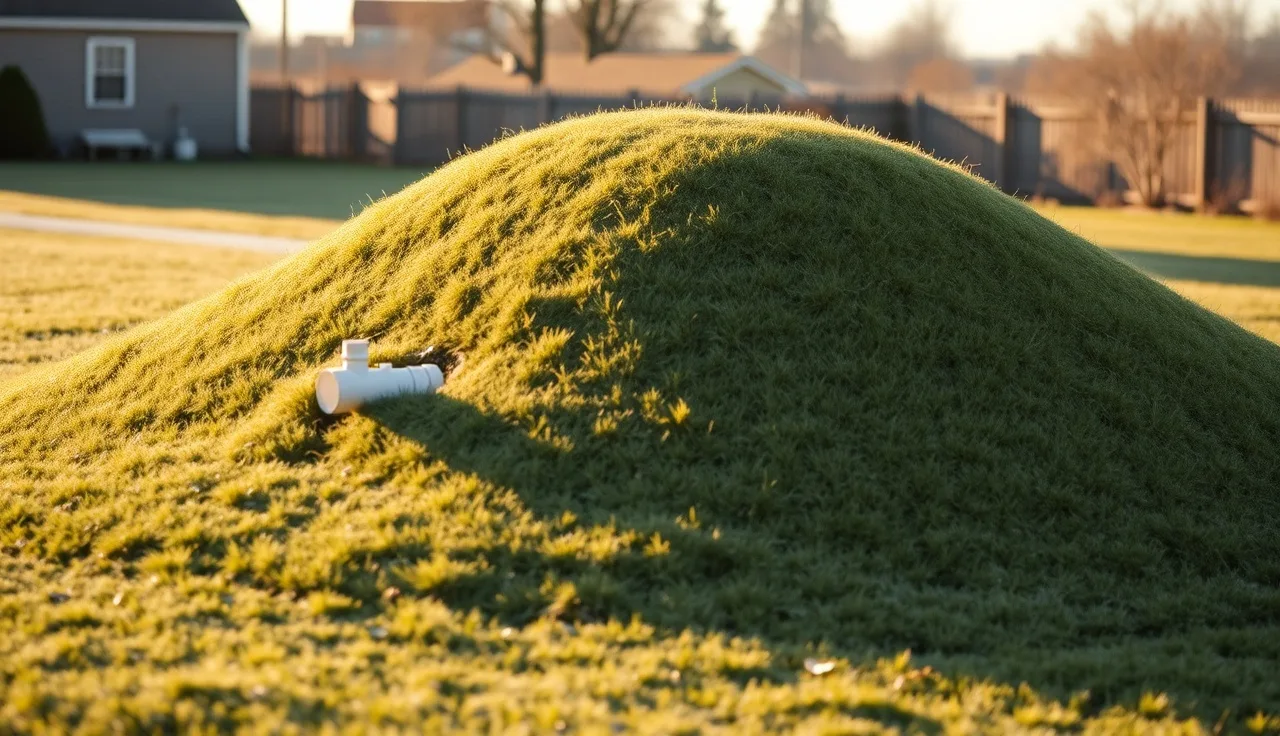
Then the whole mound gets capped with topsoil and seeded with grass or a shallow-rooted groundcover. From the yard it reads as a low grassy ridge. The cap protects the media, drives off water through evapotranspiration, and keeps rain from sheeting across the mound face.
What does an above ground drain field cost?
This is the part that makes people wince. A mound costs roughly two to three times what a conventional septic system costs, and the gap is real, not padded.
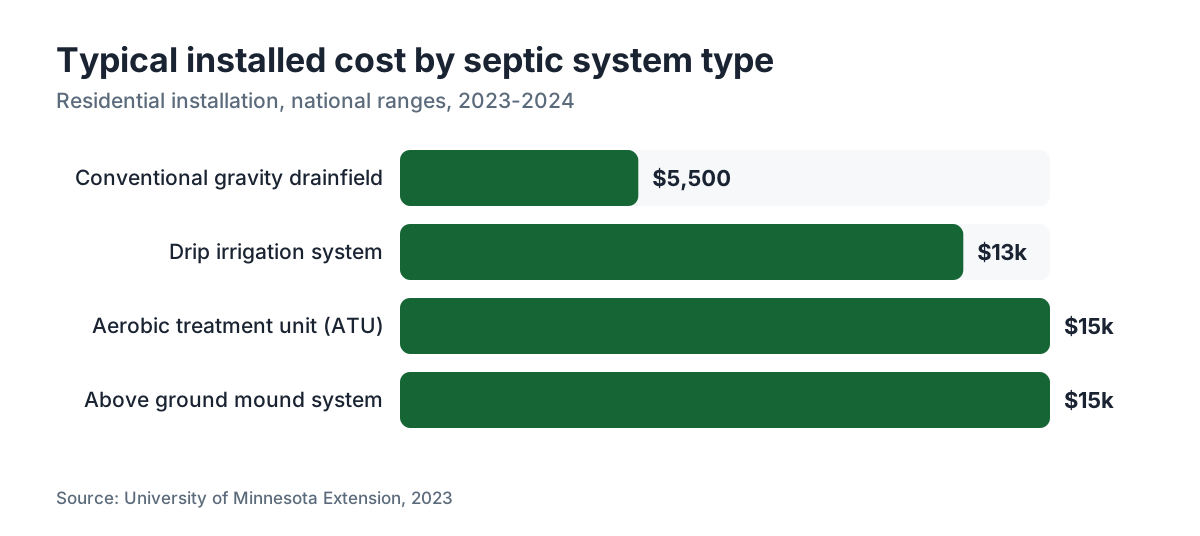
Installed cost runs about $10,000 to $20,000 for a typical residential mound, based on state extension figures and contractor surveys [4]. That covers everything: design, permitting, excavation, imported sand, gravel, pump equipment, electrical, and inspection. Rough access or large lots can push it past $25,000.
Why so much? You're paying for imported sand fill (sometimes 50 to 100 tons of it, trucked in), a pump and pump chamber that a gravity system never needs, and more engineering and inspection. The pump chamber alone adds $1,000 to $3,000 in equipment and labor.
Running costs are higher too. The pump runs every day and burns electricity, roughly $30 to $60 a year depending on how often it doses and your local rates. The bigger line item is pump replacement, which comes every 7 to 15 years depending on brand and use, at $300 to $800 for the pump plus labor.
Here's how the main system types compare.
| System type | Typical installed cost | Pump required | Primary use case |
|---|---|---|---|
| Conventional gravity drainfield | $3,000 to $8,000 | No | Good soil, adequate depth |
| Above ground mound system | $10,000 to $20,000 | Yes | High water table, slow/shallow soil |
| Drip irrigation system | $8,000 to $18,000 | Yes | Steep slopes, poor soil |
| Aerobic treatment unit (ATU) | $10,000 to $20,000 | Yes | Strict treatment requirements |
These ranges come from University of Minnesota Extension and comparable state sources, reflecting 2023-2024 data [4][9]. Your local market and soil will move the number either way.
If you're budgeting for the whole project, the cost to install a septic system guide breaks out tank costs, permit fees, and site work together.
How long does a mound system last?
Twenty to thirty years is the accepted lifespan for a mound that's designed right, sized right, and maintained [4]. Some run longer. Some fail in ten. The spread comes down almost entirely to use and maintenance, not the technology.
Organic loading is the biggest variable. Every drainfield, buried or mounded, eventually grows a biomat: a thin biological layer that forms at the soil interface and slows infiltration. In a mound it forms at the bottom of the sand where it meets native soil. A well-loaded mound grows that layer slowly and the surrounding soil keeps up with it. An overloaded one grows it fast and backs up.
Grease, non-degradable wipes, harsh chemicals, and too much water all speed up biomat growth. Keeping solids out of the effluent through regular septic tank pumping is probably the single highest-return thing you can do. When sludge and scum overflow the tank into the pump chamber and get dosed onto the mound, the biomat thickens fast.
The pump is a wear part. Budget for at least one replacement over the system's life.
How do you maintain an above ground drain field?
Maintenance splits into two halves: the tank side and the mound side.
The tank side is the same as any septic system. Pump the tank every 3 to 5 years. With a garbage disposal, a big household, or heavy water use, lean toward every 3 [5]. Flush nothing but human waste and toilet paper. Keep cooking grease, medications, and bulk bleach out of the drains. If you want pump frequency broken down by household, the guide on how often to pump a septic tank sorts it by tank size and occupancy.
The mound side has a do list and a hard don't list.
Do keep the surface covered in grass. Reseed bare spots fast, because exposed soil erodes and one heavy rain can move fill and mess up the slope. Check the vent pipes (most mounds have one at each end) to confirm they're clear. Test the pump alarm at least once a year. Many jurisdictions require an annual operation and maintenance (O&M) inspection and a signed report; check your local rules.
Don't drive or park on the mound, ever. The weight compacts the media. Don't plant trees or woody shrubs anywhere near it, since roots crack pipes and short-circuit treatment. Don't route roof runoff, sump discharge, or surface drainage onto the mound. It's already taking dosed effluent, and extra surface water saturates it faster than it can drain.
Don't buy septic additives sold as mound enhancers or biomat removers. There's no credible evidence they extend system life, and the EPA does not endorse them [2].
Operators running multiple mound sites have more to track than gravity-system customers: pump alarm events, O&M due dates, pump chamber service history. That's the kind of recurring workflow where software like SepticMind earns its keep, because mound clients have more scheduled touchpoints than standard accounts.
What are the signs an above ground drain field is failing?
Mounds don't fail overnight. There's usually a progression, and you can catch it early if you're paying attention.
The first warning is the pump alarm. Most pump chambers have a high-water float that trips when liquid levels get abnormal. That usually means the pump quit, or effluent is coming back from the mound faster than the mound will take it (hydraulic overload or biomat). Never ignore a pump alarm.
Surfacing effluent is late-stage. Wet, spongy ground or dark, smelly liquid seeping from the mound face or its base means the mound is saturated and overloaded. Now you have a public health problem and you need a professional on site the same day. Surfacing effluent can carry pathogens including E. coli and other fecal coliforms [2].
Slow drains in the house plus repeated pump alarms tell you effluent isn't leaving fast enough. That can also be a tank problem, so start with a septic tank inspection before you blame the mound.
Unusually dark, lush grass over the mound (beyond normal seasonal green-up) hints that effluent is reaching closer to the surface than it should. Nitrogen in partly treated wastewater feeds plants hard.
Repair depends on cause. A dead pump is a simple swap. Hydraulic overload from a sludge-packed tank may recover after pumping. Biomat failure in the sand is the hard case, and it may need resting the mound (diverting flow to an alternating cell, if the design has one) or, in bad cases, replacing the sand fill. The septic system repair guide covers your options when a drainfield is going.
What permits and regulations apply to above ground drain fields?
Every state regulates onsite wastewater, and mounds sit at the tighter end of that spectrum because they're used on sensitive sites.
The EPA sets broad principles through SepticSmart and the Clean Water Act, but permitting authority rests with states and often counties [2]. Most states require a site evaluation (perc test plus soil profile by a licensed evaluator), an engineered design (some states accept prescriptive tables for standard conditions, others require a stamped engineer design), a construction permit, and a final inspection before the system goes into service.
Many states go further for mounds. Wisconsin, Minnesota, and several northeastern states require annual or biannual O&M inspections by a certified maintainer, and the owner or operator has to file a signed report confirming the system works [1][6]. Wisconsin's NR 113 rule spells out the maintenance certification requirements for service providers.
Cutting corners here bites back. An unpermitted mound or skipped inspections can bring fines, forced abandonment of the system, and trouble at sale. Most real estate deals in states with active onsite programs now require a septic inspection contingency or disclosure.
If you're buying a property with a mound, ask for the original design file, the installation inspection record, and any O&M reports on file. A missing design file makes future troubleshooting much harder.
Can you repair or rehabilitate a failing mound system?
Sometimes yes, sometimes the math says replace.
A failed pump is the easy case: $300 to $800 for the pump plus one to two hours of labor [4]. Worth fixing every time.
Cracked or offset laterals in the distribution network mean a contractor digs into the mound and replaces sections of pipe. More disruptive, still far cheaper than full replacement.
When the biomat at the sand-to-native-soil interface has slowed infiltration to essentially zero across the whole mound, the options get thin. Some contractors offer biomat treatment with hydrogen peroxide injection or a resting period (routing flow to a temporary system while the mound rests 6 to 12 months). Neither has a strong evidence base for fully reversing a dead mound, though resting sometimes buys a few more years.
Full replacement, meaning excavating the old fill, trucking in new sand, and rebuilding, runs close to a new install and sometimes more because of the demolition. At that point, ask two questions. Have site conditions changed (water table lowered by new drainage, say) enough to allow a conventional system now? Or would a different alternative like drip irrigation fit better?
A licensed onsite wastewater professional or your county sanitarian is the right person to judge your specific site. NAWT and NEHA keep directories of certified professionals by state [7].
How is a mound system different from other alternative drainfield types?
Mounds get filed under "alternative" septic systems, but that label covers several different technologies. Knowing the differences helps you ask the right questions when a designer lays out options.
Drip irrigation also uses a pump and pressurized distribution, but the drip lines sit just a few inches below the surface rather than in an above-grade berm. They handle slopes and tight lots well, but they're mechanically fussier (emitters clog) and cost more to maintain than mounds [9].
Aerobic treatment units (ATUs) treat wastewater to a higher standard with forced aeration before it reaches a drainfield. You see them where treatment rules are strict, near surface water for example, but they still need a drainfield for final dispersal. An ATU can even feed a mound when the site also has soil depth limits [9].
Pressurized shallow narrow drainfields (PSND) put effluent in very shallow, narrow trenches and lean hard on evapotranspiration. They fit dry climates with high evaporative demand and don't get much use in the wet northern states.
The mound wins on simplicity and track record. It has more installed examples and more decades of performance data than most alternatives, so designers can size one with confidence. The tradeoffs are footprint (a typical residential mound is 20 to 50 feet wide and 40 to 100 feet long) and the obvious raised feature sitting in your yard.
What should you ask a contractor before installing a mound system?
Not every septic contractor knows mounds. Some counties have almost none installed. Some contractors have built hundreds. The experience gap matters because mound tolerances are tighter than conventional work. Lateral slope, sand fill compaction uniformity, force main elevation relative to the pump chamber, and the mound cap geometry all shape how long the thing lasts.
Ask this directly. How many mounds have you installed in this county or region? Can you give me two or three past mound customers I can call? (This article can't verify any contractor's claims, so do your own reference checks.) Are you using a licensed soil evaluator or engineer for the design, and can I see their credentials? Will you pull all the permits and schedule the inspections?
Ask about the sand spec. State codes usually specify a grain size distribution for the fill (often ASTM C-33 or equivalent). Contractors cutting costs sometimes use a coarser or less uniform fill that doesn't treat as well. Ask for documentation that the sand meets spec.
Ask about the pump brand and warranty. Goulds, Liberty, Zoeller, and Myers are common in the market with real service networks. Ask how the alarm notifies you and whether the installer offers a service contract for the pump chamber.
For the full picture of what installation involves and what to ask before any septic work, the septic tank installation guide covers the process from permitting through final inspection.
Operators building out a mound service line have annual reporting to juggle for these clients. SepticMind's workflow tools track O&M schedules, pump service records, and customer communication across the whole book, which matters most for mound accounts with recurring reporting deadlines.
Does an above ground drain field affect property value or home sale?
A mound is neither a deal-breaker nor a selling point, but it adds complexity to a sale.
Buyers who've never seen an onsite system sometimes panic at a mound in the yard. A clean seller disclosure with the design file, installation permit, inspection records, and maintenance history flips that objection into proof of responsible ownership. A mound with clean O&M records and a recently serviced pump is a better asset than a mystery gravity system with no paperwork.
Some lenders and states require a septic inspection as part of the sale. For a mound, a qualified inspector checks pump operation, alarm function, distribution uniformity (sometimes with a dye test), and visible mound condition. A septic tank inspection done before you list lets you fix problems on your own timeline instead of under contract pressure.
If the mound is near the end of its design life, that's a fair negotiation point on price. A well-maintained 25-year-old mound may have 5 to 10 years left, or may need replacement soon. An engineer's evaluation (typically $300 to $600) gives both sides objective footing.
Value impact is highly local and tied more to how the system is maintained and documented than to the type. A failed or undocumented mound is a real liability. A well-kept one with records is just a normal feature of rural property.
Frequently asked questions
How much does it cost to install an above ground drain field?
A typical residential mound system costs $10,000 to $20,000 fully installed: design, permitting, imported sand fill, pump chamber, and inspection. Large lots, tough access, or high sand costs can push it past $25,000. The pump chamber alone adds $1,000 to $3,000. That's two to three times a conventional buried drainfield, which reflects the imported materials and pump equipment a mound needs.
How long does an above ground mound system last?
With proper maintenance, most mounds last 20 to 30 years. The main longevity factors are how often the septic tank is pumped (keeping solids out of the pump chamber and mound), household water habits, and whether the mound is protected from vehicle traffic and roots. Some mounds run past 30 years. Some fail in 10 from overloading or neglect.
Can you drive on or park on a mound system?
No. Vehicle weight compacts the sand media inside the mound, cutting infiltration capacity and risking damage to the distribution pipes. That includes cars, trucks, ATVs, and heavy lawn equipment. Keep vehicles off entirely. Foot traffic and normal mowing are fine. Mark the mound perimeter clearly if your property layout makes accidental driving likely.
How often does a mound system need to be pumped?
The septic tank feeding a mound should be pumped every 3 to 5 years, same as any tank. Households with a garbage disposal or more than 4 people should lean toward 3 years. The pump chamber itself gets inspected at each pump-out and doesn't need separate pumping unless solids overflow from the tank, which is itself a sign the tank was overdue.
What grass or plants can you put on a mound system?
Shallow-rooted grasses are the best cover: turf grasses, fescue, and similar lawn varieties. They drive evapotranspiration, hold the topsoil cap in place, and leave the media below alone. Avoid trees, shrubs, or anything with woody roots within 10 to 15 feet of the mound. Roots can crack distribution pipes and create flow paths that short-circuit treatment.
What happens when a mound system pump fails?
When the pump quits, effluent fills the pump chamber instead of dosing to the mound. The high-water alarm should trip. Drain and toilet use in the house will eventually back up once the chamber fills. This is an urgent repair, not a wait-and-see. A licensed contractor can usually swap a submersible pump in a few hours. Pump replacement runs $300 to $800 plus labor, typically $150 to $300 per hour.
Do above ground drain fields smell?
A working mound has no noticeable odor at normal distance. Most designs include vent pipes at the ends that release gases from the distribution zone, but these are usually minimal. If you smell sewage near the mound, treat it as a warning: it can mean surfacing effluent, a failed cap, or distribution damage. Call a licensed service provider to inspect before it worsens.
Can you add a bedroom or increase water use with an existing mound system?
Not without an evaluation. Mounds are sized at installation for a specific design flow, usually based on bedroom count or daily gallons. Adding a bedroom, a hot tub, or otherwise pushing water use past the design capacity can hydraulically overload the mound and shorten its life. Check the original design file for the permitted flow rate, then have a licensed engineer say whether the system can take the extra load.
Is an above ground drain field covered by homeowner's insurance?
Standard homeowner's policies usually exclude septic damage from gradual failure or wear, which is how most mound failures get classified. Sudden damage from a specific event (a vehicle crushing distribution pipes, say) may be covered. Some insurers offer a separate septic rider or endorsement. Read your policy language and ask about the rider if you have a mound, since replacement costs are high.
What states commonly require mound systems?
Mounds are most common in Wisconsin, Minnesota, Michigan, Maine, Vermont, New Hampshire, and other states with seasonal high water tables, shallow soil over bedrock, or heavy clay. Wisconsin has some of the most detailed mound design and maintenance standards in the country. Many Mid-Atlantic and southeastern states also permit mounds for high-water-table lots near coastal plain areas. Your county sanitarian can tell you how common they are locally.
Can a mound system freeze in cold climates?
Freezing is a real risk in very cold climates, especially with poor insulation, thin grass cover, or light winter use (intermittent use means less warm effluent moving through the pipes). Northern state codes usually require minimum sand depth and topsoil cover to prevent it. Insulation boards (HDPE foam) under the topsoil cap during construction are sometimes used. For a seasonal camp, ask a local designer about freeze protection.
How do you know if a mound system is still functioning correctly?
Annual O&M inspections (required in many states) check pump operation, alarm float, distribution line pressure and uniformity, pump chamber liquid levels, and visible mound condition. Between inspections, watch for high-water alarms, unusually lush green patches, wet or spongy soil at the base, and slow drains in the house. Any of those warrants a service call, not a wait-and-see approach.
What is the difference between a mound system and a raised bed system?
The terms get used interchangeably, but some state codes treat them as distinct designs. A mound typically uses pressurized distribution across the full footprint. A raised bed may use gravity distribution in a shallower elevated bed. Both put the drainfield media above natural grade. Your state's onsite wastewater code defines these terms for your jurisdiction, and the distinction affects permitting and design.
Sources
- University of Minnesota Extension, "Mound Septic Systems": Wisconsin pioneered mound system design standards; design life 20-30 years; typical mound dimensions and sand fill specifications
- U.S. EPA, SepticSmart Program: Soil beneath a mound provides final treatment and dispersal; EPA does not endorse septic additives; groundwater separation and pathogen context
- National Environmental Services Center (NESC), "Mound Systems" fact sheet: Pump chamber required between septic tank and mound; timed dosing described as standard practice
- University of Minnesota Extension, "Septic System Costs": Mound system installed cost $10,000-$20,000; pump replacement costs; comparison to conventional system costs; design life estimates
- U.S. EPA, "How to Care for Your Septic System": Septic tanks should be pumped every 3 to 5 years; household size and use affect pump frequency
- Wisconsin Department of Natural Resources, NR 113 Rule (Sanitary Maintenance Certification): Wisconsin requires annual O&M inspections and certified maintainer reports for mound systems
- National Association of Wastewater Technicians (NAWT): NAWT maintains directory of certified onsite wastewater professionals by state
- Minnesota Pollution Control Agency, "Septic Systems": Mounds required in Minnesota when seasonal high water table is within 18-24 inches of surface; permitting and design requirements
- Penn State Extension, "Alternative Onsite Wastewater Systems": Drip irrigation, ATU, and mound system comparison including cost ranges and site condition applicability
- U.S. EPA, "Onsite Wastewater Treatment Systems Manual": Soil perc rate thresholds (60 min/inch and faster soils); treatment objectives for alternative systems; Clean Water Act context
Last updated 2026-07-09