Septic tank pumped out: what happens, how often, and what it costs
By the SepticMind Editorial Team
TL;DR
- Pump a typical household septic tank every 3 to 5 years.
- The national average runs $300 to $600, though large tanks or hard access can push a bill past $1,000.
- Pumping clears sludge and scum before they spill into your drain field.
- Skip it and you invite the most common cause of drain field failure, a repair that runs $5,000 to $20,000.
What actually happens when a septic tank is pumped out?
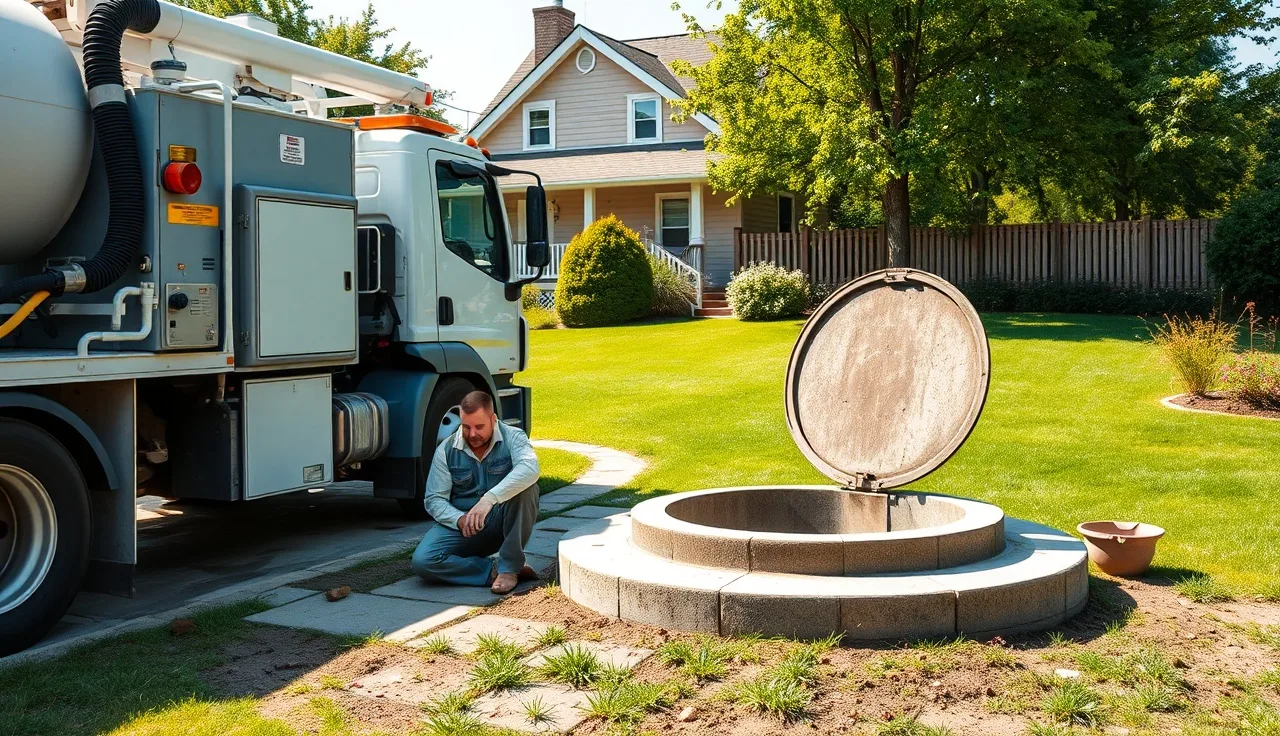
A pump truck pulls up, the technician finds your tank lid (from a map you provide or by probing the yard), and opens the access port. A 4-inch vacuum hose drops into the tank. The truck's pump pulls a vacuum, and everything in the tank, the liquid, the sludge on the bottom, the floating scum on top, gets sucked into a sealed holding tank on the truck. The whole job takes 20 to 45 minutes for a typical 1,000-gallon tank.
A good technician inspects the tank while it's empty. They look at the inlet and outlet baffles (plastic or concrete T-shaped fittings that stop solids from flowing into your drain field), check the walls for cracks, and watch the liquid level as groundwater seeps back in. A cracked tank or a missing baffle is worth knowing about before it causes a backup.
The waste then goes to a licensed treatment facility. Most states make haulers document every load and where it landed. If your hauler can't tell you where the septage goes, press on that.
What you get back is a clean tank ready to restart the biological process. Your tank smells a little stronger for a day or two after pumping because fresh air hit what's normally an oxygen-free environment. That's normal. It passes fast.
How often should a septic tank be pumped out?
The EPA's SepticSmart program recommends pumping every 3 to 5 years for a typical household [1]. That's a fine starting point. The honest answer is that it depends on your tank and your house.
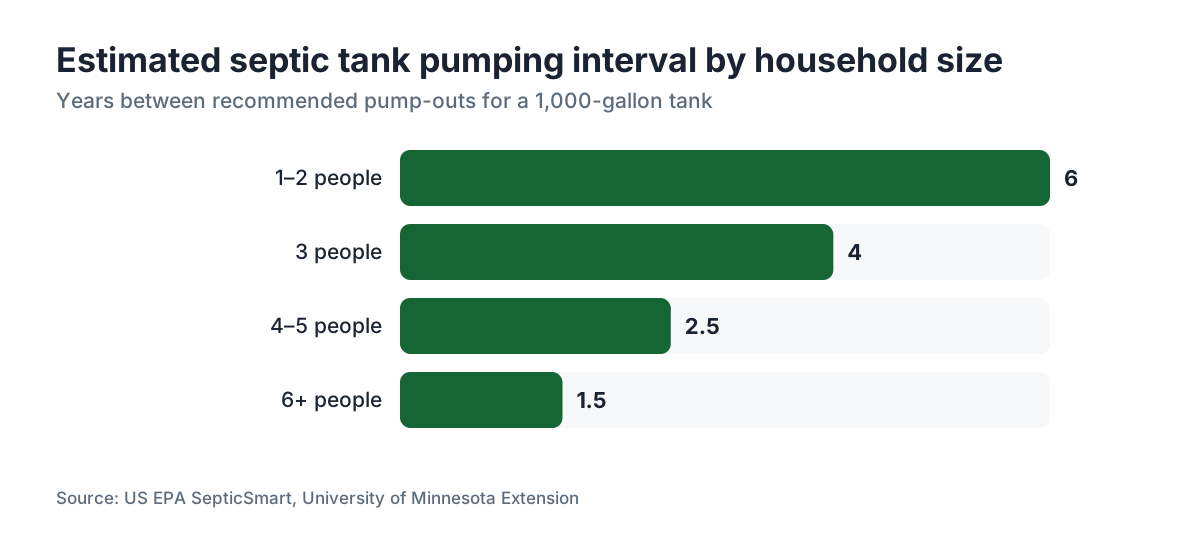
Two factors drive everything: tank size and how many people live there. A 1,000-gallon tank serving two people fills far slower than the same tank serving six. The table below shows estimated intervals from EPA guidance and industry data.
| Household size | Tank size (gallons) | Estimated pumping interval |
|---|---|---|
| 1 to 2 people | 1,000 | 5 to 7 years |
| 2 to 3 people | 1,000 | 3 to 5 years |
| 4 to 5 people | 1,000 | 2 to 3 years |
| 4 to 5 people | 1,500 | 3 to 5 years |
| 6+ people | 1,500 | 2 to 3 years |
| 6+ people | 2,000 | 3 to 5 years |
Nobody has clean long-term data on this. The closest solid references are the EPA guidance and the university extension charts that back it up [2]. Your habits matter too. A garbage disposal adds roughly 50 percent more solids to a tank, which shortens the interval by a real amount. Low-flow fixtures push it the other way.
Just bought a house and don't know the history? Pump it now and look inside. That first inspection tells you more than any formula.
For a deeper look at scheduling, see our guide on how often to pump septic tank.
How much does it cost to get a septic tank pumped?
The national average for a standard septic pump-out runs about $300 to $600 [3]. Most quotes I've seen from haulers in the midwest and southeast land right in that range for a 1,000-gallon tank with easy lid access. Coastal states and the northeast run higher, $400 to $800, partly from tighter disposal rules and higher operating costs.
Several things push the price up:
- Tank over 1,500 gallons: add $50 to $200
- Buried lid with no riser (technician has to dig): add $50 to $150
- Hard truck access, long hose runs, or soft terrain: add $100 or more
- Riser installation at time of service: $200 to $400, one-time cost
- Jetting or cleaning of the inlet line: add $100 to $300
Some companies quote a "pumping only" price, then tack on fees for the inspection or baffle check. Ask upfront what's included. A decent hauler inspects the baffles and tank condition at no charge. It takes two minutes.
Cost also depends on whether you're on a maintenance contract. Many operators knock 10 to 15 percent off for recurring service. For a four-person household pumping every three years, that adds up over a decade.
For regional pricing detail, see septic tank pumping and septic tank pump out.
What are the signs your septic tank needs to be pumped now?
Some signs are loud. Others creep up slow enough that homeowners miss them until the damage is done.
Drains slow down across the whole house at once. One slow drain is usually a clog in that line. Every drain crawling at the same time points to the tank or the line feeding it.
Sewage odors show up inside or in the yard. If you smell rotten-egg gas near the drain field or the tank lid, the tank is likely full or a baffle has failed.
Grass over the drain field turns green and spongy. Healthy field grass looks like the rest of the yard. One lush, wet patch means effluent is surfacing. That's a drain field problem, and an overfull tank is often what kicked it off.
Toilets and drains gurgle after you flush or run water elsewhere in the house.
Sewage backs up into the lowest drains, usually a basement floor drain or a first-floor toilet. This is the emergency stage. If you're here, pump right away and get the tank and baffles inspected.
Here's what surprises people: a tank can be functionally full and show none of these signs yet. That's the whole case for interval-based pumping instead of waiting for symptoms. By the time you smell it, you've likely been stressing the drain field for months.
What should you do before and after the pump-out?
Before the technician arrives, find your tank lid. If you have an as-built drawing from your county health department, pull it out. If not, the technician can usually trace the main sewer line from the house to the tank, but you'll pay a small fee for the time. Installing a riser and lid cover after the first pump-out is one of the smartest moves you can make. It drops future access from 30 minutes of digging to 30 seconds of lifting a lid.
Clear a path for the truck. These rigs are big, sometimes 25,000 pounds loaded, and soft or wet ground is a problem. If you have a long driveway or low branches, say so when you book.
After pumping, skip the garbage disposal for a few days if you can. Let the bacterial colony rebuild before you dump a heavy solids load on it. Flush nothing but waste and toilet paper for a few weeks. Products sold as "septic starter" bacteria are almost always a waste of money and have no solid evidence behind them; your waste stream reseeds the tank on its own [4].
Write down the service. Date, company, tank size pumped, and anything the technician flagged. Keep it with your home records. When you sell, buyers and inspectors will ask.
SepticMind's maintenance tracking lets homeowners log service dates and set reminders. Sounds simple. It matters, because most people have no idea when their tank was last pumped.
Does pumping a septic tank clean it completely?
No, and the difference matters. Pumping removes the liquid, the sludge, and the floating scum. It does not pressure-wash the walls or jet the inlet and outlet pipes.
For most residential tanks, pumping is all you need. The walls don't have to be spotless. They just can't be cracked. The bacterial film on the walls actually helps digestion and reforms within days.
Cleaning becomes a real question when a baffle has failed and solids have traveled into the distribution box or the drain field laterals. Then a technician might hydro-jet the pipes to clear the blockage before solids pack in harder. That's a separate service from pumping, and it costs more.
If a company pitches a "deep clean" or "full enzyme treatment" as a routine add-on to every pump-out, ask what problem it solves. Most of those add-ons have no evidence behind them [4]. For the split between pumping and cleaning, see septic tank cleaning and septic tank emptying.
What do inspectors check during a pump-out?
A good technician does more than empty the tank. With it empty, things become visible that you can't see any other way.
Inlet and outlet baffles. These fail more than any other component. A plastic baffle cracks or falls off; a concrete T-baffle crumbles. Lose the outlet baffle and raw solids flow straight to the drain field. Replacement runs $100 to $300 and takes 30 minutes. It's one of the highest-value repairs in septic systems.
Tank walls and floor. Cracks let groundwater in (which fills the tank faster) or sewage out (a contamination risk). Hairline cracks in concrete tanks are common and often not urgent. Big cracks or a visibly failing structure are a different story.
Liquid level. Groundwater seeps back over the next few hours through the normal inlet. If the tank refills fast while you're using no water, it's likely taking in groundwater through a crack or a failed seal.
Scum and sludge depth before pumping. Some technicians measure both with a "sludge judge" before they start. When sludge and scum together fill more than a third of the tank's volume, it's time to pump. That number helps set your next interval.
For a pre-purchase or pre-sale check, a formal septic tank inspection goes further than a pump-out inspection, including a load test on the drain field.
What happens if you never get your septic tank pumped?
The sludge layer on the bottom and the scum layer on top keep growing. The liquid layer in the middle shrinks. Eventually, partly treated solids start leaving through the outlet and flowing into the drain field pipes.
Drain fields clog when those solids coat the soil interface and build a biological mat that blocks absorption. Once that happens, the field won't drain. Wet spots or sewage surface in the yard. Drains back up inside.
Drain field repair or replacement runs $5,000 to $20,000 depending on size and site conditions [5]. Some states require a full system redesign when the original field can't be rehabbed, which piles on permitting, engineering, and excavation costs.
Compare that to pumping every three years at $400. Over 15 years, that's $2,000. The math isn't subtle.
Already at drain field failure? See septic tank repair and septic system repair for what recovery looks like.
There's a public health angle too. Untreated sewage reaching groundwater near a well is a real risk, especially in sandy or karst soils where water moves fast. Several state health codes cite that risk as the reason for mandatory pumping intervals [6].
How do regulations affect how often you must pump?
Most state and local codes set a minimum pumping frequency, and some require documentation. The specifics vary more than you'd expect.
North Carolina, for one, requires onsite systems to be inspected and pumped as needed, with records kept [6]. Maine sets pumping intervals under its subsurface wastewater disposal rules, with less frequent pumping allowed for systems that have risers and are easy to inspect [7]. Other states leave the interval entirely to the homeowner and lean on the EPA's general 3-to-5-year guidance.
Some counties go further than their states. Along the Chesapeake Bay, coastal jurisdictions push more frequent pumping under nutrient management rules aimed at cutting nitrogen loading to the water [8].
Selling a home? Your buyer's lender (FHA and VA loans especially) often requires a septic inspection and may want proof of recent pumping. Check your local health department's rules. Most county health departments publish their onsite wastewater regulations online, and the EPA's septic page links to state resources [1].
In states with mandatory pumping programs, fines for non-compliance are real, usually $100 to $500 per violation, though enforcement varies a lot.
How do you find and hire a reputable septic pumping company?
Start with your state's licensing board or environmental agency. Most states require septic haulers to hold a specific license, and you can verify a company is current before they come out. The National Association of Wastewater Technicians (NAWT) also certifies individual technicians, which is a credential worth asking about [9].
Ask these before you book:
- Are you licensed to haul septage in this state, and can you give me your license number?
- Where does the waste go, and can I see your disposal documentation?
- Does your price include a baffle and tank inspection?
- Will you measure sludge and scum depth before pumping?
- Do you install risers if the lid is buried?
Get at least two quotes for a first-time pump-out. Prices shouldn't swing more than 20 to 30 percent for the same job in the same area. A quote that's wildly lower is worth questioning.
For operators running multiple accounts, the scheduling and job management side of a pump-out business is where a lot of margin leaks out. SepticMind's software handles route scheduling, service history, and customer reminders in one place, which matters when you're running hundreds of accounts across a territory.
Reviews on Google and Nextdoor help, but look for mentions of whether the technician actually looked inside the tank and reported what they found. A hauler who pumps and leaves without a word is doing half the job.
Does tank size or type change what you should expect from a pump-out?
Yes, on both counts.
Size first. Standard residential tanks run 750 to 1,500 gallons. Bigger homes sometimes have 2,000 or even 2,500-gallon tanks. Pricing scales with volume; most haulers charge by the gallon above a baseline, usually $0.05 to $0.15 per gallon over the base capacity. A 2,000-gallon pump-out often costs $500 to $900.
Type next. Most tanks are precast concrete, but plastic (polyethylene) and fiberglass tanks are common in newer builds. Concrete tanks crack over time, especially in freeze-thaw climates. Plastic tanks resist cracking but can shift where the water table is high. The pump-out itself is the same regardless of material.
Alternate systems change more. Aerobic treatment units (ATUs) have aerators and sometimes chlorination that need separate service, usually an annual maintenance contract on top of pumping. Mound systems and drip irrigation systems each have parts that need checking at pump-out time. If you have one of these, confirm your hauler has experience with that type before booking.
Sizing a new system? See cost to put in a septic tank and cost to install septic system for what size decisions look like on the install side.
Can you pump a septic tank yourself?
Not legally. In every state I'm aware of, hauling septage requires a licensed operator with a certified vacuum truck and a permitted disposal site. You can't legally move sewage in a rented tank or pump it onto your own land.
What you can do yourself: find the lid, dig to expose it, and stand there during the pump-out to watch and ask questions. Some handy homeowners replace their own baffles after a technician points out a failed one. Baffle replacement isn't legally regulated in most states and is a manageable DIY job if you understand the confined-space risks and stay out of the tank.
The danger of a full DIY pump-out is serious. Septic tanks produce hydrogen sulfide and methane. Confined-space entry without atmospheric testing and ventilation has killed people [10]. That alone makes this one to leave to licensed pros, every time.
Frequently asked questions
How long does a septic tank pump-out take?
For a typical 1,000-gallon residential tank with accessible lids, the pumping itself takes 20 to 45 minutes. Add 15 to 30 minutes if the technician has to locate or dig to the lid. With travel and setup, plan for the hauler to be on your property about an hour. Larger tanks or complicated systems take longer.
How much does it cost to get a septic tank pumped?
The national average is $300 to $600 for a standard 1,000-gallon residential tank. Prices vary by region, with northeastern and coastal states typically higher. Extra charges apply for buried lids, tanks over 1,500 gallons, difficult access, or services like jetting. Get a quote that spells out whether the baffle inspection and tank condition check are included.
How often should a septic tank be pumped out?
The EPA recommends every 3 to 5 years for a typical household. The real interval depends on tank size and number of occupants. A 1,000-gallon tank serving two people may go 5 to 7 years. The same tank serving five people may need pumping every 2 to 3 years. Heavy garbage disposal use shortens the interval significantly.
What happens to your septic tank after it's pumped?
The tank refills gradually with household wastewater and groundwater seepage. The natural bacterial colony rebuilds within a few days, fed by bacteria already in the waste you generate. The tank goes back to separating solids from liquids. There's no need to add bacteria boosters or starters; research does not support their effectiveness.
Is it normal for the septic tank to smell after pumping?
Yes, briefly. Pumping introduces oxygen to an anaerobic environment, which raises odor for a short window as conditions shift. Mild smells near the tank or in the yard for one to three days are normal. Persistent strong odors inside the house or at the drain field after that window may point to a baffle problem or a drain field issue worth checking.
Can a septic tank be pumped in winter?
Yes. Winter pumping is possible and sometimes necessary in an emergency. Frozen ground makes lid access harder and truck positioning riskier. If the ground over the tank is deeply frozen, the technician may need a spud bar or hot water to break through. In most climates, scheduling for late fall or early spring dodges the worst complications while keeping you on a consistent interval.
Should you be home when the septic tank is pumped?
It's worth being home, especially for the first pump-out at a property. You learn where the tank and lid are, see the baffle condition firsthand, and can ask questions while the tank is open. For routine repeat pump-outs where you've documented the location and the system is known to be sound, you don't need to be present, though it's still useful.
How do you know if your drain field is already damaged from an overfull tank?
Watch for wet or soggy areas over the field that don't dry after rain, unusually green grass in the field area, sewage odors in the yard, and slow drains or backups inside. Surfacing sewage is the clearest sign. If you're seeing these after neglected pumping, get the tank pumped and inspected right away, then assess the field on its own.
What should you not do after getting your septic tank pumped?
Avoid running heavy laundry loads back to back for the first day or two, which floods the tank before bacteria rebuild. Skip the garbage disposal for a few days if you can. Never flush wipes, medications, or grease. Products sold as post-pump-out bacterial treatments are unnecessary. The main rule is to let the system settle back into its normal rhythm.
Do you need a permit to have your septic tank pumped?
Homeowners don't need a permit to have their tank pumped. The hauler must hold a state license for septage transport and dispose of the waste at an approved facility. Some counties require the hauler to submit a disposal manifest to the local health department. If you're in a jurisdiction with mandatory pumping intervals, you may need to keep records proving the service was done.
What is the difference between septic tank pumping and septic tank cleaning?
Pumping removes all liquid and solid content from the tank with a vacuum truck. Cleaning usually means a more thorough service that may include pressure-washing or jetting the tank interior and pipes. Routine maintenance needs only pumping for most residential systems. Cleaning matters when there's been a baffle failure, suspected solids migration to the field, or a system that's been badly neglected.
How do you find out when your septic tank was last pumped?
Check with the previous owner or your closing documents. Your county health department may have records if your jurisdiction requires disposal manifests. You can also call local haulers to see if your address is in their files. If none of that works, the safest move is to pump now and treat today as your new baseline. A technician can estimate how long it's been from sludge and scum depth.
Does homeowners insurance cover septic tank pumping?
Standard homeowners insurance does not cover routine pumping; that's maintenance. Some policies cover sudden and accidental damage, such as a collapsed tank wall, but most exclude damage from lack of maintenance or wear and tear. A few specialty riders or home warranty products cover septic components. Read your policy language carefully before assuming coverage.
How do garbage disposals affect how often you need to pump?
Garbage disposals raise the solids load to the tank a lot. EPA and university extension guidance estimate that disposal use roughly doubles the solids accumulation rate compared to a household without one. In practice, that shortens your interval by one to three years depending on use and tank size. If you run a disposal heavily, plan to pump closer to every 2 years than every 4 or 5.
Sources
- US EPA, SepticSmart Homeowners: EPA recommends pumping household septic tanks every 3 to 5 years as a standard maintenance interval.
- University of Minnesota Extension: Pumping frequency varies by tank size and household size; charts correlate occupancy to interval.
- HomeAdvisor / Angi, Septic Tank Pumping Cost Guide: National average cost for septic tank pumping is $300 to $600 for a standard residential tank.
- Penn State Extension: Research does not support the effectiveness of commercial septic additives or bacteria boosters for routine maintenance.
- US EPA, Septic Systems: Drain field replacement costs $5,000 to $20,000 and is the consequence of deferred pumping and maintenance.
- North Carolina Department of Health and Human Services, Environmental Health: North Carolina onsite wastewater rules require inspection and pumping as needed with records kept.
- Maine Department of Health and Human Services, Subsurface Wastewater Program: Maine sets pumping intervals under its subsurface wastewater disposal rules, with less frequent pumping allowed for systems with risers.
- Chesapeake Bay Program: Coastal counties near the Chesapeake Bay have more frequent pumping requirements to reduce nitrogen loading to surface water.
- National Association of Wastewater Technicians (NAWT): NAWT provides certification for septic system inspectors and technicians as a professional credential standard.
- CDC / NIOSH, Confined Spaces: Septic tanks produce hydrogen sulfide and methane; confined space entry without proper equipment has caused fatalities.
- US EPA, How Your Septic System Works: Description of tank components including inlet and outlet baffles and their role in preventing solids from reaching the drain field.
- Virginia Cooperative Extension: Garbage disposal use approximately doubles solids accumulation in a septic tank, shortening the pumping interval.
Last updated 2026-07-09