How often should you pump your septic system?
By the SepticMind Editorial Team
TL;DR
- The EPA recommends pumping a septic tank every 3 to 5 years for a typical household.
- Your real interval hangs on two things: tank size and how many people live there.
- A 1,000-gallon tank serving four people usually needs pumping every 3 to 4 years.
- A big tank with a small household can stretch past 8 years.
- Measure the sludge layer to know for sure.
What is the standard pumping frequency for a septic system?
Every 3 to 5 years for most homes. That's the baseline from the U.S. Environmental Protection Agency's SepticSmart program, and it holds up across the country [1].
But "3 to 5 years" is a range, not a prescription. The real number for your house comes from two things above all: how many people live there and how big the tank is. One person in a house with a 1,500-gallon tank might go 8 or 9 years. A family of six with a 750-gallon tank might need service every 18 months. The spread really is that wide.
The EPA puts it plainly in its SepticSmart guidance: "Have your septic system inspected (at least) every three years by a licensed professional, and your tank pumped as recommended by the inspector" [1]. Read that twice. Inspection every 3 years. Pumping as recommended. Those are two different services, and treating them as one is how people end up either over-paying or running a tank into failure.
State codes add another layer. Many states write their own pumping rules into onsite wastewater regulations, and counties often stack more on top. Massachusetts Title 5 ties pumping to the inspection that happens before a real estate sale [2]. Virginia requires owners of alternative systems to follow a maintenance contract that usually spells out pumping intervals. Check your state's environmental or health department rules before you assume the federal 3-to-5 baseline is your legal floor.
How do tank size and household size determine your actual schedule?
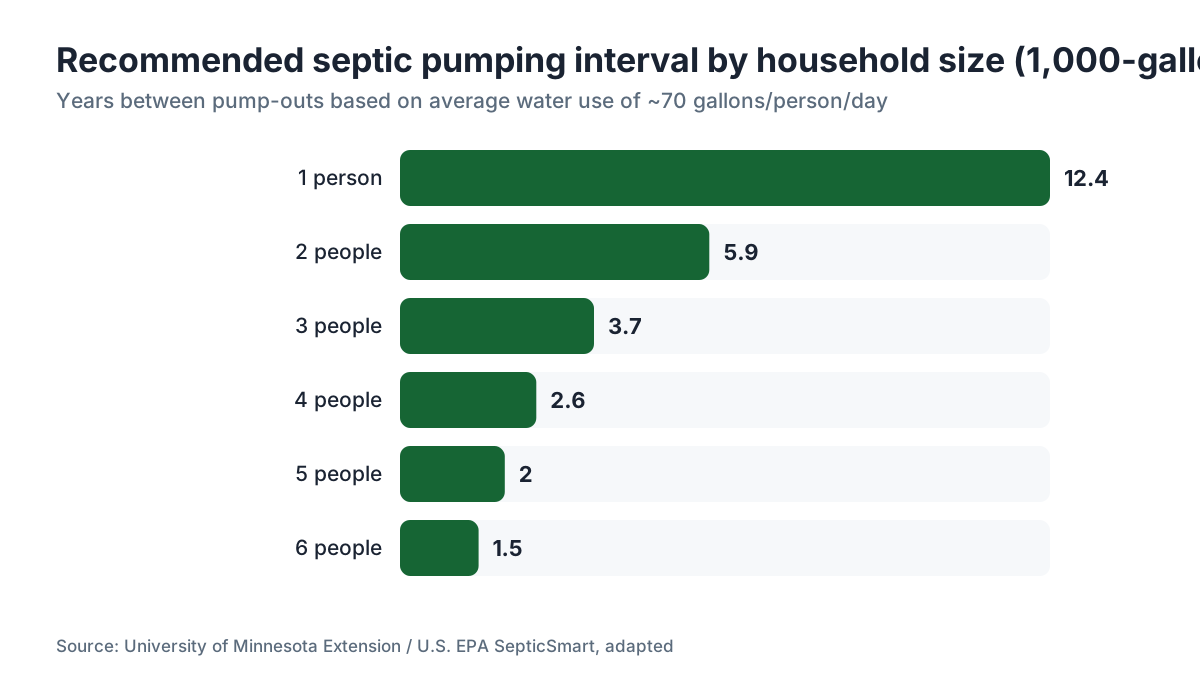
This is where the math lives. The EPA and University of Minnesota Extension both publish lookup tables that cross tank capacity against household size to give you a recommended interval [1][3]. The table below reproduces the core numbers.
| Tank size (gallons) | 1 person | 2 people | 3 people | 4 people | 5 people | 6 people |
|---|---|---|---|---|---|---|
| 500 | 5.8 yrs | 2.6 yrs | 1.5 yrs | 1.0 yr | 0.7 yr | 0.4 yr |
| 750 | 9.1 yrs | 4.2 yrs | 2.6 yrs | 1.8 yrs | 1.3 yrs | 0.9 yr |
| 1,000 | 12.4 yrs | 5.9 yrs | 3.7 yrs | 2.6 yrs | 2.0 yrs | 1.5 yrs |
| 1,250 | 15.6 yrs | 7.5 yrs | 4.8 yrs | 3.4 yrs | 2.6 yrs | 2.0 yrs |
| 1,500 | 18.9 yrs | 9.1 yrs | 5.9 yrs | 4.2 yrs | 3.3 yrs | 2.6 yrs |
| 2,000 | 25.4 yrs | 12.4 yrs | 8.0 yrs | 5.9 yrs | 4.5 yrs | 3.7 yrs |
Source: EPA SepticSmart / University of Minnesota Extension, adapted [1][3]
Three caveats before you trust those numbers. First, they assume average water use, roughly 70 gallons per person per day. High-efficiency fixtures pull that down. A garbage disposal, water softener, or hot tub pushes it up hard. Second, the table assumes a two-compartment tank running normally. If you have a single-compartment tank, trim the intervals by about 20 percent. Third, this is sludge and scum modeling, not a measurement. The only way to know where you actually stand is to have a technician open the tank and measure the layers.
The rule contractors use on the ground: pump when the sludge layer at the bottom plus the scum layer at the top together fill more than one-third of the tank's working volume [12]. Past that point the tank can't settle solids anymore, and effluent quality drops.
What factors make you need pumping more often than average?
Several things compress your interval well below what the table predicts.
Garbage disposal use is the big one. Grinding food scraps dumps a heavy load of solids into the tank. Research in the journal Bioresource Technology found garbage disposal use can raise the rate of sludge accumulation by 50 percent or more compared to households without one [4]. If you run a disposal regularly, cut your standard interval by at least a third.
Water softeners come next. The backwash cycle sends a large volume of salt-heavy water into the tank on a schedule. That brine load can upset the bacterial balance and build scum faster. Most extension programs suggest routing softener discharge away from the septic system entirely if you can [3].
Company and guests count too. Grandkids staying for three months every summer is not a "4-person household" as far as the tank is concerned. If you host long stretches of extra people, fold that into your estimate.
High-volume water events matter more than people think. A stuck toilet float, a washing machine that never stops, or a leaky faucet can double daily flow through the tank and push solids toward the outlet before they settle. Fix plumbing leaks fast.
Old single-compartment tanks are their own problem. Pre-1970s tanks often have one chamber and no effluent filter. They build accessible sludge faster and pass more solids to the drain field. If you have one, get on a 2-to-3-year cycle no matter what the table says, and ask a contractor whether a new tank pays for itself. Our guide on septic tank repair covers when repair tips over into replacement.
What factors let you safely go longer between pumpings?
You can honestly stretch the interval in a few situations.
Small household, big tank. Buy a house sized for five, live there alone, and a 1,500-gallon tank could run 15 years or more before it needs service under the Minnesota Extension model [3]. Still, most contractors want to inspect every 3 years anyway, because baffle integrity and tank condition matter independently of sludge depth.
High-efficiency plumbing helps. Low-flow toilets (1.28 gallons per flush or less) and efficient front-load washers cut daily water into the tank. Less water in means slower solid transport and lighter hydraulic loading on the drain field.
No garbage disposal helps a lot. Households that compost food scraps instead of grinding them add far less load to the tank.
A two-compartment tank with an effluent filter helps most. The second chamber gives solids more time to settle. An effluent filter on the outlet catches suspended solids before they reach the leach field. Both push out the time before pumping turns urgent.
One thing I'd skip: additives. Bacterial and enzyme products get marketed hard as ways to stretch intervals or dodge pumping entirely. The EPA says a well-designed and properly used septic system does not need them [11]. The science that they work is thin. Keep the money.
How do you know when your tank actually needs pumping right now?
Your tank doesn't read a calendar. Some signs say "do this now" no matter when you last pumped, and you ignore them at your own expense.
Slow drains across the house, more than one fixture, point at a full tank or a partly blocked outlet. A single slow drain is usually a pipe clog. Widespread slowness is a system problem.
Sewage odors, inside or out. Smell sulfur or sewage near the tank, over the drain field, or near a floor drain, and the system is under stress. Could be a full tank. Could be a failed baffle. Could be worse.
Wet, spongy ground over the drain field, especially with grass that's unusually green and lush. Surfacing effluent is a late-stage warning. By the time it shows, the system may already have damage that pumping alone won't fix. Our leach field guide covers what's happening at that point.
The technician's measurement beats every other sign. When a pumper opens your tank and uses a Sludge Judge or similar tool, ask for the sludge depth and the effective tank depth. If the ratio tops one-third, pump now and reset your interval going forward [12].
Don't use warning signs as your main scheduling strategy. Pumping is cheap. A failed drain field is not.
How much does it cost to pump a septic system?
A standard residential pump-out runs roughly $300 to $600 nationally, depending on region, tank size, and site access [5]. That's the price to drive out, pump the tank, and dispose of the waste at an approved facility.
What pushes it higher:
Tank depth or hard access can add $50 to $150 in labor. If the riser isn't at grade and the crew has to dig, expect a surcharge. Installing a concrete or plastic riser once almost always pays for itself in saved dig charges.
Tank size at the extremes. A 500-gallon tank might cost $200 to $300. A 2,500-gallon tank or a multi-tank system can run $700 to $1,000 or more.
Region swings the number a lot. Rural areas with few haulers, or cities with steep disposal tipping fees, drift well off the national midpoint. In parts of the Northeast, $500 to $700 is routine. In the rural South, $250 still happens.
Combined inspection and pumping. Some companies bundle a basic inspection, a camera check of the outlet baffle, and the pump-out for a flat rate, often $400 to $700. If you're due for both, that's usually a better deal than booking them separately. Our septic tank pump out guide lays out what the service should include.
The long-run math is almost embarrassing in pumping's favor. Pumping every 3 years at $400 a visit costs about $13,400 over 100 years at one property. A failed drain field replacement costs $10,000 to $30,000 or more, and failure often happens precisely because someone skipped pumping. Pumping on schedule is one of the most defensible maintenance dollars a homeowner spends.
Does the type of septic system change the pumping schedule?
Yes, and the difference is real.
Conventional gravity systems (tank plus passive drain field) follow the table-based schedule above. They're the most common type and the easiest to plan around.
Alternative systems ask for more. Aerobic treatment units (ATUs), mound systems, drip irrigation systems, and constructed wetlands have more moving parts and tighter maintenance rules. ATUs especially. They run air pumps, diffusers, and effluent quality standards that need watching. Many states require quarterly or semi-annual ATU inspections under a maintenance contract, and pumping the clarifier chamber every 1 to 2 years is typical [6].
Pressure distribution systems don't change the tank schedule on their own, but the pump and distribution network need periodic inspection.
Ejector pump systems, common when a basement sits below the tank inlet, add a pump chamber that needs its own attention. That chamber collects solids and usually needs pumping on a schedule similar to or slightly tighter than the main tank.
Not sure what you have? Your county health department should hold a permit on file that describes the system. That record usually shows tank size too, which you need for the scheduling table. Our septic tank inspection guide walks through reading those permit records.
Should you get an inspection every time you pump?
Ideally, yes. Pumping and inspection are separate services that happen to pair well.
Pumping removes solids. Inspection judges the condition of the system: baffles, lids, risers, tank walls, distribution box, and at minimum a visual check of the drain field. The EPA recommends inspection at least every 3 years [1]. If you're pumping every 3 to 5 years, doing both at once is the obvious move.
What a proper inspection covers, per EPA SepticSmart guidance: checking for leaks, measuring scum and sludge layers, inspecting the inlet and outlet baffles (or tees), and assessing the drain field [1].
For alternative systems the bar sits higher. Many state rules require a licensed inspector or system-specific technician to perform and document inspections on a set schedule, with records sent to the local authority. Massachusetts Title 5 is one of the most detailed examples of that structure anywhere in the country [2].
Some operators run software to track inspection records, maintenance history, and pump-out dates across large service areas. SepticMind is built for that kind of operations work, helping service companies schedule and document compliance across their client base.
Here's the line I'd hold: if a company offers to pump with no inspection at all, that's a wasted visit. At minimum, have the technician measure the sludge layer before and after, check both baffles, and tell you the condition of the lid and risers.
What happens if you wait too long between pumpings?
The failures cascade, and they get expensive fast.
First, solids carry over into the drain field. An over-full tank can't settle properly, so effluent leaving the outlet baffle carries suspended solids that clog the drain field aggregate and soil pores. That clogging layer is called biomat, and once it sets up in the soil, pumping the tank won't reverse it.
Second, the inlet baffle or tee can corrode or collapse. When it does, the tank stops working as a settling chamber and the solid carryover problem speeds up dramatically.
Third, a full or failing tank can back up into the house. That's a health hazard and a cleanup bill on top of the repair.
Drain field restoration is sometimes possible, through rest periods, jetting, or chemical treatment, but none of it is cheap or dependable. Full drain field replacement runs $5,000 to $25,000 depending on size, soil, and site constraints [5]. If the field is failing and lot size or soil test results limit your replacement area, you may be staring at a far more complex and costly alternative system.
Our full breakdown on septic system repair covers what to do if you're already past the preventive window.
How do you find a qualified pumping contractor and what should the service include?
Licensing for septic pumpers varies by state. Most states require a license or registration to haul septage, and some require extra certification for inspection. Your state's environmental agency website is the right place to verify requirements and look up licensed contractors [1].
When you call to schedule, ask:
Do they measure sludge and scum depth before and after, and will they put those numbers in writing? That's the only objective record of your tank's condition.
Do they inspect the inlet and outlet baffles? Replacing a cracked concrete baffle or a corroded tee is a small repair that heads off a big failure.
Where do they dispose of the septage? Licensed facilities only. Illegal dumping is a real problem in some markets, and it can create liability for the homeowner.
Will they leave a written report or service record? You want it for your files, and especially if you sell the house. Buyers and their inspectors will ask.
Our guide on septic tank cleaning covers what the truck, the hose, and the technician should actually be doing during the visit.
Operators who manage large residential portfolios lean on digital records of every service visit. That documentation trail is often required for regulatory compliance, and it's what makes proactive scheduling possible, which is what keeps drain fields alive. SepticMind's platform is built around that workflow.
Are there any state laws that require pumping on a fixed schedule?
Yes, and it's genuinely state-specific. No single federal law mandates a pumping interval. The EPA sets guidance. States set enforceable rules.
A few examples of how states handle it:
Massachusetts. Title 5 of the State Environmental Code (310 CMR 15.000) is one of the most detailed septic regulations in the country. It requires inspection, which includes deciding whether pumping is needed, before any property transfer, and it sets specific standards for what counts as a failing system [2].
Virginia. Regulation 12VAC5-613 requires owners of alternative onsite sewage systems to keep a service contract with a licensed operator, and those contracts set maintenance and inspection intervals that often include pumping schedules [9].
Wisconsin. Chapter SPS 383 of the Wisconsin Administrative Code sets maintenance requirements for various system types, including provisions that effectively mandate periodic pumping for certain systems [10].
Plenty of counties and municipalities add their own rules. Some coastal and lake-adjacent counties require every system to be pumped on a fixed interval, regardless of size or occupancy, to protect water quality.
The practical move: check with your county health or sanitation department, more than the state agency. Local rules are often tighter than state minimums, and local enforcement is usually what actually reaches homeowners.
Frequently asked questions
How often should I pump my septic system?
For most households, every 3 to 5 years, the standard recommendation from the EPA. The exact interval depends on tank size and how many people live in the home. A 1,000-gallon tank serving four people typically needs pumping every 2.6 to 3.7 years. The only way to know your precise schedule is to measure sludge depth at each service visit and adjust from there.
How often should you clean a septic system?
"Cleaning" and "pumping" are the same service for most homeowners: a pump truck removes all liquids and solids from the tank. Every 3 to 5 years covers most residential systems. Small tanks or large families may need annual or every-other-year service. Large tanks with few occupants can go 8 to 10 years. Measure sludge depth at every visit to calibrate your specific interval.
How much does it cost to clean a septic system?
A standard residential septic pump-out costs roughly $300 to $600 nationally, running from about $200 in parts of the rural South to $700 or more in the Northeast. Tank size, site access, and disposal fees at the treatment facility all move the final price. Adding a basic inspection to the visit usually costs $50 to $150 and is worth it.
Can I go 10 years without pumping my septic tank?
It depends entirely on tank size and occupancy. One person in a 2,000-gallon tank might not need pumping for 12 or more years based on sludge accumulation models. But most households should not go that long. Even with acceptable sludge depth, a 10-year gap means nobody has checked baffle condition, tank integrity, or drain field status. Plan inspections every 3 years no matter what.
Does a garbage disposal mean I need to pump more often?
Yes, meaningfully more often. Research has found garbage disposal use can raise sludge accumulation rates by 50 percent or more. If you run a disposal regularly, cut your standard interval by at least a third. Better yet, compost food scraps instead. The savings in pumping frequency over 20 years easily beat the convenience of a disposal.
How do I know if my septic tank is full and needs pumping now?
Watch for slow drains across the house (more than one fixture), sewage odors indoors or near the tank, and wet or unusually green patches over the drain field. The most reliable check is having a technician measure sludge and scum depths. When those layers together fill more than one-third of the tank's working volume, pump it promptly regardless of your last service date.
What is the pumping schedule for an aerobic septic system?
Aerobic treatment units (ATUs) need more frequent service than conventional systems. The clarifier or settling chamber typically needs pumping every 1 to 2 years. Many states require quarterly or semi-annual ATU inspections under a licensed maintenance contract, separate from the pumping schedule. Check your state's onsite wastewater regulations and your system's maintenance contract for the exact requirements that apply to you.
Does pumping the septic tank more often than necessary cause any harm?
No meaningful harm, just wasted money. Pumping removes the beneficial bacteria living in the sludge layer, and the tank takes a few days to rebuild full treatment capacity. That's not a serious problem, but it's a reason not to pump far more often than your sludge accumulation rate calls for. Follow the data, not a fear-based over-schedule.
Will septic additives let me pump less often?
The EPA says properly functioning septic systems do not need additives. The evidence that bacterial or enzyme products meaningfully cut sludge accumulation or stretch pumping intervals is weak. Some products may even harm the system by stirring up settled solids or introducing compounds that stress the drain field. Keep the money and put it toward your next scheduled pump-out.
How often do local health departments require septic pumping?
Requirements vary widely. Some states set mandatory intervals for alternative systems, often every 1 to 3 years. Many counties in sensitive watersheds require all systems to be pumped every 3 to 5 years regardless of size. There is no single federal requirement. Contact your county health or environmental department for the enforceable rules in your jurisdiction, and check your state's onsite wastewater code.
How often should a septic tank be pumped for a vacation or seasonal home?
Seasonal homes build sludge more slowly because of lower occupancy, but the tank still needs regular service. A common guideline is to pump before closing the home for the season if it's been 3 or more years since the last pump-out, or to inspect every 3 years and pump as measurements show. Dormant tanks can also develop scum cap problems if left too long, so don't skip inspections.
What size septic tank do most houses have?
In the United States, 1,000 gallons is the most common residential tank size, and many jurisdictions set it as the minimum for new construction. Older homes may have 750-gallon or even 500-gallon tanks. Homes built after 2000 in most states have 1,250 to 1,500-gallon tanks, especially with more than three bedrooms. Check your permit records with the county health department if you don't know your tank size.
Can I pump my own septic tank?
Legally, no, in almost all jurisdictions. Septage, the material pumped from a tank, is a regulated waste under most state codes. Hauling and disposing of it requires a licensed septic pumper with an approved transport vehicle and access to a permitted disposal or treatment facility. DIY pumping is both illegal and dangerous because of toxic gases in the tank. Hire a licensed contractor.
How long does a septic pump-out take?
Most residential pump-outs take 30 to 60 minutes from the truck arriving to leaving. A 1,000-gallon tank with easy access is usually done in 20 to 30 minutes of actual pumping. Access issues (buried lids, deep tanks, a tight site) can stretch the job to 90 minutes or more. Adding a baffle and riser inspection adds 10 to 20 minutes, and it's time well spent.
Sources
- U.S. EPA, SepticSmart: Protect Your Investment: EPA recommends having septic systems inspected at least every 3 years and tanks pumped as recommended by the inspector; typical pumping interval is every 3 to 5 years.
- Massachusetts DEP, Title 5 State Environmental Code (310 CMR 15.000): Massachusetts requires septic inspection before property transfer and sets specific standards for failing systems under Title 5.
- University of Minnesota Extension, Septic System Owner's Guide: Lookup table cross-referencing tank size and household occupancy to estimate recommended pumping intervals; single-person use with a 1,000-gallon tank yields roughly 12 years between pumpings.
- Bioresource Technology, Vol. 100, Issue 21 (2009), garbage disposal and septic sludge accumulation: Research indicates garbage disposal use can increase sludge accumulation rates in septic tanks by 50 percent or more compared to households without disposals.
- HomeAdvisor / Angi, Septic Tank Pumping Cost Guide: National average cost for residential septic tank pumping is approximately $300 to $600, with variation by region, tank size, and site access; drain field replacement runs $5,000 to $25,000 or more.
- U.S. EPA, Types of Septic Systems: Alternative and aerobic treatment systems require more frequent inspection and maintenance than conventional gravity systems, often quarterly or semi-annually under state maintenance contracts.
- Virginia Department of Health, Regulation 12VAC5-613, Alternative Onsite Sewage Systems: Virginia requires owners of alternative onsite sewage systems to maintain service contracts with licensed operators that specify maintenance and inspection intervals.
- Wisconsin Department of Safety and Professional Services, Chapter SPS 383 (POWTS): Wisconsin Administrative Code Chapter SPS 383 sets maintenance requirements for private onsite wastewater treatment systems, including provisions that effectively mandate periodic pumping for certain systems.
- U.S. EPA, How Your Septic System Works: Well-designed and properly used septic systems do not need bacterial additives or enzyme products to function correctly.
- National Environmental Services Center (NESC) at West Virginia University, Septic Tank Maintenance Fact Sheet: Septic tanks should be pumped when combined sludge and scum layers occupy more than one-third of the tank's working liquid volume.
Last updated 2026-07-09