Septic system pump out: how often, what happens, and what it costs
By the SepticMind Editorial Team
TL;DR
- Most households should pump their septic system every 3 to 5 years.
- The right interval depends on tank size, number of people in the home, and how much solid waste accumulates.
- The EPA recommends pumping when solids reach one-third of tank capacity.
- Skipping pump outs is the leading cause of drain field failure, which costs $5,000 to $25,000 to fix.
How often should you pump a septic system?
Every 3 to 5 years for most households. That's the honest ballpark, and it's the number the EPA's SepticSmart program uses for a conventional system [1]. The range exists because two things matter far more than the calendar: how big your tank is and how many people use it.
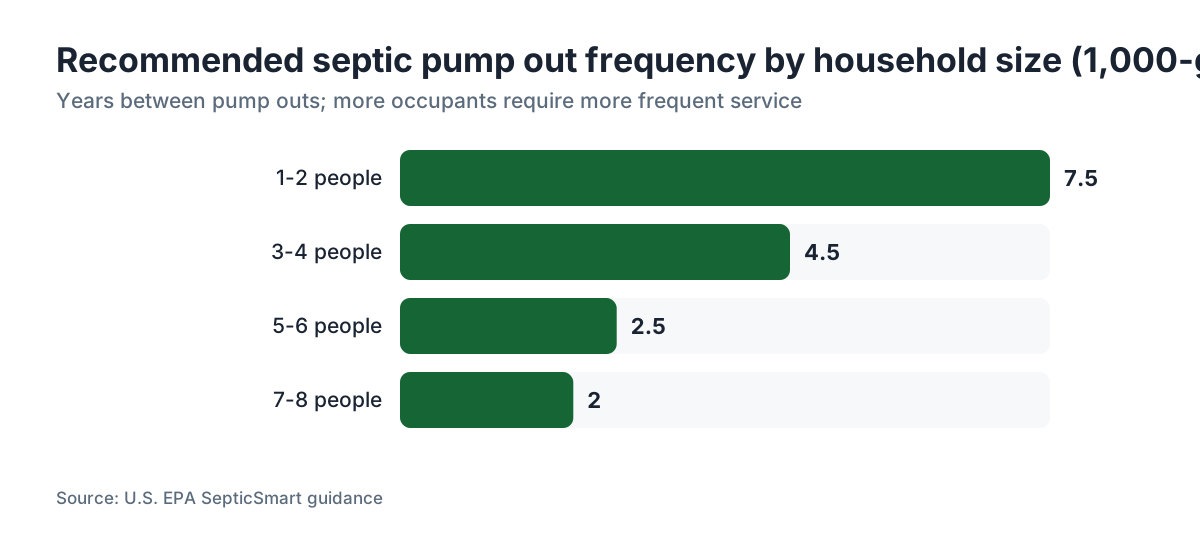
A 1,000-gallon tank serving two people might go 7 to 10 years between pump outs with no trouble at all. That same tank serving five people could need service every 2 years. The math is plain. More people means more wastewater, more solids, and a faster buildup of the sludge layer at the bottom and the scum layer on top.
The technically correct trigger is not a time interval. The EPA says to pump when the combined scum and sludge layers fill one-third or more of the tank's liquid capacity [1]. A pumper measures this on-site with a tool called a sludge judge. If you'd rather not measure, the 3-to-5-year rule keeps most households safely under that threshold.
Skipping pump outs gets expensive fast. The solids spill into the drain field, clog the soil, and wreck a system that costs $5,000 to $25,000 to replace [2]. A pump out costs $300 to $700 in most markets [3]. The math on skipping is brutal.
What is a septic system pump out, exactly?
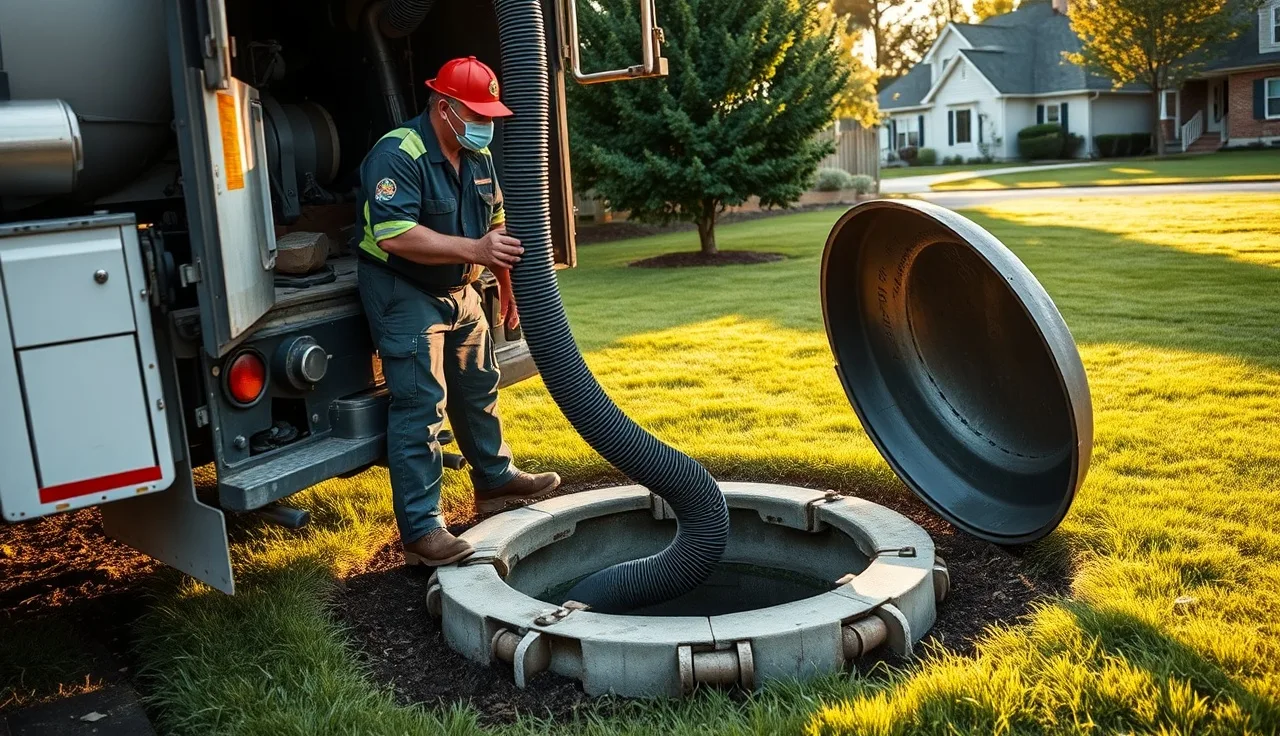
A pump out is the process of vacuuming everything (liquid and solid) out of your septic tank with a truck-mounted pump. Sometimes it goes by septic tank pumping or a septic tank pump out. The truck carries a large vacuum tank, usually 1,500 to 4,000 gallons, and a hose that drops into your tank through the access lid.
The service takes 20 to 60 minutes for a standard residential tank. The pumper removes the floating scum layer, the middle liquid layer (effluent), and the settled sludge at the bottom. Done right, the tank comes out essentially empty.
A good technician does more than suck the tank dry. After pumping, they inspect the baffles (the inlet and outlet T-shaped fittings that keep scum from flowing to the drain field), check the tank walls for cracks, and confirm the effluent filter is clear if your system has one. Some operators camera-inspect the outlet line to the leach field. That inspection step earns its keep. A lot of damage gets caught early this way.
Septic tank cleaning gets marketed as a separate, more thorough service. In practice, a full pump out plus a rinse of the tank walls with the truck's backwash is what most licensed operators call a cleaning. Ask your pumper what's included before you book.
How often should you pump a septic system based on tank size and household size?
Extension programs and federal agencies have published pumping frequency tables that factor in tank size and household occupancy. These are the numbers practitioners actually use [1][4].
| Tank size (gallons) | 1-2 people | 3-4 people | 5-6 people | 7-8 people |
|---|---|---|---|---|
| 750 | 5-6 years | 3-4 years | 2 years | 1-2 years |
| 1,000 | 7-8 years | 4-5 years | 2-3 years | 2 years |
| 1,250 | 9-10 years | 5-7 years | 3-4 years | 2-3 years |
| 1,500 | 11-12 years | 6-8 years | 4-5 years | 3-4 years |
| 2,000 | 16+ years | 9-10 years | 6-7 years | 4-5 years |
These are estimates, not promises. Real accumulation rates shift with diet, garbage disposal use, and whether anyone's home all day. A garbage disposal adds a heavy solids load. The EPA recommends more frequent pumping if you run one regularly [1].
Don't know your tank size? Check your home's as-built septic permit, usually on file with your county health department, or have your pumper measure the tank at the next service call. Most residential tanks installed after 1980 hold 1,000 to 1,500 gallons [4].
What does a septic pump out cost?
Nationally, residential septic pump outs run $300 to $700 for a standard 1,000 to 1,500-gallon tank [3]. Rural areas with few operators run higher. Dense metro markets with lots of competition often land at the low end. The spread is real, and it's worth shopping.
Some things push the price up: tank depth (deeper access means more labor), multiple compartments, tough site access, an add-on inspection, or a state-required report. A few states, like Massachusetts with its Title 5 program, require a licensed inspection at sale [5]. That inspection combined with pumping costs $400 to $800 on its own.
Some things bring the cost down. Signing a regular maintenance contract with an operator helps. So does bundling with a neighbor (some trucks will do two homes back-to-back for a discount) or scheduling mid-week in off-peak months. Spring is the busiest season. Late summer or fall pumping sometimes comes with a shorter wait.
Here's a cheaper option that's almost always a waste of money: septic additives sold at hardware stores that claim to "reduce pumping frequency." The EPA has looked at these products and does not recommend them as a substitute for pumping [1]. Biological additives don't remove solids from the tank. Save the $30 and put it toward your next pump out.
What are the signs your septic system needs a pump out now?
Don't wait for a scheduled interval if you're seeing any of these. They mean the tank is at or past capacity, and the clock is against you.
Slow drains throughout the house (more than one fixture) often mean the tank is full. Gurgling in the plumbing when you flush points to back-pressure from a full tank. Sewage odors indoors or right around the tank or drain field are a red flag that effluent is backing up somewhere it shouldn't.
Wet, spongy ground over the drain field with a rotten smell is serious. This is called surfacing effluent. It can mean the tank is overflowing into the field, the field is failing, or both. At that point you need more than a pump out. You need a full septic system repair evaluation right away.
Green, unusually lush grass over the drain field during a dry spell is another tell. The grass is feeding on extra nutrients from partially treated effluent reaching the surface. People sometimes think it looks nice. It's a problem.
None of these should wait for a scheduled pump. Call a licensed pumper or inspector.
How do you find the septic tank to pump it out?
Before a pumper can service your tank, someone has to find it. On older properties that's harder than it sounds.
Start with your county health department's records. Most counties have digitized septic permits and as-built drawings that show tank location and depth. That's the fastest route. If the records don't exist or the tank got moved during a remodel, a pumping company can usually locate it with a metal probe or a small pipe camera sent down from the nearest cleanout.
Once it's found, get the GPS coordinates or mark the spot on a site plan. Plenty of homeowners stake the access lid location in the yard so it never needs relocating again. Lids should sit at or near grade for easy access. If yours is buried 18 inches down, ask your pumper about installing a riser. Risers cost $100 to $300 per opening installed and pay for themselves in reduced labor at every future service call [3].
Some newer systems have multiple access points, including aerobic treatment units and systems with effluent filters. Know what type of system you have before booking, and tell the operator. Aerobic systems (ATUs) often need more frequent pumping than conventional gravity systems, sometimes yearly [6].
What happens to the waste after a pump out?
The truck hauls the septage (the combined liquid and solid waste from your tank) to a licensed disposal facility. Septage is a regulated material under EPA rules [7]. It gets treated at a municipal wastewater plant, a licensed septage treatment facility, or applied to agricultural land under strict permit conditions.
Land application is legal and common in rural states. The EPA's 40 CFR Part 503 rules govern how septage can be applied to land, including pathogen reduction requirements and setback distances from water bodies [7]. If that concerns you, ask your pumper where they dispose. Licensed operators have to keep disposal records in most states.
After proper processing, the treated end product is often a biosolid used as a soil amendment. The cycle is more regulated than most people realize.
Does a pump out hurt the beneficial bacteria in the tank?
No, and this is the worry homeowners raise most. Your septic tank works because a population of anaerobic bacteria breaks down organic solids. The fear is that pumping flushes those bacteria out along with the waste.
The bacteria come back fast. Within a few days of a pump out, incoming wastewater re-seeds the tank with the bacteria it needs for decomposition. There's no reason to add a starter culture or any additive to restart the process. The EPA states plainly that a properly working septic system does not need additives after pumping [1].
Some pumpers leave a small amount of sludge behind on purpose to speed recolonization. That's fine. So is pumping the tank completely clean. Either way, the tank returns to normal biological activity within days.
How do state regulations affect how often you pump?
State rules vary a lot. Some states set mandatory maximum pumping intervals. Others lean on the tank-size and occupancy guidance and leave scheduling to the homeowner.
Massachusetts requires a septic inspection (and often pumping) every two years for systems within 100 feet of a wetland, and mandates inspection at every property sale under Title 5 [5]. Washington state's rules (WAC 246-272A) require homeowners to keep their systems in working order and let counties set their own inspection programs [8]. Florida's Chapter 64E-6 covers onsite sewage treatment, including aerobic system service contracts that require quarterly inspections [6].
EPA's SepticSmart guidance puts the baseline this way: "Have your system inspected by a septic service professional at least every three years, and have your tank pumped when necessary (generally every three to five years)" [1]. Your state and county may require more.
Check with your county health department or state environmental agency for the rules where you live. Many states post onsite wastewater codes on their department of health or department of environmental quality websites. If your system sits near a sensitive water body or in a designated nutrient-sensitive watershed, local rules are often stricter.
Should you get a septic inspection at the same time as a pump out?
Yes, almost always. Pumping and inspecting together is efficient, and the tank is easiest to read when it's open and empty. A septic tank inspection checks the condition of the baffles, inlet and outlet pipes, the tank structure, and the distribution box if it's reachable.
The cost difference is usually $50 to $150 more for the inspection on top of the pump out [3]. That's cheap next to missing a cracked baffle that's been sending raw solids into the drain field for two years.
For homes being sold, an inspection is often legally required (Massachusetts Title 5, as mentioned) or lender-required. Even where it isn't mandatory, buyers frequently ask for one. If you're buying a home on septic and the seller can't produce a recent inspection report, insist on one before closing. A failing system that looks fine from the surface can cost $10,000 to $25,000 to replace [2].
Operators who run systematic inspection programs often use scheduling and reporting software to stay on top of service intervals across their customer base. SepticMind, for example, is built for operators who want to track inspection histories and automate service reminders across a large customer list.
For a deeper look at what a full inspection covers, see our guide to septic tank inspection.
What should you do between pump outs to protect your system?
The stretch between services is where you either add years to your drain field or take them away.
Watch what goes down the drain. Cooking grease, "flushable" wipes (they don't break down), feminine hygiene products, medications, and heavy doses of harsh chemical cleaners all damage the biological process or pile up as solids faster than organic waste. The EPA's SepticSmart program keeps a specific list of items to keep out of the system [1].
Conserve water. Every gallon that enters the tank is a gallon the system has to process. Leaking toilets and faucets are a genuine problem. A running toilet can waste up to 200 gallons per day and hydraulically overload a system sized for normal flow [9]. Fix leaks fast.
Protect the drain field physically. Don't park vehicles on it. Don't plant deep-rooted trees near it. Keep roof drains and sump pump discharge well away from the field. The leach field depends on unsaturated soil to treat effluent, and anything that saturates or compacts that soil cuts its capacity.
Keep a maintenance log. Record every pump out, inspection, and repair with the date, the company, and what they found. That record is worth a lot when you sell, and it tells you whether your interval is actually holding up.
How often should you pump an aerobic septic system vs. a conventional one?
Aerobic treatment units (ATUs) inject oxygen to speed up the breakdown of waste. They produce cleaner effluent than conventional anaerobic tanks, which is why many sensitive environmental zones require them. But they need more attention, not less.
Most state regulations require ATUs to carry a service contract with a licensed operator, typically covering quarterly inspections. Florida's rules specifically require quarterly service visits for aerobic systems [6]. Pumping frequency for ATUs depends on the design, but annual or biennial pump outs are common, against the 3-to-5-year cycle for conventional systems.
Mound systems and drip irrigation systems carry their own maintenance requirements too. If your system has a pump chamber or dosing tank, that chamber usually needs pumping on a separate schedule from the main treatment tank. Ask your system designer or the county for the manufacturer's recommended schedule.
Not sure what type of system you have? Pull the permit records from the county. The permit identifies the system type, tank sizes, and often the design loading rate.
Frequently asked questions
How often do you pump a septic system?
For most households, every 3 to 5 years. The EPA's SepticSmart program recommends this range for conventional systems. The exact frequency depends on tank size and how many people live in the home. A 1,000-gallon tank serving two people can often go 7 to 8 years. That same tank serving five people may need service every 2 to 3 years.
How often should I pump my septic system if I have a large family?
More people means faster solid accumulation. A household of 5 to 6 people with a standard 1,000-gallon tank typically needs pumping every 2 to 3 years. With 7 or more people, every 1 to 2 years is realistic. If you run a garbage disposal regularly, add those solids to your estimate and lean toward the shorter end of the range.
What happens if you never pump your septic system?
Solids overflow from the tank into the drain field, clog the soil, and destroy the field's ability to treat effluent. Sewage then backs up into the house or surfaces in the yard. Drain field replacement costs $5,000 to $25,000 depending on soil and system type. A pump out at $300 to $700 every few years is the cheapest insurance you can buy.
How much does a septic system pump out cost?
Most residential pump outs cost $300 to $700 nationally for a 1,000 to 1,500-gallon tank. Prices vary by region, site access difficulty, and whether an inspection is included. Adding a tank riser installation runs $100 to $300 per opening and cuts future labor costs. State-required inspections at property sale, like Massachusetts Title 5, add $400 to $800.
Can I pump my septic tank myself?
No. Septage is a regulated waste material under EPA rules (40 CFR Part 503), and handling or transporting it requires a licensed vacuum truck and a permitted disposal site. DIY pumping is illegal in every state. There's also a real safety hazard: septic tanks contain hydrogen sulfide and methane, both of which can be lethal in an enclosed space without proper equipment.
Do septic additives reduce how often you need to pump?
No. The EPA does not recommend biological or chemical additives as a substitute for pumping. Additives don't remove the solid sludge layer at the bottom of the tank. Only a vacuum truck does that. Some additives can actually harm the biological process in the tank or damage drain field soils. Save the money and put it toward your next scheduled pump out.
How do I know when my septic tank is full and needs pumping?
Signs include slow drains throughout the house, gurgling when you flush, sewage odors indoors or near the tank, and wet soggy patches over the drain field. The technically correct method is having a pumper measure sludge and scum depth with a sludge judge, then pumping when those layers total one-third or more of tank capacity. Don't wait for visible symptoms if you're near your interval.
How often do you pump a septic system for a vacation home?
Less often than a full-time residence, but not never. Intermittent use lets the bacterial population go dormant or die off between visits, which slows decomposition and allows solids to build up. Many pumpers recommend inspecting every 3 to 5 years regardless of use, since a rarely-used system can develop its own problems including dried-out seals and root intrusion.
Does a pump out kill the bacteria in the septic tank?
The bacteria repopulate within days. Wastewater flowing into the tank after pumping re-seeds it naturally. You don't need additives or starter cultures. Some operators leave a small amount of sludge in the tank to speed recolonization, which is fine but not required. A properly working tank returns to normal biological activity quickly after a complete pump out.
How long does a septic pump out take?
For a standard 1,000 to 1,500-gallon residential tank, the actual pumping takes 20 to 45 minutes. Add time for locating and uncovering the access lid, doing a basic inspection, and finishing paperwork, and the total visit is usually 1 to 1.5 hours. Tanks that are hard to reach, buried deep, or need multiple pump truck loads take longer.
Should I be home during a septic pump out?
It helps but isn't strictly required if your tank is accessible. Being there lets you ask the operator questions, watch the inspection, and get a firsthand report on what they found. If you can't be home, mark the access lid location clearly, unlock any gates, and set up a way to receive the service report. Some operators send photos and notes electronically after the visit.
What's the difference between a pump out and a septic tank cleaning?
They're often the same thing, depending on who you ask. A pump out removes all liquid and solid content from the tank. A cleaning, in most operators' usage, means pumping plus rinsing the tank walls with backwash to dislodge stuck solids. Some companies charge more for a cleaning. Ask exactly what each service includes before booking so you know what you're getting.
Does my state require regular septic system pump outs?
Rules vary by state and county. Massachusetts requires inspection (and often pumping) at every property sale under Title 5. Florida requires quarterly service visits for aerobic systems. Most states follow EPA SepticSmart guidance recommending pumping every 3 to 5 years, but some counties in sensitive watersheds set shorter mandatory intervals. Check with your county health department for the rules that apply to your address.
Is a septic inspection included in a pump out?
Not automatically. Basic pump outs include removing the tank contents and a visual check of accessible components. A formal inspection, which evaluates baffles, outlet lines, and drain field condition, often costs $50 to $150 more. Ask your operator exactly what the service includes. Combining both in one visit is more efficient than scheduling separately and cuts the labor cost of a second access.
Sources
- U.S. EPA, SepticSmart: How to Care for Your Septic System: EPA recommends pumping every 3 to 5 years and when solids reach one-third of tank capacity; does not recommend additives as substitute for pumping
- U.S. EPA, Septic System Fact Sheet (EPA/832-F-12-057): Drain field replacement costs cited in the range of thousands to tens of thousands of dollars for failed systems
- HomeAdvisor / Angi, Septic Tank Pumping Cost Guide: National average cost for residential septic pump out is $300 to $700; riser installation runs $100 to $300 per opening
- U.S. EPA, Types of Septic Systems and How Your Septic System Works: Pumping frequency depends on tank size and household occupancy; most residential tanks installed after 1980 are 1,000 to 1,500 gallons
- Massachusetts DEP, Title 5 Inspection Requirements (310 CMR 15.000): Massachusetts Title 5 requires septic inspection at every property sale and for systems within 100 feet of a wetland
- Florida Department of Health, Chapter 64E-6 Onsite Sewage Treatment Rules: Florida requires quarterly inspection service contracts for aerobic treatment units
- U.S. EPA, 40 CFR Part 503 Standards for the Use or Disposal of Sewage Sludge: Septage classified as regulated material; land application requires pathogen reduction and permitted setbacks from water bodies
- Washington State Department of Health, On-Site Sewage Systems (WAC 246-272A): Washington state rules require homeowners to maintain systems in working order; counties may set inspection programs
- U.S. EPA WaterSense, Fix a Leak Week: A running toilet can waste up to 200 gallons per day, hydraulically overloading a septic system
- Penn State Extension, Septic System Maintenance: Detailed guidance on pumping frequency, system inspection, and what to avoid putting into a septic system
Last updated 2026-07-09