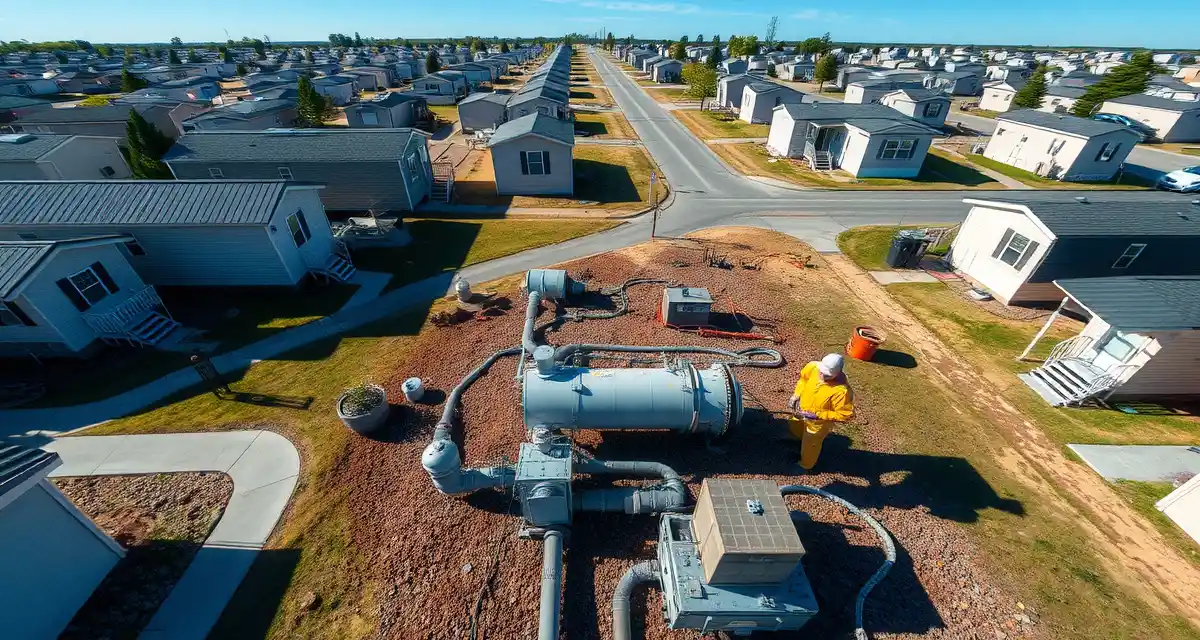
Septic Service for Trailer Parks and Manufactured Housing Communities
By the SepticMind Editorial Team
EPA has identified manufactured housing community wastewater as a priority enforcement area. Trailer park septic systems serving 50+ units operate at commercial-scale loads with limited operator budgets -- a combination that creates real compliance challenges for park operators and genuine service opportunities for septic companies that can serve community-scale accounts effectively.
TL;DR
- Trailer Parks facilities have distinct wastewater loading patterns that affect septic system sizing, service frequency, and permit requirements.
- Commercial and institutional properties like trailer parks typically require more frequent pumping than residential systems due to higher daily usage.
- Some trailer parks operations generate waste streams (grease, chemicals, or high-volume flow) that require pre-treatment before reaching the septic system.
- Service contracts for trailer parks provide predictable recurring revenue and are easier to manage with a platform that tracks commercial account schedules.
- Health department inspections for trailer parks properties may require septic system condition documentation as part of facility licensing.
- Septic companies specializing in trailer parks service build referral networks with property managers, architects, and health inspectors in that niche.
SepticMind's community account type manages both individual and shared trailer park septic systems.
The Scale Challenge
A trailer park with 50 residential units is, from a wastewater perspective, equivalent to a small apartment complex or a mid-size commercial property. The daily wastewater generation from 100-150 residents is significant. But many trailer parks -- particularly older ones developed in the 1960s-1980s -- are operating on systems that were designed for lower density or have aged significantly beyond their intended service life.
The combination of:
- Commercial-scale loads (many residents, continuous daily use)
- Residential-scale budgets (residents are often lower-income; park operators have limited capital)
- Aging infrastructure (many systems installed 30-50 years ago)
- Increased regulatory oversight (EPA and state enforcement priority)
...creates the compliance challenge that defines trailer park septic management.
Individual vs. Community System Configurations
Understanding the configuration at any trailer park you're considering serving is the first step:
Individual lot systems: Each home site has its own septic system. This is common in older parks that were developed when each lot was treated as a separate property for permitting purposes. The park operator may or may not be responsible for maintenance depending on the lease terms.
Community septic systems: A central system serves all or a portion of the park. This is more common in newer parks and in states that required community systems for larger developments. The park operator is clearly responsible for the community system.
Hybrid configurations: Some parks have a combination -- individual lot systems for older sections and community systems for newer additions, or community systems for some utilities and individual systems for others.
For service purposes, hybrid configurations are the most complex. You're managing multiple service schedules, multiple system types, and potentially different responsible parties for different parts of the property.
Operator Responsibility and Lease Terms
In many trailer parks, the lease agreement defines who is responsible for septic system maintenance. Common arrangements:
Park operator responsible for all systems: The cleanest arrangement for compliance tracking. One responsible party, one service contract, all systems managed under one account.
Residents responsible for individual lot systems: The park operator manages community systems if present; residents are responsible for their individual lot systems. Creates fragmentation of service responsibility and often leads to deferred maintenance as residents focus on short-term costs.
Shared responsibility: Some hybrid of the above, often not clearly defined in older leases.
When the park operator approaches you for service, understand clearly what systems they're responsible for. Don't assume they manage everything -- clarify before establishing the service program.
Compliance Requirements
The EPA's focus on manufactured housing community wastewater reflects documented problems in this sector: aging systems, deferred maintenance, limited operator resources, and in some cases, operators who are unaware of or non-compliant with basic permit requirements.
State health departments typically require:
- Operating permits for community systems serving manufactured housing developments
- Regular service records for community systems
- Operator certification for larger systems (some states require a licensed system operator)
- Reporting to the health department when system problems occur
Individual lot systems in trailer parks face the same requirements as standalone residential systems, but compliance tracking is more complex because there are many of them.
As a service company, maintaining organized records for every system at a trailer park property positions you as a valuable compliance partner to operators who are trying to maintain their operating permits.
Service Programs for Trailer Parks
The service structure that works best for trailer park accounts:
Full-park service contract for individual lot systems: The park operator contracts for regular service across all individual lot systems. You schedule them on a rotating basis (a few lots per visit, covering the entire park over a defined cycle), bill at a package rate, and maintain records for each system. This is the most efficient approach and gives the park operator complete records for all systems.
Community system contract: Standard commercial service contract for central or cluster systems, with service frequency appropriate for the load (typically quarterly for most community systems).
Emergency response availability: With many residents depending on functioning sanitation, emergency response for system failures needs to be fast. Define your emergency response terms explicitly in the service contract.
Get Started with SepticMind
Trailer Parks facilities need a service provider who understands the specific wastewater challenges of their operations. SepticMind makes it easy to manage commercial service contracts, track inspection schedules, and document service visits for every account in your portfolio. See how it supports commercial account management.
Frequently Asked Questions
What compliance requirements apply to a trailer park's onsite wastewater system?
Community septic systems at trailer parks and manufactured housing communities require operating permits issued by the state health department or environmental agency, and operators face the same commercial wastewater compliance requirements as other community-scale systems. These include regular pump-out documentation, periodic system inspections, operator certification requirements in some states, and notification requirements when system failures occur. EPA has specifically identified manufactured housing community wastewater as a priority enforcement area, meaning inspectors are actively looking at these properties in many states. Individual lot systems face residential compliance requirements, but the park operator may be the responsible party depending on lease terms.
How often should a 50-unit trailer park central septic system be inspected?
A central community system serving 50 units should be inspected at minimum annually and pumped at least quarterly. At 50 units with average household size of 2-2.5 residents, you're managing wastewater from 100-125 people continuously, which is a commercial-scale load. The inspection should evaluate not just whether the tank needs pumping but the overall condition of the system including distribution components and drainfield indicators. If the community system is more than 20 years old, more frequent inspections (semi-annual) are appropriate given the age-related failure risk for older infrastructure.
Does SepticMind support community-scale septic management for trailer parks?
Yes. SepticMind's community account type supports both individual lot system tracking (each lot has its own system record within the park account) and community system management (service schedule and records for central or cluster systems). The park operator has one account that shows all systems across the property, while individual lot records are maintained separately for health department compliance purposes. Service reminders, compliance documentation, and emergency response protocols are stored at the park account level. When the park operator needs to demonstrate compliance to a health department inspector, SepticMind generates the complete service history report for any system or the whole property.
How often should a septic system serving a trailer parks property be inspected?
Septic systems at trailer parks properties should be inspected at least annually and pumped more frequently than residential systems, since commercial-scale daily water usage accelerates sludge and grease accumulation. The exact frequency depends on the specific activities at the facility, peak occupancy, any food service or chemical use on-site, and local regulatory requirements. A service provider familiar with trailer parks operations can recommend an appropriate inspection and pumping schedule based on the system's actual usage profile.
What septic system issues are most common at trailer parks properties?
The most common septic problems at trailer parks properties are rapid sludge accumulation from high occupancy, grease trap failure if food service is involved, hydraulic overloading during peak-use periods, and non-biodegradable waste disposal from cleaning or maintenance activities. Regular inspection and a service contract with clear maintenance intervals are the most effective ways to catch these problems before they cause system failure or regulatory violations.
Try These Free Tools
Sources
- National Onsite Wastewater Recycling Association (NOWRA)
- US EPA Office of Wastewater Management
- NSF International
- Water Environment Federation
- National Environmental Services Center (NESC)