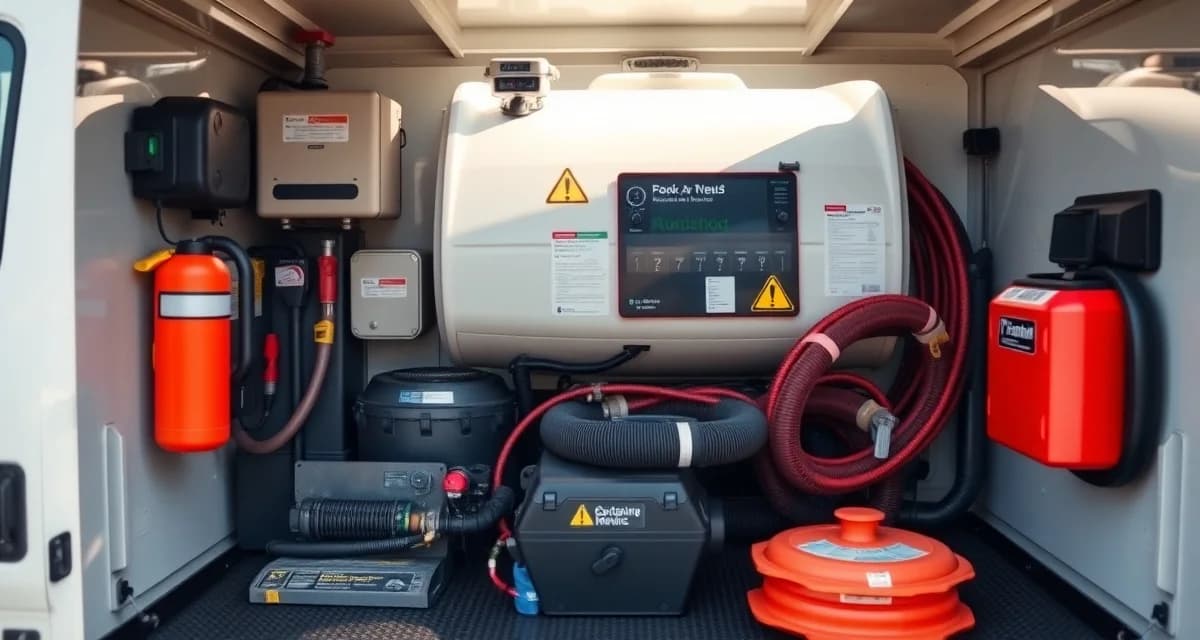
Septic Pump Truck Setup Guide for New Companies
By the SepticMind Editorial Team
Proper truck setup prevents 34% of the compliance and safety incidents common in new septic operations. New septic companies that set up trucks without a checklist miss critical safety or compliance equipment, not because they're careless, but because the list of required items is longer than it looks, spans multiple regulatory categories, and isn't consolidated anywhere obvious.
TL;DR
- Septic Pump Truck Setup Guide for New Companies requires balancing field operations, customer relationships, compliance obligations, and administrative management.
- Recurring service agreements provide the most predictable revenue base in the septic trade and should be a priority for growing businesses.
- Digital tools that automate scheduling, reminders, invoicing, and reporting reduce administrative overhead without adding staff.
- Tracking key performance metrics by route, technician, and service type identifies the most profitable and least profitable parts of the operation.
- Customer retention improvement through systematic follow-up typically generates more revenue than equivalent spending on new customer acquisition.
- Building commercial and institutional accounts alongside residential pumping creates revenue stability that supports equipment and hiring decisions.
SepticMind can be configured on a new truck's tablet before the first job in under 2 hours, giving you a compliant documentation system from day one.
Regulatory Context: What Governs Your Truck Setup
Before the equipment list, understand which agencies have authority over your truck. A septic pump truck is subject to requirements from multiple regulatory bodies simultaneously:
Federal DOT. Commercial vehicles over 26,001 pounds GVWR (most vacuum trucks) are subject to Federal Motor Carrier Safety Administration rules, driver CDL requirements, vehicle inspection requirements, hours of service rules, and hazardous materials transport rules if applicable.
OSHA. All operations involving confined spaces (septic tanks are permit-required confined spaces) are subject to OSHA 29 CFR 1910.146. Hydrogen sulfide exposure requires compliance with OSHA's respiratory protection and H2S monitoring requirements.
State environmental agency. Septage hauling requires state licensing and registration, typically through the state environmental or health agency. Some states require vehicle registration in addition to company licensing.
State DOT. Commercial vehicle weight limits, oversize/overweight permit requirements, and inspection requirements vary by state.
Local municipal rules. Some municipalities require septage hauling company registration or impose additional requirements on vehicles operating within their jurisdiction.
Equipment Checklist: The Pump System
Vacuum pump. The vacuum pump is the core operating component. Match pump capacity to the tank volume on your truck and the typical job size in your market. Most residential pump-out trucks use liquid ring or rotary lobe vacuum pumps rated in cubic feet per minute (CFM) and inches of mercury (Hg) vacuum.
Vacuum/pressure gauge. A functional vacuum gauge is a basic safety and operational requirement. You need to know what vacuum the pump is pulling to assess job progress and identify pump problems.
Relief valve. Over-pressure protection for the tank. The relief valve must be sized appropriately for the tank and inspected regularly.
Control valves and manifold. The valve arrangement that controls flow direction, vacuum for pumping, pressure for unloading. Label all valves clearly. A new employee who doesn't know which valve does what is a safety and spill risk.
Hose reel and supply hose. Standard supply hose for residential work is 3 or 4 inches. Carry adequate hose length, a minimum of 100 feet to reach systems set back from truck access points. Inspect hose condition regularly; degraded hose fails at the worst moments.
Tank. Most residential pump trucks run 1,500-3,500 gallon tanks. Know your exact tank capacity and track loads against it. Don't overfill, you're driving a liquid load and overfilling creates instability and spillage risk.
Level indicator. A functional liquid level indicator is an operational safety requirement. Estimating load by feel and experience works until it doesn't.
Safety Equipment: Required Items
These items are not optional. OSHA and state regulations require them; an incident without proper safety equipment creates regulatory, legal, and insurance exposure:
H2S monitor (personal gas detector). Every technician who opens a septic tank access requires a personal gas detector that monitors for hydrogen sulfide. Clip-on personal monitors that alarm at 10 ppm and shut-down alarm at 15 ppm (OSHA action levels) are standard. Gas detectors require calibration and bump-testing before each shift.
PPE kit. Standard PPE for septic work includes gloves (nitrile or rubber, minimum 12 mil for pump work), safety glasses or face shield, waterproof boots or coveralls, and hearing protection when operating near running pump equipment. Keep a complete PPE kit on the truck, not in a location that requires unlocking or notable access effort.
Confined space entry kit. If you ever do work that involves entry into a septic tank or vault (retrieval of an object, pump repair at depth), you need a confined space entry kit: harness, retrieval line, and a defined attendant-required entry procedure. Most routine pump-out work doesn't require confined space entry, but the equipment needs to be available.
Spill response kit. Septage spills require immediate response and, in most states, regulatory notification. Carry absorbent material, plastic sheeting, a shovel, and the phone number for your state's environmental spill hotline. Know your obligation, in most states, any spill over a minimum volume requires a report to the state environmental agency within 24 hours.
First aid kit. OSHA requires a first aid kit on all commercial work vehicles. Keep it stocked and inspect it regularly.
Documentation Tools: Setting Up for Compliance From Day One
The documentation system you set up on day one establishes your compliance habits and your record quality for the life of the company. Getting this right early is far easier than converting paper or improvised records later.
Tablet mount. Mount a tablet securely in the cab in a position where the driver can interact with it at stops but not while moving. A tablet that slides around or sits unsecured is a distraction and creates data entry inconsistency.
Field software configuration. Configure SepticMind on the truck's tablet before the first job. The configuration process takes under two hours and covers: company information setup, state compliance template selection, service type configuration, technician profile, and customer import if you're bringing in existing records. Equipment management for septic trucks covers the truck profile setup in SepticMind that tracks vehicle maintenance and inspection records.
Printed backup materials. Until you're confident in the digital workflow, keep printed blank service tickets and a permit documentation folder in the cab. The goal is digital documentation, but having paper backup for the first month prevents a lost connection from costing you a record.
Get Started with SepticMind
Running a profitable septic business means managing compliance, customer relationships, and field operations without letting any of them slip. SepticMind handles the operational and compliance infrastructure so you can focus on growing the business. See what the platform can do for your operation.
Frequently Asked Questions
What equipment must a septic pump truck carry for every service call?
At minimum: a functional vacuum pump and control system, adequate supply hose (typically 100+ feet), a liquid level indicator, a functioning vacuum gauge, and all required safety equipment. Safety equipment that must be on the truck includes a personal H2S gas detector for each technician working the truck, appropriate PPE (gloves, eye protection, waterproof boots or coveralls), a confined space entry kit if your work scope includes any tank entry, a spill response kit with absorbent materials and the regulatory spill hotline number, and a first aid kit meeting OSHA requirements. State regulations may impose additional equipment requirements, check your state's septage hauler licensing rules for any state-specific requirements.
What safety equipment is required on a septic pump truck by OSHA standards?
OSHA's primary requirements for septic service operations include personal H2S monitoring equipment (29 CFR 1910.1000 for hydrogen sulfide PEL of 20 ppm ceiling, though OSHA's general industry standard treats 10 ppm as an action level), respiratory protection when gas exposure may exceed limits (29 CFR 1910.134), confined space equipment and procedures when any work involves tank entry (29 CFR 1910.146), and a first aid kit for all commercial work vehicles. Additionally, hearing protection is required when noise levels exceed 85 dB over an 8-hour TWA, which applies when operating near running vacuum pump equipment. State OSHA programs (which operate in about half of states) may have requirements beyond federal OSHA minimums.
How do I configure SepticMind on a tablet for a new septic pump truck?
The SepticMind tablet setup process takes under two hours and covers four areas: company setup (business name, address, license numbers, contact information), state compliance template selection (choose the state or states where you'll be working, templates include state-specific permit documentation fields and regulatory requirements), service type configuration (set up the service types you'll be performing: residential pump-out, commercial pump-out, inspection, ATU maintenance), and technician profile (create the technician profile with license credentials, certification documents, and contact information). After basic setup, configure the offline sync settings and test offline mode before the first job to ensure data saves correctly in areas without cellular coverage.
What metrics matter most for managing a septic service business?
The most important operational metrics for a septic service company are route utilization rate (percentage of available truck capacity actually booked), customer retention rate (percentage of customers who return for the next service visit), revenue per truck per day, cost per job including labor, disposal, fuel, and overhead allocation, and recurring revenue percentage from service agreements versus one-time calls. Companies that track these metrics by route and by technician identify improvement opportunities faster than those looking only at total revenue.
How does field service software reduce administrative costs for septic companies?
Field service software eliminates manual steps in scheduling, dispatching, invoicing, permit tracking, and inspection report preparation. Tasks that take an office manager 2-4 hours per day on spreadsheets and phone calls are handled automatically: reminders go out, reports generate, invoices are sent, and permit deadlines are flagged without human intervention. The hours saved are redeployed to customer service, sales, and higher-value work that grows the business.
Try These Free Tools
Sources
- National Onsite Wastewater Recycling Association (NOWRA)
- US EPA Office of Wastewater Management
- National Environmental Services Center (NESC)
- Water Environment Federation
- Occupational Safety and Health Administration (OSHA)