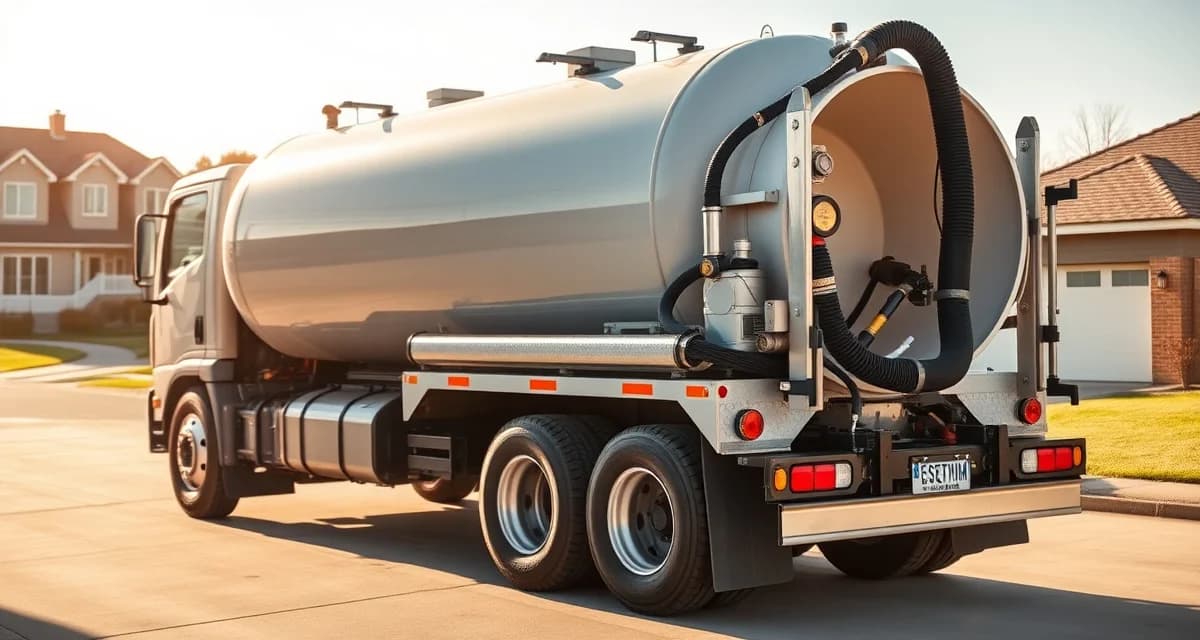
Septic Pumping Truck Buying Guide: New vs Used and What to Look For
By the SepticMind Editorial Team
A quality used septic pump truck costs $45,000-90,000 vs $120,000-250,000 for new. Companies that buy undersized trucks for their service area turn away profitable jobs they cannot handle. SepticMind's job volume data helps companies identify the tank size range their new truck needs to handle.
TL;DR
- Septic Pumping Truck Buying Guide: New vs Used and What to Look For requires balancing field operations, customer relationships, compliance obligations, and administrative management.
- Recurring service agreements provide the most predictable revenue base in the septic trade and should be a priority for growing businesses.
- Digital tools that automate scheduling, reminders, invoicing, and reporting reduce administrative overhead without adding staff.
- Tracking key performance metrics by route, technician, and service type identifies the most profitable and least profitable parts of the operation.
- Customer retention improvement through systematic follow-up typically generates more revenue than equivalent spending on new customer acquisition.
- Building commercial and institutional accounts alongside residential pumping creates revenue stability that supports equipment and hiring decisions.
Whether you're buying your first truck or adding to a fleet, the decision involves more variables than just price. This guide covers what to evaluate.
New vs Used: The Core Trade-Off
The decision between new and used pump trucks comes down to capital allocation and risk tolerance.
Arguments for buying new:
- Warranty coverage on major components (tank, vacuum pump, body)
- Lower initial maintenance cost and more predictable operating expenses
- Financing available at lower interest rates for new equipment
- Ability to specify exactly the configuration you want
- Better technology and emissions compliance for current regulations
Arguments for buying used:
- $45,000-90,000 vs $120,000-250,000 -- significant capital savings
- Existing revenue from the truck finances future maintenance rather than coming from capital
- Lower financial risk if the truck is in your fleet while you're building volume
The right answer depends on your financial position, your volume certainty, and the quality of the used truck available in your market. A well-maintained 5-7 year old truck with documented service history at $65,000 is often the best value. A truck with unknown history at $45,000 can turn into a money pit.
Determining the Right Tank Capacity
Buying a truck with the wrong tank capacity for your service area is the most common purchasing mistake. The consequences:
Too small: You can't pump the large tanks that exist in your service area. You turn away profitable jobs or make multiple trips to complete single jobs. Your competitors with larger tanks take the jobs you can't do.
Too large: You're paying for capacity and operating weight you rarely use. Fuel costs are higher, and some access roads or older structures won't support a fully loaded heavy truck.
The right tank size for your operation depends on:
Your service area's tank size distribution: What are most of your residential customers' tanks? Suburban developments often have 1,000-1,500 gallon tanks. Rural properties and commercial accounts may have 2,000-5,000 gallon tanks. SepticMind's job volume data helps you analyze the distribution of tank sizes in your customer base to identify what your new truck needs to handle.
Your commercial ambitions: If you plan to pursue commercial accounts, you need capacity for restaurant grease traps, commercial septic tanks, and service holding tanks that residential accounts don't require.
Weight and access: Larger tanks mean heavier trucks (fully loaded). Weight limits on bridges and rural roads, narrow access lanes, and residential driveways all affect what you can take to a job site.
Most general-purpose residential septic trucks are sized at 2,000-3,500 gallons. Commercial-capable trucks run 3,500-5,000+ gallons. Specialty trucks for large commercial or industrial accounts can exceed 5,000 gallons.
Vacuum Pump Assessment
The vacuum pump is the heart of the septic pump truck. It determines how effectively you can empty tanks and how fast you can complete jobs.
Types of vacuum pumps:
- Rotary lobe (most common for septic service): Reliable, repairable, mid-cost
- Liquid ring: Excellent for wet applications, higher maintenance
- Rotary vane: Lower cost, adequate for lighter applications
What to assess on a used truck:
- Hours on the pump (pump meters should be present and documented)
- Condition of the pump housing (no cracks, corrosion within acceptable limits)
- Seal and gasket condition (leaking seals are a sign of neglected maintenance)
- Pump performance (can it achieve and hold rated vacuum quickly?)
A vacuum pump rebuild costs $4,000-15,000 depending on the pump type and size. Factor this into used truck pricing if the pump is at or approaching the end of its service interval.
Tank Condition Inspection
The pump tank (the actual storage vessel on the truck) is the other major component to evaluate:
Steel tanks: Susceptible to corrosion, particularly around the baffles and seams. Look for rust scale, pitting, and any evidence of corrosion-related repairs. Use a flashlight to inspect the interior.
Aluminum tanks: More resistant to corrosion but can show stress cracking. Examine welds carefully.
Fiberglass tanks: Most corrosion-resistant. Inspect for impact damage and stress cracks.
Any evidence of previous leaks -- residue on the undercarriage below welds or seams -- warrants a pressure test before purchase.
Pre-Purchase Inspection Checklist for Used Trucks
When evaluating a used pump truck, work through this checklist:
Engine and drivetrain:
[ ] Engine hours documented and consistent with visible wear
[ ] No unusual smoke under load
[ ] Transmission shifts cleanly through all gears
[ ] No unusual noises in differential under load
Frame and undercarriage:
[ ] No cracks or repairs in the main frame rails
[ ] Suspension components in good condition
[ ] Brake system functional, drums/rotors within spec
Tank and pump:
[ ] Tank interior inspected for corrosion or damage
[ ] Vacuum pump performance test completed
[ ] Hose and fittings in good condition (no cracking, no loose connections)
[ ] All valves operational and not bypassed
Documentation:
[ ] Maintenance records available
[ ] Vehicle title clear
[ ] Equipment registration current
[ ] Inspection/safety sticker current
Have a qualified diesel mechanic inspect the engine and drivetrain and a pump truck service technician inspect the vacuum system before finalizing any used truck purchase.
Get Started with SepticMind
Running a profitable septic business means managing compliance, customer relationships, and field operations without letting any of them slip. SepticMind handles the operational and compliance infrastructure so you can focus on growing the business. See what the platform can do for your operation.
Frequently Asked Questions
What should I inspect before buying a used septic pump truck?
Prioritize the vacuum pump (hours, performance, seal condition), the tank (interior corrosion inspection, any evidence of previous leaks), the engine and drivetrain (documentation, diesel mechanic inspection), and the hose and valve system (cracking, corrosion, operational condition). Get the maintenance records if available -- a truck with documented service history is worth more than the same truck without it. Have a diesel mechanic inspect the engine and a pump truck technician inspect the vacuum system. A pre-purchase inspection that costs a few hundred dollars can identify a $10,000+ problem before you sign the check.
What tank capacity should my pump truck have for a service area with primarily residential accounts?
2,000-3,000 gallons is the sweet spot for residential service in most markets. A 2,500 gallon tank handles 95%+ of residential tanks (typically 1,000-2,000 gallon residential tanks) without leaving for disposal between jobs, while keeping the truck's total weight manageable for residential access. If your service area has significant new construction with larger tanks (2,000+ gallon residential systems are increasingly common), consider stepping up to 3,000-3,500 gallons. If you anticipate any commercial work, size toward the higher end of the residential range so you're not turning away commercial jobs that exceed your residential-sized truck's capacity.
How does truck capacity affect which jobs I can accept in SepticMind?
SepticMind allows you to associate each truck's tank capacity with the truck record, so when dispatching jobs, the system can flag jobs where the customer's tank size exceeds any single truck's pumping capacity. For tanks that require multiple trips or a larger truck, the dispatch system can route accordingly. As your job history builds, SepticMind's reporting shows the distribution of tank sizes you're serving -- useful data when you're evaluating whether your current fleet is sized right for your market or whether a truck addition or replacement is needed.
What metrics matter most for managing a septic service business?
The most important operational metrics for a septic service company are route utilization rate (percentage of available truck capacity actually booked), customer retention rate (percentage of customers who return for the next service visit), revenue per truck per day, cost per job including labor, disposal, fuel, and overhead allocation, and recurring revenue percentage from service agreements versus one-time calls. Companies that track these metrics by route and by technician identify improvement opportunities faster than those looking only at total revenue.
How does field service software reduce administrative costs for septic companies?
Field service software eliminates manual steps in scheduling, dispatching, invoicing, permit tracking, and inspection report preparation. Tasks that take an office manager 2-4 hours per day on spreadsheets and phone calls are handled automatically: reminders go out, reports generate, invoices are sent, and permit deadlines are flagged without human intervention. The hours saved are redeployed to customer service, sales, and higher-value work that grows the business.
Try These Free Tools
Sources
- National Onsite Wastewater Recycling Association (NOWRA)
- US EPA Office of Wastewater Management
- National Environmental Services Center (NESC)
- Water Environment Federation
- Occupational Safety and Health Administration (OSHA)