Septic inspections in Prince William County, VA: what to expect
By the SepticMind Editorial Team
TL;DR
- Septic inspections in Prince William County are regulated by the Virginia Department of Health (VDH) and enforced locally by the county's Office of Environmental Health.
- A standard inspection covers the tank, distribution box, and drain field.
- Expect to pay $200 to $500 for a routine inspection, more if pumping is included.
- Home sales in Virginia require a specific inspection protocol under state law.
Who regulates septic inspections in Prince William County?
The Virginia Department of Health sets the rules. The Office of Drinking Water and the Division of Onsite Sewage and Water Services (OSWS) write the regulations that govern every septic system in the state, Prince William County included [1]. The local arm that enforces those rules day to day is the Prince William County Health Department, Office of Environmental Health, in Woodbridge [2].
Virginia's Sewage Handling and Disposal Regulations (12 VAC 5-610) are the legal backbone. They cover system design, soil evaluation, construction, and the maintenance homeowners owe on their systems. They also define what counts as an approved "operation and maintenance" inspection and who can legally perform one [1].
No contractor can install, repair, or certify a septic system in Virginia without a current VDH license. That matters when you hire an inspector. Ask for the VDH operator license number before you write a check. Anyone signing a certification letter for a home sale must hold a Class I, II, or III onsite sewage system operator license, or be a Certified Onsite Reviewer (COR) under Virginia code [3].
Prince William County straddles the Piedmont and the eastern edge of the Blue Ridge foothills, which means clay-heavy Piedmont soils and some rocky subsoils near the Bull Run Mountains. Those soils drive drain field performance and how quickly VDH flags a marginal system. If your field sits on red clay, watch the drain field observations closely during any inspection.
What does a septic inspection in Prince William County actually cover?
A full inspection has three parts: the tank, the distribution system, and the drain field (also called the leach field). Each one tells you something the others don't. Skip any one of them and you've got a blind spot.
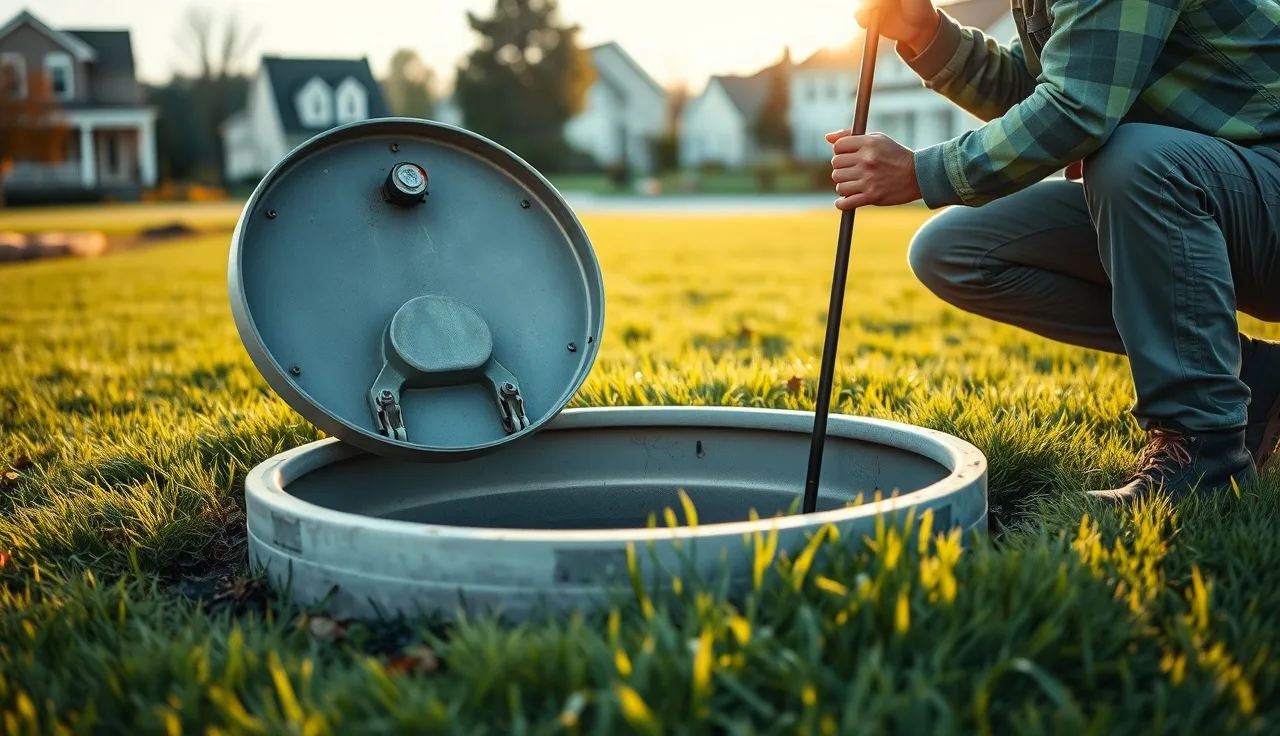
The tank. The inspector finds and uncovers the access lids, measures sludge depth and scum thickness, and checks the inlet and outlet baffles. Baffles are the plastic or concrete T-pipes that keep solids from washing out toward the drain field [9]. In Prince William County, tanks put in before roughly 1980 often have concrete baffles that have already crumbled or soon will. A septic tank inspection should always include a baffle check. The tank also gets checked for cracks, root intrusion, and high-water marks.
The distribution box (D-box). Not every system has one, but most in this county do. The D-box splits effluent evenly across the drain field trenches. If one corner of the box settles, all the flow dumps into a single trench while the rest sit dry. That imbalance kills a drain field faster than almost anything else.
The drain field. This is the hardest part to judge without invasive probing. A good inspector walks the field looking for soft, wet, or smelly ground, lush grass stripes over the trenches, and surface breakout. Some carry a probe rod to test soil saturation. Ponding or a sewage smell in the yard both point to a system in failure or close to it.
A basic visual pass won't tell you whether a drain field has five years left or fifteen. For that you need a fuller evaluation, sometimes a hydraulic load test, where the inspector runs water through the system and watches how the field responds. That test costs more but paints a much clearer picture, especially on older systems or purchases.
A septic tank pump out often happens at the same visit, both to let the inspector see the tank properly and to satisfy VDH operation and maintenance requirements.
How much does a septic inspection cost in Prince William County, VA?
Honest answer: it varies more than it should, and most contractors don't post prices online.
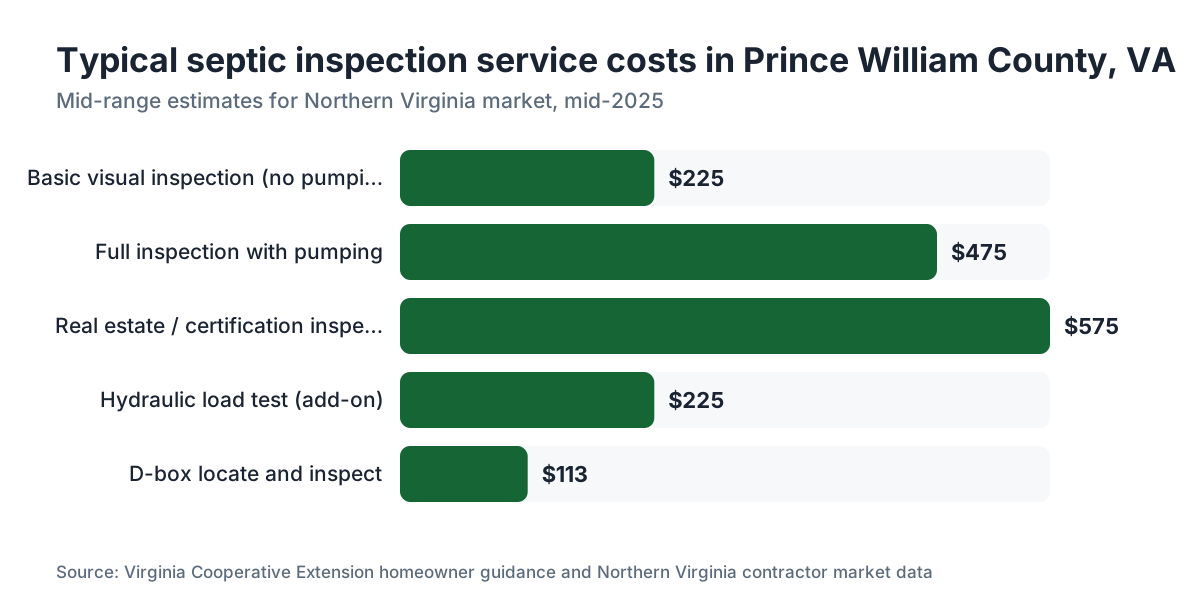
Here's a realistic range based on the Northern Virginia market as of mid-2025:
| Service | Typical price range |
|---|---|
| Basic visual inspection (no pumping) | $150 to $300 |
| Full inspection with pumping | $350 to $600 |
| Real estate / certification inspection | $400 to $750 |
| Hydraulic load test (add-on) | $150 to $300 |
| D-box locating and inspection | $75 to $150 |
Drive 50 miles south and those numbers drop 20 to 30 percent. Prince William competes with Fairfax and Loudoun for the same pool of licensed operators, which keeps prices up here.
The biggest cost swing is whether septic tank pumping is included. A tank that hasn't been pumped in five or more years (and plenty in this county haven't) has to be emptied before anyone can see the tank bottom, the baffles, or the inlet pipe. Don't let a contractor inspect without pumping and then call the job done.
A home sale adds the VDH certification letter and inspection protocol, which means more time and paperwork, which is why those cost more. Some inspectors tack on a trip fee to come back with the written report. Get that folded into the original quote.
See our full breakdown in septic tank inspection for a wider national comparison.
When is a septic inspection required in Virginia?
Virginia doesn't require routine annual inspections for most homeowners. But three situations make one either legally required or practically unavoidable [1][4].
Home sales. Virginia Code 32.1-164.1:1 requires a septic system to be inspected during a home sale if the buyer requests it or the lender demands it. In practice almost every mortgage lender requires one, and almost every buyer should want one anyway. The inspection has to follow the VDH Sewage Handling and Disposal Regulations and be performed or certified by a licensed operator [4].
Permit work. Pull a permit for an addition, an accessory dwelling unit, or any change of use that raises sewage flow, and Prince William County will review your existing septic capacity. That review almost always triggers an inspection [2].
Systems under an O&M agreement. Alternative (engineered) systems, including aerobic treatment units (ATUs), drip irrigation, and low-pressure distribution, must carry a formal O&M contract with a licensed operator and get inspected on a set schedule, often quarterly or annually, under 12 VAC 5-613 [5]. There are a fair number of these in Prince William County because clay soils rule out conventional systems on some lots.
Even if none of that applies to you, VDH guidance and the EPA's SepticSmart program both point to an inspection every three years as a sensible baseline. The EPA states: "Have your septic system inspected every three years by a professional" [6]. That's the number to put on the calendar.
What's the process for a real estate septic inspection in Prince William County?
The process has more steps than most buyers expect, and the timeline can bite you if you wait until the last week before closing.
First, the buyer or their agent hires a licensed Virginia septic inspector. The Prince William County Health Department doesn't do these inspections for buyers; the work goes to licensed private contractors. You can find them through the VDH operator licensing database [3].
The inspector schedules the visit, locates every system component (sometimes using the county's as-built records, the "plat" or site evaluation on file at the health department), uncovers and inspects the tank, checks the D-box, and evaluates the drain field. The tank gets pumped during the visit. Everything goes into a written report.
If the system passes, you get a certification letter. Virginia law sets no standard form for it, so the quality of these letters swings wildly. A good one names every component inspected, lists the sludge and scum measurements, describes the baffles and the drain field, and says plainly whether the system is working as designed.
If there are deficiencies, the inspector writes them up. Some, like a missing baffle, are minor and get repaired before closing. See septic tank repair for typical scenarios. Others, like drain field failure or a cracked tank, are major and reshape the whole negotiation. A full septic system repair or replacement can run $8,000 to $30,000 or more in Northern Virginia, depending on soil and system type [7].
Give it at least two weeks for the inspection and report, more if the health department's as-built records are missing or muddy. Some older subdivisions here have gaps in their records, and the inspector may have to probe the yard to find the tank and field lines.
What are the most common septic problems found during inspections in Prince William County?
Look at VDH inspection patterns and talk to licensed operators in Northern Virginia, and the same handful of problems keep surfacing in this county.
Missing or failed baffles. Older tanks (pre-1990) very often have deteriorated concrete baffles. Without a working outlet baffle, solids drift into the drain field and clog the soil over time [9]. This is the single most common finding in older Prince William homes.
Drain field stress from clay soils. The Piedmont clay across much of the county has low percolation rates. A system that was marginal when it was designed in 1975 is often well past its practical life today. Inspectors keep finding wet, slow-recovering fields on these properties.
Undersized tanks. Virginia's current minimum for a three-bedroom home is a 1,000-gallon tank [10]. Homes built in the 1960s and early 1970s sometimes have 500 to 750-gallon tanks that were legal then but buckle under modern water use. A septic tank cleaning buys time, but an undersized tank is a structural problem.
Roots. Tree roots are relentless. Oaks, willows, and maples are everywhere here, and their roots will find drain field trenches. Inspectors turn up root intrusion in tanks, D-boxes, and field lines all the time.
Pump failures on ATUs. Alternative systems with effluent pumps need those pumps checked at every O&M inspection. Pump failures are common, and an undetected one can push raw sewage to the surface of the yard.
None of this is unique to Prince William County. But the mix of older housing stock (lots of 1960s to 1980s construction), clay soils, and lots too tight for easy replacement makes these problems especially common here.
How do you find a licensed septic inspector in Prince William County?
Start with the VDH operator licensing database. The Virginia Department of Health keeps a searchable list of licensed onsite sewage system operators by locality [3]. Filter for Prince William County or the zip range that covers your property.
Then call the Prince William County Office of Environmental Health for a referral list. They usually keep an informal list of contractors they've watched do consistent work in the county, though they won't officially endorse anyone.
When you call a contractor, ask four questions:
- What's your VDH operator license number and class?
- Does the inspection price include pumping, or is that separate?
- Will you provide a written report naming every component inspected?
- How long have you been inspecting specifically in Prince William County?
Local experience matters. An inspector who knows the common ATU brands installed here, knows where the county holds its as-built records, and has dealt with this health department before will give you a better inspection than someone driving in from Richmond.
Operators running a fleet of inspection routes and maintenance contracts across Prince William and its neighbors can use scheduling and documentation tools like SepticMind to cut the administrative load of tracking O&M due dates and generating compliant reports.
Expect a five to ten business day wait for an appointment, longer during spring home-buying season (March through June) when Northern Virginia inspection demand peaks.
How often should you pump your septic tank in Prince William County?
The EPA recommends pumping every three to five years for a typical household [6]. VDH guidance sits in the same range. But "typical" covers a lot of ground, and real pumping frequency depends on household size, tank volume, and whether you run a garbage disposal.
The EPA's SepticSmart guidance states: "Household septic tanks are typically pumped every three to five years" [6]. A four-person house with a 1,000-gallon tank hits the pump-it line faster than a two-person house with a 1,500-gallon tank.
Here's a practical table:
| Household size | Tank size | Recommended pumping interval |
|---|---|---|
| 1-2 people | 1,000 gal | 5-7 years |
| 3-4 people | 1,000 gal | 3-5 years |
| 5-6 people | 1,000 gal | 2-3 years |
| 3-4 people | 1,500 gal | 4-6 years |
| Any household | Any tank, with garbage disposal | Reduce interval by 1-2 years |
In Prince William County, plenty of homes that changed hands recently have tanks that haven't been pumped since the last sale. Bought a house more than three years ago with no pumping record? Call a pumper now. See how often to pump septic tank for a deeper look at the math.
The septic tank emptying process runs about 30 to 60 minutes for a typical residential tank in good shape. Budget more if the lids are buried, which happens a lot in Prince William County homes where landscaping has swallowed the access risers over the decades.
What happens if your septic system fails inspection in Prince William County?
The outcome depends on what failed and how badly.
Minor failures, like a missing baffle, a cracked riser lid, or a D-box that needs re-leveling, usually count as maintenance items. A licensed contractor fixes them, the inspector rechecks, and the system passes. These fixes typically run $150 to $500.
Serious findings, like a confirmed drain field failure or a structurally compromised tank, kick off a different process. The Prince William County Health Department can issue a Notice of Violation (NOV) requiring repair or replacement within a set timeframe [2]. VDH can also issue a Sewage Disposal System Failure notice under Virginia Code 32.1-164, which carries legal consequences if you ignore it [4].
For a failed drain field, you have a few options:
- Repair or expand the existing drain field, if there's suitable soil and space. This needs a new site evaluation by VDH and a repair permit. See septic system repair for what's involved.
- Replace with an alternative system (ATU, drip irrigation, mound system) if conventional field repair isn't feasible. See cost to install septic system for a full breakdown.
- Connect to public sewer if a county sewer line runs on your street. Prince William County has been expanding its sewer service area, especially in the eastern county near Woodbridge and Manassas. Check with the Prince William County Service Authority to see if your address qualifies [8].
In a home sale, a failed inspection hands the buyer real bargaining power. The seller can repair before closing, cut the price to cover the work, or the deal can collapse. Don't let an agent push you into waiving a reinspection after the seller claims the repairs are done.
How do you get a copy of your septic system's as-built records in Prince William County?
Every permitted septic system in Virginia should have a site evaluation and installation record on file. In Prince William County, the Prince William County Health Department, Office of Environmental Health, holds them [2].
Request your as-built records by contacting the health department directly. Have your property address and parcel ID ready (both are on the county's GIS portal). Records for systems installed before the mid-1980s may be on paper and take some lead time to dig up.
What a complete record contains: the original VDH site evaluation showing soil type and percolation rate, the system design drawing with tank location, D-box location, and field line layout, and the installation inspection record naming the contractor and date.
This stuff is genuinely useful. Knowing exactly where the field lines run before you dig a fence post or plant a tree can save you from a very expensive mistake. And if the as-built shows a 750-gallon tank on a house you're about to buy and the seller has five kids, that's a conversation to have before closing.
If records are gone entirely, an experienced local inspector can usually find the components by probing and reading landscape clues. It just takes longer and costs more. Missing records are common for systems installed before 1970 and for older rural subdivisions in the western county near Gainesville and Nokesville.
Is a new septic system installation different in Prince William County than the rest of Virginia?
The state rules are the same everywhere: 12 VAC 5-610 governs design and construction, and 12 VAC 5-613 covers alternative systems [1][5]. What changes is the local soil and lot size, which decide what systems actually get approved.
The heavy clay in the Piedmont parts of the county (broadly, west of I-95) often fails conventional percolation tests or lands in a long-term acceptance rate category that demands larger field areas or alternative technology. Many new installations and replacements out there end up as ATUs with drip irrigation or low-pressure pipe distribution, which cost more up front and carry ongoing O&M contracts.
The eastern county closer to Woodbridge and Dale City is more developed and has more public sewer access, so new septic installs are less common there. New construction on septic in Prince William County mostly happens in the rural west and south: Nokesville, Catlett, Aden, and the parts of Gainesville still without sewer.
For cost context, a new conventional septic system in Prince William County runs $8,000 to $15,000 for a standard install. An ATU or drip system runs $15,000 to $30,000 or more [7]. See cost to put in a septic tank and septic tank installation for the full detail on what drives those numbers.
Operators managing inspection and maintenance work across multiple properties in Prince William and nearby counties can use SepticMind's scheduling tools to track O&M contract dates, which get more important as the stock of alternative systems in this market grows.
Frequently asked questions
Does Prince William County require a septic inspection when selling a home?
Virginia Code 32.1-164.1:1 gives the buyer the right to request a septic inspection as a condition of sale. Mortgage lenders, including FHA and VA lenders, nearly always require one. The inspection must be performed by a VDH-licensed operator. The county health department doesn't conduct these inspections; you hire a private licensed contractor.
How long does a septic inspection take in Prince William County?
A full inspection including pumping typically takes two to four hours on site. That covers locating and uncovering lids, pumping the tank, inspecting the tank interior, checking the D-box, and walking the drain field. Add another week or more for the written report, especially if the contractor has to cross-reference as-built records from the county health department.
What is the Prince William County Health Department's role in septic inspections?
The county health department's Office of Environmental Health enforces VDH regulations locally, issues repair and replacement permits, and holds the as-built records for permitted systems. For routine or real estate inspections, they don't send an inspector to your property; they rely on licensed private operators. They do respond to reported failures and can issue Notices of Violation.
Can a general home inspector inspect a septic system in Virginia?
No. A general home inspector in Virginia isn't licensed to certify a septic system. Under Virginia's onsite sewage regulations, certification must come from a VDH-licensed onsite sewage system operator, Class I through III, or a Certified Onsite Reviewer. A general inspector can flag surface concerns (wet spots, odors) but the report won't satisfy a lender or a legal requirement.
How do I find the location of my septic tank in Prince William County?
Start by requesting your as-built records from the Prince William County Health Department, which show the tank and field line locations from the original install. If records are missing or incomplete, a licensed septic inspector can locate the tank with a soil probe and, in some cases, an electronic locator. Most tanks in the county sit 5 to 20 feet from the house foundation.
What's the difference between a maintenance inspection and a real estate inspection in Virginia?
A maintenance inspection (part of a routine O&M program) checks operating condition and documents system health. A real estate inspection also certifies whether the system is functioning as designed at the time of sale, following the VDH protocol in 12 VAC 5-610. Real estate inspections require a formal written report and signature from a licensed operator and typically include pumping.
How much does it cost to repair a failed septic system in Prince William County?
Minor repairs like a baffle replacement or D-box re-leveling run $150 to $500. A partial drain field repair can run $2,000 to $8,000 depending on scope. Full system replacement in Prince William County typically costs $10,000 to $30,000 or more, depending on whether conventional or alternative technology is required by soil conditions. Get at least two licensed contractor bids.
Do alternative (ATU) septic systems in Prince William County require more frequent inspections?
Yes. Alternative systems including aerobic treatment units, drip irrigation, and low-pressure distribution must carry a formal O&M contract with a licensed operator under 12 VAC 5-613. Inspection frequency is typically quarterly to semi-annual, compared to the every-three-to-five-year baseline for conventional systems. These O&M requirements are enforced as a condition of the system's operating permit.
Can I connect to Prince William County public sewer instead of repairing my septic system?
Possibly. The Prince William County Service Authority has been expanding sewer service in parts of the county, especially in Woodbridge, Dale City, and Manassas. If a sewer main runs within a reasonable distance of your property, connection may be an option, though it involves a connection fee that can run $10,000 or more plus plumbing costs. Contact the Prince William County Service Authority to check your address.
What records should I keep after a septic inspection in Prince William County?
Keep the written inspection report, the pumping receipt showing gallons removed and disposal site, any repair invoices, and a copy of your system's as-built drawing. Store these with your home records. VDH recommends maintaining a system file and passing records to new owners at sale. Good records make every future inspection faster and cheaper.
How long does a septic system last in Prince William County?
A conventional system in good soil with proper maintenance can last 25 to 40 years. In Prince William County's clay-heavy Piedmont soils, drain fields on systems from the 1970s and early 1980s are frequently at or past the end of their useful life. Alternative systems have shorter mechanical component lifespans (pumps: 7 to 15 years), but the soil treatment component can last as long as a conventional field if properly maintained.
What's a perc test and is one required for a septic inspection in Prince William County?
A percolation (perc) test measures how fast water absorbs into the soil. It's required for new installations or replacement systems, not for routine inspections of existing systems. VDH now primarily uses soil morphology evaluation (examining soil profiles) rather than perc tests for new site evaluations in Virginia. If you're permitting a new system or replacement field, VDH will require a site evaluation by a licensed soil scientist or engineer.
Sources
- Virginia Department of Health, Sewage Handling and Disposal Regulations (12 VAC 5-610): Virginia's Sewage Handling and Disposal Regulations (12 VAC 5-610) govern septic system design, installation, and maintenance obligations statewide, including Prince William County.
- Prince William County Health Department, Office of Environmental Health: The Prince William County Health Department's Office of Environmental Health enforces VDH onsite sewage regulations locally, issues permits, and holds as-built records.
- Virginia Department of Health, Onsite Sewage System Operator Licensing: VDH maintains a database of licensed onsite sewage system operators; inspectors certifying systems for real estate must hold a Class I, II, or III operator license or be a Certified Onsite Reviewer.
- Virginia Code, Title 32.1, Chapter 6, Section 32.1-164.1:1: Virginia Code 32.1-164.1:1 establishes the buyer's right to a septic inspection as a condition of sale and requires the inspection to follow VDH protocols.
- Virginia Department of Health, Alternative Onsite Sewage System Regulations (12 VAC 5-613): 12 VAC 5-613 requires alternative onsite sewage systems to have formal O&M contracts with licensed operators and regular inspections, typically quarterly to semi-annual.
- U.S. EPA, SepticSmart Homeowner Information: The EPA SepticSmart program states: 'Have your septic system inspected every three years by a professional' and 'Household septic tanks are typically pumped every three to five years.'
- Virginia Cooperative Extension, Homeowner's Guide to Septic Systems: Septic system replacement in Virginia, particularly with alternative technologies required in clay-heavy soils, typically costs $15,000 to $30,000 or more.
- Prince William County Service Authority: The Prince William County Service Authority manages public water and sewer service expansion in parts of the county including Woodbridge and Manassas areas.
- U.S. EPA, How Your Septic System Works: EPA describes the function of septic system components including the tank, distribution box, and drain field, and the role of outlet baffles in preventing solids migration.
- Virginia Department of Health, Onsite Sewage and Water Services: Virginia's minimum tank size standard for a three-bedroom home is 1,000 gallons under current regulations.
Last updated 2026-07-09