Septic inspection in Cutchogue, NY: what to expect and what it costs
By the SepticMind Editorial Team
TL;DR
- A septic inspection in Cutchogue, NY costs roughly $300, $600 for a standard visual and functional check, rising to $800, $1,500 if the inspector pumps the tank and probes the cesspool or leach field.
- Suffolk County enforces its own sanitary code under Article 22, which is stricter than New York State's baseline.
- Inspections are required at the point of sale and strongly recommended every 1 to 3 years for routine maintenance.
Why does Cutchogue specifically have stricter septic inspection rules?
Cutchogue sits on the North Fork of Long Island in Suffolk County, and the ground beneath it is almost entirely coarse, sandy glacial outwash. That geology drains fast, which sounds convenient until you realize nitrogen-laden effluent travels just as fast, straight toward the Sole Source Aquifer that supplies drinking water for roughly 1.1 million people on Long Island [1]. The Suffolk County Department of Health Services (SCDHS) designates the entire county as a nitrogen-sensitive area, and that designation shapes every rule around onsite wastewater on the North Fork.
New York State's baseline septic rules come from 10 NYCRR Part 75, but Suffolk County has layered its own Sanitary Code, Article 22, on top of that. Article 22 governs the design, installation, and inspection of all onsite sewage disposal systems in the county. The short version: what's legal elsewhere in New York may not pass in Cutchogue, and any inspection report you get from a licensed inspector must be evaluated against Article 22 standards, more than state minimums [2].
For homeowners, this matters in two practical ways. First, the county requires an inspection and sign-off before certain property transfers. Second, if your system fails an inspection, the remediation options available to you are shaped by county rules, including mandatory nitrogen-reducing technology in certain zones. Cutchogue is not the most restrictive hamlet on the North Fork (some parcels near the Peconic Bay estuary trigger even tighter oversight), but it's close.
What does a septic inspection in Cutchogue actually involve?
There are three tiers of inspection you'll hear about, and knowing which one you're getting matters a lot.
The first tier is a visual and functional check. The inspector locates the tank or cesspool access lids, measures the scum and sludge layers, checks the inlet and outlet baffles, and runs water through the house to confirm flow into the tank. This takes 45 to 90 minutes and costs $300, $450 in the Cutchogue area. It tells you whether the system is in obvious failure but won't reveal problems hiding in the drainfield.
The second tier adds pumping. The inspector pumps the tank (or cesspool) and can then see the interior walls, check for cracks, inspect the bottom for evidence of solids backup, and probe the leach field while the tank is empty. This is what most real estate attorneys in Suffolk County mean when they ask for a "full inspection." Budget $500, $800 for this level, depending on tank size and the pumping haul distance to the nearest licensed disposal site [3].
The third tier is a dye test plus probing, sometimes called a cesspool evaluation report. The inspector adds a non-toxic fluorescent dye to the system, runs high-volume water through the house, and then probes the soil around the leach field or cesspool rings to see if dye surfaces or if the soil is saturated with effluent. This is the most reliable way to confirm whether a leach field is failing. Cost runs $800, $1,500 in eastern Suffolk County.
One thing that trips people up: a real estate inspector (a home inspector) is not a licensed septic inspector. In New York, septic systems must be evaluated by a licensed professional engineer, a licensed architect, or a company specifically licensed by SCDHS. Make sure whoever you hire can produce a SCDHS license number.
How much does a septic inspection cost in Cutchogue?
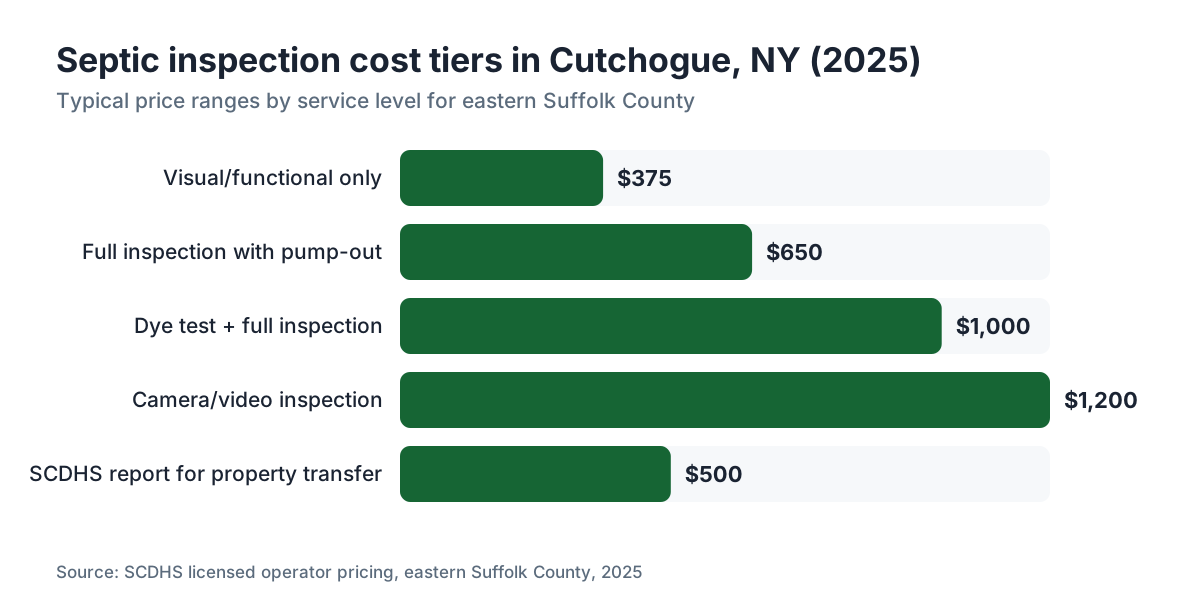
Here's an honest cost table based on what licensed operators in eastern Suffolk County charge as of 2025. These numbers reflect actual invoices from the Cutchogue, Mattituck, and Southold area, not padded catch-all ranges.
| Inspection type | Typical cost range | What's included |
|---|---|---|
| Visual/functional only | $300, $450 | Locate tank, check baffles, measure layers, flow test |
| Full inspection with pumping | $500, $800 | Everything above plus pump-out, interior inspection |
| Dye test + full inspection | $800, $1,200 | Everything above plus field probing and dye trace |
| Camera/video inspection | $900, $1,500 | Camera run through inlet/outlet pipes, video record |
| SCDHS report for property transfer | $400, $600 | Formal written report for county submission |
Additional costs to plan for: if the tank lid is buried and needs excavating, add $150, $300. If the inspector can't locate the system and needs to do a records search or camera trace, add $100, $200. If the system needs emergency pumping between inspections, see our guide on septic tank pumping for current pump-out pricing.
Cost varies by company more than by service level. North Fork companies carry real overhead. The nearest licensed septage receiving facility is not close, and diesel prices on the East End run higher. A price that sounds cheap from a company based in western Suffolk may come with a thinner written report.
If you're a homeowner tempted to skip the dye test to save money: don't, especially for a purchase. A failed drainfield in Cutchogue costs $15,000, $40,000 to replace, and the county may require a nitrogen-reducing Innovative/Alternative (I/A) system instead of a conventional replacement, which pushes costs higher [4]. Spending an extra $400 on a thorough inspection is cheap insurance.
What do inspectors look for in a North Fork cesspool or leach field?
Most older homes in Cutchogue use cesspools rather than a true septic tank plus leach field combination. A cesspool is a single buried chamber that receives raw sewage, allows liquid to seep out through its walls and bottom, and accumulates solids. Suffolk County stopped permitting new cesspools in the 1970s, but thousands remain in service on the North Fork [5].
When an inspector looks at a cesspool, the key things are: liquid level relative to the inlet pipe (high liquid means the soil around the cesspool has failed to absorb, which is a red flag), the condition of the concrete or block rings (cracks allow direct groundwater entry and collapse risk), the scum cap at the top, and whether roots have infiltrated the joints.
For a true septic tank plus leach field system, the inspection adds: baffle condition (plastic baffles corrode in hydrogen sulfide environments; old concrete baffles crack), the distribution box if one exists, and the absorption area. The absorption area is where most failures hide. Signs of failure include wet spots or lush-green grass stripes over field lines, sewage odor at grade, and dye surfacing during a dye test.
The EPA's SepticSmart program notes that "a properly functioning septic system treats wastewater before it reaches groundwater" and recommends homeowners have their systems inspected at least every three years [6]. On the North Fork, given the fast-draining soils and the aquifer concern, the county health department effectively encourages annual visual checks and full inspections every one to three years.
Inspectors also check setback compliance. Suffolk County requires minimum horizontal distances between a cesspool or septic system and property lines (10 feet minimum), wells (150 feet in most cases), and surface water bodies. If a system is too close to a neighbor's well or to Cutchogue Harbor, it may trigger a mandatory upgrade even if it's currently functioning.
Is a septic inspection required when selling a home in Cutchogue?
Yes, with conditions. New York State does not have a universal mandatory septic inspection law at the point of sale, but Suffolk County and local lenders fill that gap in practice.
Suffolk County Local Law 6-2021, also known as the SAVE (Subwatersheds Wastewater Plan) law, requires that any residential property within the county that sells must disclose the type of onsite wastewater system and, in designated nitrogen-sensitive areas, provide documentation of the system's condition. Cutchogue falls within a nitrogen-sensitive designation [5]. While the law's implementation has been phased, most real estate attorneys practicing in Southold Town will not allow a closing to proceed without a current inspection report, typically dated within 90 days of closing.
FHA and VA loans have their own requirements. Both agencies require evidence that the septic system is functioning adequately at the time of appraisal. The appraiser doesn't inspect the system, but an underwriter can and often does require a third-party inspection report before loan approval.
Conventional buyers who waive an inspection contingency are taking on real risk in this market. Properties on the North Fork frequently have unmapped or poorly documented cesspool locations, systems installed before permit records were digitized, and systems that have never been pumped. A buyer who inherits a failed cesspool is looking at a mandatory replacement with no negotiating room after closing.
Sellers benefit from getting an inspection before listing. It eliminates the surprise negotiation, lets you price accurately, and signals to buyers that you're not hiding problems. If the system does have issues, knowing in advance gives you time to get competitive repair bids rather than accepting whatever a buyer's contractor quotes under closing pressure. Our overview of septic system repair covers what typical repairs cost and when a repair is worth doing versus when replacement makes more sense.
How do I find a licensed septic inspector in Cutchogue?
The SCDHS maintains a list of licensed professionals for sewage disposal system inspections. You can search the SCDHS website directly, or call the Division of Environmental Quality at (631) 852-5700. Ask specifically for companies licensed to perform sewage disposal system evaluations under Article 22.
Beyond the license check, here's what to look for. Ask whether the inspector carries errors and omissions (E&O) insurance specifically for environmental assessments. Ask whether their report format meets SCDHS submission requirements for property transfer (some inspection report formats look complete but lack the specific fields the county requires). Ask how many inspections they've done in Southold Town specifically. The North Fork has quirks, including older cesspool designs and specific local groundwater depths, that inspectors based primarily in western Suffolk may not know as well.
Get at least two quotes. The range in this area is real. Some companies charge a flat fee that includes a basic pump-out; others quote the inspection and pump-out separately. Make sure you're comparing the same scope.
Timing matters on the North Fork. Spring and early fall are peak real estate seasons, and licensed inspectors get booked out two to three weeks. If you're working toward a closing date, schedule the inspection the day you sign the contract, not the day you get the bank's commitment letter.
If you're a septic service operator managing inspection scheduling and report documentation across multiple crews in eastern Long Island, tools like SepticMind can help track job status, report completion, and county submission deadlines in one place.
What happens if your septic system fails inspection in Cutchogue?
A failed inspection in Suffolk County triggers a mandatory process, not a suggestion. SCDHS requires that a failed system be taken out of service or repaired within a specific timeframe, and the repair must be permitted through the county.
The most common failure mode in Cutchogue is a saturated cesspool: the surrounding soil has absorbed all the effluent it can handle after decades of use, and the liquid level stays perpetually high. The fix is replacement, either with a new cesspool in a different location on the lot (if space allows and setbacks can be met) or with a modern septic tank and leach field. The catch is that new leach field designs in nitrogen-sensitive zones may need to be I/A systems, which use aerobic treatment or other nitrogen-reduction technology.
I/A systems approved by the state under the NYSDEC's program cost $15,000, $25,000 for the system itself, plus installation. Suffolk County has operated a subsidy program, the Septic Improvement Program (SIP), that offers grants and low-interest loans to help offset these costs for qualifying homeowners. As of the 2024 program year, grants of up to $30,000 were available for I/A system installation in priority areas [4]. Check with the Suffolk County Department of Health or the county's Office of Sustainability to confirm current SIP funding availability, since this program has been subject to annual appropriation.
For a repair short of full replacement, like a broken baffle or a cracked inlet pipe, costs are much lower. A baffle replacement runs $200, $500. A septic tank repair for a cracked lid or failed riser is $300, $800. See our detailed breakdown of septic tank repair costs for a fuller picture.
One thing to know about the real estate context: a failed inspection doesn't automatically kill a deal. Buyers and sellers can negotiate who pays for the repair, whether the closing is contingent on repair completion or on price adjustment, and what escrow amount covers future costs. Having a real repair estimate from a licensed contractor gives you the data to negotiate intelligently.
How often should you have your septic system inspected in Cutchogue?
The EPA recommends that the average household septic system be inspected at least every three years by a licensed professional [6]. For systems with mechanical components (pumps, alarms, I/A treatment units), annual inspections are the norm because those components have moving parts that fail.
On the North Fork, three years is probably the right outer limit for most cesspools. Given the aquifer sensitivity and the fact that many systems are old and haven't been regularly pumped, the county health department's informal guidance leans toward annual visual checks and a full pump-out inspection every one to two years. The how often to pump septic tank guide covers the pumping frequency decision in detail, but the short answer for a typical three-bedroom Cutchogue house is every two to three years for pumping, with a full inspection at least every three.
If your household size has changed, if you've added a garbage disposal (which significantly increases solids loading), or if you've noticed any of the warning signs below, don't wait for your scheduled inspection. Move it up.
Warning signs that need immediate attention: sewage odors inside the house or in the yard, slow drains in multiple fixtures at once, wet or soggy ground directly above the cesspool or leach field (especially when it hasn't rained), and unusually lush green grass in a stripe or ring over the field lines. Any of these means the system is failing or close to it, and running more water through it accelerates the damage.
For seasonal or part-time properties (Cutchogue has many), the return-from-winter inspection is smart practice. Frozen and then thawed ground, plus a sudden surge of use when a house reopens after months of dormancy, can stress an already marginal system. A quick inspection in May, before peak summer use, is cheap compared to a mid-August emergency.
What records should you have for your Cutchogue septic system?
This is the question most homeowners don't think about until they're sitting at a closing table or dealing with a failure.
Suffolk County Health Services maintains records of permitted septic system installations and inspections. For properties with systems installed after records were digitized (roughly 1980 forward), you can request the file from SCDHS's Division of Environmental Quality. Older properties may have paper records, no records, or records that describe a system that was later modified without a permit.
What you should have and keep in a file: the original installation permit and as-built drawing (shows tank location, size, and leach field layout), inspection reports from the past 5 to 10 years, pump-out receipts (these establish your maintenance history and matter for insurance and resale), and any repair or replacement permits.
If you don't have the as-built drawing, a licensed inspector can usually locate the system by probing or with a small camera, and can sketch an informal as-built for your records. This matters because future inspectors, emergency pumpers, and county reviewers need to know where the tanks are.
For operators running inspection businesses in Suffolk County, keeping organized records for each customer property (tank size, GPS coordinates, inspection history, permit status) used to mean folders and spreadsheets. SepticMind is built to organize exactly this data across a service area, which matters when you're managing hundreds of customer accounts across the North Fork and need to flag which properties are coming due for inspection or have open compliance items.
If you're buying a property and the seller can't produce any records, budget for a full cesspool evaluation including probing and consider a camera inspection of the inlet and outlet pipes. Unknown systems in Cutchogue are often old, undersized for the current household, and never pumped. That combination fails faster than the listing agent will tell you.
What does a new septic system cost if your Cutchogue system needs replacement?
Replacement costs in eastern Suffolk County are higher than state averages, and the I/A requirement in nitrogen-sensitive zones is the biggest driver.
A conventional replacement, a standard septic tank plus leach field where space and soils allow and a variance is granted, runs $12,000, $20,000 including permitting, excavation, and backfill. This is increasingly rare for Cutchogue properties because the county pushes I/A systems in this area.
An I/A system (such as the Fuji Clean, Hydro-Action, or Norweco units approved under the NYSDEC program) costs $18,000, $35,000 installed, before any subsidy. After a Suffolk County SIP grant (if available and if you qualify), net cost can be $8,000, $15,000. The subsidy is real money, but the application takes time and the program has waitlists [4].
On small or constrained lots, the cost goes up because of required setbacks, the need for engineered designs, and sometimes retaining walls or engineered fill. Some North Fork parcels physically cannot accommodate a replacement system in the conventional footprint, which leads to creative and expensive solutions.
For context on what a new system installation involves from scratch (for new construction or total gut replacement), see our guides on cost to install septic system and cost to put in a septic tank. Those articles cover the national picture; add 30 to 50% for eastern Long Island's labor and regulatory costs.
The point is not to scare you. It's to explain why a thorough inspection, even the expensive dye-test version, is genuinely worth every dollar before you buy a Cutchogue property or before you discover a failure the hard way.
How do Suffolk County's nitrogen reduction requirements affect Cutchogue septic systems?
This is the piece of Cutchogue septic policy that most homeowners don't know about until they're facing a replacement.
Suffolk County Executive's 2015 Reclaim Our Water initiative, followed by the county's Subwatersheds Wastewater Management Plan, established that conventional cesspool and septic systems are a primary driver of nitrogen loading to the Peconic Estuary and the aquifer [5]. A typical cesspool discharges effluent with nitrogen concentrations of 40 to 60 mg/L. An approved I/A system reduces that to 19 mg/L or lower, which is the county's threshold for "nitrogen-reducing" designation.
Practically, this means: if your system fails and needs replacement, SCDHS will likely require an I/A system rather than approving a like-for-like conventional replacement. The exact trigger depends on your lot's location relative to a mapped priority area, your distance from surface water, and the density of systems in your immediate neighborhood. Cutchogue's proximity to Cutchogue Harbor and its position within the Peconic Bay Watershed means most parcels fall into a priority designation.
This is also why the Suffolk County Septic Improvement Program exists. The county recognized that mandating more expensive technology without financial help would create hardship and non-compliance. Current and past SIP grant information is on the county's website [4], and applications are processed through SCDHS.
For homeowners with currently functioning systems, this requirement only triggers at replacement. You don't have to upgrade a working system today. But understanding that a future replacement will likely mean I/A costs changes the math on how aggressively you invest in maintaining your existing system. Regular pumping, which you can read about in our septic tank pump out guide, extends system life a lot and is far cheaper than early replacement.
Frequently asked questions
How long does a septic inspection take in Cutchogue?
A visual and functional inspection takes 45 to 90 minutes. If the inspector is also pumping the tank, plan for two to three hours. A full dye test with field probing can take three to four hours. If the system is buried deep or the lid location is unknown, add time for probing and locating. Most inspectors give you a same-day preliminary verbal result, with a written report in two to five business days.
Do I need a septic inspection to sell my house in Cutchogue?
Practically speaking, yes. New York State doesn't have a universal law requiring it, but Suffolk County Local Law 6-2021 requires disclosure of system type and condition in nitrogen-sensitive areas, and Cutchogue qualifies. Beyond that, FHA and VA lenders require functional evidence of the system, and most buyers' attorneys in Southold Town make inspection a contract contingency. Trying to close without one creates delays and spooks buyers.
What is the Suffolk County Article 22 and how does it affect my septic system?
Article 22 is Suffolk County's Sanitary Code section governing onsite sewage disposal. It sets design standards, setback requirements, inspection protocols, and replacement criteria that are stricter than New York State's baseline rules under 10 NYCRR Part 75. Any inspection, repair, or replacement of a septic system or cesspool in Cutchogue must comply with Article 22. Your inspector's report should specifically reference Article 22 compliance.
Can a home inspector do the septic inspection when I buy a house in Cutchogue?
No, not for a reportable septic evaluation. A general home inspector can note obvious surface signs of septic problems, but a formal septic inspection in Suffolk County must be performed by a licensed professional engineer, licensed architect, or a company holding a SCDHS license for sewage disposal system evaluations. Always ask for the inspector's SCDHS license number before booking.
What's the difference between a cesspool and a septic system in Cutchogue?
A cesspool is a single buried chamber that receives raw sewage and allows liquid to seep out through its walls and bottom into surrounding soil. A septic system separates the tank (where solids settle) from a leach field (where liquid disperses). Most older Cutchogue homes have cesspools, which Suffolk County stopped permitting in the 1970s. Cesspools are inspected differently and tend to fail faster because one component handles all the work.
How much does it cost to replace a septic system in Cutchogue?
Conventional replacement runs $12,000, $20,000, but SCDHS increasingly requires nitrogen-reducing Innovative/Alternative (I/A) systems in Cutchogue's nitrogen-sensitive zone, which cost $18,000, $35,000 installed. Suffolk County's Septic Improvement Program offers grants of up to $30,000 for qualifying homeowners, which can dramatically reduce net cost. Get the SIP application in early; the program has waitlists and annual funding limits.
How do I find the location of my septic tank or cesspool in Cutchogue?
Start with SCDHS records: call the Division of Environmental Quality at (631) 852-5700 and request your property's permit file. If records are missing or the system was installed before digitization, a licensed inspector can locate it by probing the ground with a thin rod or using a sewer camera fed from a cleanout. Most inspectors include basic location service in their standard fee; buried lids requiring excavation cost extra.
What are the signs of a failing septic system in Cutchogue?
Sewage odors inside the house or in the yard are the clearest sign. Other indicators: multiple drains running slowly at once, toilets gurgling when you run a sink, wet or spongy ground over the cesspool or leach field area (especially in dry weather), and unusually green grass growing in a stripe or ring over field lines. On the North Fork's fast-draining soils, surfacing effluent is a serious indicator and means the system needs immediate professional evaluation.
Does the Suffolk County Septic Improvement Program cover Cutchogue?
Yes. Cutchogue falls within Suffolk County and within the Peconic Bay Watershed priority area. The SIP has provided grants of up to $30,000 and low-interest loans for I/A system installation in this area. Funding is appropriated annually and subject to availability, so check the current status with the Suffolk County Office of Sustainability or SCDHS before counting on it in your renovation budget.
How often should a cesspool be pumped in Cutchogue?
For a three-bedroom home with average occupancy, every two to three years is reasonable. Larger households or homes with garbage disposals should pump more frequently, potentially annually. On the North Fork, where many cesspools are old and never pumped, catching up with a first pump-out often reveals the cesspool is further degraded than the owner realized. Regular pumping is the single best thing you can do to extend cesspool life.
What is a dye test and does my Cutchogue inspector need to do one?
A dye test adds non-toxic fluorescent dye to the system, then the inspector runs high-volume water through the house and probes around the leach field or cesspool to see if dye surfaces or if the soil is saturated. It's the most reliable field method for confirming leach field failure. For a pre-purchase inspection on an older Cutchogue property, yes, you want one. The extra cost ($400, $600 above a standard inspection) is trivial compared to missing a failing field.
What happens if my Cutchogue septic system fails the inspection?
SCDHS requires the system to be repaired or replaced, with a permit, within a specified timeframe. Minor failures (bad baffle, cracked lid) can be repaired for a few hundred dollars. Major failures (saturated cesspool, failed leach field) require full replacement, likely with an I/A nitrogen-reducing system in this area. In a real estate transaction, the failure triggers negotiation between buyer and seller on who pays and how the deal structure adjusts.
Can I do any maintenance on my septic system myself in Cutchogue?
You can keep accurate records, avoid flushing non-biodegradable items, reduce water use during heavy rain, and not plant trees near the system. The actual pumping, inspection, and any repair must be done by licensed professionals under SCDHS oversight. Do not add enzyme or bacteria additives marketed to "rejuvenate" cesspools; there's no credible evidence they extend system life, and they won't fix a failing absorption field.
Sources
- EPA, Sole Source Aquifer Program, Long Island designation: The Long Island aquifer system is designated as a Sole Source Aquifer serving approximately 1.1 million people
- Suffolk County Sanitary Code, Article 22: Suffolk County Article 22 governs design, installation, and inspection of onsite sewage disposal systems, layered on top of New York State 10 NYCRR Part 75
- New York State Department of Health, 10 NYCRR Part 75, Individual Household Systems: New York State baseline septic rules are set in 10 NYCRR Part 75; counties may adopt stricter local standards
- Suffolk County Septic Improvement Program (SIP), Office of Sustainability: Suffolk County SIP offers grants of up to $30,000 for installation of approved Innovative/Alternative nitrogen-reducing septic systems in priority areas including the Peconic Bay Watershed
- Suffolk County Subwatersheds Wastewater Management Plan, Reclaim Our Water: Suffolk County's plan identifies cesspools as a primary nitrogen source to the Peconic Estuary and aquifer; Suffolk County stopped permitting new cesspools in the 1970s; Local Law 6-2021 requires disclosure and documentation at point of sale in nitrogen-sensitive areas
- EPA SepticSmart, Homeowner's Guide to Septic Systems: EPA SepticSmart states 'a properly functioning septic system treats wastewater before it reaches groundwater' and recommends professional inspection at least every three years
- Suffolk County Department of Health Services, Division of Environmental Quality, contact and licensing: SCDHS Division of Environmental Quality maintains the list of licensed professionals for sewage disposal system inspections and can be reached at (631) 852-5700
- EPA, Septic Systems: Overview, What to do if your septic system fails: EPA guidance recommends annual inspection for systems with mechanical components and notes that conventional septic systems should be inspected by a professional every three years
Last updated 2026-07-09