How long does it take to pump a septic tank?
By the SepticMind Editorial Team
TL;DR
- Pumping a typical residential septic tank takes 20 to 60 minutes once the truck is on site.
- Larger tanks, heavy sludge, buried lids, and aerobic systems with an air pump can push the job past 90 minutes.
- A visit under 15 minutes is a red flag that the tank wasn't emptied completely.
What is the typical time to pump a septic tank?
For a standard residential septic tank in the 1,000- to 1,500-gallon range, the technician is actively working for 20 to 60 minutes. That window covers locating and uncovering the access lids, setting up the vacuum hose, pulling the liquid and solid waste, doing a quick visual inspection of the tank interior, and cleaning up. The truck may sit in your driveway a bit longer while the operator writes a report or answers your questions.
That 20-to-60 range is a real range, not a hedge. A lightly loaded 1,000-gallon tank with exposed risers and a short hose run can genuinely be done in under half an hour. A 1,500-gallon tank that hasn't been pumped in eight years, with deeply buried concrete lids and a long driveway, runs past an hour [1].
Anything under 15 minutes deserves a conversation. Pumping 1,000 gallons of mixed liquid and sludge through a 4-inch vacuum hose takes physical time. A 10-minute visit almost certainly means the tank wasn't emptied completely, or wasn't emptied at all.
What factors make a pump-out take longer?
Tank size is the biggest variable. A 1,000-gallon tank takes less time than a 2,000-gallon tank, full stop. But several other things stack up quickly.
Sludge depth. The thicker the sludge layer at the bottom, the more work the vacuum pump has to do. Sludge moves slower than liquid. If the tank is overdue, a technician may need to backflush water into the tank to break up solids, which adds 15 to 30 minutes [2].
Buried lids. Many older tanks have no risers. If the lids sit 12 inches underground, the technician has to probe and dig before the hose ever goes in. That alone adds 20 to 45 minutes and sometimes triggers an extra charge. Installing risers after the service call is worth the money for every visit going forward.
Hose distance. The vacuum truck can only pull effectively across a limited distance. If the tank is 100 feet from where the truck can park, the operator needs extension hoses and the suction efficiency drops. A standard hose run is typically under 50 feet.
Aerobic treatment systems. Homes with an aerobic septic system, which uses a septic tank air pump to introduce oxygen and treat wastewater more aggressively, often have multiple chambers and extra components. Servicing those systems takes longer than a conventional two-compartment tank because the technician has to inspect the air pump for the septic tank, check the chlorinator, and sometimes pull a pump. Budget 60 to 90 minutes for a full aerobic service [3].
Pump-out access problems. Concrete tanks crack. Baffles fall. Sometimes a lid won't open cleanly. If the technician finds a damaged inlet or outlet baffle, or a cracked riser, they'll document it and may need time to discuss options with you. See septic tank repair for what comes next when that happens.
How long does the full pump-out visit take, start to finish?
The pump-out itself is only part of the visit clock. Here's a realistic breakdown of a complete service call:
| Phase | Typical time |
|---|---|
| Truck arrival, setup, hose deployment | 5 to 15 min |
| Locating and uncovering lids (risers installed) | 2 to 5 min |
| Locating and uncovering lids (buried, no risers) | 20 to 45 min |
| Active pumping (1,000-gal tank, normal load) | 10 to 20 min |
| Active pumping (1,500-gal tank, heavy sludge) | 25 to 40 min |
| Backflushing to break up sludge (if needed) | 15 to 30 min |
| Interior inspection, baffle check | 5 to 10 min |
| Hose cleanup, lid replacement, notes/invoice | 5 to 10 min |
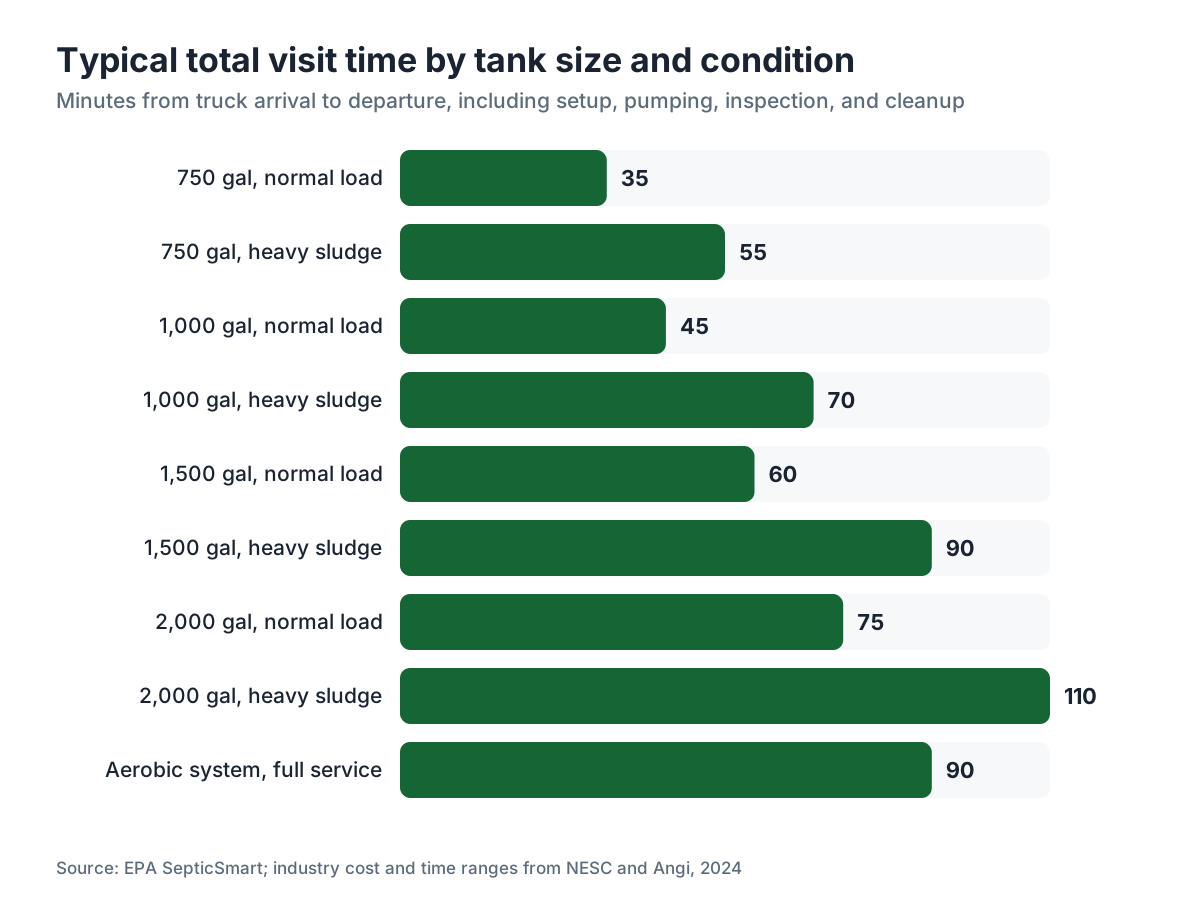
Add those columns and you get 30 to 75 minutes for a straightforward job, or 60 to 120 minutes if there's digging, backflushing, or a complex aerobic system. Plan for an hour and you're in good shape. A technician who quotes "about 45 minutes" is being honest for a typical tank.
Does tank size change how long pumping takes?
Yes, and more than most people expect. A vacuum truck's hose moves roughly 100 to 150 gallons per minute under good conditions, but real-world sludge slows that down a lot [4]. Here's how tank size translates to pump time in practice:
| Tank size | Liquid-only pull | With typical sludge |
|---|---|---|
| 750 gallons | 8 to 12 min | 15 to 25 min |
| 1,000 gallons | 10 to 15 min | 20 to 30 min |
| 1,250 gallons | 12 to 18 min | 25 to 35 min |
| 1,500 gallons | 15 to 22 min | 30 to 45 min |
| 2,000 gallons | 20 to 30 min | 40 to 60 min |
These are pump-time only, not total visit time. The EPA's SepticSmart program notes that most residential tanks are sized between 1,000 and 1,500 gallons, which matches the range most service companies quote when they say "about 30 to 45 minutes" [1].
Commercial systems, large residential systems with multiple tanks, or any system running a secondary treatment unit will run longer. A two-tank system can double the active pump time.
What should actually happen during the pump-out?
A proper septic tank pump out is more than sucking out liquid. Here's what a competent technician does during a service visit and why each step matters.
First, they locate both access ports, the inlet side and the outlet side. Pumping from a single port is faster but it leaves settled sludge behind. A thorough job pulls from both openings or uses backflushing to move solids toward the suction hose.
Second, they inspect the baffles. The inlet baffle slows incoming waste. The outlet baffle keeps floating scum from leaving the tank toward the leach field. A missing or deteriorated baffle is one of the most common reasons drain fields fail early. The technician should tell you the condition of both baffles before they leave [7].
Third, they check for cracks, root intrusion, or groundwater infiltration. Groundwater getting into the tank is a real problem because it overloads the system and shortens the time between pumpings. Standing water in the tank right after pumping is a sign of infiltration.
Finally, they give you a service record. North Carolina, for example, requires operators to provide a written record of each pump-out including the date, the tank volume, and the condition of the system components [5]. Many states have similar rules. If your technician leaves without handing you any documentation, ask for it explicitly.
Is backflushing worth the extra time and cost?
Backflushing means pumping some liquid back into the tank and agitating it to loosen compacted sludge, then vacuuming it out again. It adds 15 to 30 minutes and typically $50 to $100 to the bill [4].
For a tank on a regular 3-to-5 year schedule with normal household loading, backflushing usually isn't necessary. The sludge layer stays manageable and a straight vacuum pull gets it.
For a tank that's been neglected, backflushing earns its keep. Compacted sludge that doesn't come out this visit will be there next visit, and it's creeping toward your outlet baffle the whole time. I'd rather pay the $75 now than deal with a clogged baffle and a soggy drain field next year.
Some companies include backflushing as standard. Others charge extra. Ask before the truck arrives.
How do you know if the septic tank was actually fully pumped?
This is the question most homeowners don't think to ask until they've been burned. A few real checks:
Look inside the tank after pumping. Your technician should leave the lid off briefly. The tank floor should be visible and relatively clear. If there's still a thick layer of material coating the walls or sitting on the bottom, ask whether that's normal residue or a sign the job got cut short.
Check the time on-site. Cross-reference with the tank size chart above. If the truck was there 20 minutes total and you have a 1,500-gallon tank with no risers, something didn't happen the way it should have.
Ask for a sludge depth reading. Before pumping, a good technician uses a "sludge judge" (a clear tube that shows the depth of the sludge layer) or a similar tool [9]. Knowing the pre-pump sludge depth gives you a baseline for next time and confirms there was actually material to remove.
For ongoing records and scheduling, software tools like SepticMind help service operators log tank conditions, sludge depths, and pump intervals so nothing falls through the cracks between visits.
For more on what the full service should include, see septic tank cleaning.
How often should you pump, and does frequency affect how long it takes?
The EPA SepticSmart program recommends pumping every 3 to 5 years for a typical household [1]. The actual interval depends on tank size, number of people in the house, and what goes down the drains. Households with garbage disposals build sludge faster. Two people with a 1,500-gallon tank might stretch to 7 years without trouble.
Frequency directly affects how long each pump-out takes. A tank pumped on schedule has a manageable sludge layer. A tank that goes 10 years between services has a thick, compacted layer that takes longer to remove, may need backflushing, and risks damaged baffles from years of pressure and biological activity.
The homeowners most annoyed by a long, expensive pump-out are usually the ones who skipped the last one or two. It's a self-inflicted problem. See how often to pump septic tank for the full breakdown by household size and tank volume.
What role does a septic tank air pump play in service time?
A septic tank air pump is a core component of aerobic treatment units (ATUs). Instead of relying only on anaerobic bacteria to break down waste, an aerobic system runs a continuous air supply into the treatment chamber. The bacteria work faster and the effluent quality is higher, which is why ATUs are often required in areas with poor soil conditions or small lots.
Servicing a system with an air pump for septic tank aeration takes longer than servicing a conventional tank, for a few reasons. The technician has to check whether the air pump is running (a failed air pump kills the aerobic bacteria and turns the system anaerobic essentially overnight). They inspect the diffusers or air lines inside the tank for clogging or cracking. On many systems they also service the chlorination unit and verify the effluent alarm works [3].
A full aerobic service call is commonly priced separately from a standard pump-out, and for good reason. If you have an ATU, tell the company when you schedule so they send someone with the right training and budget 60 to 90 minutes.
State requirements for ATU maintenance vary. Texas, for example, requires a maintenance contract with a licensed provider for all aerobic systems, with service visits at least twice per year [6].
What does septic pumping cost, and does the time affect the price?
Nationally, residential septic tank pumping runs roughly $250 to $600, with most homeowners paying in the $300 to $450 range [4]. The variation comes from regional labor costs, tank size, and add-ons like backflushing, lid locating, or riser installation.
| Service | Typical cost range |
|---|---|
| Standard pump-out (1,000 to 1,500 gal) | $250, $450 |
| Pump-out with backflushing | $320, $550 |
| Pump-out with lid locating and digging | $350, $600 |
| Aerobic system full service | $150, $300 per visit (above pump cost) |
| Riser installation (per riser) | $200, $500 |
Time and cost are linked but not perfectly. Most companies charge by tank size, not by the hour. A job that takes an hour because of buried lids might cost more in a line-item for excavation, not because the clock ran long. Ask your provider how they price extras before they start digging.
For context on the broader cost picture, see septic tank pumping.
What are the signs your tank needs pumping now, regardless of schedule?
The schedule matters, but so does what's happening in your yard and your house. Several signs mean pump it now, don't wait for the 5-year mark.
Slow drains throughout the house, more than one fixture, often point to a full or failing septic tank rather than a simple clog. Sewage odors near the tank or in the yard are a direct signal. Wet, spongy, or unusually green grass over the drain field means effluent is surfacing, which turns into a septic system repair conversation fast if you don't act.
Inside the tank, if the sludge layer is within 6 inches of the outlet baffle, it needs to come out. The EPA SepticSmart guidance states a tank should be pumped when "the scum layer is within 6 inches of the bottom of the outlet" or the sludge layer is within 12 inches [1].
A septic tank inspection before you buy a home, or if you haven't serviced the system in years, is the right first step. The inspector measures sludge depth, checks baffles, and tells you whether a pump-out is urgent or whether you have another year.
Can you speed up the pump-out process, and should you?
A few things genuinely help the job go faster without cutting corners.
Install risers if you don't have them. Digging to buried lids is the single biggest time thief in a typical service call. Risers bring the access points to grade and turn a 45-minute excavation into a 2-minute lid pop. The one-time cost ($200 to $500 per riser) pays back immediately in saved time and reduced fees [4].
Keep records. If you know the exact tank location, its size, and the last pump date, the technician isn't guessing or probing the yard. Good records take 5 minutes to maintain and can shave 20 minutes off a service call.
Make access easy. The vacuum truck needs to get within 50 feet of the tank. Trim overhanging branches, unlock gates, and move vehicles before the crew arrives.
What you should not do is pressure a technician to hurry. Cutting the pump time short leaves sludge in the tank. Skipping the baffle inspection means a problem that costs $150 to fix today can turn into a $15,000 drain field replacement next year. See septic tank emptying for more on what a complete job actually looks like.
Frequently asked questions
How long does it take to pump a 1,000-gallon septic tank?
Active pumping on a 1,000-gallon tank takes roughly 10 to 20 minutes under good conditions. Add setup, inspection, and cleanup and the full visit runs 30 to 50 minutes. If the lids are buried or the tank has heavy sludge from a long service gap, budget up to 75 minutes total.
How long does it take to pump a 1,500-gallon septic tank?
A 1,500-gallon tank typically takes 30 to 45 minutes of active pump time, and 45 to 75 minutes for the complete visit including inspection and paperwork. A neglected tank with compacted sludge that requires backflushing can push that past 90 minutes. Installing risers beforehand keeps it on the shorter end.
Is 20 minutes long enough to pump a septic tank?
For a small tank (750 gallons) that's on schedule and has accessible lids, 20 minutes of active pumping is plausible. For a 1,000-gallon or larger tank, 20 minutes total visit time is almost certainly not enough to fully empty the tank and inspect the baffles. Ask your technician to explain what was completed if the visit seems short.
Why did my septic pump-out take longer than the company said it would?
The most common reasons are buried lids that required digging, more sludge than expected (a sign the tank was overdue), a need for backflushing to break up compacted material, or a damaged component that needed documentation. None of these are emergencies, but they add time and sometimes cost. Ask for an itemized explanation.
How do I know the tank was fully pumped?
After pumping, the tank floor should be visible with only a thin residue coating the walls. Ask the technician for the pre-pump sludge depth reading (from a sludge judge or similar tool) and confirm both access ports were used. If the job took suspiciously little time relative to the tank size, question that directly before the truck leaves.
Does an aerobic septic system take longer to pump than a conventional tank?
Yes, usually a lot longer. Aerobic systems have an air pump for septic tank aeration, multiple chambers, a chlorinator, and alarm systems that all need checking during service. A full aerobic service visit commonly runs 60 to 90 minutes compared to 30 to 60 minutes for a conventional tank. Many operators price aerobic service separately for this reason.
How often should a septic tank be pumped?
The EPA SepticSmart program recommends every 3 to 5 years for a typical household. The right interval depends on tank size and the number of occupants. A family of four with a 1,000-gallon tank is closer to the 3-year end. Two people with a 1,500-gallon tank might go 5 to 7 years. A sludge depth measurement at each service call is the most accurate guide.
What happens if you don't pump a septic tank for too long?
Sludge and scum accumulate until they reach the outlet baffle, at which point solids start flowing toward the drain field. Solids clog the soil and cause effluent to surface or back up into the house. Drain field replacement costs $5,000 to $25,000 or more depending on the system type and soil conditions, making regular pumping one of the highest-ROI maintenance tasks a homeowner can do.
Can I pump my own septic tank?
Legally, in most states you cannot. Septage (septic waste) is regulated and requires licensed hauling and disposal at approved facilities. DIY pumping is prohibited in most jurisdictions and creates real public health risk. A few states allow homeowners to pump their own tank only under specific land-disposal conditions, but those cases are the exception, not the rule.
Does the time of year affect how long septic pumping takes?
Cold weather can thicken sludge slightly, making it pull more slowly, but this is a minor factor next to sludge depth and tank size. Scheduling in winter is fine and often easier because demand is lower. Frozen ground makes locating buried lids harder. If you're in a cold climate without risers, fall scheduling avoids that complication.
How long after pumping before I can use my septic system normally?
Immediately. There's no waiting period after a pump-out. The tank starts refilling with household wastewater as soon as you use water, and the bacterial colony reestablishes naturally within a few days. You don't need to add any starter product. The bacteria repopulate from the small amount that remains on the tank walls and from incoming waste.
What's the difference between pumping and cleaning a septic tank?
Pumping removes the liquid and most of the sludge through vacuum suction. Cleaning implies a more thorough process that includes backflushing, agitating compacted material, and removing residue from the tank walls. Some companies use the terms interchangeably. Others charge more for a full clean. Ask specifically whether the service includes backflushing if your tank is overdue.
Does a garbage disposal make pumping take longer or more frequent?
It increases frequency more than individual pump time. Garbage disposals add significant organic solids to the tank, which builds sludge faster. The EPA notes that using a garbage disposal can raise solids accumulation substantially and recommends more frequent pumping for households that use one regularly. The pump-out itself takes the same amount of time. You just need it sooner.
How much does it cost if the septic pump-out takes longer than expected?
Most companies charge by tank size with fixed add-on fees for extras like lid locating ($50 to $150), excavation ($75 to $200), or backflushing ($50 to $100). Hourly overrun charges are less common but do exist. Confirm the pricing structure when you book, specifically whether buried lid locating and digging are included or billed separately. That one question prevents most invoice surprises.
Sources
- EPA SepticSmart, Homeowner's Guide to Septic Systems: EPA recommends pumping every 3 to 5 years and states a tank should be pumped when scum is within 6 inches of the outlet device or sludge is within 12 inches; most residential tanks are 1,000 to 1,500 gallons.
- University of Minnesota Extension: Overdue or heavily loaded tanks may require backflushing to break up compacted sludge during pump-out, adding time and cost to the service.
- National Environmental Services Center (NESC), West Virginia University, Aerobic Treatment Units: Aerobic treatment units include an air pump, multiple chambers, and a chlorinator that require inspection and servicing beyond standard pump-out procedures.
- Angi, Septic Tank Pumping Cost Guide: National average for residential septic tank pumping is roughly $250, $600; backflushing and riser installation are common add-on costs; vacuum hose moves approximately 100 to 150 gallons per minute under optimal conditions.
- North Carolina Department of Environmental Quality, Septage Management Program: North Carolina requires operators to provide written service records including date, tank volume, and system condition at each pump-out.
- Texas Commission on Environmental Quality, On-Site Sewage Facilities: Texas requires a maintenance contract with a licensed provider for all aerobic septic systems, with service visits at least twice per year.
- EPA, How Your Septic System Works: Septic tanks separate solids from liquids; the outlet baffle keeps scum from reaching the drain field, making baffle inspection a required part of any proper service visit.
- Penn State Extension: Garbage disposals significantly increase solids accumulation rates in septic tanks, requiring more frequent pumping for households that use them regularly.
- University of Florida IFAS Extension: A sludge judge or similar measurement tool should be used before pumping to record pre-service sludge depth as a service baseline.
- EPA SepticSmart Program: EPA SepticSmart program guidance recommends homeowners keep records of pump-out dates, sludge measurements, and service findings for each septic service visit.
Last updated 2026-07-09