Signs of drain field failure: what to look for and what to do
By the SepticMind Editorial Team
TL;DR
- A failing drain field shows up as wet, spongy grass over the leach field, sewage smells in the yard, slow or gurgling drains inside, and sewage backups.
- These signs mean wastewater is no longer soaking in and getting treated.
- Catch them early and you might repair or rest the field.
- Miss them and you're looking at a full replacement costing $10,000 to $30,000.
What does a failing drain field actually look like?
A drain field fails when the soil can no longer absorb and treat the wastewater leaving your septic tank. The effluent has to go somewhere. So it pools on the surface, backs up into the house, or moves sideways into places it shouldn't.
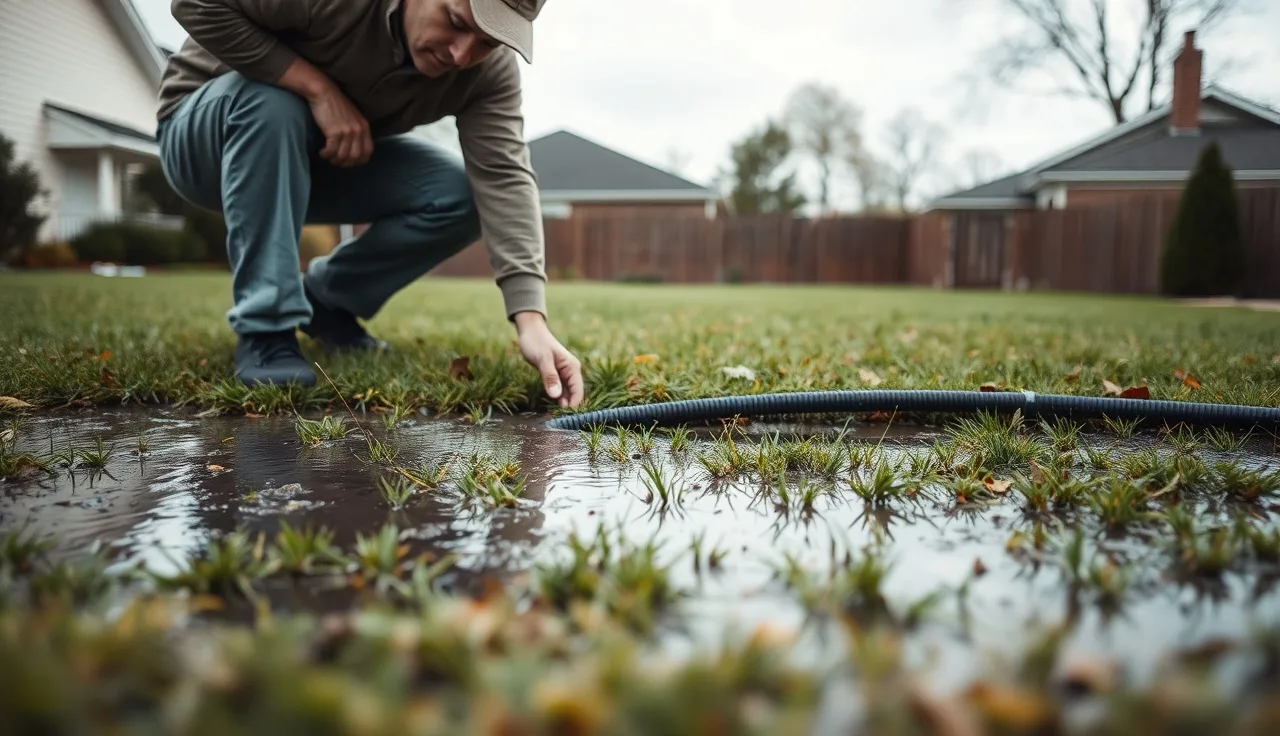
The physical signs are obvious once you know the pattern. The most common one is a patch of grass that's greener, taller, and softer than the rest of your yard, sitting right over the leach field trenches. Sounds nice. It isn't. It means saturated, half-treated sewage is parked just under the surface. You might also see standing water or muddy puddles on a dry day, sometimes with a faint gray sheen.
Inside the house, the early warnings show up at your drains. Toilets that flush sluggishly, drains that gurgle when nothing else is running, and that rotten-egg or sewage smell from floor drains or rarely used fixtures all say the system is backing up. By the time sewage is surfacing in the yard or coming up through a floor drain, the failure is well along.
Not every symptom points at the field. One slow drain usually means one clogged pipe. But when several fixtures act up at once, or the trouble gets worse after rain or a big laundry day, the field is the likely culprit [1].
What are the specific signs of septic drain field failure?
Here's the full list, ranked roughly from early warning to severe.
1. Slow drains and gurgling across multiple fixtures. When the field is saturated, the tank fills and effluent has nowhere to go. Drains slow because the system is backing up from the outlet end, not because of a clog in any one pipe. Gurgling in the shower while the washing machine drains is a classic tell.
2. Sewage odors outside near the field. A healthy drain field has no smell at the surface. If you catch hydrogen sulfide (rotten egg) or raw sewage in the yard, especially after rain, effluent is surfacing or close to it. The EPA's SepticSmart program lists "odors inside the home or near the septic system" as a warning sign that calls for immediate inspection [2].
3. Bright green, lush grass directly over the field. The nutrient load from half-treated wastewater fertilizes the grass above it. A rectangular or linear green stripe that lines up with where your trenches were dug is not good luck. It's a symptom.
4. Wet, soggy ground over the field on dry days. Effluent pooling at or near the surface. In bad failures you'll see standing water with a grayish, oily tint. Don't walk through it barefoot. It carries pathogens including fecal coliform bacteria [3].
5. Sewage backup inside the home. Raw sewage coming up through a floor drain, bathtub, or toilet is the most urgent sign. This is a health emergency, not a plumbing annoyance. Stop using water and call a septic professional.
6. High nitrate levels in nearby well water. If you have a private well within a few hundred feet, a failing field can push nitrates and pathogens into groundwater. Many state health departments recommend testing well water once a year if you're on septic [4]. A nitrate spike is sometimes the only sign of a slow field failure that hasn't reached the surface.
7. Alarm on a pump-equipped system. Pressure-dosed and mound systems have high-water alarms in the pump chamber. When that alarm sounds, effluent is not leaving the chamber at the expected rate, which usually points to a clogged or saturated field.
| Sign | What it likely means | Urgency |
|---|---|---|
| Multiple slow drains, gurgling | Tank backing up, field saturated | High, inspect within days |
| Sewage odor outside | Effluent at or near surface | High, inspect immediately |
| Lush green grass over field | Nutrient loading from effluent | Medium, schedule inspection |
| Standing water over field | Surface failure | Very high, stop water use |
| Sewage backup indoors | Complete failure or blockage | Emergency |
| Elevated nitrates in well | Groundwater contamination | High, test and inspect |
| Pump alarm activated | Pump or field issue | High, same-day response |
What causes a drain field to fail?
Most failures trace back to one of four root causes, and which one you have decides your repair options.
Biomat buildup. The most common cause. A biomat is a layer of biological slime, mostly anaerobic bacteria and their byproducts, that forms where the gravel meets the native soil in your trenches. Every field grows some biomat, and a thin one actually helps filter pathogens. The problem starts when solids overflow from a neglected or undersized tank. The biomat thickens until it's basically waterproof, and water sits in the trenches with nowhere to go. Biomat at the gravel-soil interface is the failure cause inspectors cite most often across New England states [12].
Hydraulic overloading. More water going in than the soil can absorb. This happens with high-water-use households, water softeners that backwash into the septic system, and additions of bathrooms or bedrooms without resizing the field. It also happens for a stretch after heavy rain raises the water table, which is why fields that behave all year can fail in a wet spring.
Physical damage to the distribution system. Crushed or broken distribution pipes, a failed distribution box, or tree and shrub roots can stop effluent from reaching all parts of the field evenly. One or two trenches get overloaded while the rest sit dry. The overloaded trenches fail while the field is only half used [5].
Soil saturation and poor original design. Some fields went into soils with percolation rates too slow for the load, or over seasonal high water tables the designer never accounted for. These systems are set up to fail no matter how careful you are.
Age matters too. Most drain fields have a design life of 25 to 30 years, though well-kept fields in good soil run 40 years or more. The EPA notes that "proper maintenance" is the single biggest determinant of system lifespan [1].
How can you tell if it's the drain field or just the septic tank?
A good inspector answers this before recommending any work, because the fix is completely different. Pumping the tank cures a tank problem. It does nothing lasting for a field problem.
If the trouble is in the tank (a clogged outlet baffle, a full tank, a broken pump), pumping and fixing the mechanical issue solves it. If the trouble is in the field, pumping buys you a few days before the symptoms come back. That's the whole diagnostic in one sentence: tank problems stay fixed after a pump-out, field problems return within days or weeks.
A qualified inspector can run a simple wet test. They open the distribution box (d-box) and check whether effluent is backing up from the trenches into it. Water sitting high in the d-box means the trenches are saturated and the field is the problem. A dry or normal d-box points upstream to the tank or pipes.
Some contractors run a dye test too, sending fluorescent dye through the system and watching for it to surface or show up in nearby water. Good for confirming surface breakthrough. Not much use for diagnosing the cause.
A proper septic tank inspection before you spend money on field restoration is worth the $200 to $500 it costs. You need to know what you're actually fixing.
Can a failing drain field be repaired, or does it need full replacement?
Sometimes repair works. Sometimes it doesn't. The honest answer rides on the root cause and how far gone the field is.
If a clogged or broken distribution box or a single broken lateral pipe caused the failure, those are cheap repairs. A distribution box runs $500 to $1,500 in most regions. Replacing one lateral line runs $1,000 to $3,000.
If a biomat problem got caught early, aeration-based restoration methods (products like Terralift or aerobic injection) can sometimes break down the mat and bring back permeability. Success rates vary a lot, and no large controlled study has confirmed any of these methods. The closest honest benchmark is EPA guidance: "resting" a field, diverting flow away from saturated trenches for six to twelve months while the biomat degrades, restores function in some cases [1]. This only works if you have a backup field or can alternate between two.
Full replacement is the answer when long-term saturation has physically changed the soil, when the percolation rate was always marginal, or when a big fraction of the field has failed. A conventional replacement costs $10,000 to $30,000, and more for a mound system or the alternative technology that difficult soils and tight lots demand [6].
For how that cost breaks down, see cost to install septic system and cost to put in a septic tank.
Want to explore repair before replacement? Septic system repair breaks down what's fixable and what isn't.
How much does drain field failure cost to fix?
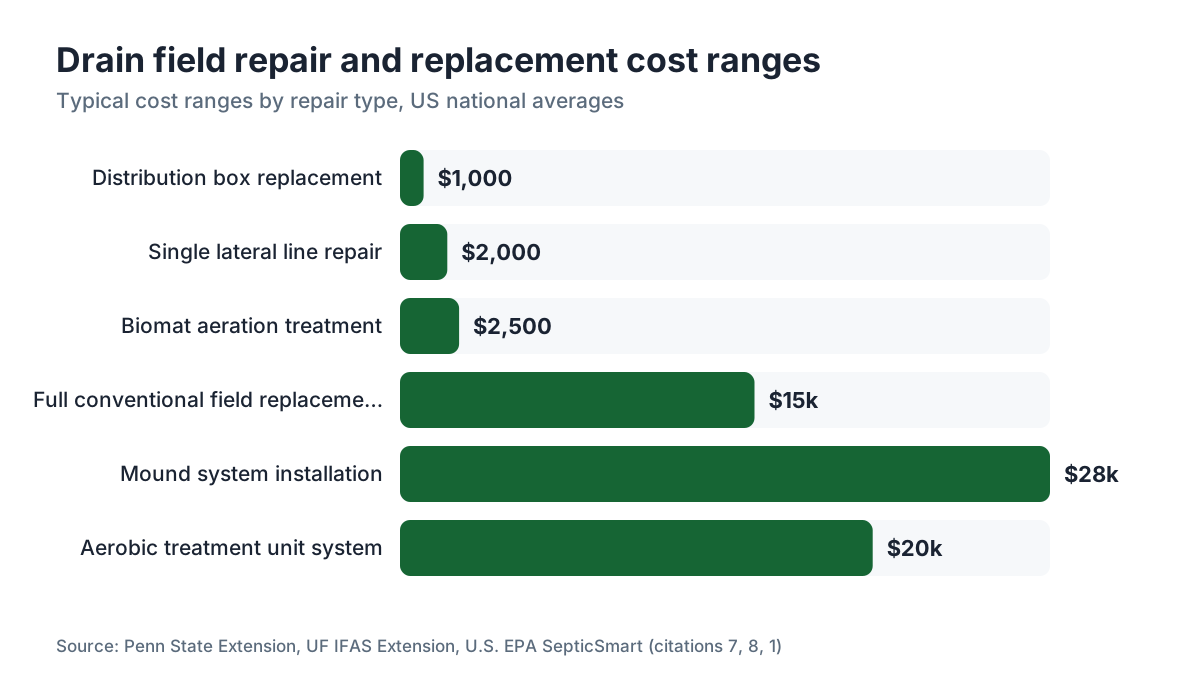
The range is huge and depends on what failed and where you live. Here's a realistic breakdown from industry pricing and state extension publications.
| Repair type | Typical cost range | Notes |
|---|---|---|
| Distribution box replacement | $500 - $1,500 | Common first fix |
| Single lateral line repair | $1,000 - $3,000 | If only one trench failed |
| Aeration/biomat treatment | $1,000 - $4,000 | Results not guaranteed |
| Field resting (alternate system required) | Variable | May need second system |
| Full conventional drain field replacement | $10,000 - $20,000 | Average lot, good soil |
| Mound system (poor soil, high water table) | $15,000 - $40,000 | Higher in difficult soils |
| Aerobic treatment unit (ATU) system | $10,000 - $30,000 | Required in some states |
These numbers line up with estimates from several state cooperative extension services [7][8]. Bids in high-cost states like California, Massachusetts, or New York can run 20 to 30 percent above these figures.
One number worth carrying around: the EPA estimates septic repairs and replacements average about $3,000 to $7,000 for targeted repairs and $15,000 to $30,000 for full system replacement, with large regional swings [1]. Nobody should quote you a firm price without a site visit and a percolation test.
On the prevention side, septic tank pumping every 3 to 5 years is the best thing you can do for the field. A pump-out costs $300 to $600 in most areas. That's cheap insurance against a $20,000 replacement.
What should you do the moment you notice drain field failure signs?
Stop adding water to the system. That's the first move. Every gallon you send down the drain while the field is saturated makes it worse and can stretch recovery time by weeks. Fix leaky faucets, park the dishwasher, skip laundry for a day or two.
Call a licensed septic contractor, not a plumber. A plumber can clear a clog, but diagnosing a field failure takes someone who can locate and open the distribution box, inspect the outlet baffle, and read the trenches. In most states this work requires a licensed onsite wastewater installer or inspector [9].
Don't let anyone sell you additives, enzymes, or bacteria products before you have a diagnosis. These are broadly unproven for active failures, and some state environmental agencies have flatly warned that they do not restore a failed field [10].
If sewage is surfacing in your yard, you may have a reporting obligation. Several states require homeowners to report surfacing sewage to the local health department within 24 to 72 hours. Check your state's onsite wastewater code. Until then, fence or mark the area and keep children and pets out.
Document everything with photos and dates before anyone disturbs the site. If a property sale is in your future, or you think the system was badly designed, your records matter.
Operators managing multiple properties can track inspection findings, pump schedules, and field conditions across a portfolio with tools like SepticMind, built for onsite wastewater service companies.
Does rain make drain field problems worse?
Yes, and this trips up more homeowners than any other part of the problem. A field that runs fine in dry weather can fail outright in a wet spring. That doesn't mean it was healthy before. It means it was marginal before, and the raised water table pushed it over the edge.
When the water table rises, the unsaturated soil below your trenches shrinks or disappears. That zone does most of the treatment and absorption. Lose it, and effluent has less room to move and less time to be treated. Systems with a seasonal high water table within 12 to 24 inches of the trench bottoms are the most exposed, which is why most state codes set a minimum vertical separation between trench bottom and seasonal high water [9].
If your system acts up every March and recovers by June, you've got a seasonally marginal field. The permanent fix usually means a mound system or another design that lifts the trenches higher in the soil. Short term, cut water use hard during wet spells and route all roof and surface drainage well away from the field.
Adding a second field and alternating between them every few years is another play. It extends field life and gives each area time to recover. Some states require dual fields for exactly this reason.
How do you find your drain field to check it?
You can't inspect what you can't find, and plenty of homeowners have no idea where their field sits, especially in older homes.
Start with your property records. Most counties keep recorded as-built drawings or permit files for septic systems. The local health department or building department is the right call. Many counties have digitized these and can email you a sketch.
If records don't exist or don't match the ground, a few physical clues help. The field is almost always downhill from the tank, usually in the most open part of the yard away from trees. Look for a rectangular area with no big trees or shrubs (roots and drain fields don't share space well). The soil over the trenches is sometimes slightly mounded or a different texture than the ground around it.
A septic locating service can use a probe or electronic equipment to find the lines. Some contractors throw this in with an inspection visit.
Once you know where the field is, mark it on a sketch and hand it to anyone who does yardwork, landscaping, or digging on your property. Heavy equipment driven over a field compacts the soil and crushes the distribution pipes. That's an easily prevented cause of failure.
See leach field for how these systems are laid out and what the different designs mean for maintenance.
How long does a drain field last and when is it time to replace it?
Most conventional drain fields are permitted with a 20 to 30 year expected lifespan, though real-world range is enormous. Fields in sandy, well-drained soil with low water use and regular tank maintenance can last 40 years or more. Fields in heavy clay, with a high water table, or fed poorly treated effluent from a neglected tank may fail in 10 to 15 years.
The EPA SepticSmart program states that "a properly designed, installed, and maintained septic system can last indefinitely" [2]. Technically true, for systems that get genuine care. In practice, most systems need some field work before the 30-year mark.
If your system is past 25 years old and showing any of the warning signs above, budget for replacement instead of hoping for repair. An aging, biomat-loaded field rarely responds well to treatment. You'll spend money on attempts that fail, then spend the replacement money anyway.
Septic tank pump out history matters a lot here. A system pumped every 3 to 5 years has far better odds of a long field life than one that went 15 years without service. The pumping schedule is the most direct lever a homeowner has over field longevity. For the right interval, see how often to pump septic tank.
If you're closing in on a replacement and want the financial picture, septic tank installation covers the whole process.
What are the health and legal risks of ignoring drain field failure?
Surfacing sewage carries fecal coliform bacteria, enteric viruses, and parasites including Giardia and Cryptosporidium [3]. Direct contact is a real health risk, worst for children and anyone with a weak immune system. Groundwater contamination from a failing field can reach a nearby well within months, depending on soil permeability and distance.
On the legal side, most states classify surfacing sewage as a public health nuisance and require prompt correction. Some require homeowners to report it to the local health department within 24 to 72 hours. Not acting can bring fines, forced connection to municipal sewer where available, or condemnation orders that bar you from occupying the property [9].
Real estate law adds another layer. Most states require you to disclose known septic defects to buyers. A field failure you knew about and hid is a liability that follows you after the sale. Buyers now routinely request septic inspections as a condition of closing, so quietly offloading a bad system is mostly a thing of the past.
There's civil exposure too. If your failing system contaminates a neighbor's well, you can face a lawsuit. Homeowners insurance rarely covers septic failures and almost never covers contamination of a neighbor's property.
The practical math is simple. A $500 inspection and a $1,500 distribution box replacement now beats a $25,000 field replacement plus a health department order plus attorney fees later.
What maintenance prevents drain field failure in the first place?
Most drain field failures are preventable, or at least pushed years down the road, with a handful of habits.
Pump the tank on schedule. The single most important thing. When solids carry into the field because the tank is full, they clog the biomat zone fast. The standard is every 3 to 5 years for a typical household, more often for large households or systems with garbage disposals [1]. See septic tank cleaning for what that service covers.
Conserve water. Hydraulic overloading is a leading cause of early failure. Spreading laundry loads across the week, fixing running toilets, and installing low-flow fixtures all cut the daily load on the field. The EPA says water conservation extends system life, though the hard data is thin.
Plant the right things over the field. Grass is ideal. Deep-rooted trees and shrubs send roots into pipes and trenches. Keep large trees 30 to 50 feet from the field edge.
Protect the field from traffic and weight. One pass by a loaded truck can compact soil and crush pipes. Mark the boundary and enforce it.
Send surface water elsewhere. Gutters, downspouts, and grading should route rainwater away from the field, not toward it. A field that stays wet fails faster than a dry one.
Go easy on the garbage disposal. Ground food waste adds a heavy solids load to the tank and speeds biomat formation in the field. If you use a disposal, pump more often.
Skip the additives. Commercial septic additives (enzymes, bacteria, yeast) have not been shown to prevent or reverse drain field problems in controlled studies [10]. Keep the money.
For operators running service schedules across many properties, tracking pump history and field notes systematically is where SepticMind earns its keep. The patterns that predict failure show up clearly once the data is organized.
Frequently asked questions
How do I know if my drain field is failing or just my septic tank is full?
Have the tank pumped and watch the next week. If slow drains and yard odors clear up completely and stay gone, the tank was the problem. If they return within a few days to a couple of weeks, the field is saturated. A qualified inspector can also check the distribution box for backflow from the trenches, which confirms field saturation without the wait.
Can a failed drain field fix itself if I stop using water for a while?
Sometimes, if the failure is mild and biomat-related. Resting a field for 6 to 12 months while diverting flow to a backup area can let the biomat break down and restore some permeability. The EPA acknowledges this approach in its guidance. But if the soil itself is physically altered, or the failure has run for years, rest alone won't fix it. Get a professional assessment before counting on recovery.
Is it safe to be in my yard if the drain field is failing?
Avoid direct contact with any soggy or surfacing area. Surfacing effluent carries fecal bacteria, viruses, and parasites. Keep children and pets away from the wet zone. If you have to walk through it, wear waterproof boots and wash up thoroughly afterward. Fence or mark the area until the problem is corrected. Contact with standing effluent is a real infection risk, not a theoretical one.
How much does it cost to replace a drain field?
Full conventional replacement typically runs $10,000 to $20,000 for a standard lot with adequate soil. Mound systems in poor or high-water-table soil run $15,000 to $40,000. Alternative systems like aerobic treatment units can reach $30,000 or more. Regional labor rates, soil conditions, and local permitting drive big variation. Get at least two bids and make sure each contractor has run a percolation test before quoting.
Can tree roots cause drain field failure?
Yes. Roots from large trees and shrubs grow toward moisture and nutrients, which is exactly what a drain field offers. They enter distribution pipes, crack them, and block flow to sections of the field. That's why codes require setbacks from trees and why you should never plant large-rooted species over or near the field. Willow, poplar, and large maple are especially aggressive. Grass is the best cover over any drain field.
Does rain cause drain field failure?
Rain doesn't cause failure, but it can push a marginal system into failure by raising the water table and saturating the soil around the trenches. A field that struggles every rainy season but recovers in dry months is already marginal. The lasting fix is usually a redesign that raises the trenches above the seasonal water table, like a mound or elevated sand mound. Short term, divert surface runoff away from the field and cut indoor water use during wet periods.
How long does a drain field last?
Design life is typically 20 to 30 years. Well-maintained systems in good soil can last 40 years or more. Systems with poor maintenance, heavy water use, clay soils, or high water tables often fail in 10 to 15 years. Regular tank pumping every 3 to 5 years is the strongest predictor of long field life. The EPA SepticSmart program says a properly maintained system can last indefinitely, but that standard is rarely met in practice.
What happens if I ignore drain field failure signs?
The system moves toward complete failure. Eventually you get sewage surfacing in the yard or backing up into the house. Beyond the health risk, most states require you to report and fix surfacing sewage. Fines, mandatory repairs, and sometimes property condemnation are possible. If you have a private well nearby, groundwater contamination is a serious concern. And selling the property means disclosing known septic defects in most states.
Do septic additives help a failing drain field?
No reliable evidence supports them for active field failure. Multiple state environmental agencies have issued guidance that additives do not restore failed drain fields. Some products may even speed biomat formation by flooding the field with extra biological activity. Keep the money, pump the tank on schedule, and conserve water. Those interventions have a real track record.
Can I put a new drain field on my property if the old one fails?
Only if you have a suitable area that passes a percolation test and meets your state's setback and soil requirements. Many properties have limited space, and the failed field often can't be reused right away because the soil is still saturated and degraded. Some states have you designate a reserve field area at original installation. On a tight lot, you may be limited to a mound system, an aerobic treatment unit, or connection to public sewer if it's available.
What is the smell from a failing drain field?
Hydrogen sulfide, the classic rotten-egg odor, is the most common. You may also notice a general sewage or raw waste smell, especially after rain or heavy water use when the system is most stressed. Odors inside the house, from floor drains or infrequently used toilets, mean pressure from a backing-up system has displaced the water seal in those traps. Any persistent outdoor sewage smell near the field warrants an immediate inspection.
What is the difference between a drain field and a leach field?
They're the same thing. Drain field, leach field, and absorption field all name the network of perforated pipes buried in gravel-filled trenches that receive effluent from the septic tank and spread it into the soil for final treatment and disposal. Regional usage varies: leach field is more common in the Northeast, drain field in the South and Midwest. The design, function, and failure modes are identical regardless of the name.
Should I be worried about drain field failure if I just bought a house?
If you didn't get a septic inspection before closing, schedule one now. Ask for the pumping history and any permit records showing the system's age and design. Fields over 20 years old with no documented maintenance deserve close attention. A pre-purchase septic inspection typically costs $200 to $500 and includes a tank inspection and a check of the field for saturation or failure. It's one of the highest-value inspections you can get on a rural property.
Can a garbage disposal cause drain field failure?
It can contribute a lot. Garbage disposals send ground food solids into the tank, which raises the solids load and speeds sludge buildup. That sludge, if you don't pump often enough, carries into the field and accelerates biomat formation. If you have a disposal, pump more often, roughly every 2 to 3 years instead of the standard 3 to 5. Some septic professionals recommend against using a disposal on septic at all.
Sources
- U.S. EPA, SepticSmart homeowner guidance: Proper maintenance is the single biggest determinant of septic system lifespan; resting a field for 6-12 months can restore some function; average replacement costs range from $3,000 to $7,000 for targeted repairs and $15,000 to $30,000 for full replacement
- U.S. EPA, SepticSmart program warning signs page: Odors inside the home or near the septic system are listed as a warning sign requiring immediate inspection
- U.S. EPA, Onsite Wastewater Treatment Systems Manual: Surfacing septic effluent contains fecal coliform bacteria, enteric viruses, and parasites including Giardia and Cryptosporidium
- U.S. CDC, Private Well Water and Septic Systems guidance: State health departments recommend testing private well water annually for households on septic; a failing field can push nitrates and pathogens into groundwater
- University of Minnesota Extension, Septic System Owner's Guide: A failed distribution box or broken lateral can cause uneven loading where one or two trenches fail while others remain dry
- North Carolina State University Extension, Homeowner's Guide to Septic Systems: Full drain field replacement costs $10,000 to $30,000 for a conventional system; mound and alternative systems can cost more in difficult soil conditions
- Penn State Extension, Septic System Costs and Maintenance: Distribution box replacement typically costs $500 to $1,500; single lateral line repair costs $1,000 to $3,000
- University of Florida IFAS Extension, Septic Tank Systems for Rural Households: Mound system installation in poor soils runs $15,000 to $40,000; aerobic treatment unit systems range from $10,000 to $30,000
- Florida Department of Health, Chapter 64E-6 Onsite Sewage Treatment and Disposal Systems: State onsite wastewater codes require minimum vertical separation between trench bottom and seasonal high water table; work requires a licensed onsite wastewater installer or inspector; surfacing sewage may require reporting to the health department
- U.S. EPA, Septic System Additives guidance: Commercial septic additives have not been shown to prevent or reverse drain field problems; some state environmental agencies have explicitly warned that they do not restore a failed field
- New England Interstate Water Pollution Control Commission: Biomat buildup at the gravel-soil interface is the most commonly cited cause of drain field failure in inspections across New England states
Last updated 2026-07-09