Septic system parts: every component explained
By the SepticMind Editorial Team
TL;DR
- A conventional septic system has four main parts: the building sewer, the septic tank (with baffles and usually an effluent filter), a distribution box or manifold, and the drain field.
- Aerobic systems add an air pump, a treatment chamber, spray heads, and a chlorinator.
- Knowing each part helps you catch failures early and dodge the $5,000 to $20,000 cost of replacing a drain field.
What are the main parts of a septic system?
Every septic system moves waste through the same four steps: collect it, separate it, treat it, disperse it. The hardware differs between a conventional gravity system and an aerobic treatment unit (ATU), but the sequence never changes.
A conventional system has four main parts:
- The building sewer (the main drain line leaving the house)
- The septic tank, including inlet and outlet baffles and usually an effluent filter
- The distribution system (a D-box, manifold, or pressure-dosed header)
- The drain field (also called a leach field or soil absorption system)
Aerobic systems keep all of that and pile on more: a blower or air pump, a treatment chamber, a pump tank with a spray or dosing pump, and a disinfection unit (usually a chlorine tablet feeder or a UV lamp).
The EPA's SepticSmart program calls a septic system "a highly efficient, self-contained, underground wastewater treatment system" that depends on each component working in order [1]. Break one link and the whole thing either backs up or dumps untreated waste into the ground. That's the reason to learn the parts. It's not trivia. It's the difference between a $300 fix and a $15,000 one.
What does each part of the septic tank do?
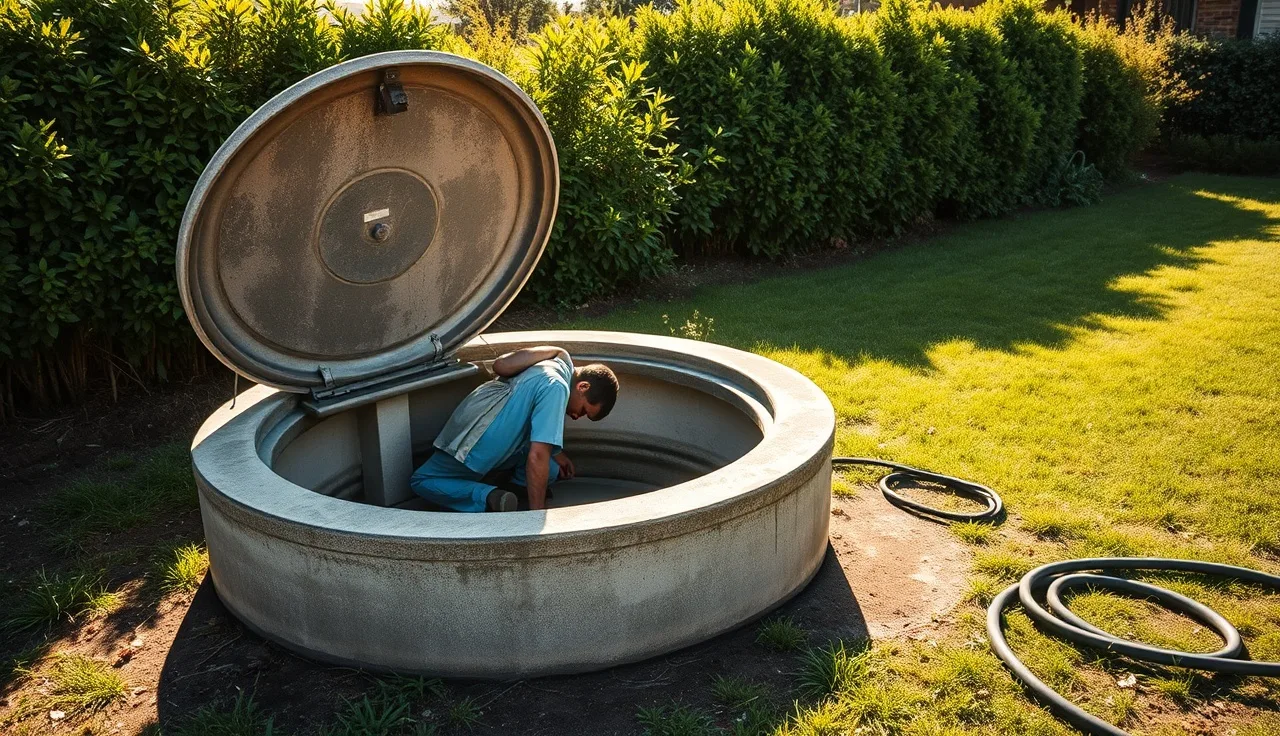
The septic tank is a watertight buried box, almost always concrete, polyethylene, or fiberglass, usually 1,000 to 1,500 gallons for a 3-to-4-bedroom home [2]. It does three jobs: hold wastewater long enough for solids to settle, trap the grease and scum that float, and let partially clarified liquid (effluent) flow downstream.
Here's what's inside.
Inlet baffle. Sits just inside the inlet pipe and pushes incoming flow downward so it doesn't stir up the settled sludge. Old tanks used a concrete tee. Most tanks built since the 1990s use a PVC sanitary tee.
Outlet baffle. Guards the outlet end and keeps floating scum from escaping the tank. This is the part that fails most in older concrete tanks, because hydrogen sulfide gas eats the concrete from the inside. A crumbling outlet baffle is one of the most common findings in a septic inspection [3].
Effluent filter. A cartridge that fits inside or over the outlet baffle. The Zabel A100 and Orenco Biotube are the two brands you'll see most. It screens out particles bigger than roughly 1/16 inch before effluent leaves the tank. EPA SepticSmart guidance recommends inspecting and cleaning the filter every year [1]. Skip it and you're on the fast track to a clogged drain field.
Riser and lid. Most tanks put in since the mid-2000s have a concrete or plastic riser running up to grade, so the pumper doesn't dig every visit. If yours is still buried 12 to 18 inches down, add a riser at your next pump-out. It runs $100 to $300 and pays for itself in saved digging.
Compartments. Many tanks split into two compartments with a wall or baffle between them. The first compartment does the heavy solids separation. The second cleans up what's left. Two-compartment tanks produce cleaner effluent than single-compartment designs.
See septic tank repair and septic tank inspection for what inspectors actually look for inside the tank.
What is a distribution box and why does it matter?
A distribution box (D-box) splits effluent evenly across your drain field trenches. It's a small concrete or plastic box, usually 12 to 24 inches wide, with one inlet pipe and several outlet pipes, one per trench. Once effluent leaves the tank, the D-box is the traffic cop that decides where it goes.
Here's the problem. If the D-box settles or tilts even a little, all the flow runs to the lowest outlet. One trench floods and fails while the others sit dry and never do any work. A failed D-box is fixable, usually $500 to $1,500 with excavation. But it gets misdiagnosed all the time, because wet spots and slow drains look exactly like a dead drain field [4].
Pressure-dosed systems ditch the D-box. They use a pump to push effluent through a pressurized header full of small orifices, which spreads flow evenly no matter the grade. More reliable, but you're now maintaining a pump and controls.
The leach field article covers the soil science behind why even distribution matters so much.
How does a conventional drain field work?
The drain field is where final treatment happens. Effluent drips from perforated pipes into gravel or a chamber, then trickles down through unsaturated soil. Aerobic bacteria living in the top foot or two of that soil break down the remaining pathogens and nutrients before the water reaches groundwater [1].
A standard gravity trench system has:
- Perforated 4-inch PVC pipe running down each trench
- Gravel or crushed stone around the pipe
- A layer of geotextile fabric between the gravel and the backfill soil
- 18 to 36 inches of soil cover
Chamber systems (Infiltrator, ADS) swap the gravel and perforated pipe for open-bottomed plastic arches. They install faster, handle heavier loads, and now dominate new construction in most states.
Sizing depends on soil percolation rate and bedroom count. Your state's onsite wastewater code sets the required absorption area, and most states track close to the EPA's design guidance [5]. Typical numbers run 150 to 300 square feet of trench bottom per bedroom.
A well-maintained drain field lasts 25 to 50 years. The thing that kills it is hydraulic overload, usually solids or grease that escaped the tank and clogged the soil pores. That's why the effluent filter earns its keep [3].
What are the parts specific to an aerobic septic system?
An aerobic treatment unit (ATU) treats wastewater to a much higher standard than a plain tank, and it needs more hardware to do it. States with bad soil, high water tables, or lots near lakes and streams often require them. Texas has the biggest installed base in the country. Estimates put ATUs at roughly 15 to 20 percent of onsite systems in some southern states, though solid national data is thin.
Here are the parts an ATU has that a conventional system doesn't.
Air pump (blower). The heart of the whole thing. It pumps air into the treatment chamber nonstop, feeding oxygen to aerobic bacteria that chew through waste far faster than the anaerobic bacteria in a conventional tank. Hiblow, Medo, and Gast are the common brands. A residential air pump draws about 40 to 80 watts and runs 24/7.
Treatment chamber. The aeration zone. The blower's air bubbles up through the wastewater here, and suspended bacteria (activated sludge) break down the solids.
Clarifier. A calm zone inside or after the treatment chamber where treated water settles before it moves on.
Pump tank (dosing tank). Holds treated effluent before dispersal. Inside sit the spray or dosing pump, the float switches (usually three: a low alarm, a pump-on, and a high-water alarm), and the wiring back to the control panel.
Spray pump or effluent pump. Sends treated water to spray heads across the yard, or to a subsurface field. Residential spray pumps run 1/2 to 1 HP.
Spray heads. Pop-up heads that look like lawn irrigation heads, usually on 6-to-12-inch risers. They need a setback from property lines, wells, and buildings. Rules vary by state, but 10 feet off the property line is common.
Chlorinator. A chamber holding chlorine tablets (trichlor or calcium hypochlorite) that effluent flows past before discharge. Newer systems sometimes use a UV lamp instead. Most state codes want a chlorine residual of 0.5 to 1.0 mg/L at the discharge point.
Control panel. Mounted on the house or a nearby post. It powers both pumps, reads the float switches, and sets off an alarm (a buzzer, a light, or both) when something breaks.
Operators juggling a fleet of ATU service agreements can track air pump runtime, service schedules, and compliance paperwork for every account in one place with SepticMind's platform, which cuts down on missed visits.
| Component | Conventional System | Aerobic (ATU) System |
|---|---|---|
| Septic/pretreatment tank | Yes | Yes (pretreatment tank) |
| Outlet baffle / effluent filter | Yes | Yes |
| Air pump / blower | No | Yes, runs continuously |
| Treatment / aeration chamber | No | Yes |
| Chlorinator or UV unit | No | Yes |
| Pump tank with float switches | Sometimes (pressure dose) | Yes |
| Spray heads or subsurface dispersal | No (gravity trenches) | Often spray heads |
| Control panel with alarms | No | Yes |
| Annual maintenance contract required | Recommended | Required in most states |
What does the aerobic septic system air pump do and how long does it last?
The air pump is the part that makes an aerobic system aerobic. Without steady aeration, the treatment chamber goes anaerobic, the bacteria population crashes, and you start pushing partially treated sewage out the discharge. Most state rules require the alarm to warn the homeowner within 24 hours of a blower failure [6].
Residential ATU air pumps are almost always linear diaphragm compressors. The Hiblow HP-80 and HP-100 are everywhere; the Medo LA-80B is the other big name. They push 80 to 100 liters per minute at low pressure, around 1 to 1.5 PSI. Quiet, efficient, built to run without stopping.
Expect 3 to 5 years out of the diaphragm assembly and 5 to 10 years out of the motor housing, as long as the unit stays dry and you clean the air filter twice a year. A clogged air filter is the number one cause of early death. The pump overheats fighting to push air through a choked inlet.
Air pump not running? It's almost always one of four things: a tripped breaker, a blown thermal fuse inside the unit, worn diaphragms (the pump hums but moves no air), or a seized motor. Check the breaker first. If it hums but the aeration chamber isn't bubbling, the diaphragms are shot.
Replacing the air pump runs $150 to $400 for the pump, plus $100 to $200 for a service call if you're not handy. Hiblow and Medo both sell rebuild kits (diaphragms and valve plates) for $30 to $60 that add years of life [7].
The spray pump in the pump tank is a different beast. It's a submersible effluent pump, close cousin to a sump pump, and costs $200 to $600 to replace depending on horsepower and brand. Goulds, Zoeller, and Liberty are the usual picks.
What parts fail first and what are the warning signs?
Knowing which parts die first keeps you ahead of the emergency repair bill. Here's the order of trouble.
Outlet baffle (conventional). Concrete corrodes from hydrogen sulfide. A corroded baffle lets solids slip out to the drain field. The warning sign is slow drains with no indoor plumbing cause, or a failed inspection. Fix it now. Solids in the drain field are a death sentence for the trenches.
Effluent filter (conventional and ATU pretreatment tank). Clogs over time. Warning: slow drains that clear after heavy rain, or a full tank at pump-out even though you're on schedule. Clean it every 1 to 3 years.
D-box (conventional). Settles or cracks. Warning: one patch of yard is always wet while the rest of the field is bone dry. Confirm it with a dye test or a camera.
Air pump diaphragms (ATU). Wear out every 3 to 5 years. Warning: alarm light on, no bubbling in the aeration chamber, or dead silence when the pump should be running.
Float switches (ATU pump tank). Stick high or low from grease coating or tangling. Warning: the pump runs constantly (float stuck low) or never runs (float stuck high, then the high-water alarm goes off).
Chlorinator (ATU). The tablet feeder scales up or the tablets run out. Warning: the effluent smells, or the quarterly visit shows zero chlorine residual. In states that require disinfection, that's a compliance violation.
Spray heads (ATU). Clog with scale or get clipped by a mower. Warning: soggy spots near certain heads, or heads that won't pop up during a dose.
For pump-specific diagnosis and repair costs, septic system repair goes deeper.
How much do septic system parts cost to replace?
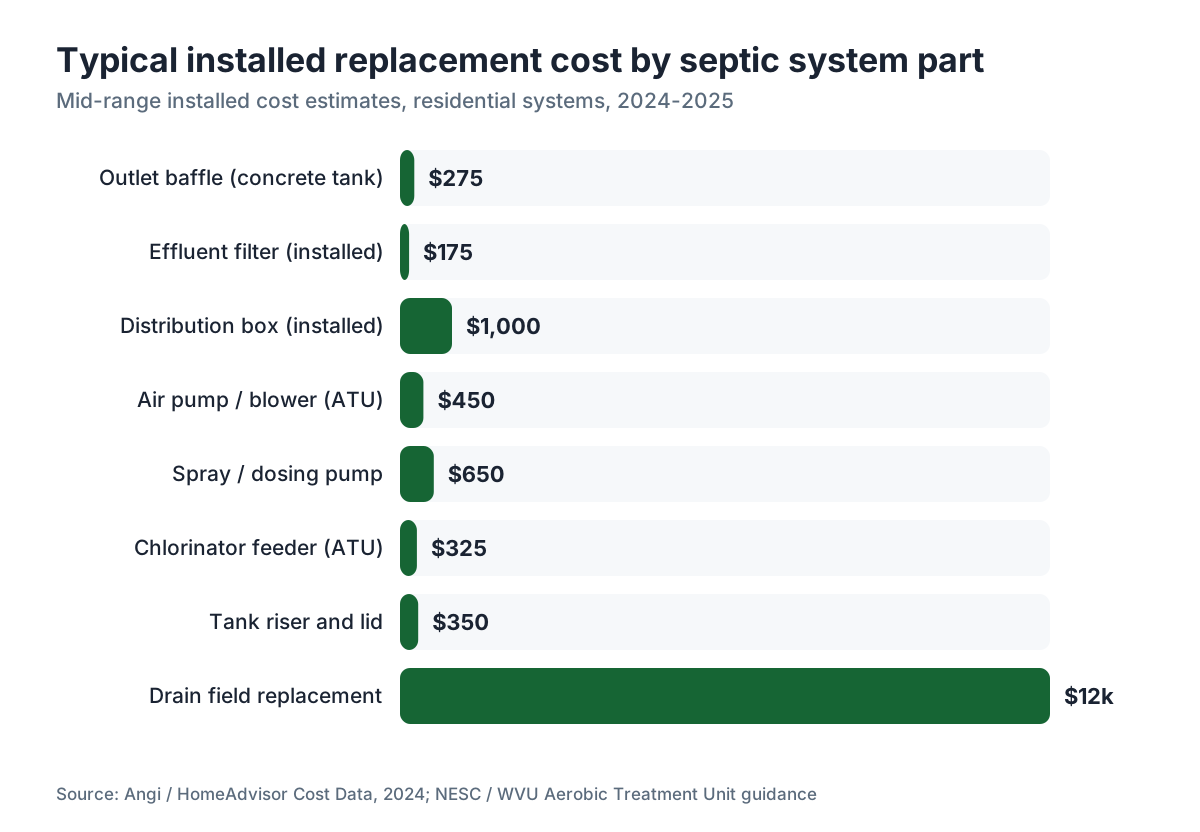
These are real ranges based on industry pricing for 2024-2025. Labor swings hard by region; the figures below assume a qualified service technician.
| Part | DIY Part Cost | Installed Cost (typical) |
|---|---|---|
| Outlet baffle (concrete tank) | $20-$60 | $150-$400 |
| Effluent filter (Zabel, Orenco) | $30-$80 | $100-$250 |
| Distribution box | $40-$120 | $500-$1,500 |
| Air pump / blower (ATU) | $150-$350 | $300-$600 |
| Air pump rebuild kit | $30-$60 | $100-$200 |
| Spray pump (effluent pump) | $200-$500 | $400-$900 |
| Float switch (single) | $15-$50 | $100-$250 |
| Chlorinator (replace feeder) | $80-$200 | $200-$450 |
| Spray heads (each) | $5-$25 | $50-$150 |
| Tank riser and lid | $100-$300 | $200-$500 |
| Full ATU component overhaul | N/A | $800-$2,500 |
Drain field replacement lives in a different world: $5,000 to $20,000 or more depending on system type, soil, and local permit fees [8]. That's the number that makes every other line in this table look like pocket change.
For installation from scratch, see cost to install septic system and cost to put in a septic tank.
How do you maintain every part of a septic system?
Different parts, different schedules. Here's the maintenance calendar for each one.
Septic tank: Pump every 3 to 5 years for a typical household [9]. EPA SepticSmart materials say to "have your septic system inspected at least every three years by a septic service professional and your tank pumped when necessary (generally every three to five years)" [1]. For a household of four with a 1,000-gallon tank, every 3 to 4 years is the safe call. See how often to pump septic tank for the math.
Effluent filter: Clean every 1 to 2 years, or at every pump-out at minimum. Pull the cartridge, hose it off into the tank, put it back.
ATU air pump filter: Clean every 6 months. Most manufacturers spell this out. Skip it and you void the warranty and kill the pump early.
ATU chlorinator: Add tablets every 1 to 3 months depending on tablet size and household use. Check the feeder for scale every quarter.
Spray heads: Inspect monthly during the operating season. Clean with a small brush if a head won't retract.
Control panel: Test the alarm once a year by briefly lifting the high-water float.
Whole ATU: Most states require a maintenance contract with a licensed provider for aerobic systems. Texas requires inspections every four months with a report filed to the local authority [6]. Frequency varies, but annual professional inspection is the floor everywhere.
For the full pump-out procedure, septic tank pumping and septic tank pump out walk through the service visit start to finish.
Operators running dozens of ATU maintenance agreements lean on automated scheduling and compliance tracking. SepticMind's software does that, routing technicians, logging service records, and flagging systems that are overdue.
Do aerobic septic systems have different parts than conventional ones?
Yes, and it's not a small difference. A conventional gravity system has maybe six or seven distinct parts. A residential ATU can have fifteen or more, each with its own way to fail and its own maintenance schedule.
The regulations follow the hardware. Most states treat ATUs as engineered devices that need ongoing oversight. A conventional system in most places needs a permit to install and a pump-out every few years, with nobody checking in between. An ATU almost always needs a service contract and regular reports to a state or county health department [6].
The money follows too. A conventional concrete tank with a gravity drain field has almost no moving parts and runs maybe $300 to $500 a year in a good year. An ATU with spray irrigation can run $400 to $800 a year in contract fees plus parts, just to stay compliant and working [10].
None of this is an argument against ATUs. On tight lots, high water tables, or weak soils, they're often the only option that protects public health and passes code. But homeowners moving from a conventional system to an aerobic one almost always underestimate the cost and hassle of keeping it running.
Can you replace aerobic septic system parts yourself?
Some parts, sure. Others, no, or at least not legally. Here's the honest line between them.
Swapping an air pump is easy on most systems. Kill the power, pull the air line, drop in the new pump, reconnect. A handy homeowner does it in under an hour. Same story with cleaning the effluent filter, adding chlorine tablets, and cleaning spray heads. All fair game.
Replacing float switches means working inside the pump tank, a confined space with hydrogen sulfide risk. Doable for someone with the right tools and a healthy respect for the gas, but not a casual Saturday job.
Anything touching the control panel wiring, the dosing pump, or the treatment chamber itself is almost certainly regulated work in your state. Licensing rules for onsite wastewater vary, but most states require a licensed installer or certified maintenance provider for any repair that affects how the system performs [6].
And here's the part people forget: if your ATU is under a required maintenance contract, unauthorized repairs can void the contract and land you in trouble with the county health department. Call your service provider first. Ask what you're allowed to touch, and get the answer in writing if it's anything beyond the obvious consumer tasks (tablets, filter cleaning, air filter cleaning).
For major tank work, septic tank repair covers what licensed techs actually do and when a tank is past saving.
What should you know before buying a home with a septic system?
Get an independent inspection before you close. Not the seller's report. Hire a licensed inspector who watches a pump-out and evaluates every accessible component: tank condition, baffle integrity, effluent filter, D-box, and any sign the drain field is failing [11].
If the home has an ATU, ask for the service records. A well-kept ATU comes with a folder of quarterly or semi-annual reports going back years. No records is a red flag. It usually means the maintenance contract lapsed and the system has been running neglected.
Find out how old the system is. Concrete tanks from the 1960s and 1970s are often near the end of their structural life. Drain fields built before effluent filters were standard have taken years of solids-laden effluent. An ATU past 20 years may need a full control panel and component replacement no matter how it looks.
See septic tank inspection for a full pre-purchase checklist.
Ask whether the property has a reserve drain field area. Most modern codes require one to be set aside and left untouched. If the original field ever fails, the reserve is where the replacement goes. A reserve that's been built over or planted with trees is a very expensive problem sitting in wait.
Frequently asked questions
What are the four main parts of a septic system?
The four main parts are the building sewer (the drain line from the house), the septic tank with its baffles and effluent filter, the distribution system (a D-box or pressure manifold), and the drain field where treated effluent disperses into the soil. Every residential system, conventional or aerobic, follows this sequence. Aerobic systems add aeration, disinfection, and spray dispersal parts on top of that framework.
How often should an aerobic septic system air pump be replaced?
Most residential ATU air pump diaphragms last 3 to 5 years with normal use. The full pump housing may last 5 to 10 years if you clean the air intake filter every 6 months. A clogged filter is the leading cause of early failure. Rebuild kits with new diaphragms and valve plates cost $30 to $60 and can add years of life between full replacements.
Why is my aerobic septic system air pump not running?
Start with the circuit breaker and the outlet the pump plugs into. If power checks out, listen to the pump. A hum with no airflow means worn diaphragms. Dead silence usually means a tripped thermal fuse or a seized motor. A high-water alarm plus no pump operation is a service call. Don't leave the system without aeration more than 24 to 48 hours, or the bacteria population crashes.
What does an effluent filter do and when should it be cleaned?
An effluent filter (the Zabel A100 and Orenco Biotube are common) mounts at the outlet baffle and screens particles bigger than about 1/16 inch before effluent leaves the tank. It keeps solids out of the drain field, where they clog soil pores. Clean it every 1 to 2 years or at every pump-out. A clogged filter causes slow drains, and if ignored long enough it forces solids past it into the field.
What is a distribution box in a septic system?
A distribution box (D-box) is a small concrete or plastic junction box that splits effluent from the tank evenly across the drain field trenches. If it shifts or settles out of level, all the flow runs to one trench and overloads it while the others sit dry. A tilted D-box is one of the most common and most misdiagnosed causes of apparent drain field failure. It usually fixes for $500 to $1,500 instead of a full field replacement.
How much does aerobic septic system pump replacement cost?
An air pump (the blower) costs $150 to $350 for the part and $300 to $600 installed. The spray or dosing pump in the pump tank costs $200 to $500 for the part and $400 to $900 installed. Air pump rebuild kits run $30 to $60 and are worth trying first if the pump is under 10 years old. Prices vary by region; coastal and mountain areas often run 20 to 30 percent higher.
What happens if the outlet baffle in my septic tank fails?
A failed outlet baffle lets floating scum and solids leave the tank and travel to the drain field. Solids clog the soil pores that do the final treatment, and a clogged field usually cannot be fully restored. This is the most common path to a $5,000 to $20,000 drain field replacement. Replacing a failed baffle costs $150 to $400 and takes a technician under an hour. It's one of the highest-value repairs in septic maintenance.
Do aerobic septic systems require a maintenance contract?
In most states, yes. Because ATUs are mechanical systems that discharge treated effluent, state rules typically require a service contract with a licensed provider plus periodic inspections with reports filed to the county or state. Texas requires inspections every four months. Skipping required maintenance can bring fines, a notice of violation, and an order to repair or replace the system on your dime.
What is the difference between a septic tank and an aerobic treatment unit?
A conventional septic tank uses anaerobic bacteria (no oxygen) to partially treat wastewater, then disperses effluent into the soil for final treatment. An aerobic treatment unit (ATU) actively pumps air into the wastewater, feeding aerobic bacteria that reach much higher treatment levels before dispersal. ATUs produce cleaner effluent and work on smaller or less permeable lots, but they cost more to install and need ongoing mechanical maintenance.
How long do septic system parts last?
Concrete tanks last 40 or more years if the concrete stays sound and the baffles are maintained. Plastic and fiberglass tanks last just as long with a proper install. Drain fields last 25 to 50 years with good loading and solids control. ATU air pump diaphragms last 3 to 5 years. Spray pumps last 5 to 10 years. Float switches last 5 to 15 years. Effluent filters last indefinitely if cleaned. The weak links are always the moving and plastic parts in ATUs.
What type of chlorine tablets go in an aerobic septic system?
Most ATU manufacturers specify 3-inch trichlor (trichloroisocyanuric acid) tablets, the same chemistry used in pools. Some require calcium hypochlorite tablets instead, so check your system's manual because the wrong tablet can damage the feeder housing. Consumption varies with use but usually runs 1 to 4 tablets per month for a residential system. Never use dichlor tablets; they dissolve too fast and can spike chlorine levels.
Can I add a riser to my existing septic tank?
Yes. A licensed pumper or installer can add a concrete or plastic riser to most existing tanks, including older concrete ones without access risers. The riser attaches over the existing opening and extends up to grade, so nobody has to dig at every service visit. Cost is typically $200 to $500 per riser installed. Most tanks have two openings, at the inlet and outlet ends, and adding risers to both is the practical move.
What parts should be inspected during a septic tank pump-out?
A thorough pump-out should include the inlet and outlet baffles, the effluent filter (pull it, inspect it, clean it), the tank walls for cracks or root intrusion, the lids and risers for integrity, and a rough check of scum and sludge layer depth before pumping. The technician should note the pump-out interval and tell you if the sludge buildup suggests pumping more often. For ATUs, float switches and alarm function should get tested too.
What is a septic tank's effluent filter, and is it standard on all tanks?
An effluent filter is a removable cartridge that mounts at the outlet baffle to screen solids before effluent leaves the tank. It's been standard on new installations in most states since the 1990s and 2000s, but plenty of older tanks still lack one. Adding an Orenco Biotube or Zabel A100 to a tank without one costs $100 to $250 installed, and it's one of the best preventive investments you can make to protect the drain field.
Sources
- U.S. EPA SepticSmart Program: EPA describes septic systems as self-contained underground wastewater treatment systems and recommends effluent filter inspection and tank inspection every 3 years with pumping every 3 to 5 years
- U.S. EPA, Onsite Wastewater Treatment Systems Manual (EPA/625/R-00/008): Typical residential septic tank size is 1,000 to 1,500 gallons for a 3- to 4-bedroom home
- U.S. EPA SepticSmart Program: Solids escaping a failed outlet baffle clog drain field soil pores; effluent filter maintenance protects the field
- Penn State Extension, Septic System Operation and Maintenance: A settled or tilted distribution box directs all flow to one trench and is a common misdiagnosed cause of apparent drain field failure
- U.S. EPA, Design Manual: Onsite Wastewater Treatment and Disposal Systems: Drain field sizing is governed by soil percolation rate; typical requirements run 150 to 300 square feet of trench bottom per bedroom
- Texas Commission on Environmental Quality, Aerobic Sewage Treatment Systems (30 TAC Chapter 285): Texas requires ATU inspections every 4 months with reports filed with local authority; most states require alarm notification within 24 hours of blower failure and licensed providers for performance repairs
- Hiblow USA, HP Series Linear Air Pump Product Documentation: Manufacturer specifies air intake filter cleaning every 6 months and diaphragm rebuild as primary maintenance for HP-80 and HP-100 series pumps
- HomeAdvisor / Angi, Septic System Replacement Cost Guide: Drain field replacement costs $5,000 to $20,000 or more depending on system type, soil conditions, and local permit fees
- U.S. EPA SepticSmart Program: EPA recommends pumping a typical household septic tank every 3 to 5 years
- National Environmental Services Center (NESC), West Virginia University: Annual service contract costs for residential ATU systems typically range from $400 to $800 per year covering required inspections and parts
- American Society of Home Inspectors (ASHI), Standards of Practice: Pre-purchase septic inspection should include observation of pump-out, baffle condition, effluent filter, distribution box, and visible drain field signs
Last updated 2026-07-09