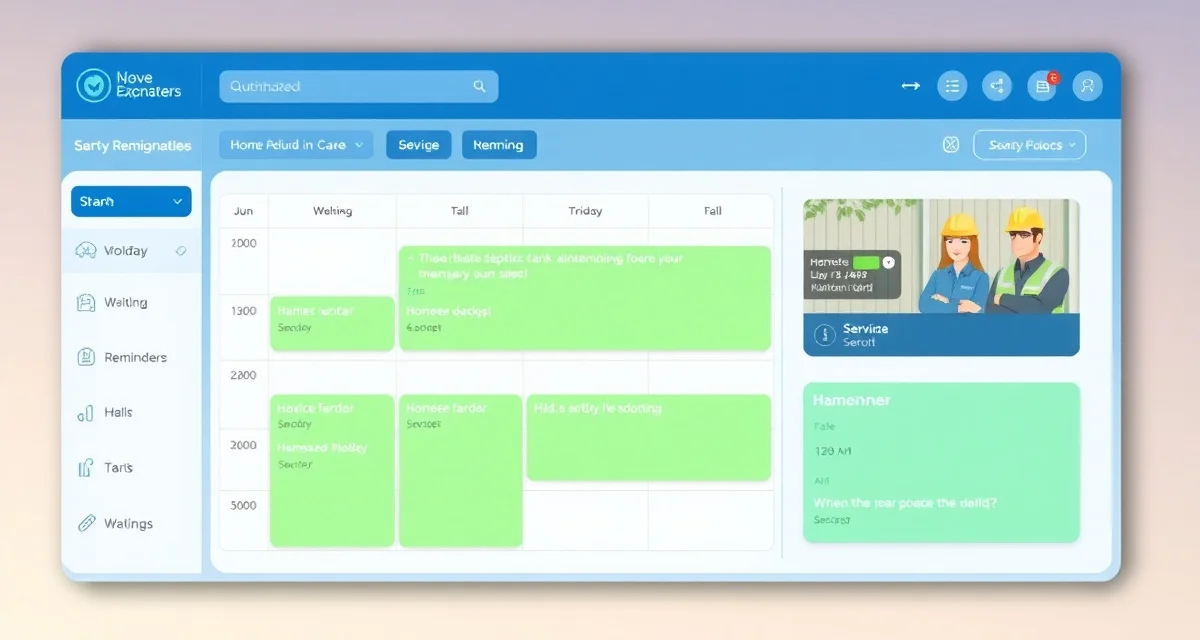
Septic Maintenance Reminder Software That Fills Your Schedule Before Customers Call You
By the SepticMind Editorial Team
The average homeowner doesn't think about their septic tank until something goes wrong. They don't remember when it was last pumped. They can't tell you the tank size. They have no idea what a 3-bedroom house on a 1,000-gallon tank looks like when it's overdue by a year.
TL;DR
- Septic Maintenance Reminder Software That Fills Your Schedule Before Customers Call You is designed to address the specific workflow and compliance requirements of septic service operations.
- Purpose-built septic software handles permit tracking, state inspection report templates, and tank data management that generic platforms do not offer.
- Companies managing ATU contracts, multi-county permit portfolios, or real estate inspection volume need software designed around those workflows.
- Mobile access allows field technicians to complete and submit inspection reports before leaving a property.
- Cloud-based platforms ensure records are accessible from any device and backed up automatically.
- Switching costs from generic software are real, so evaluating septic-specific platforms early saves migration pain later.
Your most loyal customers aren't calling you every 3 years to schedule their next pump. They're calling you when sewage backs up into the shower. That's an expensive emergency for them and a reactive, unpredictable revenue stream for you.
Automated maintenance reminders change this dynamic. They move you from reacting to emergencies to managing a predictable schedule. They turn your existing customer base into a reliable forward revenue pipeline. And they do it without requiring an office staff member to manually track every account.
The Business Case for Maintenance Reminders
Most septic companies have 200–600 active accounts. Assume an average pump interval of 3 years. That's 65–200 accounts due for service this year. Do you know which ones they are right now?
If the answer is "kind of", a mix of customer calls, memory, and a stack of service records you check manually when it comes up, you're leaving a significant amount of booked revenue to chance.
At $350–$450 per pump-out, 65–200 accounts due per year represents $22,000–$90,000 in annual revenue that depends entirely on customers remembering to call you. Maintenance reminders capture the ones who won't.
Studies on field service businesses consistently show that proactive reminder systems recover 30–45% of customers who would otherwise drift to a competitor or simply delay service past the safe interval. For a company with 400 active accounts, that's 40–70 additional jobs per year from customers you already have relationships with.
How SepticMind Calculates Service Intervals
The Variables That Actually Matter
Service intervals aren't one-size-fits-all. They depend on:
Tank capacity. A 1,000-gallon tank and a 2,000-gallon tank on the same household fill at the same rate, the larger tank just takes longer to fill. Tank capacity is the most important variable in interval calculation.
Household size. The EPA estimates that a typical household generates roughly 50–70 gallons of wastewater per person per day. A 4-person household generates twice the load of a 2-person household. Interval calculations that ignore household size are wrong for half your customers.
System type. A standard gravity-fed system follows the standard interval calculation. An ATU (aerobic treatment unit) requires more frequent maintenance visits, typically every 6 months in most states, regardless of load. A cesspool fills at a different rate than a septic tank. Sand filters and drip irrigation systems have their own maintenance schedules.
Actual service history. How much was the tank actually holding when it was last pumped? A tank pumped at 70% capacity vs. one pumped at 25% capacity tells you different things about how fast it fills. SepticMind adjusts future interval predictions based on actual pump volume history.
The Calculation
SepticMind's service interval engine runs this calculation for every customer account:
- Pull tank capacity from the customer record
- Apply EPA per-person-per-day wastewater generation rate × household size
- Calculate annual sludge accumulation rate
- Adjust for actual historical pump volumes if available
- Add safety margin to stay ahead of maximum safe capacity
- Generate a predicted service date
- Set reminder sequence to fire 60 days, 30 days, and 7 days before predicted date
For ATUs and other systems with regulatory maintenance requirements, SepticMind uses state-specific interval rules rather than the capacity calculation.
The Reminder System
Three-Touch Sequence
SepticMind sends a three-touch reminder sequence for each account:
60-day reminder:
"Hi [First Name], this is [Company Name]. Your septic system is coming up for its scheduled maintenance. We recommend scheduling before [Month]. Click here to book online or call us at [number]."
30-day reminder:
"[First Name], your septic service is scheduled for next month. Slots are filling up, book now to get your preferred time. [booking link]"
7-day reminder:
"Your septic service is coming up this week! Book your appointment today. [booking link] or call [number]."
Text vs. Email
Customers indicate their preferred contact method when you capture their information. SepticMind sends by their preference. If you don't have a preference on file, SepticMind defaults to text (which has a dramatically higher open rate than email for service reminders).
Text open rates for service reminders typically run 85–95%. Email open rates run 20–35%. The difference is significant when you're running 50 reminder sequences at a time.
Customizing the Messages
You can edit the reminder message templates in SepticMind's settings. Add your company name, adjust the tone, include a special offer for customers booking their first appointment through the portal. Messages can include:
- Company name and branding
- Tech name if you want to use a named sender
- Booking link to your customer portal
- Phone number
- Optional promotional offer
The messages use the customer's first name automatically pulled from the record.
Non-Responder Follow-Up
Customers who don't respond to the automated sequence are flagged in SepticMind after the 7-day reminder passes. Your office gets a list each morning of non-responders, accounts that have received all three reminders and haven't booked. These accounts are candidates for a direct phone call.
The follow-up call list is pre-built for you. Your office staff doesn't have to figure out who to call. They open SepticMind in the morning and the list is there.
Managing ATU Maintenance Contracts
Aerobic treatment units are a special case. Most state regulations require:
- Maintenance visits every 6–12 months (varies by state)
- A licensed operator to conduct each visit
- A maintenance report filed with the county after each visit
- Active maintenance contract on file
For customers on ATU maintenance contracts, SepticMind manages the entire schedule:
- Recurring maintenance visits are scheduled automatically at the contract interval
- Reminders go to the customer 2 weeks before each visit
- After the visit, the maintenance report is generated and filed
- Contract renewal reminders fire 90 days before expiration
For a company with 40 ATU accounts on contract, this automation eliminates hours of manual tracking per month.
Get Started with SepticMind
The right software for a septic company handles compliance and documentation alongside scheduling and billing, not just the basics. SepticMind is built specifically for septic operations, from county permit tracking to ATU maintenance management. Start a free trial to evaluate it against your workflow.
FAQ
How far in advance does SepticMind start sending reminders?
SepticMind sends the first reminder 60 days before the predicted service date, with follow-ups at 30 days and 7 days. For ATU maintenance contracts and other recurring service schedules, reminders go out 14 days before the scheduled visit. You can adjust the timing of each reminder in the settings. Some companies prefer a 90-day first touch for customers in rural areas where scheduling lead time is longer. Others prefer a tighter 30/14/7 sequence for customers in denser service areas where same-week availability is common.
Can I customize the reminder messages?
Yes. SepticMind's message templates are fully editable. You can write your own text and email messages, include your branding and phone number, add a booking link, or include a promotional offer. Messages can be personalized with the customer's name, their last service date, or a predicted service due date. Many companies customize the messaging by service type, pump-out reminders have a different message than ATU maintenance reminders or real estate inspection follow-ups.
What happens if a customer books online after receiving a reminder?
When a customer books through the SepticMind customer portal, the job appears immediately in your dispatch queue. The reminder sequence for that customer stops automatically, they won't receive the 30-day or 7-day reminders once they've booked. You see the booking in your schedule, the customer receives a confirmation by text and email, and if you want to confirm the appointment personally, their contact information is right there in the job record.
What makes Septic Maintenance Reminder Software That Fills Your Schedule Before Customers Call You different from general field service software?
The primary differences are septic-specific features: county permit databases, state inspection report templates formatted for regulatory submission, tank size and system type records that drive service interval calculations, and ATU maintenance contract management. General field service platforms can handle scheduling and invoicing but require manual workarounds for every compliance and documentation task that purpose-built septic software handles automatically.
Is there a free trial available to test the software?
SepticMind offers a free trial period so you can evaluate the platform with your actual workflow before committing. The trial includes access to the permit database, inspection report templates, and scheduling tools. Most companies complete their evaluation within two to three weeks and have a clear picture of how the platform fits their operation before the trial ends.
Try These Free Tools
Sources
- National Onsite Wastewater Recycling Association (NOWRA)
- US EPA Office of Wastewater Management
- NSF International
- Water Environment Federation
- National Environmental Services Center (NESC)