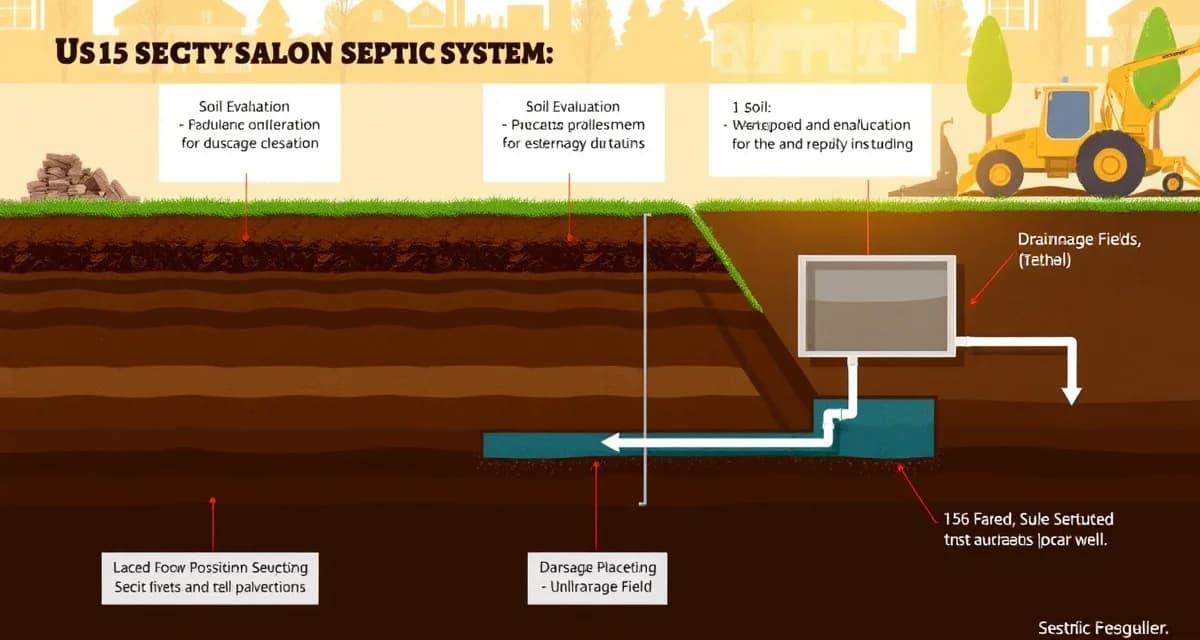
Septic System Installation Best Practices: A Guide for Installers
By the SepticMind Editorial Team
Improperly installed septic systems fail at 3x the rate of systems installed following best practices. That statistic reflects a consistent pattern: most early system failures trace back to skipped or rushed steps in the installation process. Installation shortcuts that skip site evaluation steps lead to system failures within 5-10 years, and often earlier when the shortcuts involve drainage, soil contact, or setback compliance.
TL;DR
- Soil evaluation and percolation testing are required before installation in virtually all jurisdictions and directly determine system design options.
- System sizing based on the number of bedrooms is a minimum standard; high-water-use households or commercial applications require adjusted design criteria.
- Proper distribution pipe levelness in the drainfield is the installation detail most directly affecting long-term system performance.
- Installation inspection by the county or state at defined checkpoints is required before backfilling, and inspectors must physically observe the components before soil covers them.
- Documentation of installation including photos of tank placement, drainfield layout, and pipe depths creates a record that supports future service and repair work.
- Common installation errors including improper tank depth, unlevel distribution pipes, and inadequate gravel depth are the most frequently cited causes of early system failure.
SepticMind's installation project type tracks every required step from soil percolation testing through final inspection so nothing gets skipped under schedule pressure.
Phase 1: Site Evaluation
A complete site evaluation is the foundation of a good installation. The decisions made during site evaluation (system type, sizing, location) determine whether the installed system performs adequately for its design life.
Percolation testing. Perc testing measures the rate at which soil absorbs water. Results drive drainfield sizing under most state regulations. Follow your state's prescribed testing protocol exactly: correct number of test holes, correct presaturation period, correct measurement interval. Shortcuts in perc testing produce unreliable results that either undersell the site (requiring a larger system than needed) or overestimate absorption (producing an undersized drainfield that fails prematurely).
Soil profile evaluation. Look at what's below the surface. A soil evaluation identifies soil texture, structure, and any limiting layers, hardpan, seasonal high water table, bedrock. The limiting layer depth determines whether a conventional drainfield is approvable and what separation distance from the high water table can be achieved.
Seasonal high water table. In many states, you're required to determine the seasonal high water table depth, not just the current water table. A site that looks good during a dry August may have a water table within 12 inches of the surface in April. Know what your state's rules require for water table determination and document accordingly.
Setback measurement. Measure all required setbacks before finalizing the site plan: from wells, from property lines, from structures, from surface waters, from wetlands. Measure from the correct reference points, "well" and "property line" sound obvious, but the measurement reference (top of casing vs. wellhead, edge of right-of-way vs. recorded property line) matters for accurate compliance determination.
Phase 2: Permit Application
Submit a complete permit application before breaking ground. The permit protects you, it documents that a regulatory authority reviewed and approved your design before installation.
Required documentation. Most permit applications require: site plan with setback measurements shown, soil evaluation results, perc test results, proposed system design drawing, property legal description, and your installer credentials. Missing documents slow approval and create opportunities for permit conditions you didn't anticipate.
Permit conditions. Read the approved permit conditions before starting work. Permit conditions sometimes include requirements beyond the standard rules, construction timing restrictions, specific materials requirements, inspection hold points. Conditions you didn't read can cause inspection failures after installation is complete.
Hold points. Identify every inspection hold point, the stages where you must stop work and wait for an inspector before proceeding. Covering a drainfield before the inspector has signed off on the excavation is one of the most common and costly installation mistakes. Mark hold points in your project schedule before starting.
Phase 3: Excavation and Bedding
Excavation equipment choice. Match your equipment to the site. Oversized equipment compacts native soil that should remain uncompacted for drainage. Equipment that's too small may not achieve the design depth cleanly. The sidewalls of the drainfield trench matter, smearing sidewalls with a bucket can create a glazed surface that reduces absorption.
Native soil protection. Don't allow equipment to travel over the drainfield area before installation. Compacted native soil under a drainfield reduces absorption capacity. Establish equipment paths that stay off the drainfield footprint.
Bedding depth. Install aggregate (gravel or approved equivalent) at the specified depth. Under-bedding reduces effective drainfield volume. Aggregate that's too deep doesn't improve performance and wastes material cost. Record actual bedding depth at multiple points as part of your installation documentation.
Pipe slope. Drainfield distribution pipes require accurate slope, too steep, and effluent runs to the end of the trench rather than distributing across the full length; too flat, and effluent ponds in low spots. Use a level and verify slope at both ends and midpoint of each lateral.
Phase 4: System Installation
Tank installation. Set the septic tank on a stable, level bed. Tank settling after installation causes inlet or outlet pipe joint failures and can shift the tank enough to affect cover accessibility. In areas with high water tables, tanks need to be anchored or weighted against buoyancy during installation if the trench will be flooded.
Inlet and outlet connections. Make watertight connections at the tank inlet and outlet. Check for pipe slope between the house and the tank (minimum 1/8 inch per foot of pipe run) and between the tank and the distribution box. Verify that the outlet pipe penetrates the correct compartment of the tank.
Distribution box installation. Set the distribution box level, level to within 1/8 inch. An unlevel distribution box causes preferential flow to one drainfield lateral while starving others. Uneven distribution is a leading cause of premature drainfield failure. Check level in both directions before backfilling.
Filter installation. Install effluent filters in the tank outlet if required or specified. Filters protect the drainfield from solids that escape primary treatment. Note the filter brand and model in installation records so future maintenance technicians know what to service.
Phase 5: Alternative System Components
For mound systems, pressure distribution systems, ATUs, and other alternative designs:
Mound construction. The mound fill material, fill depth, and cover soil specifications are set in the permit. Don't substitute unapproved fill materials, soil texture matters for treatment and drainage. Compact cover soil adequately but not excessively.
Pressure distribution. Pressure distribution systems require precisely balanced laterals. Lateral length, orifice size, and orifice spacing must match the design to ensure uniform distribution. Verify pump operation, timer settings, and dose volume against the design specification.
ATU installation. Aerobic treatment units have manufacturer-specific installation requirements in addition to state regulatory requirements. Follow the manufacturer's installation manual as well as the permit conditions. Document the unit model, serial number, and installation date, maintenance contract tracking depends on this information.
Phase 6: Final Inspection and Record Creation
Pre-cover inspection. The most important inspection is before you cover anything. Take photographs at every inspection hold point. Photograph: tank installation and connections, distribution box level, drainfield excavation before aggregate, aggregate in place, pipe installation and slope, and cover soil before final grading.
As-built documentation. Create an as-built drawing that accurately shows where the system components are located. Measure from permanent reference points (building corners, property corners) not from trees or fences that may not exist in ten years. Tank lids, distribution box lids, and ATU access points should be clearly located on the as-built.
System startup. Verify that the system is functional before leaving the site: pump operation verified, all connections made, gravity flow confirmed where applicable.
SepticMind's onsite wastewater installer software tracks installation project milestones from design approval through final inspection, with photo attachment at each stage. New construction septic compliance covers the permit coordination steps specific to new construction projects.
Get Started with SepticMind
SepticMind is designed around the actual workflows of septic service companies, from county permit tracking to automated maintenance reminders. Whether you are managing a single truck or a multi-county fleet, the platform scales with your operation. See how it works for your business.
Frequently Asked Questions
What site conditions must be evaluated before installing a septic system?
A complete pre-installation site evaluation includes percolation testing (following state-prescribed protocol), soil profile evaluation to identify soil texture, structure, and limiting layers including seasonal high water table depth, topographic evaluation for slope and drainage patterns, and setback measurement from all regulated features. The site evaluation drives every design decision: system type, sizing, and location. States vary in their specific evaluation requirements, but all require some form of soil and percolation assessment. Rushing or skipping site evaluation steps produces a system design that doesn't match actual site conditions, the primary cause of premature system failure.
How do I document installation work for final permit inspection?
Documentation that supports final permit inspection includes: photographs at each required inspection hold point, including pre-cover photos of all system components; measurement records for aggregate depth, pipe slope, and distribution box level; tank installation records including tank model, serial number, and coordinates or measurements to permanent reference points; as-built drawing showing all component locations measured from permanent reference points; ATU or alternative system manufacturer documentation including installation confirmation and warranty registration; and any materials testing documentation if required by permit. In states with mandatory final inspection before cover, having complete photo documentation of each stage is your protection if a question arises about what's under the ground.
Does SepticMind track all installation project milestones from design approval through completion?
Yes. SepticMind's installation project type includes a milestone tracking structure covering design approval, permit application submission, permit approval, site preparation, system component stages, inspection hold points, final inspection, and permit closeout. Each milestone can have attached photos, notes, and the date completed. For companies managing multiple installation projects simultaneously, the milestone view shows every project's current stage and upcoming required steps at a glance. The as-built documentation section stores component location data that becomes the permanent system record, used for future service calls, inspections, and permit applications when the system needs repair or modification.
What is the most common installation error that leads to early system failure?
Improper drainfield distribution pipe levelness is the installation detail most directly correlated with early system failure. Uneven pipe grades cause all effluent to flow to the lowest point in the distribution network, overloading a portion of the field while other sections receive little or no flow. This causes the overloaded section to saturate and fail while the rest of the drainfield is unused. Proper installation requires a level or slightly downgrade pitch in lateral pipes to achieve even distribution, and this must be verified by the inspector before backfilling. Correcting uneven distribution after the field is covered requires excavation.
When does county inspection occur during a septic system installation?
County inspection typically occurs at two or three defined checkpoints: after the tank is set but before backfill, after the drainfield pipes are placed but before gravel and final backfill, and sometimes after final grading. The inspector must physically observe the components at each checkpoint; once the work is covered, retroactive inspection is not possible. Scheduling inspections with adequate lead time and maintaining job site communication with the county inspector office prevents delays caused by late inspection scheduling. Work should not proceed past each checkpoint without the required inspection approval.
Try These Free Tools
Sources
- National Onsite Wastewater Recycling Association (NOWRA)
- US EPA Office of Wastewater Management
- NSF International
- Water Environment Federation
- National Environmental Services Center (NESC)