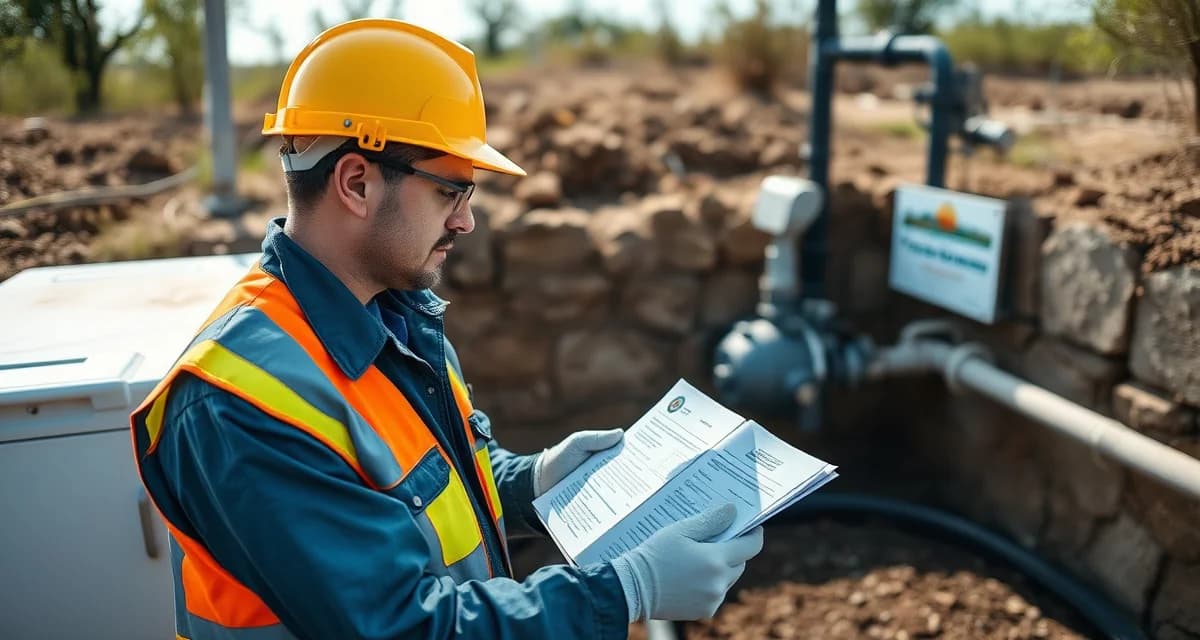
Texas Onsite Wastewater Regulations: TCEQ OSSF Requirements Guide
By the SepticMind Editorial Team
Texas is big in every way that matters for septic compliance, including regulatory complexity. The Texas Commission on Environmental Quality (TCEQ) governs onsite sewage facilities (OSSF) across 254 counties, with a designated representative structure that creates county-level variation within a statewide framework. For companies operating across Texas county lines, this creates a compliance landscape that generic field service tools cannot handle.
TL;DR
- Texas septic regulations are administered at the state level with enforcement typically delegated to county health or environmental departments.
- Licensing requirements for pumping, inspection, and installation work vary by county within Texas and should be verified with local authorities.
- Operating, maintenance, and inspection reporting requirements in Texas differ for conventional systems versus alternative systems like ATUs.
- Companies operating in multiple Texas counties need to track permit and reporting requirements by county, not just by state.
- State-mandated inspection report formats in Texas must be used for regulatory submissions; generic forms are typically not accepted.
- SepticMind's permit database covers Texas county-level requirements to reduce the research burden for multi-county operations.
Texas also has one of the most specific requirements in the country for aerobic treatment units: TCEQ-designated maintenance providers are required statewide for ATU service contracts. That requirement alone creates licensing obligations that many companies discover too late.
The Texas OSSF Regulatory Framework
TCEQ's Chapter 285 rules govern the design, installation, and maintenance of on-site sewage facilities in Texas. The basic framework is statewide, but enforcement authority is typically delegated to county-level or city-level designated representatives.
What is a Designated Representative?
In Texas, TCEQ can authorize a county, city, or other local government entity to serve as the local authority for OSSF permitting and inspection. When a designated representative exists, they handle permits and inspections in their jurisdiction following TCEQ Chapter 285 rules, with their own forms, fee schedules, and processes.
When no designated representative exists in a county, TCEQ handles permitting directly for that area.
This split creates the compliance complexity. Companies working across Texas counties need to know whether each county they serve has a designated representative, who that representative is, what forms they use, and how their enforcement processes work.
Texas has approximately 2.6 million OSSF across its 254 counties. SepticMind maps all 254 Texas county OSSF permit requirements in its compliance and dispatch workflow, eliminating the need for manual research on each county's designated representative structure.
TCEQ Permits Required in Texas
Chapter 285 requires authorization (a permit or approval) before installing, altering, repairing, or extending any OSSF in Texas. The specific requirements depend on the work type.
New OSSF Installation
A new system in Texas requires:
- Site evaluation by a licensed OSSF professional (engineer, soil scientist, or registered sanitarian with OSSF credentials)
- System design meeting Chapter 285 technical standards
- Application submitted to the designated representative or TCEQ
- Authorization (permit) issued before construction begins
- Inspections at required stages during construction
- Final approval and permit close-out documentation
Site evaluations in Texas require assessment of soil characteristics, depth to restrictive layers, and seasonal high water table conditions. The results determine which system types are eligible for the site.
Repair and Alteration
Repairs that alter the function or footprint of an OSSF require authorization in Texas. Minor repairs may qualify for a simplified process in some jurisdictions, but don't assume without confirming with the relevant designated representative.
Maintenance Inspections
Routine pump-outs and maintenance don't require separate permits in most Texas jurisdictions, but documentation requirements for the work completed vary. For alternative systems with maintenance contract requirements, inspection documentation must be maintained and may need to be reported.
The ATU Maintenance Provider Requirement
This is the Texas requirement that catches companies off guard most often. Texas requires that aerobic treatment units (ATUs) be serviced by TCEQ-designated maintenance providers under a written maintenance contract.
What that means for your company:
- If you want to service ATUs in Texas, your company must qualify as a TCEQ-designated maintenance provider
- Each ATU must have an active maintenance contract
- Inspections of ATUs must be performed at intervals required by the operating permit (typically every four months for standard ATUs)
- Inspection reports must be filed with the designated representative or local authority
The contract requirement is not optional. ATUs without active maintenance contracts are non-compliant under Texas rules. Homeowners are responsible for maintaining contracts, but if you're servicing ATUs without completing the designation requirements yourself, you may be providing services you're not authorized to perform.
SepticMind includes Texas licensed maintenance provider contract documentation features, so ATU service agreements and required inspection reports are tracked and documented for each system.
Texas OSSF Licensing and Credentials
Installer License
Texas requires a Registered Sanitarian (RS) or Professional Engineer (PE) to design OSSF in some contexts, but installation contractors operate under different requirements. Check the current TCEQ licensing requirements for installers in your specific work category.
OSSF Inspector
Inspections of OSSF for permit purposes require credentials recognized under Chapter 285. Licensed on-site sewage facility inspectors must meet TCEQ's education and experience standards.
Maintenance Provider Registration
As noted above, ATU maintenance providers must be designated by TCEQ. This involves a formal registration process and ongoing compliance with reporting requirements.
Pumper Registration
Texas requires pump trucks operating in certain areas to be registered with local designated representatives. Requirements for septic waste hauling also include approved disposal site requirements and manifest documentation.
System Types Approved in Texas
Texas recognizes a range of OSSF types under Chapter 285, from conventional to alternative systems:
Conventional Systems
Standard gravity-flow systems with septic tanks and drainfield (soil absorption system). The dominant system type in Texas where soil and site conditions are suitable.
Low-Pressure Dosing
Pressure-dosed systems for sites where gravity flow is insufficient to distribute effluent evenly.
Aerobic Treatment Units
ATUs are widely used in Texas, particularly in areas with clay soils, shallow restrictive layers, or lots too small for conventional drainfields. The ATU maintenance contract requirement makes ATU servicing a substantial ongoing market segment.
Drip Irrigation
Drip disposal systems using treated effluent are used in Texas for sites where soil conditions favor surface application over subsurface trenches.
Mound Systems
Required for sites with high water tables or shallow depth to limiting layers. Less common in Texas than in northern states but used in specific regions.
Non-Standard Systems
For sites that cannot meet the requirements for approved standard or alternative systems, Texas allows non-standard OSSF with case-by-case TCEQ review and approval.
Texas County Variation in OSSF Requirements
The 254-county structure creates real variation. Here's what changes between counties with active designated representatives:
Application forms: Each designated representative develops its own application forms within TCEQ's framework. Forms are not standardized statewide.
Review timelines: Processing time varies from a week or two in counties with active engineering review capacity to several weeks in smaller counties with limited staff.
Inspection scheduling: The process for scheduling required construction inspections varies. Some counties have dedicated inspectors with flexible scheduling; others rely on county sanitarian staff with competing responsibilities.
Fee structures: Permit fees are set by each designated representative. Fees for identical work can vary substantially between adjacent counties.
Specific local requirements: Some designated representatives have adopted local requirements that add to Chapter 285 minimums. Urban counties with growth pressures sometimes have density-related restrictions not found in rural areas.
Areas without designated representatives: In counties where TCEQ acts as the permitting authority, you're working directly with TCEQ's regional office. The process differs from dealing with a county designated representative.
Setback Requirements in Texas
Chapter 285 establishes minimum setback distances for OSSF components:
- 50 feet from drinking water wells (additional distance for certain system types)
- Minimum distances from property lines based on system type
- Setbacks from surface water and drainage features
- Minimum distances from structures and improved easements
Texas setback requirements are generally less restrictive than California or Florida, but they still eliminate many smaller or irregularly shaped lots from conventional OSSF eligibility. In those cases, alternative systems with smaller footprints or enhanced treatment may be the only compliant option.
Managing Texas Compliance Across Multiple Counties
The number of counties in Texas means multi-county operations quickly become compliance management challenges. A company servicing the Hill Country might work in Bexar, Comal, Hays, Blanco, Gillespie, and Kerr counties, each with different designated representatives and different processes.
Tracking which designated representative handles each county, what forms they require, what their current fee schedules are, and what their specific inspection processes are requires a system. Doing it manually with spreadsheets is how companies generate permit errors, start work before authorization is issued, and miss reporting deadlines for ATU contracts.
SepticMind's permit tracking software aggregates Texas county permit requirements and tracks open permits by county and deadline. The county permit requirements resource provides the broader framework for understanding county-level variation across Texas.
Septage Disposal in Texas
Texas regulates septage disposal through TCEQ's solid waste program. Septage from Texas OSSF must be transported to approved disposal facilities, which include municipal wastewater treatment plants that accept septage and permitted land application sites.
Pump truck operators in Texas need to maintain records of each load's origin, volume, and disposal location. Many counties require manifests, and TCEQ may audit disposal records. Keep records organized and current.
Staying Current With Texas OSSF Regulations
Texas OSSF regulations change as TCEQ updates Chapter 285, issues guidance, and as designated representatives revise their local requirements. The most reliable approach:
- Monitor TCEQ's website for proposed rulemaking and adopted rule changes
- Maintain direct relationships with designated representatives in your primary service counties
- Participate in the Texas On-Site Wastewater Association (TOWA) or similar industry groups that track regulatory developments
- Use software that flags regulatory updates for your service counties
Get Started with SepticMind
Operating in Texas means navigating county-level variation in permit requirements, inspection formats, and reporting deadlines. SepticMind's permit database covers Texas counties with forms, fee schedules, and timelines so you are prepared before you apply. See how it supports compliance in your service area.
Frequently Asked Questions
What does TCEQ require for OSSF installation permits in Texas?
TCEQ Chapter 285 requires authorization before installing any OSSF. New installations require a site evaluation by a credentialed professional, a system design meeting Chapter 285 technical standards, and permit application submitted to either the county designated representative or TCEQ directly. Authorization must be issued before construction begins. Required inspections at specific construction stages must be completed, and final approval documentation closes the permit.
How do designated representative county requirements affect septic companies in Texas?
Designated representatives, usually county or city authorities authorized by TCEQ, handle OSSF permitting and inspection in their jurisdiction using their own forms, fee schedules, and processes while following Chapter 285 standards. For companies working across multiple Texas counties, this means dealing with different application procedures, different fee amounts, different review timelines, and different inspection scheduling processes in each county that has a designated representative.
Does SepticMind include Texas licensed maintenance provider contract documentation?
Yes. SepticMind includes documentation templates for Texas ATU maintenance contracts, required inspection reports, and the reporting formats needed to comply with designated representative documentation requirements. The platform tracks ATU service intervals and due dates for each system under contract, so reporting deadlines don't get missed.
What state agency regulates septic systems in Texas?
Septic system regulation in Texas falls under the state environmental or health agency, with day-to-day enforcement handled by county health departments or environmental offices. Licensing for pumping, installation, and inspection work is issued at the state level, but permit applications for individual projects are reviewed at the county level. Contact both the state agency and your specific county office to confirm current requirements, since county rules can differ from the state baseline.
Do Texas septic inspection reports need to be filed with the county?
In Texas, most inspection reports for real estate transactions and O&M permit systems must be filed with the relevant county health department or environmental office within the timeframe specified by state regulation. The required form and filing timeline vary by report type; real estate inspection reports typically have stricter deadlines than routine O&M reports. Using state-standardized digital report templates ensures the format meets Texas's requirements and can be submitted electronically.
Try These Free Tools
Sources
- National Onsite Wastewater Recycling Association (NOWRA)
- US EPA Office of Wastewater Management
- NSF International
- Water Environment Federation
- National Environmental Services Center (NESC)