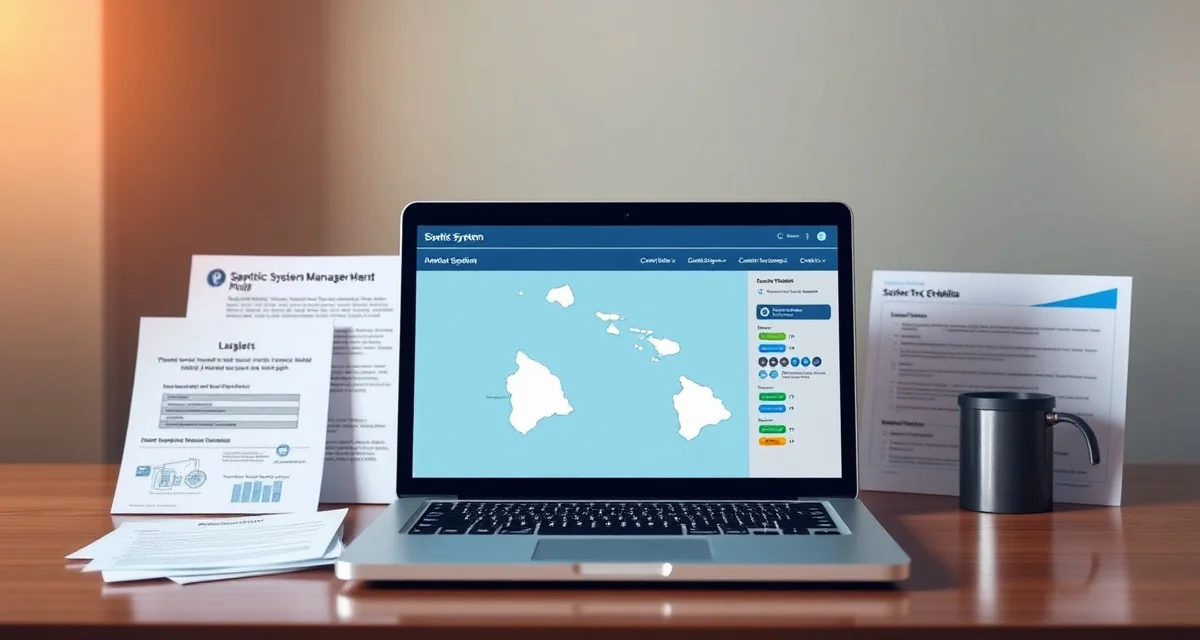
Septic Service Software for Hawaii Companies
By the SepticMind Editorial Team
Hawaii's septic regulation is organized differently than any other state. Hawaii's counties, which are also its primary municipal units, each have their own health department with distinct permit requirements and documentation standards. The Hawaii Department of Health (HDOH) sets statewide baseline rules, but day-to-day septic oversight runs through the City and County of Honolulu, Maui County, Hawaii County (the Big Island), and Kauai County separately.
TL;DR
- Hawaii septic regulations are administered at the state level with enforcement typically delegated to county health or environmental departments.
- Licensing requirements for pumping, inspection, and installation work vary by county within Hawaii and should be verified with local authorities.
- Operating, maintenance, and inspection reporting requirements in Hawaii differ for conventional systems versus alternative systems like ATUs.
- Companies operating in multiple Hawaii counties need to track permit and reporting requirements by county, not just by state.
- State-mandated inspection report formats in Hawaii must be used for regulatory submissions; generic forms are typically not accepted.
- SepticMind's permit database covers Hawaii county-level requirements to reduce the research burden for multi-county operations.
For a company operating on one island, that's manageable. For companies with operations on multiple islands, it requires knowing four distinct regulatory environments.
The Direct Answer
Hawaii septic companies need software that tracks the permit requirements of each island's county health department, generates HDOH-compliant inspection documentation, and handles the service logistics of island geography. SepticMind covers all four Hawaii counties in its permit database with island-specific templates and handles the scheduling complexity of dispersed island service areas.
Hawaii's Regulatory Framework
HDOH's Environmental Management Division regulates individual wastewater systems (IWS) under Hawaii Revised Statutes Chapter 340E and Title 11 of the Hawaii Administrative Rules. County departments of health or environmental management handle permit issuance and enforcement.
Hawaii County (Big Island) has the largest land area and the most complex terrain. Maui County covers Maui, Molokai, and Lanai. Honolulu covers Oahu. Kauai is the most rural county per capita. Each has its own fee schedule, documentation requirements, and processing timeline.
What Makes Hawaii Different
Island isolation. There are no county-crossing routes. Each island's service operation is self-contained. Equipment transport between islands is expensive. This concentrates competition on each island and makes multi-island operations uncommon, but companies that do operate on multiple islands need to track distinct regulatory environments without confusion.
Coastal and environmental sensitivity. Hawaii's freshwater resources are precious and its coastal ecosystems are heavily protected. Systems near ocean, streams, and wetlands face strict setback requirements. Nitrogen and nutrient management concerns are real in resort-dense areas of Maui and the Kohala Coast.
Tourism property and vacation rental service. Hawaii has a large inventory of vacation rentals and resort properties that generate consistent septic service demand. High-turnover properties need more frequent service than typical residential customers.
Get Started with SepticMind
Operating in Hawaii means navigating county-level variation in permit requirements, inspection formats, and reporting deadlines. SepticMind's permit database covers Hawaii counties with forms, fee schedules, and timelines so you are prepared before you apply. See how it supports compliance in your service area.
FAQ
Does SepticMind handle all four Hawaii county health departments?
Yes. SepticMind's permit database covers the City and County of Honolulu, Hawaii County, Maui County, and Kauai County with county-specific permit requirements and contact information. For companies operating on multiple islands, each island's requirements are tracked separately.
How does SepticMind handle Hawaii's vacation rental property volume?
Vacation rental and short-term rental properties often have different service frequency needs than full-time residences. SepticMind allows customer records to be flagged as short-term rental with service interval configurations that account for higher occupancy rates. Automated reminders can be configured to alert property managers rather than property owners for absentee-owned vacation rentals.
What certification tracking does SepticMind handle for Hawaii?
SepticMind tracks Hawaii's individual wastewater system contractor certifications and the county-specific licensing requirements for each island's health department. The system sends alerts when certification renewals are approaching.
What state agency regulates septic systems in Hawaii?
Septic system regulation in Hawaii falls under the state environmental or health agency, with day-to-day enforcement handled by county health departments or environmental offices. Licensing for pumping, installation, and inspection work is issued at the state level, but permit applications for individual projects are reviewed at the county level. Contact both the state agency and your specific county office to confirm current requirements, since county rules can differ from the state baseline.
Do Hawaii septic inspection reports need to be filed with the county?
In Hawaii, most inspection reports for real estate transactions and O&M permit systems must be filed with the relevant county health department or environmental office within the timeframe specified by state regulation. The required form and filing timeline vary by report type; real estate inspection reports typically have stricter deadlines than routine O&M reports. Using state-standardized digital report templates ensures the format meets Hawaii's requirements and can be submitted electronically.
Try These Free Tools
Sources
- National Onsite Wastewater Recycling Association (NOWRA)
- US EPA Office of Wastewater Management
- NSF International
- Water Environment Federation
- National Environmental Services Center (NESC)