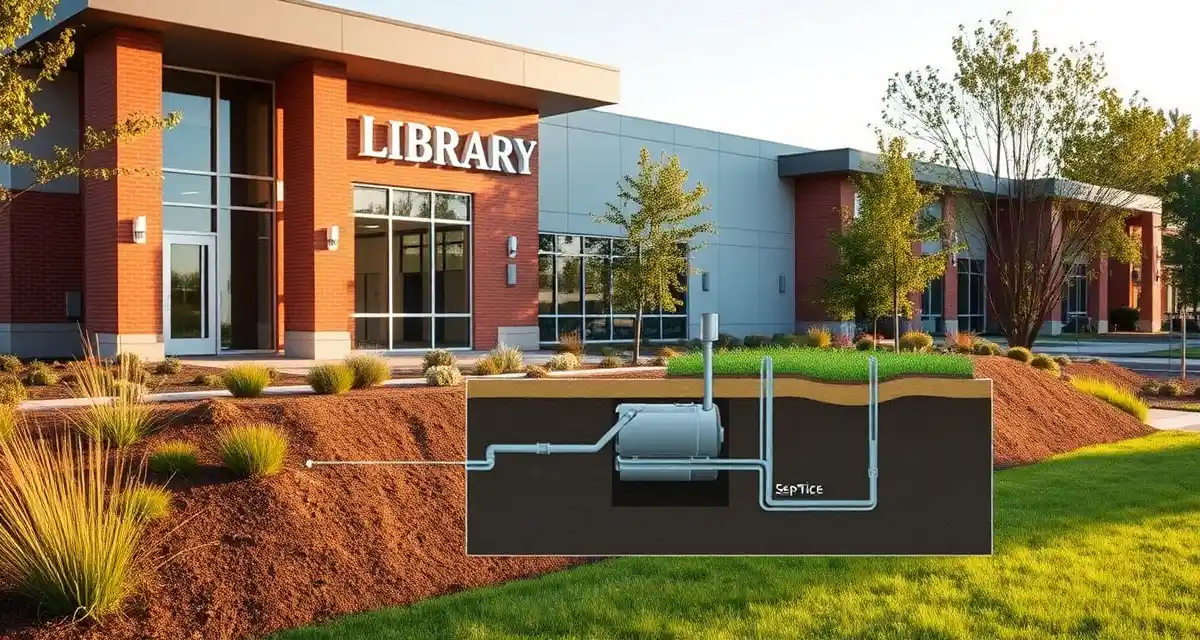
Septic Service for Libraries and Municipal Buildings
By the SepticMind Editorial Team
Septic failures at libraries and municipal buildings trigger public health concerns and media attention that government facilities work hard to avoid, and municipal buildings with public restrooms and private septic must meet public facility compliance standards that private property owners don't face. When you're the septic service provider for a public library or town hall, your documentation becomes part of the public record.
TL;DR
- Libraries facilities have distinct wastewater loading patterns that affect septic system sizing, service frequency, and permit requirements.
- Commercial and institutional properties like libraries typically require more frequent pumping than residential systems due to higher daily usage.
- Some libraries operations generate waste streams (grease, chemicals, or high-volume flow) that require pre-treatment before reaching the septic system.
- Service contracts for libraries provide predictable recurring revenue and are easier to manage with a platform that tracks commercial account schedules.
- Health department inspections for libraries properties may require septic system condition documentation as part of facility licensing.
- Septic companies specializing in libraries service build referral networks with property managers, architects, and health inspectors in that niche.
SepticMind's public building account type tracks municipal compliance requirements alongside service scheduling, giving government facility managers the organized records they need for public oversight and regulatory compliance.
Public Building Compliance Requirements
Libraries and municipal buildings face compliance requirements from several directions:
Health department oversight: Public facilities with restrooms open to the public are subject to health department inspection. A functioning, properly maintained septic system is a prerequisite for health department permits to operate a public facility. Health departments can order closure of a public facility whose septic system fails or shows signs of imminent failure.
ADA accessibility: Public facilities must meet ADA requirements for restroom access. While this doesn't directly affect septic service, it means the restroom facilities may see higher-than-typical use intensity from full public access design.
Local government maintenance requirements: Municipal governments often have internal maintenance standards for public facility infrastructure. The facilities director or public works department may have specific documentation requirements for service records that differ from what private clients expect.
Environmental agency permits: Municipal septic systems above certain daily flow thresholds may require permits from state environmental agencies, including operating permits that specify inspection and service intervals.
Public records: Service records for municipal facilities may be subject to public records requests. Your service documentation could be reviewed by journalists, residents, or elected officials with an interest in how the municipality maintains its facilities.
Libraries: Specific Characteristics
Public libraries have a load pattern with some distinctive features:
Daytime concentrated use: Most library restroom use happens during business hours, with evening hours for libraries that stay open late. The pattern is more predictable than facilities with evening events or 24/7 operations.
Variable community use: Libraries serve diverse populations -- school groups during the day, adult programming in the afternoon, seniors, parents with children. The restroom use patterns vary more than an office building's predictable daily routine.
Programming and events: Libraries hosting community programs, author readings, children's story time, and public meetings see load spikes during and immediately after events. A library that hosts regular evening programs experiences higher evening load than its daytime pattern suggests.
Meeting room rental: Some libraries rent meeting rooms to community organizations. Meeting room events add restroom load during hours when the library might otherwise be low-traffic.
Calculate service intervals for library accounts using the daily patron count from library records rather than assumptions about "typical" public building use. A busy urban branch library with high programming activity and meeting room use has a very different load profile from a small rural library with limited hours.
Town Halls and Municipal Administrative Buildings
Town halls and municipal administrative buildings have office-building load patterns with occasional high-load public meeting events:
Regular business hours use: Staff and daily office visitors generate predictable weekday loading. Calculate intervals based on daily employee count and visitor volume.
Public meeting events: Town council meetings, planning board hearings, and public comment sessions can bring large numbers of people to the building during evening hours. A contentious development hearing might bring 100+ people to a town hall that typically sees 15 people on a normal day.
Permit offices and public counters: High-traffic permit offices and public counters see variable daily visitor loads that are harder to predict than administrative office use alone.
Service intervals for town hall and municipal buildings should account for the regular staff load plus the periodic public meeting events. A pre-meeting service reminder for buildings with frequent large public meetings follows the same logic as pre-event service for sports complexes and event venues.
Documentation for Municipal Clients
Municipal facility managers have documentation needs that differ from private clients:
Formal service records: Municipal clients often want service records formatted for formal filing in government record systems rather than informal service receipts. Make sure your documentation format meets their requirements.
Budget cycle alignment: Government facilities operate on budget cycles. Service reminders timed to align with budget planning periods make it easier for facilities directors to secure maintenance funding.
Multiple stakeholder reports: A library director, a facilities director, and a public works department may all be stakeholders in the septic service relationship. Know who needs copies of service documentation and make sure they all receive it.
Long-term planning support: Municipal governments plan facility infrastructure on multi-year timelines. If a library's septic system is aging, the facilities director needs your assessment of remaining useful life to include that in capital planning. Provide professional judgment on system condition and projected replacement timeline when it's relevant.
Get Started with SepticMind
Libraries facilities need a service provider who understands the specific wastewater challenges of their operations. SepticMind makes it easy to manage commercial service contracts, track inspection schedules, and document service visits for every account in your portfolio. See how it supports commercial account management.
Frequently Asked Questions
What compliance requirements apply to septic systems at public library buildings?
Public library septic systems must meet state environmental agency permit requirements for the treatment system serving the building -- operating permits may specify inspection and service intervals for systems above defined daily flow thresholds. Health departments require functioning sanitation systems as a condition of operating a public facility with public restrooms. Local government maintenance standards may require documented service at defined intervals. Some states with mandatory inspection programs require periodic formal inspections of public facility septic systems. The combination of health department, environmental agency, and local government requirements means public library facilities need more comprehensive service documentation than equivalent private commercial properties.
How often should a public library with a private septic system be serviced?
Service interval depends on daily patron count, staffing, and programming activity. A small rural library with 20-30 daily visitors and minimal programming may need service every 2-3 years on a standard tank capacity. A larger library with 100+ daily patrons, active programming, and community meeting space should plan for annual service and potentially more frequent service if programming activity is high. Track actual fill levels at each service visit -- if the tank is consistently above 70% at service time, shorten the interval. For libraries with regular large public events, consider pre-event service before the highest-attendance programming, similar to the approach for event venues and community centers.
Does SepticMind track public building septic compliance for municipal accounts?
Yes. SepticMind's public building account type maintains compliance tracking for health department requirements, environmental agency operating permits, and any local government maintenance standards applicable to the facility. Service records are formatted to meet the documentation requirements of government facility management systems. When a state or local regulatory review requires documentation of maintenance history, SepticMind generates complete service history reports that demonstrate compliance with all applicable requirements. For municipal clients managing multiple public buildings -- several library branches, a town hall, a community center -- each building is tracked as a separate facility within the municipal account, with its own service schedule and compliance history.
How often should a septic system serving a libraries property be inspected?
Septic systems at libraries properties should be inspected at least annually and pumped more frequently than residential systems, since commercial-scale daily water usage accelerates sludge and grease accumulation. The exact frequency depends on the specific activities at the facility, peak occupancy, any food service or chemical use on-site, and local regulatory requirements. A service provider familiar with libraries operations can recommend an appropriate inspection and pumping schedule based on the system's actual usage profile.
What septic system issues are most common at libraries properties?
The most common septic problems at libraries properties are rapid sludge accumulation from high occupancy, grease trap failure if food service is involved, hydraulic overloading during peak-use periods, and non-biodegradable waste disposal from cleaning or maintenance activities. Regular inspection and a service contract with clear maintenance intervals are the most effective ways to catch these problems before they cause system failure or regulatory violations.
Try These Free Tools
Sources
- National Onsite Wastewater Recycling Association (NOWRA)
- US EPA Office of Wastewater Management
- NSF International
- Water Environment Federation
- National Environmental Services Center (NESC)