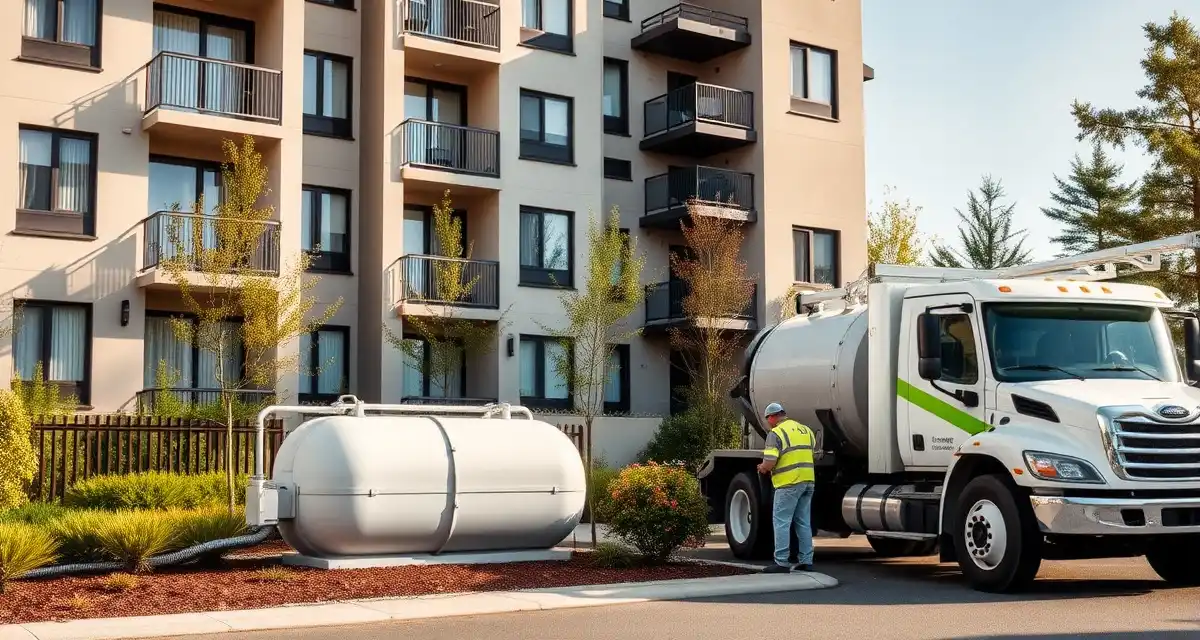
Septic Service for Small Apartment Buildings With Private Septic
By the SepticMind Editorial Team
Multi-family residential buildings on private septic systems require 2-4x more frequent service than single-family homes. A septic failure at an apartment building requires tenant notification and potential displacement -- creating liability for the landlord that extends well beyond the repair cost. For property managers and landlords with small apartment buildings on private septic, proactive service isn't optional; it's the only responsible approach.
TL;DR
- Apartment Buildings facilities have distinct wastewater loading patterns that affect septic system sizing, service frequency, and permit requirements.
- Commercial and institutional properties like apartment buildings typically require more frequent pumping than residential systems due to higher daily usage.
- Some apartment buildings operations generate waste streams (grease, chemicals, or high-volume flow) that require pre-treatment before reaching the septic system.
- Service contracts for apartment buildings provide predictable recurring revenue and are easier to manage with a platform that tracks commercial account schedules.
- Health department inspections for apartment buildings properties may require septic system condition documentation as part of facility licensing.
- Septic companies specializing in apartment buildings service build referral networks with property managers, architects, and health inspectors in that niche.
The Wastewater Math for Multi-Family Buildings
The fundamental challenge with apartment buildings on private septic is volume. An 8-unit apartment building housing 16-20 residents generates daily wastewater comparable to a mid-size commercial property -- but it's often sitting on a system designed and permitted for lower residential use.
Septic system sizing is typically based on bedroom count and expected occupancy. A 3-bedroom conventional residential system might be designed for 6 people generating 150-200 gallons per day. An 8-unit building with 2-bedroom apartments and 2 residents per unit generates 16 people x roughly 75 gallons per person per day = approximately 1,200 gallons per day.
That's 6x the daily flow of the residential system example -- and for a property that may have been developed by converting or adding units to an original single-family home, the septic system may have been designed for a fraction of the current load.
SepticMind's multi-unit residential account type calculates service intervals from unit count and occupancy, giving you a starting point for each new account that's calibrated to actual use rather than defaulting to a standard residential interval.
Laundry and Kitchen Loading
Beyond basic restroom use, apartment buildings generate significant additional wastewater from:
In-unit laundry facilities: Buildings with washer/dryer hookups in each unit see laundry gray water from all residents entering the septic system. A 6-unit building where every resident does 4 loads of laundry per week generates thousands of gallons of laundry gray water weekly.
Common laundry rooms: Buildings with shared laundry facilities have commercial washing machine use concentrated in a common area, with the load pattern of a small laundromat.
Kitchen waste: Multiple active kitchens running simultaneously create continuous dishwashing, cooking, and food waste that increases BOD loading and grease accumulation.
For buildings with older systems, the combination of these loads may be pushing the system beyond its design capacity without the owner realizing it -- the system handles the flow but is slowly degrading the drainfield through years of overloading.
Service Intervals by Building Size
As a starting framework, service intervals for multi-family residential buildings on private septic:
- Duplex (2 units): Annual to semi-annual, depending on system size and occupancy
- 4-6 unit building: Quarterly to semi-annual
- 8-12 unit building: Quarterly minimum
- Over 12 units: Monthly to quarterly depending on tank configuration
These are starting points, not fixed rules. A large tank with low actual occupancy (units that are often vacant) can support a longer interval. A full building with in-unit laundry and active residents needs service at the more frequent end of the range.
The first service call at a new account should include a baseline assessment: tank size, condition, fill level relative to the previous pump-out date (if known), and any system performance concerns. That information calibrates the appropriate service interval for that specific property.
Compliance and Permit Status
Small apartment buildings on private septic have a permit status question similar to the B&B scenario: was the system permitted for multi-family residential commercial use, or was it originally permitted for a single-family residence?
In many cases, property owners added units over time -- converting a large home to apartments, adding a rental unit over a garage, or building a secondary structure -- without revisiting the septic permit. The resulting system may be operating on a residential single-family permit that doesn't reflect current use.
This is a tenant safety issue as much as a compliance issue. An undersized, under-permitted system running at overload is a failure waiting to happen, and when it fails at an occupied multi-family building, it's not just a property management problem -- it's an emergency with direct human welfare implications.
Verify permit status when taking on a new apartment building account. If the system appears to be operating on an inadequate permit, note it in the account record and communicate the concern to the property owner.
Tenant Communication and Failure Response
A septic failure at an apartment building requires tenant notification and potential displacement. Most states have landlord-tenant laws that specify notification requirements when essential services (including functioning sanitation) are disrupted.
As the service provider, your emergency response for apartment building accounts should be:
- Faster than for single-family properties (tenant displacement is a higher-stakes emergency)
- Documented thoroughly (date, time, nature of failure, response taken)
- Communicated clearly to the property manager or owner
Landlords and property managers who've been through a septic emergency at a rental property are highly motivated to invest in preventive maintenance programs going forward. That first emergency service call is often the beginning of a long-term account relationship.
Get Started with SepticMind
Apartment Buildings facilities need a service provider who understands the specific wastewater challenges of their operations. SepticMind makes it easy to manage commercial service contracts, track inspection schedules, and document service visits for every account in your portfolio. See how it supports commercial account management.
Frequently Asked Questions
How often should an 8-unit apartment building with a private septic system be pumped?
Quarterly service is the standard starting point for an 8-unit building at normal occupancy. If the building has in-unit laundry hookups, full occupancy, and larger-than-average household sizes, quarterly may not be frequent enough -- some 8-unit buildings need monthly service to stay ahead of accumulation. If the building has a larger-than-standard tank, lower actual occupancy (multiple vacant units), or no in-unit laundry, semi-annual service might be adequate. The baseline assessment on the first service call -- tank fill level relative to the installation date or last service -- is the most useful indicator for calibrating the right interval.
What size septic system does a small apartment building need?
Septic system sizing for multi-family residential buildings is calculated based on bedroom count and expected occupancy, which varies by state. A general rule of thumb is 150 gallons per bedroom per day in the design flow calculation. An 8-unit building with 2-bedroom apartments generates a design flow of roughly 2,400 gallons per day (8 units x 2 bedrooms x 150 gpd). The tank size should be sized to handle at least 1.5-2 days of design flow, meaning an 8-unit building typically needs at least a 3,500-5,000 gallon tank. Many multi-family buildings are operating on tanks significantly smaller than this design requirement, which creates service frequency needs that wouldn't exist with proper sizing.
Does SepticMind calculate service intervals for multi-family residential accounts?
Yes. SepticMind's multi-unit residential account type uses unit count and occupancy information to calculate recommended service intervals rather than defaulting to a generic residential schedule. You can input the building's unit count, average occupancy, and whether units have in-unit laundry to generate a service frequency recommendation. The account records track each service visit's findings so interval adjustments can be made based on actual fill rates observed over time. Multiple buildings under a single property manager can be managed within one SepticMind account, with individual property records for each building.
How often should a septic system serving a apartment buildings property be inspected?
Septic systems at apartment buildings properties should be inspected at least annually and pumped more frequently than residential systems, since commercial-scale daily water usage accelerates sludge and grease accumulation. The exact frequency depends on the specific activities at the facility, peak occupancy, any food service or chemical use on-site, and local regulatory requirements. A service provider familiar with apartment buildings operations can recommend an appropriate inspection and pumping schedule based on the system's actual usage profile.
What septic system issues are most common at apartment buildings properties?
The most common septic problems at apartment buildings properties are rapid sludge accumulation from high occupancy, grease trap failure if food service is involved, hydraulic overloading during peak-use periods, and non-biodegradable waste disposal from cleaning or maintenance activities. Regular inspection and a service contract with clear maintenance intervals are the most effective ways to catch these problems before they cause system failure or regulatory violations.
Try These Free Tools
Sources
- National Onsite Wastewater Recycling Association (NOWRA)
- US EPA Office of Wastewater Management
- NSF International
- Water Environment Federation
- National Environmental Services Center (NESC)