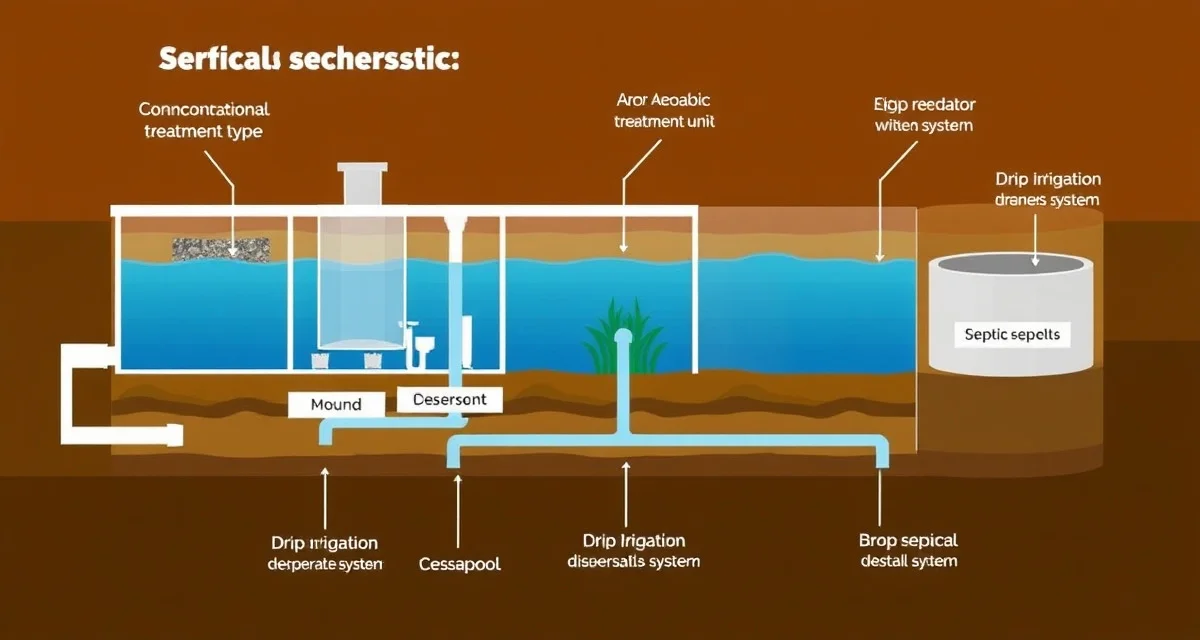
Septic Pumping Frequency by Tank Type and System Type
By the SepticMind Editorial Team
The pumping schedule that works for a conventional gravity system doesn't work for an aerobic treatment unit. A cesspool needs attention more often than a modern 1,500-gallon concrete tank. And a drip irrigation system that isn't pumped because "it's not a conventional tank" can fail in specific ways that conventional systems don't.
TL;DR
- Conventional gravity tanks require pumping based on tank size and household size, typically every 2-5 years.
- ATU systems require quarterly service visits defined by state regulation, regardless of tank accumulation levels.
- Mound system tanks require the same pumping frequency as comparable conventional tanks, but drainfield media condition should be checked more frequently.
- Drip irrigation system pre-treatment tanks typically require more frequent pumping than conventional tanks because effluent quality requirements are stricter.
- Holding tanks (no drainfield component) require pumping every 30-90 days depending on use because there is no soil dispersal.
- Grease traps at commercial properties require more frequent service than any residential system type: every 2-4 weeks for high-volume food service.
Here's the pumping and service frequency by system type, based on how these systems actually accumulate waste and what happens when service is deferred.
Conventional Gravity Septic Systems
Service interval: 3-5 years for a typical family of 4 on a 1,000-gallon tank
The pumping frequency for a conventional system depends almost entirely on two variables: tank size and household occupancy. The rule of thumb is pump when the combined sludge and scum layer reaches 30% of the tank's liquid capacity, typically 12 inches of combined depth.
For reference:
- 1,000-gallon tank + 4 people = pump every 3-5 years
- 1,500-gallon tank + 4 people = pump every 5-7 years
- 1,000-gallon tank + 6 people = pump every 2-3 years
Modifiers that shorten the interval: garbage disposal in regular use (30% more frequent), water softener discharge (20% more frequent), commercial or high-use properties.
The consequences of skipping: solids overflow to the distribution box and drainfield, accelerating bio-mat accumulation and shortening drainfield life.
Aerobic Treatment Units (ATUs)
Service interval: Every 3-6 months regardless of household size
ATUs are fundamentally different from passive systems. They're active treatment systems with mechanical components, blowers, pumps, timers, alarms. These components require regular maintenance to function. The aerobic bacterial community that provides treatment also needs ongoing support.
ATU pump-out frequency depends on the specific system design and the solids load. Most ATUs need the pretreatment or primary treatment chamber pumped every 2-3 years. But the maintenance visit, checking mechanical components, blower operation, effluent quality, needs to happen quarterly.
The consequences of skipping: the aerobic bacteria die off when aeration fails. Treatment quality drops. If chlorination is part of the system, disinfection failure creates effluent that doesn't meet permit standards. In states with mandatory O&M permits, missed service visits are compliance violations.
Mound Systems
Service interval: Annual inspection, pump-out every 3-5 years depending on usage
Mound systems have two maintenance components: the septic tank (pumped on the same schedule as a conventional tank for similar household size) and the pump chamber (pumped every 3-5 years depending on solids accumulation).
The maintenance that's often missed is the inspection port check. Mound systems have inspection ports in the distribution zone. A tech who pulls inspection port caps and probes for liquid level is checking whether the mound is accepting effluent normally. Rising liquid levels in inspection ports are an early warning of saturation, catchable before the mound fails if you're checking regularly.
Annual visual inspection of the mound surface and inspection port checks are the maintenance that extends mound system life.
Drip Irrigation Dispersal Systems
Service interval: Quarterly visits for mechanical components, annual filter inspection minimum
Drip systems aren't pumped in the conventional sense, there's no large tank holding solids in the dispersal zone. But they have pump chambers, filters, and distribution networks that need regular maintenance.
Filters should be inspected at least quarterly. Many drip system failures trace to a filter that was never cleaned after installation. A clogged filter causes pump overloading and uneven distribution.
Emitter inspection for clogging should happen at least annually. In systems with high biological load, more frequent emitter checks are warranted.
Pump chambers pump-out: typically every 3-5 years depending on solids accumulation.
Cesspools
Service interval: Every 12-24 months
Cesspools are smaller than modern septic tanks, have no effluent treatment, and lose absorption capacity faster as the surrounding soil loads with solids. Most actively used cesspools need service every 12-18 months. Some high-occupancy or high-use cesspools need service annually or more.
The cesspool that goes 3-4 years between service calls is the one that seeps effluent into the surrounding soil and creates surface issues. Don't let cesspools go on the same interval as modern tanks.
Sand Filter and Recirculating Sand Filter Systems
Service interval: Semi-annual to annual maintenance visits
Sand filter systems don't have large pump-out needs in the media bed itself, but the pretreatment tank needs pumping on a schedule similar to conventional tanks. The mechanical components, dosing pump, recirculation pump, distribution system, need semi-annual or annual inspection.
Media condition assessment is the unique maintenance need for sand filters. Media clogging is gradual and shows up first in reduced infiltration rates and rising effluent levels in the distribution zone. Annual inspection of media condition, with cleaning or media replacement when indicated, extends system life.
Get Started with SepticMind
SepticMind is designed around the actual workflows of septic service companies, from county permit tracking to automated maintenance reminders. Whether you are managing a single truck or a multi-county fleet, the platform scales with your operation. See how it works for your business.
FAQ
How often should a septic tank be pumped for a family of 4?
A conventional 1,000-gallon septic tank serving a family of 4 should be pumped every 3-5 years under typical conditions. For a 1,500-gallon tank with the same household, every 5-7 years is reasonable. These intervals assume average water use and no garbage disposal or water softener. For ATUs, quarterly maintenance visits are required regardless of household size.
Do aerobic treatment units need to be pumped differently than conventional tanks?
Yes. An ATU has both a passive primary treatment chamber (pumped every 2-3 years) and mechanical treatment components that need quarterly maintenance visits. The quarterly visits check blower operation, pump function, effluent quality, and alarm systems, they're not pump-outs, they're maintenance inspections. Missing quarterly visits on an ATU causes treatment failure and regulatory violations in states with mandatory O&M programs.
How does SepticMind handle different service intervals for different system types?
SepticMind's customer records include a system type field that determines which service interval logic and inspection template applies. Conventional systems get service interval calculations from tank size and household occupancy. ATUs get quarterly maintenance scheduling from the O&M permit terms. Mound systems get annual inspection scheduling plus pump-out scheduling based on usage. The right service schedule applies to each customer automatically based on their system type.
Why do holding tanks require so much more frequent service than septic tanks?
A holding tank collects all wastewater but has no soil dispersal component; it holds everything until pumped. There is no biological treatment happening and no effluent leaving the tank until it is removed by the service company. This means the tank fills at the full rate of household water use rather than only accumulating the solids portion. Most holding tanks require service every 30-90 days depending on household size and tank volume, compared to the 2-5 year interval for a conventional septic tank with a functioning drainfield.
How often should grease traps be pumped at commercial food service operations?
Grease trap pumping frequency for commercial food service depends on cooking volume, trap size, and trap efficiency. High-volume operations such as full-service restaurants typically require service every 2-4 weeks. Medium-volume operations such as cafes or delis may need monthly service. Small operations with low cooking volume and large trap capacity might go 6-8 weeks between service visits. The most accurate approach is to track grease depth at each visit and establish the service interval based on the observed accumulation rate, then set an automated reminder at the appropriate interval for each account.
Try These Free Tools
Sources
- National Onsite Wastewater Recycling Association (NOWRA)
- US EPA Office of Wastewater Management
- NSF International
- Water Environment Federation
- National Environmental Services Center (NESC)