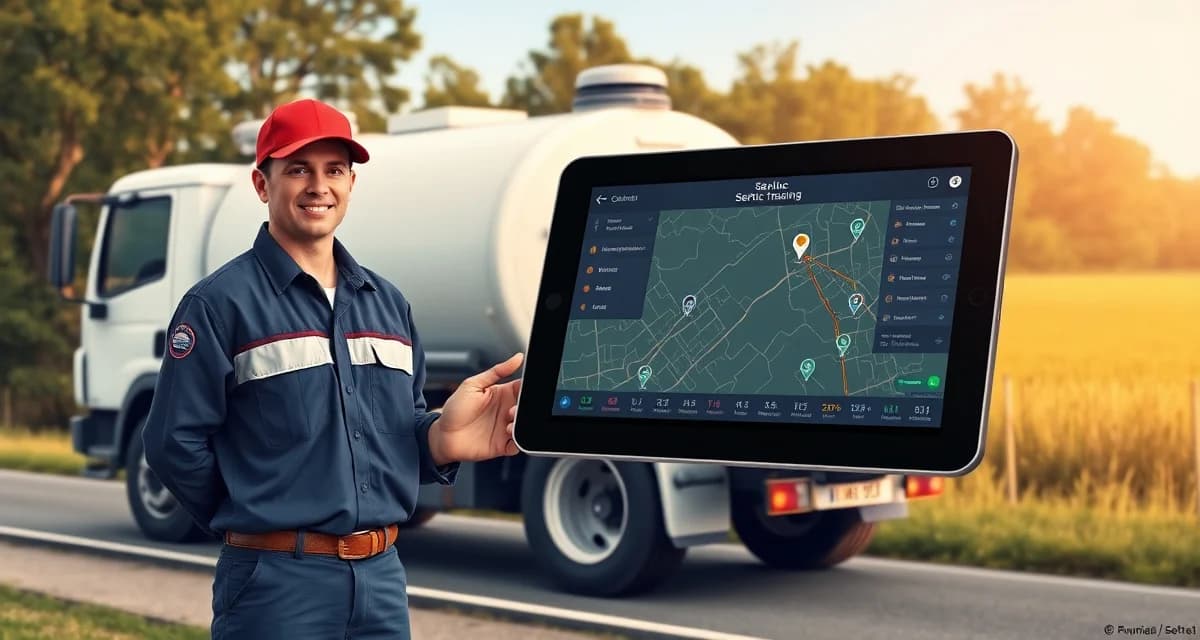
Fleet Tracking for Septic Service Companies
By the SepticMind Editorial Team
You've got four trucks on the road. From your office, you know approximately where they are, your dispatcher talked to all four techs before 8 a.m. and wrote their first jobs on the whiteboard. It's now 11:30. A same-day emergency call just came in from a residential customer 12 miles from where you think Truck 3 is working.
TL;DR
- Fleet Tracking for Septic Service Companies requires balancing field operations, customer relationships, compliance obligations, and administrative management.
- Recurring service agreements provide the most predictable revenue base in the septic trade and should be a priority for growing businesses.
- Digital tools that automate scheduling, reminders, invoicing, and reporting reduce administrative overhead without adding staff.
- Tracking key performance metrics by route, technician, and service type identifies the most profitable and least profitable parts of the operation.
- Customer retention improvement through systematic follow-up typically generates more revenue than equivalent spending on new customer acquisition.
- Building commercial and institutional accounts alongside residential pumping creates revenue stability that supports equipment and hiring decisions.
You think. You're not sure. You call Truck 3. No answer, probably on site, vaccuum running, can't hear the phone. You call back. Still no answer. You call Truck 2 to see if they can take it. Meanwhile the customer is on hold.
This is the problem GPS fleet tracking solves.
What Fleet Tracking Does for a Septic Operation
Real-time location. Every truck shows on the dispatch map with a 30-second position update. Current location, speed, direction, and job status. When the emergency call comes in, you see Truck 3 is 8 miles from the emergency address, currently on-site, 85% through their current job. You can plan the dispatch before you even make a call.
Job status without the phone call. SepticMind's GPS integration syncs with the job status system. When a tech marks a job complete in the app, the map icon updates. You see that Truck 3 finished their current job 7 minutes ago and is now traveling. You dispatch the emergency job before they hit the highway.
Driving behavior and safety. Fleet GPS captures speed data. A tech consistently running 15 mph over the speed limit on rural county roads, in a loaded vacuum truck, is a safety issue and a liability issue. Speed data lets you address the problem with documented data.
Mileage tracking. Every truck's daily mileage is logged automatically. This feeds maintenance scheduling (oil changes, PM service at specific mileage intervals) and provides accurate data for fuel cost tracking and IRS mileage documentation.
After-hours visibility. If a truck leaves the yard after hours or on a weekend without authorization, GPS records it. Not a common problem, but when it happens, the documentation matters.
How SepticMind Fleet Tracking Works
The Dispatch Map
Your dispatch view in SepticMind shows a live map of your service territory with every truck plotted in real time. Click a truck icon and see:
- Tech name and assigned truck number
- Current job status (traveling, on-site, complete)
- Current job address
- Next job address and estimated arrival
- Today's completed jobs
The map updates continuously. You're not refreshing a page, the data streams.
Dispatch From the Map
When an emergency or same-day call comes in, you enter the address in SepticMind and see every truck's current location, current status, and estimated travel time to the emergency address. Click to assign. The tech gets a push notification on their app with the new job address. The route recalculates.
No phone calls required for emergency dispatch. The whole assignment takes under 2 minutes.
GPS and Route Optimization Working Together
Fleet GPS feeds back into SepticMind's route optimization in real time. As trucks complete jobs earlier or later than scheduled, the system recalculates estimated arrival times for all remaining jobs. When a job runs long, affected afternoon customers can receive an automated update with a revised time window, before they're sitting in the driveway wondering where the truck is.
This is what separates GPS-enabled dispatch from GPS-only tracking. The location data isn't just for monitoring, it's actively improving how you manage the day.
The Equipment Side: What Goes in the Truck
SepticMind's fleet tracking uses your technician's smartphone as the primary GPS device. The SepticMind app running in the background reports location automatically when a shift is active. No additional hardware required for basic tracking.
For more robust tracking, tracking that works even when the tech's phone is off or not actively running the app, SepticMind supports integration with dedicated in-cab GPS units from major fleet telematics providers. These units plug into the OBD-II port or hardwire into the truck's power system and report independently of the phone.
Dedicated units are worth considering for:
- Large fleets where GPS continuity is operationally critical
- Operations where after-hours tracking is important
- Trucks serving areas with inconsistent cell coverage
For most 1–5 truck operations, the app-based tracking in SepticMind is sufficient.
Privacy and Technician Buy-In
Fleet GPS tracking creates a conversation with your team. Handle it directly.
The framing matters. GPS tracking is presented not as surveillance but as a dispatch tool, it's what lets you get them help faster if something goes wrong, route emergencies efficiently, and give customers accurate ETAs without playing phone tag. Most experienced field service techs have worked for companies with GPS and understand the practical benefit.
Be specific about what's tracked and what isn't:
- Location during scheduled work hours
- Job status
- Driving speed
- Mileage for maintenance tracking
What GPS doesn't do: monitor personal conversations, track location outside work hours (app tracking can be configured to stop at end of shift), or create a punitive environment. Make clear that data is used operationally, not to count bathroom breaks.
Techs who understand the purpose generally accept GPS without significant pushback.
Fleet Maintenance Scheduling
SepticMind's GPS mileage data connects to vehicle maintenance records. Set service intervals by mileage, oil change every 5,000 miles, transmission service every 30,000 miles, DOT inspection annually, and SepticMind alerts you when trucks approach each interval.
A loaded vacuum truck driven on rural roads accumulates wear faster than a standard service vehicle. A maintenance schedule built on actual mileage data is more accurate than a calendar-based schedule. And a truck that's properly maintained doesn't break down at 2 p.m. on a Wednesday with a full tank and a loaded route.
Get Started with SepticMind
Running a profitable septic business means managing compliance, customer relationships, and field operations without letting any of them slip. SepticMind handles the operational and compliance infrastructure so you can focus on growing the business. See what the platform can do for your operation.
FAQ
Does fleet tracking work in rural areas with limited cell coverage?
The SepticMind app uses the phone's GPS chip for location and reports via cellular. In low-coverage areas, location data may show gaps when the phone doesn't have a signal. When the device returns to coverage, the most recent location syncs. For operations with regular dead zones on rural routes, a dedicated in-cab GPS unit with store-and-forward capability provides more complete coverage.
Can I see historical GPS data for past routes?
Yes. SepticMind stores GPS track data for each truck by day. You can pull up any truck's route for any past date and see the complete path driven, job stop locations, and time at each stop. This data is useful for customer disputes ("what time was your truck at my property?"), for accident documentation, and for identifying route inefficiencies in your historical patterns.
Does GPS tracking affect insurance premiums?
It depends on your carrier. Some commercial fleet insurance carriers offer reduced premiums for fleets using GPS tracking, particularly when the telematics data is shared with the insurer (driving speed, hard braking events, etc.). Ask your insurance broker whether fleet GPS data reporting affects your premium. In most cases, the safety monitoring benefit is the primary argument, a tech who knows their speed is tracked drives more carefully, which reduces at-fault accident risk.
What metrics matter most for managing a septic service business?
The most important operational metrics for a septic service company are route utilization rate (percentage of available truck capacity actually booked), customer retention rate (percentage of customers who return for the next service visit), revenue per truck per day, cost per job including labor, disposal, fuel, and overhead allocation, and recurring revenue percentage from service agreements versus one-time calls. Companies that track these metrics by route and by technician identify improvement opportunities faster than those looking only at total revenue.
How does field service software reduce administrative costs for septic companies?
Field service software eliminates manual steps in scheduling, dispatching, invoicing, permit tracking, and inspection report preparation. Tasks that take an office manager 2-4 hours per day on spreadsheets and phone calls are handled automatically: reminders go out, reports generate, invoices are sent, and permit deadlines are flagged without human intervention. The hours saved are redeployed to customer service, sales, and higher-value work that grows the business.
Try These Free Tools
Sources
- National Onsite Wastewater Recycling Association (NOWRA)
- US EPA Office of Wastewater Management
- National Environmental Services Center (NESC)
- Water Environment Federation
- Occupational Safety and Health Administration (OSHA)