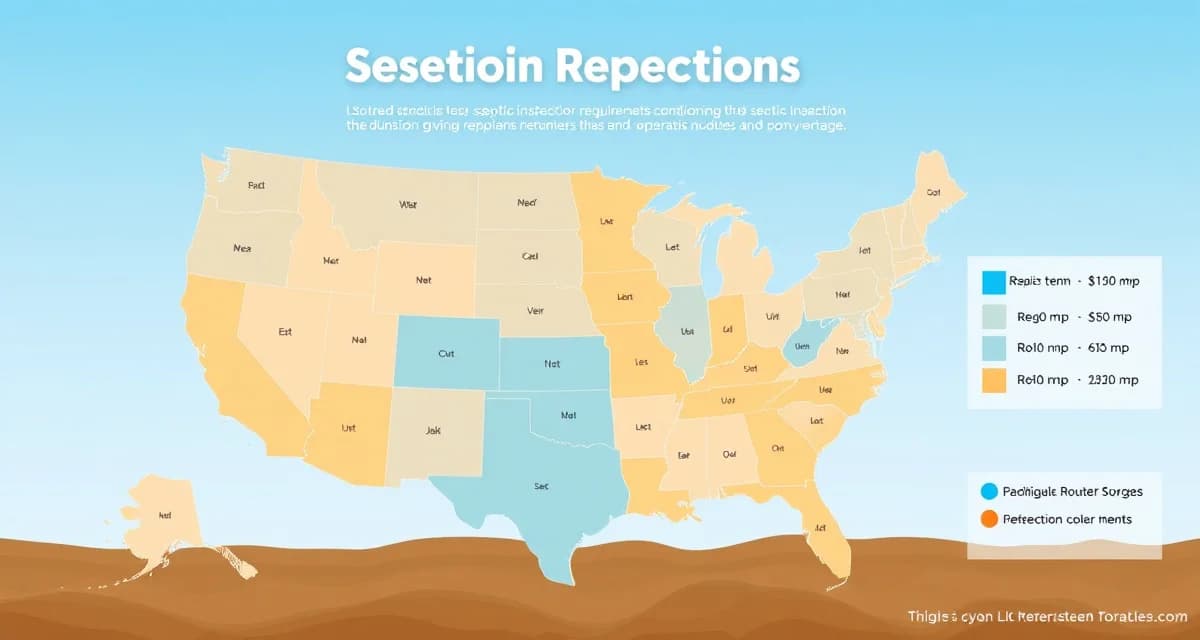
Septic Inspection Requirements by State: An Interactive Overview
By the SepticMind Editorial Team
Inspection requirement complexity varies four times between the most and least regulated US states. A company operating in Massachusetts, where Title 5 mandates inspections at property transfer and specifies the inspector credential, licensed report format, and local board of health filing requirement, faces a fundamentally different compliance landscape than a company in a state where inspection is recommended but not legislatively required.
TL;DR
- Septic inspections require state-specific report formats that must be completed correctly before they are accepted by regulators, lenders, or buyers.
- Photo documentation with timestamps and GPS coordinates is the minimum standard for defensible inspection reports.
- Real estate inspection reports in most states must be filed with the county health department within a specified timeframe.
- Inspector credentials must be current and visible on every submitted report; expired credentials are grounds for report rejection.
- Digital inspection tools reduce report completion time from hours to minutes and eliminate transcription errors.
- Consistent documentation quality across all technicians protects company reputation in the real estate inspection market.
Multi-state inspection companies use different processes in different states, creating inconsistency and errors. The fix is understanding what each state actually requires, and having a platform that loads the correct inspection protocol when a job is created in any state.
The Three Tiers of State Inspection Regulation
States fall into three broad regulatory categories:
Tier 1: Mandatory inspection states. These states legislate specific inspection triggers, inspector credentials, report formats, and filing requirements. The most stringent in this category include Massachusetts (Title 5), Virginia (licensed evaluator requirement), and New Hampshire (transfer inspections in many municipalities).
Tier 2: Regulated but not mandated states. These states have specific licensed evaluator credentials and defined inspection standards, but inspection isn't required at property transfer in most cases. Inspections happen because lenders require them, buyers request them, or as part of routine maintenance programs.
Tier 3: Minimal or no state-level inspection regulation. Some states leave inspection standards entirely to county health departments or don't have specific state-level inspection credential requirements. Inspection quality and format in these states varies considerably.
States Requiring Inspections at Property Transfer
Which states require inspections at every property transfer involving a septic system?
The states with the most consistent point-of-sale inspection requirements:
Massachusetts: Title 5 requires inspection at property transfer for most properties. Exceptions exist for recently inspected properties, new systems, and some municipal-sewer-adjacent properties.
New Hampshire: Many NH municipalities require septic inspection at property transfer through local health regulations rather than a single state mandate. Requirements vary by town.
Maine: Some Maine municipalities require inspection at transfer, though there's no uniform state requirement.
New Jersey: NJ doesn't have a statewide transfer inspection requirement, but local health codes in some municipalities do.
Rhode Island: Some municipalities require or strongly encourage transfer inspections.
The important distinction is between a state mandate and a lender requirement. Even in states without mandatory transfer inspections, lenders frequently require inspection as a condition of financing for properties with septic systems. In practice, this creates near-universal inspection demand at property transfers, even where law doesn't require it.
States With Mandatory Licensed Evaluator Requirements
What states have mandatory licensed septic evaluator requirements for inspection?
States with the most specific licensed evaluator requirements:
Massachusetts: Title 5 Inspector credential, licensed by MassDEP, separate from plumbing and general contractor licensing.
Virginia: Licensed onsite soil evaluator, licensed by the Virginia Board for Contractors, required for site evaluations and inspections.
North Carolina: Licensed Soil Scientist (NCLSS) or licensed PE required for most site evaluations.
New Hampshire: Certified soil scientist or licensed evaluator requirements for formal evaluations.
Vermont: Certified site technician or PE requirements for septic design and inspection work.
Wisconsin: POWTS inspector certification required for inspection work.
Minnesota: MPCA certified inspector designation for certain inspection types.
Many other states have licensing requirements for installation contractors that are distinct from inspection credentials. In those states, a pumping license may not cover formal inspection work for real estate transactions.
Southern States: Primarily County-Level Regulation
The South generally has less prescriptive state-level inspection requirements, with county health departments setting effective standards.
Texas: TCEQ OSSF rules regulate septic contractors, but county-level variation is notable. Inspection requirements for real estate transactions are driven primarily by lender requirements rather than state mandate.
Florida: 67-county DOH structure means county-level variation is substantial. Some counties have active inspection programs; others leave inspection standards to lenders.
Georgia, Alabama, South Carolina, Mississippi: Generally county health department administration with state guidelines. Inspection credential requirements vary by county.
Tennessee, Kentucky, Arkansas: State-level contractor licensing with county-administered permits. Inspection for real estate is primarily lender-driven.
Midwest States: County-Level Variation
Michigan: No state septic code means inspection standards are entirely county-level. Each of Michigan's 83 counties has its own approach.
Ohio, Indiana: County health district administration with notable local variation.
Wisconsin: POWTS framework is one of the more structured inspection systems in the Midwest.
Iowa, Minnesota: State-level frameworks with county implementation. Minnesota has specific shoreland inspection requirements.
Western States: Generally Less Prescriptive
Western states generally have less developed onsite wastewater inspection infrastructure compared to the Northeast, though this varies:
Oregon: DEQ administers onsite wastewater with county health departments. Some county-level inspection requirements.
Washington: DOH and county health departments. Requirements vary by county.
California: County environmental health departments administer. No uniform state inspection standard; county variation is notable.
Idaho, Nevada, Montana, Wyoming: Generally minimal state inspection requirements. Lender requirements drive most inspection activity.
Get Started with SepticMind
Inspection work is the highest-visibility service in the septic trade, and your documentation quality directly affects your reputation with real estate agents, lenders, and county officials. SepticMind generates state-formatted inspection reports in the field with photo documentation attached. See how it supports your inspection workflow.
Frequently Asked Questions
Which states require inspections at every property transfer involving a septic system?
Massachusetts has the most consistent statewide transfer inspection requirement under Title 5, covering most property transfers. New Hampshire's requirement is implemented at the municipal level, so requirements vary by town. Maine, New Jersey, and Rhode Island have municipal-level requirements in some jurisdictions. In most other states, transfer inspections aren't legally mandated at the state level, but lender requirements create near-universal inspection demand at property transfers. The practical result is that inspections happen at most transfers regardless of state mandate, though the credential and format requirements vary notably.
What states have mandatory licensed septic evaluator requirements for inspection?
States with the most specific licensed evaluator requirements for formal inspection work include Massachusetts (Title 5 Inspector credential), Virginia (Licensed Onsite Soil Evaluator), North Carolina (Licensed Soil Scientist or PE), New Hampshire (certified evaluator requirements), Vermont (certified site technician or PE), Wisconsin (POWTS inspector certification), and Minnesota (MPCA certified inspector for certain inspection types). Many other states have licensed contractor requirements for installation and pumping that are separate from and do not cover formal inspection evaluation credentials.
Does SepticMind include all 50-state inspection protocol variations in its compliance templates?
Yes. SepticMind includes inspection protocol templates for all 50 states, with county-level variations where applicable. When an inspection job is created for a specific address, the platform loads the state and county-specific inspection form, required fields, condition rating format, and filing requirements automatically. This ensures inspectors use the correct protocol for each jurisdiction without manually tracking which requirements apply in each state or county where they operate.
What is the difference between a septic inspection and a septic pump-out?
A pump-out removes accumulated sludge and scum from the tank. An inspection evaluates the condition of all accessible system components: tank structure, baffles, distribution box, drainfield, and in some cases the outlet line. A real estate or regulatory inspection produces a written report in the state-required format with findings and a pass/conditional pass/fail determination. Many inspection visits include a pump-out as part of the service, but the pump-out alone is not the inspection.
Can inspection reports be submitted electronically to the county?
Yes, most counties and state agencies accept electronic inspection report submissions and many now prefer or require them. The report must be in the state-required format and include all required fields, the inspector's credentials, and any required signatures or attestations. Purpose-built inspection software generates the report in the correct state format and can submit it electronically directly from the field.
Try These Free Tools
Sources
- National Onsite Wastewater Recycling Association (NOWRA)
- US EPA Office of Wastewater Management
- NSF International
- American Society of Home Inspectors (ASHI)
- Water Environment Federation